Categories
Issue 1 Issue 1 Fiction

New Brother

By Addison Zeller

This is your new brother, said Mom. 

We adopted him. 

He needs help, we can help him. 

So here he is: Brandon. 

I looked up at fucking Brandon. 

He was an old kid, probably thirty: I was nine. 

Brandon will sleep on your floor till Thursday, when his bed gets here.   

There were deep circles under Brandon’s eyes. 

Do I have to share my room with Brandon? I asked at bedtime. 

Brandon was in the bathroom, brushing his teeth and shaving, I believe, his pubes. 

He’s your brother, said Mom. 

Brandon got up to pee six or seven times that night.  

He’d come back and wiggle into his sleeping bag and pop open the beer he brought with him. 

The very next day was Brandon’s birthday. 

Mom was crying. 

Mom, what is it? 

Oh, it’s just—you know—been a hard two years. 

And while you and Brandon have brought me joy, it’s sobering to look at a kid of yours and realize he’s hitting thirty-one. 

Eventually you’ll have kids of your own. 

Then you’ll know.   

She went downstairs to bake the cake. 

A peach-colored cake, orange-flavored. 

Brandon spent the morning enrolling at school. 

The enrollment process was counterintuitive. 

The directions on the website confused him.  

He said bad words the entire time. 

Brandon, said Mom. 

Sorry, Mom, said Brandon. 

Remember you aren’t my only child. 

Mom nodded at the kitchen table, where I was cutting my Eggo so each square was intact. 

I know, Mom, jeez, said Brandon. 

What IS the matter? asked Mom. 

Nothing. 

C’mon, partner, tell me.  

Well, said Brandon, the bedroom situation. 

Just cause he’s youngest it’s like he gets everything. 

You’ll always be my oldest, Mom said, which means you have responsibilities to your younger brother. 

You have to concede—know that word?—you gotta understand your brother needs more attention, being younger. 

Which doesn’t make anyone my favorite or least favorite, but it does mean I trust you to make more sacrifices and be more mature, even if it feels unfair. 

Your little brother is learning stuff you already internalized. 

He has a lot more growing to do. 

You’re a young man now. 

I don’t know why I was angry, but by then I was angry.  

I barely sang for Brandon when the cake was lit. 

I ate a piece but not for his sake. 

When we went to bed I didn’t say goodnight to him. 

I didn’t even look up when he went out real late to talk to a guy in our driveway. 

He came in smelling like a skunk and all I said was, There’s a skunk outside, Brandon. 

It sucked even more at school. 

I’d struggle with everything and look over and he’d be done. 

The hardest problem for me didn’t seem like a problem for him. 

A breeze maybe, not a problem. 

He answered the teacher’s questions almost always. 

The teacher smoked with him at recess. 

The whole class was about him and what a genius he was. 

He went drinking with the janitor after school. 

He’d come back for bedtime dead drunk and hollow-eyed. 

He’d smoke in the doorway and chuckle meaninglessly. 

He’d be incapable of taking his boots off without tripping. 

He’d crash onto his new bed and hum to himself and scream bad words. 

Sometimes he’d look at me and call me a little shit-custard. 

I don’t know what that means now and I didn’t then and I’m older now than he was. 

He turned, like all teenagers, into a real bastard at forty. 

A real lazy bastard with bad health issues. 

Now I have to work hard to support them both. 

I have to drive Mom to the grocery store and Brandon to the proctologist. 

There are bumps up and down the road and he goes Ah ah ah oh god oh god.  

There are bumps up and down something else, if you follow.  

Things didn’t work out for us, that’s the problem. 

Addison Zeller’s fiction appears or is forthcoming in 3:AM, Ligeia, trampset, Epiphany, ergot., Hex, Sleepingfish, minor literature[s], and elsewhere. He lives in Wooster, Ohio.

Categories
Issue 1 Issue 1 Fiction

Exorcism@the dog park

By Adelaide Faith

I told her last session, if you look at a group of humans, and they’re smiling, it’s either fake, or they’re out of their heads, on something. I told her to picture a pack of dogs. When I could tell she was doing it, I said, now how do they look? Are they happy? What’s happening with their tails? Can you see?

You can buy sleeping bags for dogs now, and I’m deep down inside my dog’s sleeping bag in the back of the car. My dog is back here too, she’s in the sleeping bag for humans. We’re parked at the side of the road right next to the dog park, and it’s five minutes short of midnight. There’s take out Chinese Chicken to share, but we both have our own water. It’s 2018, the Year of the Dog.

It’s quiet, and I take my phone out of my pocket and open YouTube. I type in: Exorcism of the Bridge@Eastham Rake. It’s mutated audio dialogue, it’s Mark Leckey. I take the lid off the tray, I take one piece of chicken for myself, I give one to my dog. I press play, turn the volume down, make like it’s a background track, some kind of karaoke. And then I start to chant.

In the name of Panhu and Wiro ku, and Goofy the anthropomorphic dog. In the name of Cerberus, Anubis and Fenrir… I invoke all these names. I call upon their powers to start a transformation, to cast out the appendix! Out, non-functioning Jacobson’s organ, out! Out, cone-dominated retina, out! Out, inability to see UV light, out! Out, disappearing of the tail at 8 weeks, out! Out, verbal communication… you’re no great loss. Supernumerary phantom limb, don’t cling to me, golden worm in the ear, come into my mind… this is a bad species, after all.

Everything in the back of the car gets clear, though it’s midnight, and I stop chanting. I sit on my phone to mute it. I see there’s rice everywhere. It’s going to have to be cleaned up, with something, maybe with my mouth. My dog takes the phone from under me and opens YouTube. She searches for something else, the sound of an ice-cream van. She’s always seemed to like that sound. She selects the Mr. Whippy Greensleeves tune. I like it too. I feel like going home.

Adelaide Faith is a veterinary nurse/dog walker from Hastings, UK. Adelaide’s short fiction has recently appeared online at Forever Magazine, Hobart, Maudlin House, ExPat Press and Stone of Madness Press. She is currently writing a novel about obsession, half told through therapy sessions. https://linktr.ee/adelaidefaith

Categories
Issue 1 Issue 1 Fiction

A Hard Job

By Ian Crutcher Castillo

Sofia, the musical artist, seizes from a fentanyl overdose on her birthday. It is only a few days into  the first stretch of the tour. She sits up and wipes froth from her mouth and nose. She spits and then she goes downstairs to the lobby to the birthday party being thrown by Sofia’s label manager. Sofia is spacy, aloof as ever, but nobody thinks anything is strange at all because she is often on drugs or Ambien. She is an arena pop star sensation. She can do what she wants. Sofia hugs the people she feels closest to in the room, her cousin, her bass player, and her band’s tour bus driver— they all tell her congratulations. Sofia does not hug her label manager; in fact, she avoids him. Eventually, Sofia finds herself alone again. She is in a kitchen and there is a cake with her name on it. Sofia. The cake is raspberry. Sofia fucking hates raspberries, raspberry flavoring, but it doesn’t really matter anymore. She eats a chunk with her fingers. She just shoves the raspberry cake in her mouth, and chews without swallowing. Then she grabs one particularly big knife from the pantry. Sofia slashes up her left wrist. She does it so quick, there’s no pain. The pain will come, she’s sure of that, the wound is already warm. Sofia tries to take the knife to her right wrist, but the knife slips out from her wet fingers. Sofia sits down to die and doesn’t, which astounds her. She is found by her label manager and quickly whisked away to a hospital, and then to a rehabilitation treatment center for three months so that she can get sober enough to perform, in time, for the second stretch of the tour. 

Ian Crutcher Castillo is a writer living in Brooklyn. He also has stories published and forthcoming in X-R-A-Y Literary Magazine, Maudlin House, and Necessary Fiction.

Categories
Issue 1 Issue 1 Fiction

A Found Thing

By David Williamson

The floor under the trampolines was mud and ooze. All gas and suction and smelling like vomit. Caleb gagged, slid across the slickness on all fours, shook his head, and recovered his sense of balance, orientation.

It was Todd’s birthday and Caleb had been invited to celebrate at the indoor trampoline park. Just moments before he was chasing a rogue dodgeball that went sailing over his head and cleared the trampoline’s parapet. He knew the word parapet because he misspelled it on a vocabulary test just last week. He ran halfway up the slanted wall, which was also a trampoline, leapt, grabbed the top edge, and hoisted himself over. It was something he couldn’t do last year when he was only nine, but pride rushed out of him when he cleared the top edge, and his body fell for entire seconds (seconds!) before hitting the mud floor.

Now, he could only see by what light seeped through the tiny breathable holes of the woven trampoline material several yards above his head. The indentations of feet from jumping bodies stretched down to him like nightmares trying to break through. 

Caleb shook the excess globs of whatever from his hands, his forearms, elbows. Dodgeballs, partially submerged in the mud, looked like swollen eggs, something alien, and – another vocab word – secreting.

In all directions was just mud and balls and horrible feet coming down at him and support beams holding up the trampolines above him. No walls. No ladder back to the top. No way out.

He called up through the trampolines, but his voice was drowned out by the joyous screams and laughter.

Then a horrible gripping fear tightened in his chest

I can’t get out. Are they looking for me? Do they know I’m gone? How long have I been down here? Has Mom given up and gone back home?

He waited for a response. The descending feet answered with a stretchy distressed yawn, coming down impossibly close to his head. He tried to smack them, to get their attention, but they retracted too quickly.

He couldn’t remember if you could see beneath the trampolines, not even when you were down on the concrete floor of the trampoline park. He started not remembering other things too, but he forgot what they were. Something was stealing things from his brain. It was like a vacuum hose pressed against the crown of his head, and every few seconds a clot of some memory would dislodge and fly out of his mind like…like something.

Do they notice my goneness? Am I missing a something? A search party? My search party I’m missing? 

His feet suctioned in the muddy stuff when he walked. 

“Do you know the way?” It was a girl smaller than him. She wasn’t there before. “I can’t find the way.” 

“No,” he said.

“I’ve been here so long. They’ve left. They can’t find me. Gave up.”

“No,” he said. “They’ll come. What’s your name?”

The girl rubbed her face. She looked like she was from a different time. There was fresh muddy stuff on her too, slicked-over layers that had crusted over, dried and cracked. 

He was about to tell her his name to encourage her, but it didn’t come to him right away, so he reached out his hand instead. He felt like a big brother. Someone who had to be brave. “Do you have a name?”

The girl shrugged.

“You don’t know?”

“I think I do, but I forget.”

“Here,” he said, careful not to let his voice quiver. “We’ll find the way together.”

They walked a few steps, and then he stopped. “I don’t think we should go much further. We should stay where we are. When you’re lost, you should stay where you are until someone finds you.”

“I’m too far already, I think.”

The boy lifted one foot out of the muddy suck, then the other. He tried to think of questions to ask, but none came. What good was he?

They waited.

She stopped crying but looked as if she’d start again. 

“Maybe we could sing a song,” Caleb said.

“Do you know one?”

The boy started to sing but lost the tune. It was right there, but he couldn’t grab it.

“Do you know a song?” he asked.

The girl pulled something small out of her pocket, put it back. “What?”

“I don’t know.”

A hole ripped open above them and light poured in. The boy and the girl squinted at the brilliance. When his eyes adjusted, he said, “Look.” 

Men descended on ropes. “Caleb,” they hollered. 

The boy looked at the girl who just shrugged. “You?” he asked.

“I don’t think so?” she said. 

“CALEB. CAAALEB! Where are you? Take my hand!”

“Here?” he said. “Here?” Then, with more confidence. “Here. I’m here. I am here!”

The boy smiled to the girl. “They’re here.”

“Those aren’t mine,” she said. Sadness fixed on her face like the mud that dried in shells around her knees, the slope of her chin.

Maybe she had strayed too far. She had wandered so long, from another trampoline park, maybe from another town, another world. Maybe not a trampoline park at all. The boy could see that something had once lit up her face but was now gone forever. So, what could he do?

The boy reached up and felt a strong grip on his forearm. He was lifted out of the mud. He clung to the man’s arm and ascended into blinding white light above his head. The chill slipped from his skin, and the boy was glad when he could make out the faces of his rescuers in the warm buzzing light.

He couldn’t tell how he knew, but he felt as if he were about to go somewhere he wanted to go. There was something pulling him toward something he wanted to see. Maybe someone. His brain felt heavy and gray as he strained toward an electric, exciting new thing. Some kind of relief. He didn’t know for sure, but it didn’t matter. From here on out, he was a found thing, and he carried this knowledge with him, indelible on his heart. 

David Williamson is a writer living and working in Richmond, VA with with his family and a whole bunch of animals. Williamson’s stories have been published in X-R-A-Y, BULL, Maudlin House, HAD, and others.

Categories
Issue 1 Issue 1 Fiction

5 Stories

By Leila Register

Guest Room 

I hate this chair and this awful room. Nothing is where it should be. I’m having a hard time. People talk all day about pets and jewelry and lunch. Everywhere an ugly crisis. Dead birds under the highway. Gray kitchens. Computer screens. A man chasing ducks in the snow refuses to see me. Life goes on people say. What does that have to do with anything?

***

Paint by Numbers 

All these plans and outfits for what. Tedious dramas. Drinks before drinks. Red wine gone bad. Lent my favorite book to a man in love. Bought new shoes from a teenager. Everything disgusts me. I’m at the bar again. Paul Simon plays over an invisible speaker and I agree. I don’t find this stuff amusing anymore. I think wearing blush and waiting for someone are two of life’s greatest indignities. I think I should stop calling everything a crisis of personhood. I’m trying too hard always. I make a list of everything fun. Can barely read my own handwriting: food with too much salt, men I’ve never met. I leave the bar drunk drunk drunk. Go home. Watch Painting with John. His drone crashes into a tree at the opening credits. TV buffers before the show really starts. I hear “Bob Ross was wrong!” then nothing at all. 

***

Birthday

I bought you a book at the bookstore. Inside of it are paintings of wild colors. The man who made the paintings was born in New York City. He fought in World War Two. He paints landscapes. He makes the sea bright purple. He makes mountains neon. He lives in Santa Cruz, California and has learned to surf. He teaches children about his wild colors. He has an easy life. The bookseller was kind enough to wrap the book for me. Even tied a bow around it. On the way to your house I practice telling you about the man. I realize I don’t know his name. Or the name of the book. I only remember the purple sea, the neon mountains, the new easy life. 

***

Postal Service 

In the movie there’s a drug that helps with awe. I am not feeling good or articulate. I’m distracted after three drinks. Am forced to confront my ordinary haircut. There’s nothing exciting on my face. I’m not spectacular in that way or wild enough. When did my life become this. You have to laugh everyone tells me. I’m trying. Glenn says the mail hasn’t come in a month, says he had to drive over to Ralph McGill and talk to the guy in charge. Recommended I do the same which no thank you. I have trouble putting my foot down. Always feel wrong. Have never successfully negotiated the price of furniture. I keep saying yes for some reason. I’m far from home. My dad is worried. I tell him the weather isn’t so bad over here. Big giant red blob coming he says. Ok I say back. I’m drunk. Pass out on the floor again. Wake up next to a postcard from a gas station in Delaware: a man lies dead in the sand, seagulls pecking at his eyes.

***

Tools

Marjorie’s been drunk for three days straight. Falls asleep everyday around 3PM while Frank does the crossword and makes up stories to tell her. It helps his brain, doing two things at once. Today the story was about a man named Peter the Mortician and 42 across what’s a three letter word for mimic. Marjorie’s been sneaking sips of vodka from the freezer in the laundry room. It’s easy to sneak from because it’s in the back of the house. Frank only goes in there to get the drill or wrench every time something breaks which is rarely. Frank’s tools live in the cabinet above the washing machine. Marjorie doesn’t like using the word live about tools but she once heard a home organization expert say it in a video on YouTube and now it’s stuck in her head. The expert was teaching a couple in Tulsa about clutter-free life. Asked the wife where she wanted her crafts to live. Explained how using human verbs for objects would help the wife treat her crafts more respectfully instead of shoving them every which way into a drawer. Marjorie doesn’t remember the end of the video, but she does remember the wife’s shirt was so ugly it made her laugh. Turquoise and white stripes with a bedazzled flower where a chest pocket might go. After the video Marjorie thought it’s sad how helpless some people can be. She practices using the word live for objects. Frank’s tools live in the cabinet. The cabinet lives in the laundry room. The laundry room lives in the house, and the house lives thirty miles away from the closest bus station. To tell the truth Marjorie’s been sneaking more than sips from the laundry room freezer. It started as sips but now it’s more like gulps. Sometimes the gulps last ten seconds, sometimes up to fifteen.

Leila Register is a designer based in New York. On her desk is a framed print of a speech bubble that says “As If I Wasn’t Embarrassed Enough.” Her writing has appeared in Hobart, Rejection Letters, and Maudlin House

Categories
Issue 1 Issue 1 Poetry

THESIS RESEARCH IN THE THROES OF A SEIZURE

By Raphael Rae

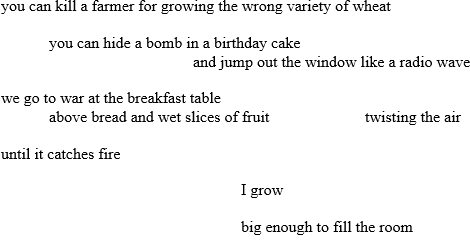
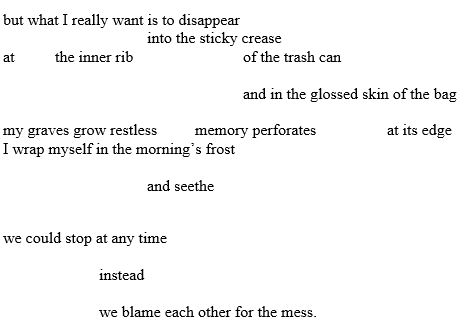
Poem "THESIS RESEARCH IN THE THROES OF A SEIZURE" by Raphael Rae

Raphael Rae is a poet, essayist, painter, disabled transsexual communist, and New School MFA program dropout. Their work has been published in Witness, Passages North, Delicate Friend, Peach Magazine, and elsewhere. Find them online at raphaelfrae.com or at patreon.com/raphaelrae.

Categories
Across The Wire

I Came to a Place of Rough Neglect and Left Myself There  

By Scott Mitchel May

Notes From The Scene

We found a pear.

We found it near the lobby’s desk and it was chewed.

Chewed and also rotten. 

By the time we found it.

She was behind the lobby’s desk.

She had a gunshot wound to the head and the bullet was lodged in the wall behind the desk, behind where she was standing.

Unclear if she was given a chance.

Supine.

Peaceful.

I’m so sick of this shit, this cocked-up shit; the whole world is full of this cocked-up shit.

We found a tooth.

In a drawer.

Of the desk.

Renaud says it’s a baby tooth.

Bagged and logged into evidence; file #46568.

Other than that, nothing of note.

I hate

The Doins’ Within the Room

“He said he was comin’, so he is comin’. Watch cable and chill the fuck out.”

“My momma says don’t trust nothin’ you can hold and I can’t hold HBO and I can’t hold happy-horse-shit.”

“Your mama was an ignorant Gypsy whore.”

“Be that as it may…”

“He’s comin’”

“When?”

“When what?”

“When he gets back from the place.”

“What place?”

“Don’t make me say it.”

“What place?”

“The gettin’…”

A knock at the door snags his attention and eases her mind. There is a green-yellow light outside and the shadow it casts against the cement looks about right for who they are expecting. They hold still. Quiet. The rate is $7.50/hr. They are running low on time.

“Get it, damn you!”

“Well, now how do we know it’s him back from the place?”

“How do we know? Who the fuck else is it gonna be?”

“Intruders.”

“What do we got so good that intruders would want to intrude upon it?”

“We got the stuff; when he gets back.”

“He ain’t back. Or, he is but we ain’t let him in. Either way, we ain’t got the stuff.”

“They could know we gettin’ the stuff. They could be knocking and anticipatin’ us gettin’ the stuff. We answer, they hit us, we wait with them, then, when he shows, they kill us and him and take the stuff.”

“You are a dumb-fuck.”

“Ok.”

“Yeah, ok.”

He answers the door and when it opens wide enough he is hit on his head with the butt end of a Maglite Flashlight that takes four D Cell batteries and is knocked unconscious and They come through the room’s door with guns drawn which they use to glue her to the bed and they yell “Don’t move a fuckin’ hair or I’ll…” and the rest she misses because she’s watching him bleed and she’s thinking that this is the stupidest time for him to be fucking be right about something he speculated on.

Notes from the Scene

Her dress is hiked up and she’s not wearing underwear.

They never tell you how you’ll feel in the academy about such things.

Roderick finds a shed pubic hair three feet away but it’s brown and hers are yellow.

Fuckin’ hourly rate shit-hole.

A casing is found.

.22.

Varmint round.

Must’ve put it right to her forehead.

No explaining it otherwise.

A chill to the air.

Her face is pocked with a lifetime’s regret.

Her teeth are a shattered ruin.

No witnesses.

No one left around.

The no vacancy light is on.

The rats know when to do their thing and go.

Rm 465 has been swept.

A bowl of pears was found.

More  Doins’ Within The Room

“I keep tellin’ everyone he ain’t back! He took the money and he left.”

“That he did.”

“You got money! You got dope!”

“We ain’t got shit!”

“He’s right.”

“Don’t you motherfuck to me!”

“I ain’t motherfuckin’ to nobody! If I was high, you’d know it.”

“We wait.”

“I told you…”

“Shut the fuck up, Leonard!”

“All I’m sayin’ is I never get credit for when I’m right.”

“I tell you plenty!”

“You never tell me squat!”

“I tell you all the damn time, you just ain’t listen!”

“Never say you’re sorry neither…”

“Well, I’m sorry you got us hogtied, that’s for sure.”

“I hate you so much.”

A knock at the door. He is back from the place from which things are gotten. One of them bites a pear. They answer.

Notes from the Scene

Three bodies upstairs.

All shot in the head.

Three .22 casings

Looks like four coffee mugs.

They were waiting a while.

No clue who did this.

Three males.

Drug-related.

Coke, likely.

Three out of state Drivers Licenses.

God damn it.

Nothing left to do but the paperwork.

See you down the road a piece, Scumbags.

___

Scott is the author of the short story collection DeKalb Illinois is a Paradise What Eats Its Own (Alien Buddha 22), the novels Breakneck: or it happened once in America (Anxiety Press 23) and Awful People (Death of Print Feb 24), and the novelette All Burn Down (Emerge Press Oct 23). His short stories and essays have appeared in many magazines across the internet.

Categories
Crayon Barn Chris

III

By Dylan Smith

This day last year a blue bird blessed my desk and now every new moment opens awake within me like a poem. Today I keep the bird shit desk pushed up against my porthole window in the city. Poems scribbled everywhere. The same shit-stained pages of my manuscript, my Chris Book: Red Crayon // Blue Crayon // Green Crayon // Spring. The Statue of Liberty with its twenty-foot flame is just a pinky-sized shadow out there on the harbor—and now here comes the sun, it’s rising up out of the river. All the clouds above the city burn bright orange sea-blue pink along their bottoms at first, edges shining like the pages of a Holy book, and then it’s the tops of those close, barn-sized clouds that come alive with color again as they burn, and I see the familiar silhouettes of those horse-shaped cranes and the dark buildings beyond them that tower, and with my candle lit and the coffee brewed, I’ll just sit on the ground for a while. Close my eyes. Criss-cross my legs. Take it all in with my breath. My therapist taught me the importance of this routine, how to meditate immediately upon waking. Diane says it’s important that I right-size myself, and that I do so right away—she suggests I even say a sort of prayer as I start. Let go of my will. Try to let the light shine through me. Sometimes I do. But other times what I do is, I just close my eyes and picture Alma. Imagine her waking up behind me in bed, eyes burning golden candles—or like two struck matches as they open perfect fires in her head—and other times I picture her farmhouse on the hill, and above that her forever spring blue woods are always greening, and I pretend to hike up that path toward my candlelit shack where every new morning opens completely new in my head, like a poem, and it’s spring. 

Halfway up that path through the mountain woods to my shack was a memorial rock for Alma’s father. Everybody called it Michael’s Rock. A mossy slab of bluestone as impressive as the side of a ship. Art installed these two green benches up there, and I like to hike to them in my head. Take along my notebook and a coffee to listen to the birdsong and sit. An embedded steel engraving holds Michael’s picture. A proper monument with his name and his dates. 

Kind eyes. Sky blue shirt. Big smile dappled in the leafy darkness and light. 

Today I brought Michael an imaginary flower and was reminded of an early summer session with Diane. What I remember most from those days is the daily rainbow hanging above Art’s barn and the way the new June dew warmed and rose up from the fields all blurry-gray-blue in a thick fog thinning slowly every morning into mist, and how on the long drive to Diane’s therapy office in town, Art told me those rainbows were because of the barn’s position to the sun. 

“The sun’s got to be behind you for rainbows,” Art said. Canopies of green leaves created a kind of green tunnel as he drove, and Art threw his thumb back behind us to the east. “Water droplets bend the light. It’s a miracle if you think about it. Try to imagine the mist as trillions of tiny pyramids. They used to be the dew. You have the sunlight shining through each drop and each drop is like a tiny pyramid projecting color out onto the sky. It’s called refraction, Sunshine. Visible light. Every new rainbow is a miracle.”

The landscape widened as we turned onto the painted county road into town. I had a duffle bag at my feet. A pair of underwear, my notebook, some socks. The plan was that Art would take me into town for therapy, then drop me off at the bus station. I’d spend a night or two in the city with Chris. Come back up the next morning with my car. Now the sky opened again all blue and big and roomy, fields and farms rolling greenly into mountains, and the sudden shift in scale made me feel like I’d shrunk. Which made me think of Chris. In the side mirror my eyes looked all puffy. Swollen. Nearly shut. I couldn’t tell if it was from early summer allergies, or from all the beers I’d downed the night before, or what. 

Objects in the mirror are closer than they appear.

I took out my notebook. Wrote down the word Calamity.

Calamity. 

Calamity. 

I wrote and rewrote it about a hundred times.

“Speaking of rainbows, Sunshine—ever been to Niagara Falls?”

I struggled to clear my throat.  

“No. Not yet. But Alma told me she went up there once with Michael.”

“Well talk about miracles. This side of the falls is even named after rainbows. Any sunny day of the year and you will see one. Guaranteed. All that falling worter. You should make a trip of it one day, Sunshine. Especially now that you’ll have a car again. Was starting to wonder when you’d ever get the balls to talk to Chris.”

I rolled my window down. Tried to wash away Art’s laugh with the mountain air, the morning light. 

Diane lived on an old dairy farm two or three miles out of town. Her office was just a bedroom in her house. Art’s truck rocked along her long wide driveway in reverse, stopping just before this big catalpa tree flowering before the deck. Diane stood up there in the shade, waving. Art watched her in the rear view mirror. Rolled his window down. Laughed. Waved back. He picked a piece of straw out of my hair and another off my shirt, then handed me a week’s pay in cash. 

It must have been like three hundred bucks. A session with Diane cost fifty. I also had a credit card in my pocket. Art watched me stuff the money into my jeans, which were covered in red and white paint, and the knees of the jeans were caked in dried mud. 

“If cleanliness is next to Godliness you’re heading to the city with a pitchfork, Sunshine. If it were me I’d try to bribe Diane with an extra twenty or two for a shower.”

Diane’s office walls were all bookshelves full of textbooks and spiritual books and coloring books and crystals. Tall ceilings. One green couch. She kept this rocking chair in the corner for herself and I sat—well, sometimes I’d lie there with my boots off, staring out at the catalpa tree in the window. I really liked Diane. Her voice was like the silhouette of some far off mountain. 

Hillsides for eyes. Wavy gray brown hair. A seven-year-old son named Jacob. 

Diane was still getting settled into to her chair. Blue pen in hand. Yellow legal pad in her lap. At the other end of the room, this low red plastic table had a bunch of art supplies all over it. 

“Well,” she said. “Tell me. Bill. What is happening up in your world?”

I just stared at my hands for a while. Duffle bag at my feet. My hands looked filthy. 

“Alma went away for a while,” I said. 

“Went away?”

“To the city. To visit Karen.”

“Karen.”

“Her mom. I’m going down today too. To get my car back from Chris.”

“Will you see Alma down there too?”

“No. Well, I don’t know. She didn’t say. She says we need to make some distance.”

“Distance.”

“Well. Just for now she said.”

Diane scribbled something blue on her pad, nodding. 

“And what do you say?”

“What do you mean,” I said.

“What do you say? About needing to make some distance.

I didn’t know what to say, so I just sat there. Like my hands, my boots looked all busted up and dirty. I unlaced them, pulled them off. Swung my dirty socks up onto the leathery green. I had a good view of the window now, but I just stared at my hands some more. The ends of my nails were ten black lines and the callouses on my palms were eight brown circles. I knew it was only a matter of time with Diane, though. Just a matter of which way to enter the session together—and before I knew it we were in, and I told Diane about how I’d fallen for Alma completely the way we rolled about in my bed together with the thunder and the close dark green clouds and the rain, and how when finally that last spring storm had stopped and day by day the mountain had been greening it was June again, and Chris was gone—and how for that first week of summer, everything in my window had been rainbows. Because Alma was there. I told Diane how the moon was close at night and clean from the rain and full, and how up in my shack these fireflies twirled up in bright splashes of electric sudden neon green like stars, and Alma was there on a blanket on the floor and the radio tumbled out its song and we were dancing screaming naked love and I was sober for a while and we were laughing. Because Alma called them lightning bugs. Haha. I just loved that. I told Diane how the lightning bugs formed brief constellations above my bed, and how Alma named them these non-Latin-sounding names, names like Bird God and Horse Skull Mountain and Love Lamp, and how tattooed to her foot in the candlelight, the phases of the moon were fading. 

Then I told Diane about Alma’s shrinking dreams. How I’d never heard of anyone else having those before. 

First night after the storm. Purple blue moonlight on the mountain in my window. By now the radio’s batteries had started losing power. Its song just a whisper, faint and wobbly and low.

The shrinking dreams started after Michael died. Made death a kind of shrinking.

Diane nodded. Wrote it down. 

I can still remember the smell of coconuts in Alma’s hair. Her chin on my chest. My heart thumping raw. 

I told her I suffer from shrinking dreams too. 

Lightning bugs burst above us. Alma leapt up.

“Well in my first one I went to the bathroom upstairs in the farmhouse and heard this peeping,” Alma said. “I found these eggs and two ducklings, a brown one and a yellow one. But Michael came in and filled up the bath with water. I didn’t realize really what had happened until the eggs bobbed and shrunk in the water and the two ducks struggled to stay up on top.”

“Did they go under?”

“Of course—the current pushed them under. One at a time by the faucet. I didn’t act quick enough to grab them out and the second duck—that’s the yellow one, it went under. By the time I pulled them up they had shrunk down to bug sizes with like these terrible thin delicate wings. I placed each one on a towel as delicate as I could but they were wet. They stuck to my fingers. I lost the brown one somewhere in the blue towel and woke up screaming because I’d squished it.”

“Exactly,” I said. “But mine are always shrinking horses. Not ducks.”

“No—no it’s not always ducks. I’ve had shrinking dreams about nearly every farm animal there’s ever been. Horses yes, but also Art kept these goats in the barn when I was little, and I’ve even had a couple about Chris’s stupid chickens—,” but that’s when Diane cut me off. 

“Why don’t you tell me more about this, how did Alma phrase it, making distance.”

So I contemplated the catalpa tree in Diane’s window for a while. Leaves were as big as bibles. Clean white flowers the size of your fist. 

“Well, I guess reality kind of crept in.”

“Reality.”

“The reality of what we were doing. Like the fear of it. Love. The reality of it.”

“Tell me more.” 

“All the sudden it was, What are we doing? Oh God. Oh no. Suddenly it was, What do we do about Chris?”

“And?”

“And so we tried to kind of avoid each other. For the last few days before she left. But it’s impossible. Like some outside energy won’t let us part. I feel powerless against it. Absorbed by it. I couldn’t even get to work until she left.”

That’s when Diane’s son started jumping up and down in a nearby room. I heard his babysitter shush him. I thought about Chris. Those catalpa flowers rubbed against the window and Diane’s face might as well have melted off her head, the way I felt. My vision sort of shook. Heart thumping high up in my neck.

I closed my puffy eyes. Took in a deep breath. That morning I’d looked up the word calamity in my book. Some say it comes from the Latin word calamus, meaning straw, as in a damaged crop. But others think it’s origin is something more obscure. 

“How do you feel right now?” Diane asked. 

“Hungover,” I admitted. 

“So you picked back up.”

“As soon as Alma left.”

“And how have things been in your cabin? In your shack. How have you managed without running water?”

“I’ve been sleeping in Art’s barn again.”

“Where in the barn have you been sleeping?”

“Like down at that bottom bay again. In the bales of hay. Where Chris used to keep all his chickens.”

Diane stayed quiet for a really long time. 

Then she said, “I suggest you tell Chris the truth.” 

Man, I hated Diane. The titles of her books fell from their spines in pure colorful alphabetic arcs, their letters splashing like confetti all over the floor as I fell deeper and deeper in through her green couch like that forever. 

“When you see Chris I suggest you tell him exactly everything you’ve just told me. That you’ve fallen in love with Alma. That it happened completely organic-like, and that you meant no harm by it. Chris can’t hurt you, Bill. Not mentally. Not spiritually. Maybe he can hurt you physically a little, but you aren’t kids anymore. You’ve grown up, Bill. You are strong.” 

I looked down at my hands. Jacob screamed and screamed and I wondered what Alma might have looked like as a kid. I decided my hands looked dirtier than usual. Covered in something, like some sickly bluish film. I pictured Alma holding Michael’s hand by a waterfall. A red ribbon in her hair. A rainbow bending bands of light—and then I remembered the job I’d done the day before with Art. Alma’s basement doors had rotted through in patches at your ankles from all the years of rainwater and splashing. These two huge wooden doors painted red. Art and I took the doors to the barn and mixed this two-part epoxy. Art told me they use the same epoxy to patch up holes in boats. Entropy. You mixed the tan putty with the blue putty and like magic, the two come together making wood. 

Art called the stuff Bondo. That’s what was all over my hands. 

“Art taught me something cool yesterday,” I said. 

“Yes?”

“He taught me about nuclear fusion. Energy in one nucleus fusing with another. Art says that’s what happens inside stars—like inside the sun. He says scientists are trying to make it happen in their labs now, but that it takes an incredible amount of heat. Art told me it’s really dangerous. The most dangerous thing a human could do. But he said if scientists can make it green, the fusion could save the earth.”

A blue bird landed on a catalpa branch in the window. Diane smiled. 

“And what do you think?”

“Well, it made me think of what I like about poems.”

“Which is what?”

“The energy between the letters. The letters forming words. Art’s Bondo made me think of that. The power of the alphabet. The ABC’s. I’ve had that song stuck in my head.”

“And?”

“And I guess it makes me even more scared to talk to Chris.”

That’s when Diane invited me to close my eyes. We ended every session with the same guided meditation. Diane led me out of the office, down the stairs, then out through a field of overflowing wildflowers in my head. Set out this red blanket in the grass. Invited me to take a seat on it in my head. Together we were to absorb the day’s divine energy. Worship the healing spiritual power of the sun inside us—but instead of doing all that, I just fell asleep. 

The next thing I remember is the big kaboom-boom sound of a crash outside. I opened my eyes. Leapt up. The blue bird in Diane’s window was gone. The catalpa tree was shaking. I thought maybe something had exploded, but Diane was at her window, and she was laughing. 

Art had backed his truck right up against the catalpa trunk. 

His hat in his hands. Taillight smashed to pieces. 

Yet somehow Art seemed totally serene. A picture of perfect calm. 

Art lifted the largest shard of plastic up from out of the grass. Held it to the light. Like a big rare rock, the shard shone and sparkled as he turned it. His face cast in this wonderful, rainbowy light. Diane and I laughed. You could tell it really amazed him.

“Art is insane,” I said. 

“Yes he is,” Diane said. “But insane in the most beautiful way.”

Dylan Smith is looking for a job if anyone knows of any jobs in Brooklyn.

Categories
Across The Wire

Love Taps

By Michael McSweeney

The game started at the intersection in South Montford, the place where drunkenness and fire melted away James Rainville three months before. We called it Love Taps and the goal was to hit the car ahead of you with your bumper but not cause any damage. I drove the swamp-green shit-box sedan my sister smashed to hell before my parents gave me the keys. G sat beside me smoking the last of our junk weed out of a crushed and pocked cola can. P’s straw-blonde hair sprouted in the window of the truck ahead of us and the wind rocked the stoplight above the intersection. Zack Sweeney, you coward, G said. Tap that bastard’s bumper. Give it a love tap. I shoved deep the lingering anxiety of my father and his father, now mine, and nudged the accelerator. The shit-box scampered half a foot. Then G shouted, Just fucking do it. I hated the smell of the junk weed and I hated G for wasting our money on it. Then I kicked the gas pedal and the shit-box lurched and we banged against P’s rear. P twisted and I saw his foul fury face and then the light glared green and the school bus behind us bellowed and we raged up the long blight nightmare of old proud Montford Main. When we reached the baseball field, the only place that didn’t demand your money for a welcome, P was ready to rough me up until G calmed him down and explained the game. P’s scowl bloomed into a grin and that night we chased our tails north and south through Montford’s endless house-pimpled mazes. G’s girlfriend C got in on it, too. C was born for it, a hot holy maniac who’d banshee her dad’s busted-up minivan into the oncoming lane and hum a $15 throwaway cell phone across your hood. Those nights we built towering bonfires in the old construction yard and cackled when the cops failed to uproot us. My mind boiled and I never slept before dawn. C and I fucked atop the brick-and-mortar bones of the ruined middle school on the hottest night of summer, the night G’s appendix tore itself apart. Three weeks later G’s parents sold their house and he was gone, right before the market burst. Dissipation, everyone. I called the number C gave me but each time a confused woman asked if my name was Tom. I pushed the shit-box harder each night, 85 mile-per-hour demon runs down Montford Main. This has to be a record, I shouted, it has to be. I wanted to wrench the wheel leftward, one last love tap for the last driver alive. I wanted the difference between the machine and me to dissolve at the place where stop signs demanded my silence, far from the highway crossing that split my town like a crucifix, me just a foot and a final drop of gas, handbrake as busted as a young friend’s promise, dashboard lights too dim to be understood.

___

Michael McSweeney is a writer and editor from Massachusetts. His first novel, Heroman, is forthcoming from Expat Press.

Categories
Across The Wire

Gulls

By Bram Riddlebarger

Mariner Market
Cannon Beach, Oregon

“Why don’t you guys wait outside?”

Less question than directive.

“I’ll get the tide map and be out in a minute.”

I grabbed my son’s hand and left without any beer.

I saw a pair of seagulls in the parking lot in the back of a truck. The truck had a cap, but the rear window was missing. The gulls breached the entry. A mound of household goods filled the bed.

“Get all your stuff and get out!”

“But I don’t want to.”

The gulls rummaged the debris. The larger gull dislodged a package of Tide washing machine tablets. The gull tossed the Tide, but the Tide stayed in.

No one paid any attention to the gulls. Everyone in Cannon Beach was used to the tide coming in and out every day.

Making no headway the bird tried to fly, but the Tide was too heavy. The small gull got in on the action. Crows swooped down. A group of tourists murdered the saltwater taffy across the street.

I shooed the gulls away.

The gulls asked who was going to do their laundry now. I tossed the package through the invisible rear window.

“Get all your stuff and get out!”

She held the tide map in her hand.

“But I don’t want to.”

Buckling up I saw the owner of the truck, a case of beer like a household good, thwart the gulls of their soapy desire.

I wondered out loud what would make those gulls so fixated on that Tide.

My youngest daughter said

“They longed for that Ocean Breeze.”

___

Bram Riddlebarger lives in SE Ohio. He’s written a number of books including Golden Rod and A Settled Ship in an Ocean of Hills. “Gulls” will be in a forthcoming collection titled The Way It All Must End.

Categories
Across The Wire

Instructions from Store Manager of Orange Julius on the Day The Mall Closed Down

By Dan Leach

If you sit around thinking 

about where all this is going

you will never do anything at all

___

Dan Leach has published work in The New Orleans Review, Copper Nickel, and The Sun. He has two collections of short fiction: Floods and Fires (University of North Georgia, 2017) and Dead Mediums (Trident Press, 2022).  His first book of poems, Stray Latitudes, will be released by Texas Review Press in 2024. 

Categories
Across The Wire

My Life

By Yuu Ikeda

B, C, D,

B, C, D,

B, C, D,

B, C, D,

_where is the start?

_where is the next stage?

_where is the end?

___

Yuu Ikeda (she/they) is a Japan based poet, writer. She writes poetry on her website. Her latest poetry chapbook “Phantasmal Flowers in The Eden Where Only I Know” was published by Black Sunflowers Poetry Press. One of her big dreams is to write while traveling around the world. You can find her on Twitter and Instagram: @yuunnnn77

Categories
Crayon Barn Chris

II

By Dylan Smith

Today I lit a candle in my apartment before I poured my coffee. This wavering flame takes me back, like way back up that spiraling path to my shack where there was no electricity or running water. Mountain birds lift into the mountain air in my head—hang high above Art’s barn, and shit into the blue mountain air in my head. I found this candlestick in the scrap pile at the dump. Alma loved it. A flowery brass ornamental-looking thing which lifts my daily flame up way above my desk, about midway up my window pane, and until this candle melts down and away and the sky alights again all yellow pink blue gray, my morning flame wavers like the sail of a boat by itself on the water. Everybody outside seems so alone. Above the flame I see cranes and the circles made by birds and the arches of bridges made of steel and massive yellow rock, and on top of most of those buildings across the river I see wooden towers that look like big beautiful barrels of whiskey. Or maybe beer. Art once told me the city’s water towers are all made of redwood trees and cedar—and the one thing nobody down there seems to wonder much about is what happens to all the bags of trash we drag out onto the street. I watch tug boats haul proper mountains of it north to God knows where, pushing whole landscapes of trash past my solitary flame as it wavers like a sail alone on the water. I bet Art would know where they take it. Art loved trash. Probably to some landfill out in New Jersey. 

The spiritual path I shaped for myself upstate is that of the outlaw or the sailor, the path of the hippie cowboy saint. It is the poet’s path—no, it is the sober poet’s path, by which I mean to suggest that poems are dangerous and holy and rare. This is the kind of thing my half-brother Chris would probably scoff at. Poems being holy and dangerous—pssh—Chris would roll those explosive blue eyes and spit. But Art and I did a lot of dangerous work together. A lot of wobbly wooden ladders in bad weather. A lot of icy roads, downed wires—a lot of charred black trees felled drunk after wild summer fires. 

And all of that felt safe compared to the traumatic childhood secrets I uncovered in my poems about Chris. 

This night last year Alma taught me there was once an order to the blossom of flowers in spring. I told her flowers were still sort of new to me. Chris and I grew up in the desert. I never knew they bloomed in order. 

“But not anymore,” Alma said. “Not with the warming earth. Now everything just flowers all at once.” 

Alma had hiked up the muddy path to my shack with this basket full of shack warming gifts: a bouquet of bright spring flowers, a box of homemade candles, some food—but the main thing was she brought up this battery powered radio. Said she worried I’d become some sort of weirdo hermit way up there alone in her woods. This was toward the end of May, and Alma had been hard at work all day in her garden. I remember dried mud on the knees of her jeans, a hole in her big green shirt. Chris had only been gone a few weeks. Alma didn’t seem so alone. 

I’d left my big book of etymologies open to the V’s on my desk. Had just looked up the the word veil, I remember—which comes from the Latin root vela, meaning candle in Spanish, but in Latin it means sail. 

Alma leaned over the book for a while, then shifted some poems around. 

“I wonder if revenge works,” Alma said. 

I thought to myself, Haha. Uh-oh

I stood beside her at my desk. Poems and drawings all over. Alma pointed to the word vengeance in the book. I could smell summer in her hair. 

“It does,” I said. “I heard revenge works great.” 

“Does it? Who told you. I’m talking about even in the long run.”

“Me too, look—my book says it means to set something free. I’ll bet you revenge works great in the long run.” 

I turned the radio on to static. 

Felt my heart beat. 

Turned the dial, found a song. 

Alma and I wrapped ourselves in blankets and went out to eat on my deck. Scooched our lawn chairs close. The food was soup kept hot in a blue thermos. This wonderful whiskey-voiced crooner croaked out a song about the wind—and after that, someone predicted another thunderstorm was coming. Days and days of rain. Alma looked out. Steam swirled up from her bowl. I felt doubtful about the storm. I told her Art’s radio had predicted it would come earlier that afternoon. We’d rushed around all day to beat it, and then it never came. 

Slowly though, the mid-spring air shifted. You could feel it. A summer-warm wind sort of swirled down through the trees and sounded like a channel of water in the branches above my shack, which is when things weirdly deepened, and a darkness rose up through the black blue green of the neighboring mountains to the east of us. 

Imagine the wind sort of wafting in through my shack, turning the pages of my book. 

Beware. Betrayal. Haha. Bible and Berth and Beauty, and Chris. 

I remember the guilt and fear I felt come alive with the changing light. Elbow to elbow with Alma on my deck. I’d recently lent Chris my Volvo—had helped him pack it full of clothes and books to be taken back down to the city. He was supposed to bring it right back up, but never did. I pictured Chris’s blue-eyed violence. Knew exactly what he’d do if he could see Alma and me, and as the trunks of all my favorite trees began to blacken, I thought about the things Art had told me at work that day, and about how all afternoon we had been in such a hurry to beat the rain. 

The Glasshouse was this empty mansion at the top of the hill above my shack. Art’s main client owned it. Some billionaire who rarely if ever came up from the city. I remember tens of thousands of little yellow flowers blooming like bright candles on the roadside, and how all along that long gravel drive we’d leveled little hills and holes in the road, holes in the road formed by ice heaves. Red shovels. Red rakes. Art found a water bottle under one of the yellow bushes, he was always finding trash, and somehow the unopened bottle was half-empty. 

“Half-full, Sunshine,” Art corrected me. 

The bottle got him going on about permeability again. About how everything has it—like even plastic bottles—and once the ice heaves had been leveled and the bed of the truck was empty of gravel again, Art and I flew back down the mountain for some beers. It was rare to see Art in such a hurry. Outside the barn I looked up the hill to where Alma worked in her garden. Art filled the cooler with beers and I lifted the generator into the bed of his truck. The generator ran on gasoline, so I lifted two red five gallon containers up into the truck bed too. A hawk hung in high, hay-colored circles up high above the barn, then the thunderclouds rolled in. 

I made a big whistle. Waved up to Alma on the hill. 

Alma turned, laughed. Made a big wave back down to me. 

Art said the plan was to replace the tractor’s rusted power steering piston. We’d abandoned the tractor below the Glasshouse all winter, in a dark hollow in the woods below the pond. A culvert had clogged but the tractor broke down mid-job. Art pulled his truck up onto the green grass growing beside the pond below the mansion. A handful of goldfinches lifted out from the flowers and reeds. A quick break in the clouds. Green water sparkled. Outside the truck Art opened one beer, then reached into the cooler for another—but I said no thanks. Surprised us both. 

“Suit yourself, Sunshine.”

West of the pond was the orchard where Art and I had just pruned a bunch of trees. A dozen red empire apples rose and reached in three rows of three. I loved pruning apple trees. The way Art taught me to prune was, you think of the branches of the apple trees as pipes. “It’s all about directing the flow,” Art told me. He added an extra syllable to the word water. “Imagine your tree is a house. You design the flow of the plumbing in the house. It’s a series of decisions about the pipes. You direct the flow. The shape of the tree. It’s about designing the flow of your worter.”

My shack had no bathroom, no toilet or pipes or sink. I got my water from a nearby spring and broke into the Glasshouse every Saturday night to wash my dirty work clothes and to shower. 

Thunder rolled above the mansion, and in a hurry I hauled the generator down the muddy hill through the woods. The tractor looked like a big green horse injured down there in the mud. I set the generator beside it. Hiked back up for the air compressor. Art had brought down the gasoline and some tools and when I got back, he’d put down some flattened cardboard boxes. He knelt there next to the rusted piston with his beer. 

And soon our working movements would merge, the tasks at hand fluid and familiar and mechanic.

I used the generator to power the air compressor, and filled up the flat tires with air while Art unwrapped the new piston—I reattached and jumped the dead battery, while Art jacked the tractor up—and together on our backs we fought to remove the rusted piston, two wrenches wrapped around the part as we took turns torquing at it, and torquing, and torquing at it—but the rust had blurred and merged the line between the tractor arm and the part. 

Thunderclouds darkened close and low, and a great big thunder clap rippled down the mountain. 

Art opened the second beer, the third beer. 

“Speaking of rust,” Art said. “I just read about this new type of battery.”

“What does battery have to do with rust?”

“To supplement with solar and wind. A rust battery. Like instead of lithium.”

“You’re saying rust, Art. Like the rust that ruined this piston. Like the rust that’s ruined your truck.”

“Right. Rust. Picture iron pellets. Now expose those pellets to oxygen. Rust could generate your energy. Your electrons. You reverse the rust back to iron pellets to eat the oxygen—and that’s what gives your battery its charge. Green energy stored by way of rust.”

“That makes very little sense to me.”

“Yeah. Well I knew this one guy who worked with lithium. A battery recycling factory in the city. You had to worry about your lead. The lead dust settled on your clothes. Settled in your hair. You take off your street clothes when you get into work. You put on your hazmat suit and you shower before lunch to get the lead dust off your skin. Off your hair. The factory gives a bonus if the lead in your blood stays at the regular levels. The goal is to keep the lead dust off your sandwich. It’s a liability. You’re in there for a test every six weeks. This guy I knew only got the bonus once. Fifteen hundred dollars. But of course you get fired eventually for having bad levels. You get lazy about it I guess. Like with anything.”

Art stood. Finished his beer. Hiked up to the truck for more. 

Nothing but bird song now, the silence leveling and sudden. 

Art hiked back down quick. Arms full. Knees wide and in a hurry. 

“Because with lithium you can store your energy for five hours—or for six hours when a storm shuts down the grid. But the point is that your generation doesn’t believe in God anymore. Or in free will either. You have no faith. No belief in your power to change the course of things. Take the old hay farmers for instance. What you probably don’t understand is that decomposition is a chemical process. You can’t rush hay. Compost generates heat. So it’s all about the moisture content of your harvest. It’s about human timing and science and faith and worter. You can’t rush these things. Fear is stupid. You have to take everything that happens as it comes.”

“We’re not hay farmers though, Art. What are you trying to tell me.”

“That if you take your bales to the barn too early you don’t give it time to dry.”

“But we don’t do hay. You said nobody’s done hay in the barn for thirty years.”

“It takes six weeks. Your moisture content’s got to get below twenty percent. You can’t rush it. Because if the moisture content is bad your bales will decompose and smolder and soon your farm is up in flames again and the barn is burning because you didn’t have faith or slow down enough to just listen. Fear is useless and stupid. You have to have faith, Sunshine. Faith in anything. It’s all about discovery and achieving the balance. Because if somebody your age could just learn to harvest green energy from something as simple as rust. Your solar energy would store for five days—for six days. You’d have green energy stored off the grid for a week.” 

And with our next effort with the wrenches, Art and I removed the rusted piston. 

The new part installed easily as Art downed the fourth beer, the fifth beer. The diesel fuel I poured into the tank was blue, and then the tractor came alive. Blue black smoke whirled out from a vertical pipe, then cleared. Art mounted the tractor as if it were a healthy horse. I followed him down the mountain, listening to the radio in his rust tortured truck, and later that night in my shack Alma said:

“First it would be the crocus and the snowdrop. Forsythia. Hyacinths. Then the tulips, and then the magnolia trees would go blooming, and the irises—and then it would be the bleeding hearts.”

Inside my shack and out of the rain, Alma built a fire. 

Last big storm of spring. Our radio predicted days and days of total rain. 

“Looks like I’m stuck with you,” Alma said. “Shipwrecked up here in your cabin.”

I lit ten thousand tiny candles and man—I couldn’t believe my luck. Thunderclouds boomed bright blue black pink and I fiddled around with the radio some more. Found the classical station. Alma’s eyes burned like perfect fires. We stood side by side before the stove, our shadows swaying against the ancient wood. We laughed. I read her some Chris poems. We danced. Alma put out a bucket to collect the rain and we drank from it all sloppy and splish-splashy, our dirty clothes drenched wet. The rain had become a column of water against the mountainside, against my life, and it would go on and on like that all night.

Embers of the lightning struck black locust tree radiated white heat. 

A kind of veil had been lifted, and I saw Alma in new crystal colors. 

We laid down before the embers. Now there was no going back. 

But I wasn’t afraid of anything. 

Not the past, not the future. Not Chris. 

I told Alma I believed in God. 

Dylan Smith is looking for a job if anyone knows of any jobs in Brooklyn.

Categories
Across The Wire

The Water Bearer

this land belonged to the 
lenape, the Susquehannock, 
the massawomeck — long 
before you were born. 

and they had names for water:
moi, oneega, o:ne:ka’. names for
mountain and for mud. they spoke
a polysynthetic syntax, now frag
-mented, not unlike their people. 

but language, like the dinosaurs —
like parents — can become extinct, 

can leave traces: the not-quite
noumena, the narrows, a word
water- wind-gap carved through
tuscarora quartzite, proving 
presence with absence. 

these same landscapes made
you. this mid-atlantic geography
of arundale clay and Gettysburg
shale — of fossilized stone of
star-tooth sauropod — built up
your bones. a bloodline more
ancient than the old line. for 

you are of the sisku hanne, a
slow-moving muddy river 
swirling with alluvium. you are of the floodplains embracing 
a drowned river valley. 

you are of the youghiogheny, an
affluent river flowing in a contrary direction. you are carving a waterline
of transgressions, with more twists and turns than an oxbow — and i’m 

wading through your brackish waters, swept along the rapids toward a watershed-sink where everything you
touch inevitably meets its end. 

and when you open your lips to speak, it’s with a tangled tongue heavy with words that spill like streams from your deepwater delta mouth.

***

The line “you are carving a waterline of transgressions” is adapted from the poem “exhibits from The American Water Museum” by Natalie Diaz.

___

Natalye Childress is a writer, an editor, and author of The Aftermath of Forever (Microcosm Publishing). She lives in Berlin, Germany. Find her at natalye.com or @deutschbitte.

Categories
Crayon Barn Chris

I

By Dylan Smith

This day last year a bird shit on my desk. I wish somebody—well wait, I wish Alma alone had been there to see it. This beautiful blue mountain bird shit in through the window of my shack and splat all over my hand, like directly onto my desk. The bird looked all rainbowy, Alma, you would have loved it. Picture a quick translucent smear against the spring blue sky, or like a whirl of blue oil in even bluer water. I’d just started work on this new poetry book. Had been calling it my Crayon Book. It was my therapist’s idea for me to use crayons, it would become a book of poems about my half-brother Chris. I called it my Chris Book sometimes, sometimes just my Art Book, but Crayon Barn Chris became a tentative title, you’ll see why. Later at work I told Art about the shit and he said all mountain birds upstate are holy, especially the blue ones. What an omen! I wanted so badly to believe it. To believe in Art. He said bird shit brings about good luck—and so on this day last year holy shit, a bluebird blessed my poetry book. It was dawn when it happened. My windows were open to the blue green woods of Alma’s world and man, I was so in love with her, I was thrumming in awe all wide-eyed and open—I was totally alive. I wiped the blessing off my hand and onto my dirty blue work jeans, smiling. The bird had even sung its little blue song as it blessed me. I laughed and laughed and laughed. Hahaha! Good morning, Chris!

I’ve been thinking about the sky a lot. Have been wondering what the hell it is. I don’t live in the mountains anymore, I left that shack in Alma’s woods for what is probably the last cheap room in Red Hook ever. You can smell the contaminated water through the wall. My apartment’s porthole window looks out at those blue and red cranes lifting trash and red crates out from boats about the bay, where the city’s canals and rivers dump waste out into the sea and to me those cranes look mostly like strangely drawn crayon horses. Like horses a kid would scribble on a wall. I’ve been thinking about the sky because half my view out this window looks out above the city with all its rolling blue gray mystery in spring, and I’ve been wondering what is going on up there exactly, like way up beyond the cranes and towers and clouds where I’ve come to think of the sky as just the deepest, bluest type of water. 

My therapist’s name upstate was Diane. Alma found her for me. Diane specialized in art therapy for kids which meant for me she was cheap, and it was Diane’s idea for me to use my crayon drawings for my poems, or as the raw materials for my book. Draw what you feel and describe what you see, Diane said. Fucking genius. I was thirty-two at the time but Diane treated me like a kid. I loved it. For nearly two years I horsed around making poems about my kid art all monastic in this shack above Alma in the woods, but now I’m thirty-three and alone and acting like an adult again in the city. I wish I had those crayons here now and a strong good stack of that red construction paper like the stuff that bluebird shit all over. I’d draw you a diagram if I did. Or like a map of Alma’s world in the mountains upstate as I saw it in my window in her woods. First I’d draw for you a blue crayon mountain with like this chaotic red spiraling thing at its center for Art’s barn, then I’d draw you tens of thousands of greening crayon trees, and all those cleared thawing crayon fields of hay and the blue yellow crayon birds, pink red dots for new spring flowers, this golden line here will be Alma in her garden and last I’d draw for you the low yellow farmhouse Alma inherited up there on the hill.

Beyond Alma’s land was the reservoir and a little beyond that was the dump. Alma made a lot of art. Inside her blue electric car she had this tangle of translucent fishing line we found which hung from her rearview mirror and hovered there all balled up perfect like a kind of sculpture. The way it held the light. It was so Alma. Even before she caught Chris cheating and cast him out of her farmhouse forever, Alma and I would go on these dump runs together every Sunday. They became our weekly adventure. Chris was big on shrinking our carbon footprint so as a house we didn’t make a lot of waste, only what we could stuff into the trunk Alma’s electric car, but usually we came back to the farmhouse with more random dump junk than when we left.

This one Sunday at the dump Alma found a backpack full of pigments by the scrap metal pile. The baggies looked full of rainbowy drugs. Next to the pigments I opened a box full of empty metal frames. The baggies had been labeled with these wonderful names and I told Alma my favorite color was Meadow Green. Back at the farmhouse Alma glued Meadow Green into a frame and glued a magnet to the back of it and hung it on the fridge for me. No larger than a tarot card. A piece of art. 

A week later Chris asked, “What the hell is this?”

“A landscape painting,” Alma said. “Meadow Green. Look close—you have to squint.”

And Art is like Alma’s uncle. She says he’s always just kind of been around. Art’s barn is full of tools and things, a lot of spare parts, mostly trash. I loved it in there. It felt like a big red boat. Century old chestnut. Cathedral ceilings. Two of every tool—Art’s Ark. I worked for him for three good years doing handyman work out of the barn and for about half that time I lived in Alma’s farmhouse, in the renovated attic room above her and my half-brother Chris. They’d been engaged to be married for like ever. The deal was that if I helped Chris renovate Alma’s house I could sleep on a mat in their attic for free. The floorboards up there had these wide spaces between them you could almost fit your fingers through, and at night Alma’s bedside light rose up to me in soft dusty rays. It’s important you know I fell in love with her immediately. Felt like hell about that for a while. I lived up there in hell for a whole year and a half before they broke up, before I hiked up to live in my shack in Alma’s woods. The sounds of their most intimate moments rose up to me in that room and unconsciously I overheard every argument, every groan whisper secret moan, every perilous fight. Chris had this electric keyboard down there too, right below the thin metal air vent slats that opened between our rooms, and every night after dinner drunk Chris went to work on his scales with bricks for fists, or practiced like the same song over and over and over again, which for a year and a half was the Star Spangled Banner. It drove Alma fucking wild. You could tell. 

After the renovation I had to find a job, Chris said. Now I had to pay him rent on the room. So I went to work for Uncle Art. Met him before the barn every morning for three years. A lot of the time we just drank beer and drove around the reservoir together in his van. Art took me under his wing. Funny how things work out. I am half Art’s age exactly. We kind of became best friends. Best job I ever had. Hahaha. Thanks a lot, Chris. 

Alma told me the reason why morning birds sing is to let their lovers know they survived the night. This day last year it was spring and my art shack window was open to the songs of sparrows and redstarts—of gray catbirds and brown-headed cowbirds and yellow warblers and wrens, and of red-eyed vireos and yellow-bellied flycatchers and cardinals, and robins—and way down below in the trees above Alma’s garden, you could hear a whole chorus of waxwings singing. I am sober now. Have been contemplating the word serenity a lot. Sober people love to use it. Back in college Chris gave me this big book of etymologies for my 21st birthday, Word Roots, it’s open to the S’s on my desk. The book says serene comes from the Latin word serēnus, meaning calm weather, but now I’m flipping way back to the B’s. 

The word book comes from the Old English bēce meaning beech, like the tree. 

Word roots. Tree books. Hell—I even stopped drinking light beer. 

And Art’s eyes are the color of cool water. A wild man. Blue splashes. A real woodsman. Situations arose for Art with the weather, our work shifting day to day and with the seasons like in spring for instance, your favorite red maple might fall onto a car or like onto your fence. After the storm you’d call up Art and his apprentice that’s me, we’ll come help you clean it up. In winter we plowed your driveway, patched holes your drywall, replaced dead outlets and all the leaky pipes inside your house and did firewood in the fall, renovated barns and attics and basements and redid decks and in the summertime we would mow your lawn if you wanted. But now it’s spring again. Art will plant your flowers, prune your trees. He taught me everything I know about the stars and mountains, the rocks and water and wait—World is a wild word. 

Comes from werald which is Dutch, like Art’s barn. 

All broken up into parts you get wer meaning man and ald meaning age, but all alone al means to grow or to nourish

Like Alma. 

Alma’s world was what I pushed my windows open to, my heart and eyes and my books. But Art’s brought me closer to that red spiraling shape at the center of things. God, maybe. How the seasons turn in narrow spirals up, and it also seems that way with death. An inch worm becomes the robin’s beak that eats it, is what I mean. Grief makes this shape. I mean loss is even in the word blossom. 

Now imagine Art with an armful of flowers. Isn’t that nice. This day last year that blue bird blessed my book and about an hour later Art hiked up to my shack like that, with an armful of lilac branches. 

“Here Sunshine. Thought these might brighten up your life.” 

Chris was gone. Bluebirds sang. I felt free. 

It was Sunday, usually our one day off, but Art said thunderstorms the night before had created a bunch of emergency work. The church basement had flooded again, Art said. High winds had ruined some trees. Art arranged the lilac branches while I looked around for my boots. Found them among green bottles. Tied them up nice and tight. Thanks for the flowers, Old Man. Let’s go.

I remember an unrooted yellow birch on a nearby farm and some red work horses black with spring mud. I remember a rock oak limb in the road Art cleared, and the yellow green wisps of a willow tree drug down below the footbridge flooded high with muddy water from the creek. Then we went into town. I remember the smell of rain-soaked oak silt, my boots all full of fragrant shavings, swelling, and I remember the rhythm of our saws on fallen trees outside the church and the holy rhythmic hum of Art’s sump pump in the basement tumbling splash splash splash while above us all these saints in stained glass were shining, and how after work we drank a thousand or so beers in the parking lot together laughing at the state of Art’s rust-tortured truck. Stories about horse barns, barn fires, green bottles gleaming as they lifted toward the light. 

Late spring is the best time of year in those mountains. Warmish days, coolish nights. Cool enough to still build a fire in your shack. The last thing we did was clean up Alma’s lightning struck black locust tree. Art told me I could take some home to burn, but he wanted to save the rest of it for fence posts. He said locust doesn’t rot. Maybe a new garden gate for Alma. 

Between the barn and Alma’s farmhouse on the hill the low field sloped down and opened into pastures. Art drove us down through the fields to the tree. The bark of a black locust tree furls deeply inward and feels cold and tough to the touch like rock. I remember an evening star, probably Jupiter, silver sliver of moon in the blue. Art stared up at the tree. The locust had split way up high and splintered out where it was struck, a silhouette of wild scribbles against the settled evening blue. An elemental thing. Like something out of the tarot. 

The design of the saw sort of settles into your hands. I remember it getting dark and I remember being drunk and thinking about the root system of the tree in the earth down below me, how its roots reach as far as its canopy of branches. Art taught me that. The leafless branches of the locust tree rose in strange tangles, wiggling up and out like weird inverted roots. Art said that when the tree was struck three years ago the sap turned to steam in an instant. The expanded air exploded, Art said, wrecking a lot of the east side of the tree. What stood was dead but fifty feet tall, the trunk two feet wide. Art confirmed the tree was dead for me. The farm truck idled in the grass behind us. 

I cut the truck engine. Lowered the tailgate. Took a seat. 

“What would Art do?”

“Well Sunshine it’s pretty straightforward. You have the weight of the split to your advantage leaning west. I wouldn’t worry about going back the wrong way toward the fence or footbridge or the creek. The trunk should be full. Not hollow like the maple trees you’ve seen. I’d make my hinge regular at the waist going west. Plain angles. Like this.”

Art took a seat beside me on the tailgate. With a carpenter’s pencil he drew this diagram for me on a piece of wood. It’s supposed to show how a tree is felled. The pencil looked like a big orange crayon in his hand and I laughed. He had a beer in his lap. We always had beers in our laps. Art’s crayon was the same color as the saw: 

crayon barn chris chapter I by Dylan Smith

And after the locust tree had been felled and bucked and loaded into the bed of the truck, a light went on in Alma’s farmhouse. Art opened two more beers with the blue handle of his knife. Handed me mine. We cheersed. The absence of the locust tree had become a strange sort of presence in the pasture now. 

“Want to know what’s weird about lightning?”

“Sure, Art.”

“All it is is static. Like this static shock between the sky and the earth. Imagine you’re rubbing your socks on the carpet. That’s what’s so weird about the thunder too. The molecules from the lightning bolt come and go so quick. What you hear is molecules collapsing into the space that’s left. That’s the thunder clap.”

Alma’s silhouette appeared in a farmhouse window. The stars did like the opposite of dissolving and I felt the revolving energy of night twist, or kind of spin, and Art sat on the stump of the lightning struck black locust tree.

I said, “That’s crazy.”

“No Sunshine. No it’s not. Nothing’s all that crazy. You just have to take everything that happen as it comes. You’re not paying anything attention. That’s the thing about your generation. Nobody’s ever looking up.” 

Alma turned off her light. Went to bed. Time passed and a year later I’m sitting here all alone above Red Hook and there is shit all over my hand. Seabirds scream in circles around cranes lifting trash out of the water in my window—the word time stems from tīd, meaning tide—and the morning after I felled the lightning struck black locust tree I woke spiritually polluted. I remember it. I woke alone sick blood red without Alma, but now I’m getting better. I am. The sky opens to the sun every morning and so does my heart, so do my eyes, my poems, my books. I am building my own little world. I guess that’s all this is. All art ever wants to be. Whatever. Today I am alive. Hahaha. Tralala—today I am singing. 

Good morning, Alma. I am totally alive. God. I love you.

Dylan Smith is looking for a job if anyone knows of any jobs in Brooklyn.

Categories
Across The Wire

Oaxaca Studies

By Wallace Barker

Levantate Campesino

zocalo draped in colored
flags and flashing
christmas lights

nativity feels near
emaciated beggars
we had mole three ways

and chapulines with pico
wide pedestrian boulevards
are a relief after narrow

sidewalks and coughing engines
i want to buy a t-shirt that
says “¡levantate campesino!”

but i am not a campesino
and my support for their struggle
seems theoretical at best

a wildman covered in grime
walks past us in the plaza
he is naked from the waist down

a tiny old woman sleeps
on the sidewalk within
a barrier of plastic bottles

a makeshift wall for her protection

***

Dios Nunca Muere

we walked down steep concrete
steps to playa carrizalillo
at the bottom were men in fatigues
carrying machine guns

the beach was hot and crowded
only shade from umbrellas
above greasy plastic chairs
we found a narrow dirt path

leading over beach rock to
a small cove shaded by palm trees
two young men with bleached hair
sat on a towel lightly kissing

i felt we were intruding but we snorkeled
and observed the tropical  fish
i hit my knee on some rough coral
emerged with blood running down my leg

we took a whale watching tour
on a boat called “angelmar”
and found a pod of humpback whales
including two young calves

when they breached the surface
a fleet of tourist boats rushed over
we watched the whale flukes emerge
then disappear beneath dark waves

el capitan told us the fluke means
they are diving deep and unlikely
to resurface in such a crowded area
dolphins escorted our boat to shore

we walked across
playa manzanilla
to our rental house
we swam in the pool

just us this time
just our little family

***

Mazunte

clean light over the ocean
mesmerizing the violent surf
conjugating spanish verbs

sometimes current events
sneak into my consciousness
with the balcony doors open

i heard voices from the beach

in the morning we will return home
if god grants safe passage
we will leave the man who carries

a bucket around the tourbus parking lot
sits on the bucket to polish hubcaps
while the drivers read papers

the beach dogs skinny but
happy in a languorous way
they splash in the surf

scaring the gulls who peck sand
i wont sleep with the beach voices tonight

___

Wallace Barker lives in Austin, Texas. His most recent book “Collected Poems 2009-2022” is available from Maximus Books. His debut poetry collection “La Serenissima” is available from Gob Pile Press. More of his work can be found at wallacebarker.com

Categories
Across The Wire

No Junk

By Leila Register

There’s a lot of pressure on this thing to be no junk. That’s why I called it No Junk. That’s how life works. You name something the ideal name and it just happens that way for you. I feel terrible. I feel in trouble. I keep saying the wrong thing to the wrong person. Keep messing up facts in public. Last night I was at a table with strangers. One man wore a suit. I told him he looked like the movie The Graduate. He said his mom recently died and then I felt bad about what I said about the suit. There we all were. His mom and the suit and The Graduate. I asked him questions about his life. He said he wants to write but can’t. I said what happens when you try. He said I just get stuck. Today was supposed to be scattered storms but I look up and see the tree in front of my window and above it the blue sky and below that some leaves that look more yellow than green because of how the sun works. I read a lot of things everyday. I don’t mean books. I mean the internet where people share their ideas and worldview and images and sounds and terrible events. I also read stories but I have trouble finishing those. Sometimes the stories are on a website that is so ugly and depressing. Sometimes the lines are arranged in a way that makes the whole thing feel cheap and bad. Sometimes the words are broken up by a square advertisement on the right side of the screen. Sometimes the square advertisement is flashing. Sometimes whoever made the website decided to get creative with fonts. Sometimes all of this is happening at once and it makes me sink into an awful sadness. It makes me ask why am I doing this. Sometimes I read a story and I get to sentence three or four or five and I have to stop because things aren’t moving in a way I like. It’s hard to describe what it means for things to move in a way I like. It’s easier to describe what I don’t like. I don’t like when someone in a story does something “exasperatedly.” I don’t like when someone in a story tucks their hair behind their ear or giggles or “smiles sheepishly.” I don’t like the phrase “nothing special, really.” I know these are things people say and do in life and in the world but when someone does them in a story or essay it sounds fake and embarrassing. What does sheepish mean? Why would someone smile that way? I can’t imagine it. I don’t like anything I can’t picture or imagine.

___

Leila Register is a designer based in New York. On her desk is a framed print of a speech bubble that says “As If I Wasn’t Embarrassed Enough.” Her writing has appeared in Hobart, Rejection Letters, and Maudlin House.

Categories
Across The Wire

Two Poems

By Jack B. Bedell

****

Swamp Thing Dives into Psalm 69

Quicksand under me, swamp water over me; 

I am going down for the third time

Daily, this is the dilemma I face—sink in the mess pulling at my feet here, in the evil and strife I face every day—or scream for help from a god that only wants me to learn to swim on my own. The fact of the matter is I am sinking either way. The swamp loves a fight as much as it loves a secret, so that’s no answer. Evil is a fire ant bed with too many mounds to burn. There is no help anywhere close enough to get to me in time to save me, so where is salvation in this swamp? For me? For what’s left of this land? Scream all you want. Flail. Turn onto your back and roll out of this trouble. It’s on you. Us. It always was. No pretty song can change that simple fact. No curse, that truth.

****

Swamp Thing Loses His Sense of Bearing

One thing’s certain. If you sit on this shore long enough, you’ll think about time. It’s unavoidable. The water comes in, goes out. Takes what it wants. Comes back for more. Sunlight, moonlight. Breeze, heat. Pelicans hovering over the barrier island offshore dance this dance, too. Even though their island’s completely rebuilt with barges of sand, they continue this cycle of sharing the space they’re given, like they know the water will rise again in time—is rising—to take it all back. Watching them glide overhead like this, it’s too easy to lose any sense of being on shore, or on anything, to feel the gulf swell until you are standing underneath a whole new ocean, the birds’ bellies riding its gentle waves.

****

Jack B. Bedell is Professor of English and Coordinator of Creative Writing at Southeastern Louisiana University where he also edits Louisiana Literature and directs the Louisiana Literature Press. Jack’s work has appeared in HAD, Heavy Feather, Pidgeonholes, The Shore, Moist, Autofocus, EcoTheo, The Hopper, Terrain, and other journals. He’s also had pieces included in Best Microfiction and Best Spiritual Literature. His latest collection is Against the Woods’ Dark Trunks (Mercer University Press, 2022). He served as Louisiana Poet Laureate 2017-2019.

Categories
Across The Wire

My Fuckin’ Car, Man

By Sy Holmes

My car was a beat-up 2000 BMW that I got from my buddy TJ, who bought it from his buddy down in Dallas who had gotten it from someone else who had probably stolen it. He gave it to me, along with a couple tools, a pair of boxing gloves, and a set of  Texas plates registered to a Prius “in case I had to handle business.” I got it for a song for him to get back to Houston. It had a white rattle-can paint job that was flaking off and showing silver in places, the oil was self-changing, and the seats got scorching hot. I loved it, even though my girlfriend told me it made me look like a failed molly dealer. It overheated one night in September for no apparent reason.

I went back in the morning  and limped it over to the closest thing I have to a mechanic, my buddy Gage, who had full use of his landlady’s garage while she was away in Florida. We took a look at it, checked the codes, and decided we didn’t know shit so we should probably order the most likely parts and see what happened. In return, I reassured Gage’s girlfriend that the headache she had probably wasn’t brain cancer, my area of amateur expertise. 

Two weeks later, I had a thermostat and water pump waiting for me at home. We popped the hood, changed the parts, and started to put it all together again, only to realize that one of the tensioner mounts on the serpentine belt had sheared off the engine block itself. This meant that we would have had to take the engine out, do some welding beyond Gage’s skill level, and trust the rest to Jesus. 

“If we pull some real fuck-your-cousin engineering, we might be able to find someone to fabricate a new mount, reroute the cable, and stick it someplace else,” Gage told me, as I tried to overcome my sadness with a sandwich. I didn’t know. It seemed beyond both our ability and inclination. 

Over the next few days, I scoured central Montana Craigslist for any suitable vehicle. Broke down enough to be affordable, but not too broke down. I finally found a late-’90s Ram that looked promising. Gage was out of town, so I called my friend Skycrane to help me look it over as a sort of combination mechanic and attorney. We showed up to test it out, and the steering was a bit wonky, but it drove. I said I would take it.

Once the price was settled, I had to figure out how I was going to pay the owner, since I realized I hadn’t had a checkbook in a good two years. Because I’m a dumbass, half of my life has been consumed by finding sketchy ways to do legit things. I suggested a couple different ways, which made me feel like a scammer, before we settled on PayPal. I didn’t need to worry, though, because when I met him to sign the title over, he told me that if I stole some government plates I could probably pass myself off as a federal employee and go where I wanted, since it seemed like to him the whole government drove white Rams. He might have been joking. 

By the time that was settled, Gage’s landlady was back from Florida, and I had to find a way to offload the BMW. I put it online as a parts car and promptly got offered loot like a sketchy Mossberg rifle, an ancient Honda Civic with anime stickers all over the outside, and a couple gold chains. Anything but cash, which was what I needed. Finally, a guy from up near Fort Benton came down with his wife, who he told me over and over was “sickly,” and bought it. We pushed it out of the garage into the snow and up to his trailer, which had a frayed Harbor Freight winch that may as well have had an OSHA VIOLATION sticker on it.. I sat in the driver’s seat and steered as he pulled it up the equally-sketchy ramps he had brought, and looked at the gray sky that stretched over the plains. I pictured myself ascending, Grease-like, into the heavens above the river, entering the DIY gates of redneck valhalla in my broke-down chariot. Then it was on the trailer and off to a fitful retirement in a front yard. On the way home, my radio got stuck on the Christian channel and I listened to how God wouldn’t let the devil touch you if you just had faith. I don’t know about all that. Maybe he could stop the devil from fucking with my cars. 

****

Sy Holmes is a writer from western North Carolina. He currently lives in central Montana with other people’s dogs.” Thanks again!

Categories
Across The Wire

Five Poems

By Mike Andrelczyk

***

The Logrollers 

The two of them are always there – eternally 

In my mind balancing on a spinning log beneath their wooden shoes 

Rolling on the river 

Wearing green caps with feathers in them 

Spinning their log 

As I:

Season an omelette with fennel, dill and sage

Type the words “fresh heist”

Waive all inspections 

Piss blood 

Hit a ping-pong ball into the net after a thrilling 8-minute volley

Try to sleep 

Leaf through an outdoor magazine 

Call my dad

They keep spinning on the log with their funny little green hats

***

Tahiti 2134

aurora borealis but you have to listen to a car insurance ad to see it 

the ghost of the gecko pasted to the anthurium 

barking dog sample sneakers with flame resistant tongues 

the translucent blue hockey player in the sea

of hovering hibiscus blooms 

I’m gluing my disastrous shoe again 

I’m wearing wraparound shades on an aluminum hydrofoil 

I’m tranced-out and sweating bullets in the tranquilizer garden 

as the fire ants swarm my strawberry-shaped wound 

***

Soap Bubbles 

I’m doing the dishes and I feel great 

because you’re describing a meme you saw 

and you just did that laugh style 

I really love

***

Secret Poem (100 mph)

I saw a yellow gibbous moon on two legs sprinting between dark

    hillocks

I saw a pigeon-colored crescent moon tripping down a spiral staircase

I wrote a secret poem called “100 mph”

It goes:

The sky has never been

Bigger and more meaningful

I am crying and driving

100 mph

And I’ll never be able to tell you about this

***

Cornflower

Speedwalking through the graveyard

into the cornfield and then crossing 

the highway without watching the traffic 

looking up at the chinook 

forgetting to update

speedwalking through another graveyard

mumbling to myself “I don’t give a fuck”

stopping at the garden to register the blue and to scan a cornflower

always talking to myself 

and maybe to you too

—-

Mike Andrelczyk is the author of four collections of poetry, including “!!!” with Ghost City Press. He lives in Pennsylvania. On Twitter @MikeAndrelczyk and Instagram mike_andrelczyk.