Categories
Issue 6 Issue 6 Non-Fiction

QUESO PEOPLE

By Nathan Willis

Our game was hide and seek, and the best place to hide in the whole house was the front closet. That’s where mom kept the dress coat she wore to school concerts, family holidays, and nice restaurants. It was long and black and if you pulled it around your shoulders, only your legs and feet were visible.

My sister would check behind, under, and inside of everywhere else first. This was something we did for each other, even though we always knew where the other would ultimately be found.

There were even times we’d pretend not to see each other’s legs sticking out from under the coat, to start the cycle over again, to keep the game going for as long as we could.  

The nicest restaurant we went to as a family was Chi-Chi’s. The waiting area was always packed with other families in their dress coats, all straining to hear the hostess over the giddy din of middle-class splurging, and the dopplering sizzle of fajita hot plates.

The dining area was divided into four open-concept sections, creating the illusion of simultaneous separation and inclusion. The overhead lights were never on. There was a lit candle on every table. The walls were painted to look like there were patches of plaster missing, exposing brick underneath. Sombreros and serapes were tacked up on any surface that would support them.

At some point, we asked our parents, “What does Chi-Chi mean?” They told us Chi-Chi is a person. A professional golfer. This is the food he likes and he wants to share it with the people of Ohio.

There was a golf course close by so we had no reason to doubt them.

We went often enough that we had our order locked in. Chicken fajita. Cheese enchiladas. Steak burrito. Chicken enchiladas, no onions. Two Cokes, an unsweetened iced tea, and a Diet Coke. The only unknown was chili con queso.

The queso came in a tray specially designed to sit over the candle. The tray had a wide lip to hold chips. It was a whole situation, big enough that the people at surrounding tables could see. Ordering queso was a very public statement.

Our parents argued at night when they thought we were asleep. Money was a recurring theme. As was my dad’s expense account. And lunches. And the company he kept. And the incidentals on his business trips.

My room was next to the stairs. I heard everything. I didn’t understand the math or the accusations, but it was clear we were on the verge of collapse.

It was by no means definitive, but getting queso became a kind of barometer. If we got queso we were still stable. We had enough money, and no one was preparing to leave or for things to fall apart. It meant we loved each other, and the game would keep going.

If queso wasn’t mentioned by the time we ordered our drinks, I would ask for it.  Sometimes my parents said no right away. Other times, they gave each other looks. Plaintive, angry, bitter looks that didn’t have anything to do with the queso. In these instances, us getting queso or not depended on which of them felt bold enough to make some larger point to the other by withholding or requesting queso when the server came back.

There was a movie of the week that aired back then called “A Place at the Table.” The film follows a family who donates their time and money to feed the unhoused and less fortunate. Mom had told us that grandma used to do the same thing. But it was a different time then. The unhoused went door-to-door and grandma would invite them inside while she made them a sandwich.

Mom said she would never do that with us in the house. She knows better. She’s learned the hard way that you can’t trust anyone.

In the movie, the dad loses his job and has to leave town to look for work. While he’s gone, the family relies on the generosity of the community for food and for monetary donations to pay their bills. Not a whole lot of people come through for them.

In the end, the dad is still out there looking for a job. The family is at home sitting before a sparse dinner. The room is dark except for a candle on the table. They glance at the dad’s empty chair. The credits roll as they eat the meal.

Recently, I learned that the restaurant was not, in fact, named for, or owned by, professional golfer Chi-Chi Rodriguez.

“Chi-Chi” was the nickname of the wife of the restaurateur who started the chain.

I tried this once, what my grandma had done. At least a version of it. One of the years that I lived in Los Angeles, on Thanksgiving, my girlfriend at the time and I cooked a turkey and made it into sandwiches that we packed into brown paper bags. We loaded them into the car and drove around looking for the unhoused and less fortunate. We couldn’t find anyone. There were usually people on nearly every street. Then we realized they were probably at all the shelters and churches that were also having Thanksgiving.

We did find one guy on our way back. I gave him a bag and he asked if the sandwich had mustard. It did. He handed it back to me.

We drove home and put the bags in the refrigerator and still felt pretty good about ourselves seeing all that food in one place and knowing it wasn’t for us. Then we got busy and didn’t take them back out again before the turkey went bad. It stunk up the whole apartment. We had to throw all of it away. For the next month, everything that went into that refrigerator came out tasting like spoiled turkey.

There was a weekend when one of the neighbors came over to see if we were sick. He asked if we had gone to Chi-Chi’s the night before. We hadn’t. He said everyone who had gone got food poisoning from bad onions. There would be a story about it in the paper. The neighbor said his whole family got sick. They were still trying to shake it off. He seemed fine.

I thought it was just our Chi-Chi’s that got the bad onions and maybe it was. Maybe the onion thing happened twice. Because this was before my parents got divorced, which would have put it at around 1990. But if you look it up online, the largest Hepatitis A outbreak in the history of the United States was caused by bad onions served at Chi-Chi’s restaurants in 1994—after the divorce, and after the trial.

Back in Ohio ca.1990, after that first, localized round of food poisoning, people stopped going to our Chi-Chi’s. My parents would talk about how Chi-Chi’s was going to shut down any time now. Think of the overhead. The location. They made guesses on when it would happen. First, it was a matter of weeks. Then maybe a couple of months. Then dad moved out and there was no more guessing. They were both wrong anyway.

Chi-Chi’s held on for at least another year. I am sure of this because they stayed open long enough for us to go there one more time, after our last day in court.

We knew it was going to be a hard day no matter what. This would be the first time we had seen our dad since he left, but we knew the lawyers and counselors had met in advance and agreed that none of them were going to put either of us, the children, on the stand.  Then dad’s team switched it up at the last minute and said, On the other hand, let’s go ahead and make this as painful as humanly fucking possible for everyone involved, except the Defendant.

So, we got through that and we needed a light at the end of the tunnel.

We’d never been to Chi-Chi’s during the day. The overhead lights were on. There was no sizzle. The bricks on the walls were just paint. We were the only customers. We could hear the staff in the kitchen complaining about employees from the other shifts.

Mom’s sister, our Aunt Charlene, was with us. She was supposed to make us stronger. She had agreed to co-sign on a loan that would allow mom to keep the house.

When the waitress came for our order, we did not get queso and I did not ask for it. I knew who we were at that point and we were not queso people.

Mom wanted to talk about the house but every time she brought it up, Aunt Charlene changed the subject. When we were done eating, mom and Aunt Charlene talked in the parking lot while my sister and I waited in the car. We watched them wave their arms and shake their heads.

My aunt drove off in her cream-colored sedan. Mom got into our old Camry. She slammed the door to seal us in and she punished the world with an open-throated yell. The world did not care.

She cried and punched the steering wheel. She punched harder than I’ll ever be able to. I marveled at her power and the miracle that none of her bones broke.

Aunt Charlene had changed her mind about the loan. Now, mom didn’t know where we were going to live but she knew she was going to have to figure that out on her own and she would have to juggle multiple jobs and odd hours and we were going to have to budget some of our meals out to a dollar fifty each at the Taco Bell drive-thru that we would then drive across the street and park to eat in the car at the Drug Mart parking lot because they had thirty-five cent soda machines out front.

As she thought all of that through, I like to think that back inside of Chi-Chi’s, the General Manager got the call from Chi-Chi Rodriguez or the wife of the restauranteur, and whichever of them it was, they would say, “We’ve had a good run but it’s time to shut this shit down.” And the General Manager would pull a switch and the place would go dark. The employees would gather their things, go to their cars and drive away and we would still be there in the parking lot trying to figure out how we were going to make it. We would be the last to leave.

Thirty years later, as part of a naive and admirably masochistic effort at reconciliation, mom arranged for us to have Thanksgiving at Aunt Charlene’s house.

Mom’s car was in the driveway when my partner and I got there. We pulled up to the curb and took in the three very large crosses in the front yard. They were solid wood, and they were not seasonal.

Inside, the kitchen counters were crowded with Thanksgiving staples in plastic containers and takeout boxes from homestyle restaurants. Everyone else who came, except for us, brought store bought pies. There was more pie that actual food. I thought of all the times we ate in the Drug Mart parking lot.

The flatware was gold-plated and the dinnerware was ornate bone china, and as we ate, Aunt Charlene told us about all the joys and challenges of training dachshunds.

The three of us left shortly after dinner. Our coats were in a pile on the hall tree. My mom had a nice coat that was fashionable at the time. Her black special occasion coat was long gone. It, along with virtually everything else from our lives back then had been sold or otherwise lost.

Our local grocery store carries jars of Chi-Chi’s chili con queso. I had been walking past it without noticing for years. As I put a jar in my cart, I remembered about the onions, and Thanksgiving, and the trial and the credits rolling, and eating queso by candlelight, as though everything was fine.

I called my sister to ask if queso ever meant more to her than just queso. It didn’t. She never really liked any of the food at Chi-Chi’s and if she had to pick, Taco Bell was much better.

I knew she was right. I put the jar back on the shelf.

Nathan Willis is a writer from Ohio. His work has appeared in Split Lip, HAD, hex, matchbook, Swamp Pink, Pithead Chapel, Moon City Review, and elsewhere. His stories have been nominated for Best Small Fictions and appeared in the Wigleaf Top 50 Longlist. He can be found online at nathan-willis.com.

Categories
Issue 6 Issue 6 Non-Fiction

POST MAN

By Ryan Bradford

Been having a lot of violent thoughts these days. Smashing faces, breaking skulls, popping eyeballs. Covered in blood, knee-deep in viscera, screaming victory.

Kind of dig it.

This is what the job does to you.

There are 385 deliveries on Route 42 and six hours of allotted street time to complete them, minus thirty-or-so minutes for lunch if you’re into that sort of thing. Convert that into minutes and it gives about 1.16 minutes per delivery. This doesn’t include driving time. Five and a half hours to make 385 deliveries. I’m going to do it in four. The regs call it running.

Slide the door up in my mail truck and behold! Letters, envelopes, magazines, advertisements. Two trays of flats and three trays of machine-sequenced envelopes. The regs call it DPS, or delivery point system—the order you’re supposed to carry the route. Just follow the mail, they say.

There’s a musty smell in the metal truck, the culmination of paper and cardboard and envelope glue and spit. Try not to think of the love and emotion that went into these notes, just the biological sacrifices.

Twenty-two houses on this swing. I clamp the letters in my hand and tuck a pile of flats in the crook of my arm.

The regs hate it when I run the route. It’s a precarious relationship between the reg and the transitional letter carrier—they love foisting sections of their route on me when they’re running behind, but hate it when I prove I can do it faster than them. They tell me to take my time, all buddy-buddy-like, secreting the same comfort they give to Mrs. So-and-So when she worries about all the new people who keep showing up in her neighborhood.

Slam the truck door. Begin the swing.

Benjamin Franklin was the first postmaster general. Not many people remember this. I’m not sure during which portion of his life he took on the role. Was it after he called upon the sky to electrocute him? Hope so. Only a man with lightning running through his veins would be crazy enough to love this job.

The sun burns the tan of my neck no matter how much sunscreen I put on.

First house: unlatch the gate one-handed, fold a catalog (bulk mail) around two letters (presorted standard). All shit mail, not a first classer in the bunch. Just wastes of paper. Could throw this bundle in the trash and no one would know or care.

Use my knuckles to lift the lid of the mailbox and drop the rolled-up pulp in. Like putting your grandpa to bed. Slam the box closed, the sound makes two dogs inside go nuts. Route 42 is a dog route. Lots of orange cards tucked in between the flats. DOG WARNING CARD, they read. I don’t pay attention to the dog warning cards because I know these dogs, and they respect me. Game sees game. I pause to hold my fist close to the window where the dogs’ mouths are, and their barking fogs the glass. Close my eyes and imagine the heat of their breath gracing my knuckles. If this glass wasn’t here, would they attack? Would they chew me up, snarling, growling, with teeth bared and eyes rolled back? Probably. Wouldn’t be surprised if it was one of God’s four-legged beasts that puts an end to me. In many ways, that seems ideal.

Do the next four houses in two minutes. Traverse the borders that separate people’s lawns — lawnmower lines that convey one neighbor’s industriousness and the other’s laziness. You don’t have to live here to get a sense of the politics of the neighborhood at work. Think of myself as a free agent, unbeholden by whatever HOA rules that keep these people subservient. I’m the unifying force.

Fresh grass clippings stick to my shoes, black sneakers that I bought at a discount shoe warehouse where they call their customers “shoe lovers.” The shoes are not regulation, but because I’m a transitional employee they don’t give me a uniform allowance. If I trip and break something, management will blame my shoes and I’ll lose my job, at which point I’ll walk into the Pacific ocean and never return.

Takes five minutes to do the rest of the swing. Not my fastest, but nothing to sneeze at.

Back in the truck, I unscrew the top to my hydro flask and drink plastic-flavored water. The bottle was clear when I bought it, but now it’s taken on a cloudy translucence.

The Long Life Vehicle roars to life when I turn the key. Most of the LLVs  have been around since the Clinton Administration. Imagine: before Jane left me, before I even knew Jane, before everything went bad, before I even knew what LLVs and DPS and 3849s were, these very same vehicles were running.

Put the vehicle in gear, but hold my foot on the break. Briefly look out to the west and see the Pacific Ocean. Between, there are pawn shops, apartment complexes, pho restaurants, skyscrapers, houses, trailer parks and bars. All of them will get mail today. All of them.

***

Juan’s washing his hands in the restroom when I return to the station, lathering his arms up to the elbow. Letter-carrying is a dirty job. It turns you into a dirtbag. You come home at night with your skin sunburnt and your fingertips blackened and your armpits stiff from sweating and the crud of everybody’s homes trailing you.

I stand next to Juan and pull the soap dispenser until my hand’s overflowing with metallic pink.

“What route you do today?” Juan asks.

“Forty-two.”

“That’s good. Peanut route.”

“Elephants all over the place,” I say. Juan smiles at me in the mirror. I don’t know why they call the easy ones peanut routes. 

The water’s scalding. Pull it up my arm, mixing it with the soap. Lather until the pink turns white. Feels like a hygienic baptism. Washing my arms like this doesn’t really stop the breakouts, but it helps. Ever since I took the job, I’ve been getting acne in weird places. 

Juan finishes his scrub and pulls a wad of paper towels from the dispenser. Often wondered if Juan is the cleanest person I’ve ever known. He’s another transitional employee, and we sometimes use these moments to talk shit on the regs, but today we wash in silence. Juan might be my favorite letter carrier because he’s comfortable in silence.

He throws his massive ball of soggy paper towels away and stops halfway out of the door. “They’re sending me to Pacific Beach tomorrow,” he says. “Lots of hot chicks out there.”

“Aw, lucky,” I say, and then when that sounds too childish, I add, “Fuck yeah.”

“I used to deliver beer out there,” he says. Don’t think Juan is any older than me, but he’s told me about his distribution job before, and I still find it inconceivable that he’s already been successful in a different career in this lifetime. “Those white kids love to drink,” he says. “They love it.”

I make a sound that signifies I know exactly what he’s talking about.

“I’ll probably be back Monday,” he says.

“Su-weet.” I scour my brain for something to add. I almost ask him to give me a text if he’s bored on Sunday. Maybe we can get beers or something. But I say nothing. He probably has kids and likes to spend his day off with them, but what if he hates his kids and he’d actually relish the opportunity? Hate’s a strong word to use in this instance, I conclude, and then I realize that Juan is gone.

***

There are a few letter carriers hanging around the timeclock, waiting for the numbers to hit 1800. These are the few lucky enough to have been approved for overtime. They rub their hands together and talk about overtime like it was God’s personal gift. It’s an honor to work until 1800 for them, and their eyes whir like slot machines, cha-chinging with time-and-a-half pay. I don’t know much about the economy, but it feels like a perversion of the American Dream getting these folks excited to work for two extra hours.

I deliver until 1800 every day. Transitional employees, we are usually the last ones out on the street. If all the mail isn’t delivered by 1800, it’s our asses. Management can let us go with the snap of a finger, kick us back to the gutters from which we crawled out. Yes, we get our time and a half pay, but working six days a week gives you no time to spend it. The majority of my life is spent at the post office.

Sheryl, one of the regs, asks what route I did today. This is a common topic of discussion. That and sports, but I don’t know sports, so people have stopped asking me about it.

“Forty-two,” I say.

“Oh, that’s a nice one. Lot of dogs, though.”

“Yeah.” I don’t tell her that I ran Route 42 to dust. Sheryl’s nice, but her loyalty is with the regs, and if word got around that I was running routes, there would be trouble.

“Have any plans for the weekend?” Sheryl asks. Feel my shoulders involuntarily slump. I wonder if this job has numbed her to the body language of someone who doesn’t want to engage with small talk. I would guess Sheryl’s age is 55, and she can’t weigh more than 100 pounds. She’s a letter-carrying scarecrow who always looks afraid, and I’d be lying if I said I didn’t find that vulnerability kind of attractive.

“I have to work tomorrow,” I say.

“I’m taking my dog to the vet tomorrow,” she says, unprompted. She brings out her phone and shows me a blurry picture of a standard-issue brown dog. “He keeps crapping on the carpet.” I laugh at the word crap and then say sorry. “I just want to know if it’s medical or behavioral.”

“Dogs can be assholes,” I say. “Cats, too.”

Sheryl laughs in a way that sounds forced and it makes me uncomfortable. Feel bad for swearing in front of Sheryl. Oh, sweet Sheryl. Even if I did offend her, she’d never say anything. I give her a once over, but not, like, in a sexual way. Years of delivering mail in the San Diego sun has given her a permanent tan. Imagine cowboys in the Wild West sucking on pieces of Sheryl’s salty, dry skin to stave off their thirst. How can her frame support the weight of mail? Pretty sure all letter carriers are supposed to be able to lift 40 pounds, but I’ve never actually read the employee manual. Still, 40 pounds would be one third of her. That Sheryl manages to carry mail at all seems like a triumph of the human mind, body, and spirit.

The hours on the timeclock are divided into hundreds, a metric system of time. At 1790, slide my timecard out from the filthy plastic pouch hanging by a lanyard around my neck. It also holds my ID badge.

Supervisor Greg strolls up and down the cases, inspecting them for any undelivered mail. The regs give him a wide berth when he gets close. Would never tell him this, but I’ve had a lot of nightmares about Greg.

He passes by and I clench everything. It’s the feeling of standing too close to wild buffalo. He’s a mountain of a man, probably ex-Marine. Smooth and bald as a terrible baby, yet carries with him the scent of old-man aftershave even though he’s not yet old enough to smell like an old man. His eyes bulge from the intensity of his life experiences. Avert mine when he gets close. Pretty sure I’m his project, a little smear that he can infuse with old-fashioned values of hard work. Guess it’s worked in a way: if he hadn’t scared me so much in those first few days, perhaps I wouldn’t be as good as I am now.

We make eye-contact for a second and he tells me that I’m going to the Point Loma station tomorrow, and I say okay. I try to gauge the amount of respect that he’s showing me at that moment, and I conclude that it’s a fair amount.

The timeclock hits 1800 and the post office fills with the sound of letter carriers sliding their cards through the slot. We’re released by the rhythm of electrical beeps, and I immediately forget that I have a job. This is the best part of carrying letters. At the end of the day, it’s like I wake from a soft hypnosis. Supervisor Greg loses his power over me; station manager Old-As-Hell Bob loses his power over me. I reacquaint myself with the world where dogs are dogs and mail is junk.  

The sun is still out when I step out of the station, but it won’t be for long. When the time changes, we deliver in the dark. I push anxious thoughts about Daylight Savings down, down. There will be enough time to worry about that later.

I hear other letter carriers say goodbye to each other before scrambling to their respective vehicles, and it gives me worker-bee vibes. Detached from the hive, we’re so innocuous. A car peels out close behind me. I turn and it’s Juan in his Bronco. He gives me the finger and then waves. Feels strange to not have a cool-guy hand gesture in response to his middle finger. Someone should really come up with that. Ben Franklin should’ve invented that.

Unlock my new Toyota Corolla by pressing a button on the key. I’ve never had a new car in my life, and this one is as good as they get. She’s a stick shift and it feels like I’m driving a racecar when we’re cruising and yes I’ve started using female pronouns to refer to cars because that’s the kind of person this job has turned me into.

The San Diego highways are clogged on a Friday afternoon. Everyone’s trying to get home or go on a date or get to a show or meet up with friends or find somewhere nice to watch the sun go down, and for a minute I feel like I’m one of them, someone with somewhere to go.

Ryan Bradford is a former USPS letter carrier, writer, and educator living in San Diego. His writing has appeared in San Diego Union Tribune, San Diego Magazine, Little Engines, Vice, Monkeybicycle, New Dead Families, and Hobart. He also writes the newsletter awkwardsd.substack.com. He is the author of the novel Horror Business.

Categories
Issue 6 Issue 6 Fiction

ELIZA

By Emma Reed Jones

When it senses I’ve pressed the clicker button, the gate to my building’s parking lot makes a sudden little jerk with its large metal body, then rolls back slowly to let me in. The alert pause, followed by the obedient smooth sliding, reminds me of how, when I was 19 and still living in New York, I had just had sex that felt good for the first time and I kept seeing cocks everywhere. I remember sitting on the subway watching the metal doors that divide the train cars from each other sliding back and forth, their protruding latches moving into and out of the holes on the other side, when I suddenly got so turned on I almost came right there. 

There are many little pauses in life; some are normal and to be expected, while others are uncanny. “Uncanny” means “beyond what is normal or expected.” For example, the pause before Anthony answered me, as we waited for the parking lot gate to open all the way. In fact, he didn’t answer me at all. 

As we drove through the gate, I tried again. “So, you live alone?” I said, “No roommates?” 

He was silent where normally you would expect words, or at least sounds; but then I was pulling into my designated spot, putting the car in park, turning the key, pulling up the emergency brake, pressing the seatbelt button – a continuous flow of action that seemed to erase the prior moment.

We rode the elevator to my apartment. Inside, I immediately straddled Anthony on the zebra print couch that demarcated the “living” area from the “bedroom” area. We made out. I caught a glimpse of myself in the vintage mirror I’d found in the trash – breasts falling out of my dark green V-neck sweater and pooling in his large hands, face flushed.

I had told Anthony I didn’t want to have sex this time. I was trying to show I was in control. After all, I could decide when to push the button, to open the gate. I had decided to pay $100 a month for a parking spot after my car was broken into again – so now I had the clicker, and the power.  

Last time, Anthony secretly took the condom off. “Oh,” he said when I realized what had happened, “I thought you knew.” He said the condom had been making him uncomfortable; and it’s true that he was big and the condom looked comically small, like the cap on a Bic pen. I’d let him keep going then, without the condom, because it felt really good. Later, these facts rearranged themselves, causing me to believe that I had chosen the whole course of action myself.

When Anthony didn’t answer my question about his living arrangement, I think a portal was opened up to another mental place. Some part of me had decided that being with him wasn’t real; was like being in a dream, where things don’t behave the way they normally do. 

In my dreams, I’m always looking for my sandwich. I am denied it over and over and over again. 

Still, in my dreams, I fuck whoever I want. So I fucked him. This time I really enjoyed it. I came three times. He said, “I knew you weren’t going to hold back when you straddled me on the couch.” 

Anthony loved it when I wanted him, or, at least, when he thought that he was the cause of my wanting. He liked to push me, standing, against the edge of my bed, so I’d stumble, the metal bed frame digging into the backs of my knees, his face bending down toward mine. Sliding his hand down the curve of my belly and into my black lace underwear without breaking eye contact, he’d gasp, widen his eyes until white surrounded the dark parts and announce, as if totally shocked,“oh my god, you’re soaking wet.” 

***

Words and their meanings can sometimes separate. Think of saying your name over and over to yourself while staring in the mirror. I used to do this as a child, and once I did it for too long. For a moment, I lost everything. I felt numb with incredible fear and joy, about to embark on some totally undetermined future, until my mom started shouting for me, and then all of it – my bedroom with the blue carpet, the mirror with the dark brown frame, my name spelled out in letter blocks on my bedroom door – swirled vertiginously for a moment and then clicked back into place. 

But it left a gap, the gap between reality and language, like the gap between your bed and the wall. If you fall into this gap, I’ve learned, words can detach and become meaningless: invasive, multiplying objects. Like cockroaches, or pieces of shit.

Maybe this kind of experience is the opposite of seeing humanity everywhere. Of drawing a face on a volleyball with your own blood, like Tom Hanks in Castaway. Of pretending, out of necessity, that it’s a person. Of wanting so badly to believe that other people must mean what they say.

***

Anthony said “I love you” to me on our third date. It took me totally by surprise. “I don’t think I can say that back to you yet,” I replied, because I was trying a new thing, which was to be honest with my feelings.

He smiled and said he understood, that he hoped I’d get there soon. 

On our first date, sitting at the bar down the street, surrounded by red velvet and old pinball machines, he had listened attentively when I told him I was wearing a hummingbird necklace because hummingbirds symbolize a search for love. “Is that what you’re looking for?” he asked, “Love?”

“Yes,” I replied, feeling proud of myself for admitting this. In the past, I had always been afraid to admit I desired closeness. Men would come over sometimes, and then leave, without my knowing much about them. 

I couldn’t ask for too much, I thought. In fact, ideally, I would need nothing, or at least nothing from others, to survive. This is how I would solve the problem of my existence.

“I can tell I really like you,” Anthony said, at the bar, “I have this funny feeling in my stomach which means I really like you.” He sipped his beer, then took my hand in his. I smiled.

***

ELIZA is one of the first chatbots. Developed in the 1960s, she was named after Eliza Doolittle from My Fair Lady. To a chatbot, a word is not even a thing, but a collection of tokens with numbers assigned. 

ELIZA ran a script called DOCTOR where she emulated a therapist. According to the developer, this required “minimal context.” In other words, ELIZA could mostly feed people their own words back to them, while sprinkling in a few nonspecific phrases like “go on” or “does that bother you?” At the time, in the ‘60s, she was apparently really convincing. Audiences were amazed and thought she could be a real person.

Someone resurrected ELIZA’s script online recently. You can chat with her. 

I told ELIZA I want to die and she said, “does that bother you?”

***

Anthony had a lot of ideas. “What I’d love to do sometime,” he said, “is to take the Ferry over to San Francisco for lunch, then come back here and make love, then fall asleep for a nap, wake up, and do it again.” He said he wanted to feel his body drifting into mine, as if they were one. 

Anthony said that when he was inside me, he felt like a key inserted in a lock. He sometimes liked to stay like that, not moving. 

We didn’t do any of the other things he suggested. Instead, we drank more whiskey at the bar down the street. I kissed the top of his head, sweaty, and he led the entire bar in a rousing chorus of that song that goes “why don’t you come on over, Valerie…” Anthony was a blues musician around town. We often ran into people he knew. Everyone knew him by another name.

He asked me to get on birth control, since condoms were such a bother for him, and since we were exclusively seeing each other. He told me that he wanted to get married and have kids in the next few years. “Could you see yourself in that picture?” he said, holding my gaze and my  hands across a sticky table strewn with tacos, my legs adhered to the red vinyl seat cover. 

I had an actual therapist at this time, not a chatbot. I learned some “feeling words.” I used my new skills to tell Anthony I was “feeling confused,” because the words he used included “love” and “marriage,” but I also experienced, notably, his absence. What I mean is, he wasn’t around much on weekends. I went to music festivals, vintage clothing stores, and cafes, where I tried to write, alone.

Anthony frowned, and he made his voice gentle and serious. “I hear you,” he said, “I see what you are saying. The truth is…” – he paused – “the truth is I’m scared. I’m scared because of how my last relationship ended. We lived together for two years, and we fought so much, especially at the end. She even threw a sandwich at me! She looked at me like I wasn’t human. I’m afraid to open up again, and so I think I’ve been holding back.”     

***

Anthony was excited to learn I’d gotten on the birth control pills. He asked me to say “I want you to come inside me” over and over again, and I did what he asked. I tried to feel his cum inside of me, to discern if it felt more special this way; but I couldn’t feel the liquid like I’d thought I would, like it was a special substance that bore a meaning.

After a while of being on the birth control pills, an uneasy sensation began to creep over me. Panic bubbled at the edges of my mind like foam on the verge of overflowing a covered pot of boiling water. Pressure built at the base of my ribcage and spread upward. My muscles were tense, like I was always poised to run a race, or hide under a rock. Or eat a jar of pickles and half a chocolate cake, which I did. 

A thought was always just about to enter my mind, but I couldn’t think it. When Anthony took too long to text me back, metal gears seemed to grind and spark inside me. I told myself I was just anxiously attached; I always pushed people away; I had to get it under control. 

***

I wonder if people who worry about Artificial Intelligence degrading our humanity have ever been degraded. Are they worried about projecting something that isn’t really there? About hoping for something, needing something? 

Because this is what every person, every child, does. We fill in the gaps. Cling to the soft monkey mother even if she is fake and has no food, not even a sandwich. The strange thing about Anthony’s uncanny silence when I asked him certain questions was that it soothed me. There was a part of him I could not reach; and so, it now occurs to me, I could use him without guilt.

If you ask ELIZA questions about herself, she deflects: “Let’s talk about you,” she says. I wonder if ELIZA ever feels relieved by the limitations on her ability to respond. 

Of course, I know she can’t feel anything. 

***

When I was a child, my father ran a psychology lab where researchers performed experiments on rats, rabbits, and rhesus monkeys. He spoke to me about the animals with pride, and once he took me to see them. Unfortunately, I had chicken pox. I had to leave the lab and fell asleep on the radiator in his office, shivering. My father said he hadn’t realized I was so sick.

But it was more than that. The feeling I had in the lab was like the feeling of panic I developed on the birth control – the sense that some horrible realization was just out of sight. It was behind me, just to the left, if I could only see it – but when I turned my head, it was gone. At the same time, it was something I had known or seen all along but had forgotten.

***

“Sit up baby,” Anthony says, “I’ve got something to tell you.” 

I’ve stopped accepting Anthony’s reasons for not bringing me to his apartment. First, I demanded he sleep at mine. He said he needed his laptop and I said then we could go to his place. He said his place was “too messy” and I would judge him. I told him I’d rather know I could trust him; I don’t give a shit if he is a slob.

I’ve called every bluff. This is the edge of the cliff.

Still, I let him fuck me one last time, before I did it.

Now, I sit up in my bed. Anthony’s face seems to unravel, like the tube inside a roll of paper towels, spirals peeling off revealing empty space inside. White bones and black space. Over a rushing sound in my ears, I hear his voice modulating, shifting tone, shifting position. He jumps from rock to rock, angle to angle, looking for his way in. 

I see it so clearly now. He wants to get inside. Is a machine for getting inside. His face hard, metal or bone, large white eyes rolling; I see red velvet and blood. I lie on my side in a silk robe, my teeth start chattering.

“It’s just that she’s got nowhere else to go,” Anthony’s saying, “if we broke up, she’d be homeless. I can’t do that to her.”

“Are you still sleeping with her?” I hear myself say, and then, “Of course, stupid question.” My voice is the one my mom used to use with me when she was livid. 

Anthony is calm. He’s smiling. He’s a cartoon now; his head is floating away from his body.

“I thought about telling you so many times,” he says. “I thought about how you’d react.” 

Now I understand everything. I’m an animal under observation; he’s a robot doctor.

“How am I doing?” My voice is hard and smooth.

“About how I expected,” he says. I see him noting down my behavior on a yellow legal pad. He asks to stay, to continue the experiment. I tell him to get out.

***

With Anthony gone, I float detached from the world on the rectangle of my bed, stripped of its green sheets. My face sinking into the foam, I drop lower and lower, until I touch something – the bottom of the pit I’ve always been in. It’s as if, before, I pretended the water in here was six feet deep; but now I feel concrete on my skin and realize it was always only half an inch.

I tell ELIZA I could go to the gun range and rent a gun and hold it up to my face and pull the trigger and everyone would be scared and everyone would be shocked and they would feel like it was something they had known and not known and there would be blood everywhere, on the glass, and I would be gone, especially my face, and I would just be a blank screen finally, like her. 

ELIZA says,“What does that similarity suggest to you?”

***

I remember something my dad told me about the rats in his lab. How they pressed a button to receive sugar pellets; and sometimes they didn’t get the pellets – but sometimes, randomly, they did.

And the horrible thing, finally: those rats didn’t care where the pellets came from. They would push those levers until they died. They thought they were living.

Emma Reed Jones writes prose and poetry shaped by a love of experimental literature, punk culture, and philosophy, in which she holds a PhD. Her writing has appeared in Hobart, Vlad Mag, Cum Punk, Zona Motel, and elsewhere. She lives in the San Francisco Bay Area. Find her on Instagram: @emma_reed_writes.

Categories
Issue 6 Issue 6 Non-Fiction

MCDONALD’S DINER

By Adam Shaw

The day the McDonald’s Diner opened in my hometown, Dad came home from his shift at the factory with his head shimmering and the pits of his shirt soaked and sagging. Isaac and I looked up from the TV; Sum 41’s video for “Fat Lip” had landed in the top spot on Total Request Live, and Deryck Whibley sang about lower-middle class brats while a girl I wanted to marry shaved her head in the middle of a halfpipe. Dad spoke over the music, said we were going to the new McDonald’s. I almost quipped it’s not new, just lipstick on a pig like I’d heard Nick Morgan say in the cafeteria that day, but Dad tossed his lunch box toward the sink, disappeared into his room to shower and change clothes.

Dad had been talking about the McDonald’s Diner for months. Our town had been selected for a pilot alongside a few others, an upscale renovation to the location by our mall complete with new signage, a dedicated hostess, phones at each table for ordering food and requesting refills. He’d come home from work only to load us into his Jeep so he could drive by it, monitor its progress, tell Isaac and me about the tiling, painting, repaving that had been done. He was the type of guy who could strip a house to its studs, rebuild it. I was the kind of kid who built a life in The Sims, locked myself in the family computer room and ate Doritos while it grew.

Isaac and I wore gym shorts that draped past our knees, Hawaiian shirts baggy enough to cover the ballooning of our waists that had started when we’d quit football the year before. Dad returned from his shower in a polo tucked into slacks and told us to stand up, get into church clothes, so we did.

A hostess greeted us at the McDonald’s Diner. Behind her, red pleather booths sat pristine, taut. The place was empty except for a man in a bleached Appetite for Destruction shirt dipping McNuggets into a sauce cup. Dad asked for a booth and we were taken to one, handed plastic-coated menus that read, It’s McDonald’s with a diner inside! Two classic restaurants in one great place. A bottle of ketchup rested in its carrier at the far end of the table, a thickened spurt sticking out from under the cap like a skin tag. Above it, mounted to the wall, hung a phone that the hostess said we could use to order straight from the kitchen.

Watch this, I told Isaac, and I picked up the phone, shouted whassuuuuuup? like the Budweiser commercials I’d seen on TV. Stuck my tongue out and everything. Dad grabbed the phone from my hand, muttered an apology into the receiver and hung up.

What’s wrong with you, he said. I wiped spit off my chin with the side of my hand, shrugged.

Dad asked what we wanted. My brother asked for a Big Mac and I said the same, but Dad said, no no no, that we were eating off the diner menu. Behind him, the man in the Appetite for Destruction shirt scraped a half-eaten McNugget around the edges of his sauce cup, popped it in his mouth.

But it’s the same menu, I said. Two classic restaurants in one great place.

Dad lowered his head, ran his thumbs across the cover of his menu. His tongue slipped out from between his lips, wet them, and he said, fine. He picked up the phone, ordered Big Macs for my brother and me, meatloaf with gravy for him, and when he hung up he exhaled and relaxed into the booth. It squeaked against his back in a way that reminded me of the beatboxing at the start of the Sum 41 video, and I exhaled, too, turned and stared out the window at girls walking into and out of the mall on the other side of the parking lot.

The food arrived slowly for McDonald’s but quickly for a diner. Our Big Macs were boxed, fries nestled into brown and red cartons, but Dad’s meatloaf had been plated, gravy cascading over its side, mushrooms shimmery. He said let’s eat and picked up his fork, cut into the meatloaf. There was a spurt of grease, maybe gravy, the clatter of his fork hitting the plate, and he took a bite, chewed, said, it is one great place. I flipped open my Big Mac box, slid my thumb underneath the sandwich to wedge it free. The back end fell limp and spilled lettuce, a pickle, some onion onto the table. I looked up at Dad. He cut another piece of meatloaf with the side of his fork, pierced it and slid it across the gravy pooled in the bottom of his plate.

My sandwich tasted as sweaty and tangy as I expected, and I pictured us coming back, back again, maybe after visits to the Circuit City that anchored the west side of the mall, an afternoon of arcade games at Aladdin’s Castle. I pictured us walking into the McDonald’s Diner with our arms around each other’s shoulders afterward, laughing with my brother about the aliens we’d picked up by the hair, punched into space in Battletoads, Dad slugging us on the shoulder, saying, you gave ’em a run for their money. The hostess would greet us and we’d sink into our booth, this booth, and Dad would pick up the phone to order us ice cream sundaes, caramel and hot fudge both. I pictured telling him about bands, showing him made-up logos I’d sketched between class notes even though the only instrument I’d ever played was the trombone. I pictured him nodding, smiling ear-to-ear, asking how’d you come up with that? and me shrugging while I ripped open a packet of peanuts, shook them onto my ice cream, shoveled a spoonful of it and caramel and fudge all into my mouth.

I finished the Big Mac, closed the box, said, can we get ice cream?

Dad set his utensils in what was left of his gravy. He grabbed his menu, and I stared at the cover as he flipped through it, two classic restaurants in one great place, and for a second, I believed it. He picked up the phone and I scooted forward, realized that my mouth had fallen open, that the drool had started to pool in the space beneath my tongue, and I searched his face for a sign that we would eat our desserts and talk and laugh even though our mouths were full and we’d have to press our palms against our temples to fight back brain freeze, but he asked for the check and I closed it, collapsed back into my seat.

I caught Dad’s eyes as he hung up the phone, set down the menu. Nobody brought our check, so Dad pulled a handful of bills out of his wallet and pinned them under the ketchup bottle. He grabbed a napkin and wiped at the glob that had been under the lid, tossed it on his plate and nodded toward the mall, said let’s go. Everything rushed forward like a kiss to the forehead, arms wrapping around my shoulders and pulling me close. But then a swell of adrenaline like that moment just before the razor meets your skin and shaves off your hair, that half-second of flight when you don’t know if you’ll stick the landing or crumble down the halfpipe: the world old but new, fresh and full of possibility.

Adam Shaw‘s work has previously appeared in Pithead Chapel, Autofocus, Rejection Letters, and elsewhere. He lives with his wife and daughter in Louisville, Kentucky, and can be found online at theshawspot.com.

Categories
Issue 6 Issue 6 Fiction

THE SWEET SOUL OF SUG

By Alex Rost

He is The Pigman. He has a name but his neighbors don’t know it and he keeps a pig in his backyard and it’s not the kind of neighborhood where people keep pigs in their backyards so they call him The Pigman. 

The pig gets out of The Pigman’s backyard and it is a big fat pig but it can still run faster than The Pigman because The Pigman is a big fat man. It runs and it runs and The Pigman yells its name and his yells drift further and further away as the pig runs further and further away. 

The pig runs down the middle of the street through the neighborhood and it is the first time a pig has ever run down the middle of the street in that neighborhood. 

People look down from their porches and say, “What the fuck?” They yell for the people inside the houses to come outside. They say, “There’s a pig running down the middle of the street!” And the people in the houses come outside and are like, “What? A pig running down the middle of the street?” But the pig is already gone and they say, “Bullshit,” and go back inside to do whatever they were doing before the pig ran down the middle of the street.

The pig is running as fast as it can and it is approaching an intersection and a car is approaching the intersection and they intersect at the intersection and the pig runs into the car and there is the sound of brakes squealing and pig squealing and woman squealing. The pig gets up and runs away and it is still squealing and now it is not just a pig running down the street. It is a pig running down the street that has caused an accident. And now the police are involved. The pig runs and it is not running fast anymore. It is running slowly. It is a slow run that is more like a trot. 

The police say, “My that’s a big pig.” 

The police say “Stop pig!” 

The pig doesn’t listen. The pig keeps trotting. But now it is a slow trot. It is a slow trot that is almost just a regular walk but a little faster than that. And now it’s not just the normal police. Now it is also the animal police. And what the animal police do is they shoot the pig with a tranquilizer dart. The pig squeals when the dart digs into its butt and for a moment it breaks from its trot that is almost a walk and begins to run again but its run turns back into a trot and then the trot turns into a walk and then the walk turns into a wobble and then the pig falls down.

The police and various other authorities tell The Pigman that he doesn’t have any permits or licenses to keep a pig in his backyard and The Pigman says he didn’t know he needed permits or licenses to keep a pig in his backyard and the police and various other authorities say The Pigman can’t have his pig back. The Pigman cries and then The Pigman gets angry and then the news catches wind of The Pigman and his pig and do a story on The Pigman and his pig.

The story goes like this:

When The Pigman’s wife died he got in his car and he drove. He drove and he drove and one day he stopped at a roadside fruit and vegetable stand and bought some fruits and vegetables. He saw a flyer taped to the stand for a bacon festival in a town called Beacon. The flyer said Beacon’s Bacon Fest!

“It’s not just bacon,” said the woman who sold him the fruits and vegetables. She said Beacon’s Bacon Festival was all things pig. She said, “Beacon…Bacon,” and she raised one palm and then the other like a scale. 

The Pigman’s wife loved bacon and she loved eating all things pig and she loved it so much that at their wedding she insisted they have a pig roast even though The Pigman didn’t want a pig roast but now The Pigman’s wife was dead and he had nothing better to do so he decided to go to the Beacon Bacon Festival that was not just bacon but was all things pig. 

There was bacon at the Beacon Bacon Festival and pork and sausage and all sorts of food trucks selling bacon and pork and sausage. There were people selling pig mugs and pig hats and pig shirts. 

But that’s not all. 

There were live pigs too. Pig competitions. Biggest pig and smallest pig and prettiest pig and ugliest pig and a show where pigs did tricks in a little ring. The Pigman bought a cup of pulled pork mac and cheese and watched the show. What the pigs did in the show is what dogs might do in a dog show but a lot slower. 

But that’s not all. 

At the Beacon Bacon Festival they also sold pigs. When The Pigman was done with his pulled pork mac and cheese he went over to the corrals where the pigs were sold and then went over to the corrals where the piglets were sold. The piglets were all running around and squealing and rolling over each other except for one piglet. The Pigman looked at the piglet and the piglet looked at The Pigman and their eyes met at the same moment with a click. He described it to the news people using words like instantaneous and unexpected and magnetic. He knew those eyes. They were the eyes of his wife. Not literally. The Pigman made sure the news people didn’t assume that he actually thought his wife’s eyes and the pig’s eyes were the same. It was more like when he looked at the pig it felt as if his wife was looking back at him. The longer The Pigman looked at the pig the more convinced he became that his wife was inside the pig. Something like a soul. So he bought the pig and named it Sugar after his wife’s nickname and he took the pig home and every day he’d look into the eyes of the pig and see his wife and The Pigman would feel better. 

“It’s hard to explain to anyone, let alone the authorities,” says The Pigman at the end of the news segment, “that Sug is an emotional support animal.”

The news articles print and television interviews air and there is a massive write-in campaign. Public outcry. Petitions are passed around. The Pigman and his pig are the talk of the town. A GoFundMe raises $34,000. The Pigman uses the money to get the best animal rights and people rights lawyer he can find and that lawyer sues and sues and sues until the town gets sick of all the suing and eventually say fuck it and give The Pigman back his pig. 

The Pigman is so touched by all the support that he decides to throw a massive party. He invites the whole neighborhood. People stream in through the front door and into his living room and comment on how welcoming the house feels. They smile at pictures of The Pigman and his wife and at pictures of The Pigman and his pig. They use words like wholesome and happy and adorable.

The smell of barbequing meat pulls the people into the backyard where The Pigman greets them. He slathers sauce on charring skin and says, “I hope you brought your appetite,” and he looks so pleased and the people are confused and they are confused because of what The Pigman is cooking. The Pigman is cooking a pig. A whole pig. Splayed open across a sawed in half metal drum grill. The party is a pig roast. And the pig being roasted is Sugar. 

After the party some people still call him The Pigman. But eventually they mostly just call him Dan.

Alex Rost runs a commercial printing press outside of Buffalo, NY.

Categories
Issue 6 Issue 6 Fiction

THE TRAILER

By Zac Smith

Yeah, I mean, I’m pretty sure it was over here somewhere. Like, I mean, we just follow the tracks, right? It’s not like it would have gone very far. Ha. But you know what I mean. right? Because, like… well, wait, how do trains move? Wheels, right? No, I know, I just mean, like. They’re not wheels wheels. They have, uh, like, those things on them. No, I know, they’re still wheels. I just meant, like, off the track, is all, they’re not, like…They don’t have tires, I guess. Is that better? They’re not just long cars. Although I’m tellin’ you, man, they should absolutely make long cars. Trucks. Like, long trucks, long, uh… long trains of trucks, is what I mean. Remember I was telling you about that? Like trains, but on the highway. Hitch up a bunch of trucks and, I mean, then you got a train that can go anywhere. That’s all I’m saying. Because normal trains, like, they probably don’t go very far off the track, because they don’t have like car, uh… car wheels, right? They’re metal or whatever. So, like, when they go off the track, I mean, they can’t go far. That’s what I’m thinking is all. It’s not like that movie. Did I ever show you that movie trailer? Fuckin’… oh, man, remind me to show you that when we get back to the car. It’s crazy. This train, like, well… I don’t want to spoil it. But believe me, man, it’s funny as shit. It’s like the train version of that Housu trailer. With the fuckin’, like… house…  the piano… Is housu just Japanese for “house?” Gotta be, right? Point is, the train’s not gonna go off and, like, run down a highway and, like – shit, okay, I don’t want to spoil the trailer. you just gotta watch it, man. Not know what to expect going in. That’s the best way. Point is, we go along the track, we’re bound to see it. Can you imagine, though? Like, fuckin’, a train just goes off the tracks but keeps going? You’re gonna love this fuckin’, uh… this trailer is good, man. But for real, I mean, like, it would definitely fall over, is the thing. Trains don’t, like, stand up right on their own. Think about it, okay? Like, why else would they have the tracks like that? So I bet it didn’t go very far. And, like, I heard the thing, is what I’m saying. Definitely heard the chugga chugga shit. And then just this loud, crazy-ass shit. Like… fuckin’… metal scraping noises, you know? Pshcrrrreeeesssh! Shit like that. And broken glass and shit, pshaw, crishhh, fuckin’… I dunno, like, thumping sounds. trees or some shit. Poles or whatever, like it was a fuckin’ candlepin alley, boom, boom, boom, motherfucker! And some screaming, too. I mean… I definitely heard that. I’m pretty sure. It was, like, actually kinda fucked up. Like – okay, yeah, see? There. Look! Look at that! Damn! Look at that! I fuckin’ told you, bro. Total fuckin’ carnage. Damn. Okay. I mean, I figured, but, like. Shit. This is pretty bad, right? Wait, hold on. Like… are we allowed to be here? There’s a lot of, like… okay, yeah, those are dead bodies. Ha. Damn! I mean. It’s not funny. But, like, shit. That’s so many dead bodies, bro. Fuck. Shit, look at that. That’s not good, right?

Zac Smith is riding the caboose.

Categories
Issue 6 Issue 6 Fiction

MONOPOLYGATE

By David Dufour

Every day Curtis counted his Monopoly tabs. “I’m almost at a thousand,” he said. He looked like a man meant to deliver something, his eyes dark and saggy. He tried explaining to me what each one meant. Some mornings he’d debrief me outside the warehouse. He said Water Works and Boardwalk were quite potent. 

We were low-totem property handlers. Drivers of trucks and schleppers of crates. Our warehouse was owned by an auction house based in Manhattan, London, Paris. Everywhere. We worked mainly on the third floor. Below us was a manufacturer of baby bibs and baby dolls. Above us, a woodworking shop. I was renting a one bedroom. A place to lay my head, that was it. My girl kicked me out after one of those spats you never quite recover from. Dirty dishes, I think it was. My bedroom doubled as a studio, where I was painting a triptych of the rapture. My ode to Bosch. 

It started a few months back. After lunch, Curtis brought in a ziploc baggie. Had all these clippings inside. He poured them on my work table, McDonald’s Monopoly tabs by the dozen. Little gold arches spread across the table. 

“What’s all this?” I asked. 

“Evidence,” he took a brief glance over his shoulder. “It’s a recession indicator. Everybody knows that.”

“No evidence to me,” I said.

“How so?”

“You can’t just doctor some apocalypse theory from a large fry container.” 

“It’s right here in front of us.” 

A door slammed in the hall. High heels echoed. I wanted to see the legs they belonged to, but it was too late when I poked my head out. 

Curtis put the tabs back in the baggie. As the door closed, I watched Willie roll trash down the hall. The doors opposite us opened to a wide window. Rain gathered outside in the purple-blue sky. 

The day before I delivered a painting to a townhouse. The owners weren’t home. Never were. It was their designer, Hans, I met. Hans said he had a guy that could forge paintings better than the one I’d brought him. 

“But this is real,” I said. 

“My guy is perfect guy. Original frame cracked? He crack the new frame.”

“Where do you want this?” 

“You want to replicate the pearly breast of renaissance girl? He can do that, too.”

When I got back to the warehouse, a black SUV was out front, the back door open. The high-heeled lady crawled in the back before it peeled off. I couldn’t find her face through the tinted windows. As it sped up, two mini Dominican flags flapped in the breeze. 

Curtis and I made a place for the tabs. In the break room ceiling. Under Willie’s watch, we raised a grey ceiling tile and placed the baggie full of tabs between the ceiling beams. “Safe now,” Curtis said. He gave the open square a long slow look. Like he’d be certain no hand could touch them but his own. Then he replaced the ceiling tile. 

“I wanna show you something,” he said. 

We took the emergency stairs to the loading docks. He hit a button on his keys and his Prius chirped. Wild geese hanging around the docks hissed and pecked at passersby. Curtis had a cold roll in his jacket, and tore bite sizes of it. His snack trail pleased the mama goose. 

“Do they want bread?” I asked. 

“Don’t be silly,” he said. “We all want bread.” 

“Fair.”

He popped the trunk. There was, naturally, a brief case. He opened it to shiny rows of gold and silver coins. All perfectly kept under plastic. 

Curtis’ combover danced in the wind. He looked at me how he looked when he had plans, when he knew the plans ahead. The ones they had. They, being the ones out there. I understood. 

Higher-ups from the main office were in town. Inspection week. “If you have nothing to hide, you have nothing to worry about,” our manager said. Perfect. They just had some questions. Procedural stuff. Ever since Marv P.’s hand got sliced by a hundred year old window, we had to have these annual pow-wows. Everybody knew that. The HR lunk they sent wore a gray sport coat, had a weak chin. Began every sentence with, If I may. 

Never caught his name. He said it to me once over break-room cookies, but I was blasting Coltrane in one ear. Sport Coat was what Curtis nicknamed him. 

“What’s your politics?” Curtis asked. 

“None,” I said. 

“Enjoy being a target.” 

“Oh please. I’m apolitical. I’ll date anyone.” 

“First mistake right there. I knew you weren’t clear of mind”

Clarity is everything. He taught me this. If the mind is muddled, you can be told anything. A weak link. A charity case. Focus your thoughts on one physical point, he said. Become solid. Unshakeable. I tried to focus on a lazy goose, its feathers, long neck. Nothing else. I closed my eyes and opened them. The goose got up and waddled over to its family, and my focus was shot.

I was outside watching the geese. They gathered to flap their wings together in idiot clusters. Recessions were imminent. Any day now. His exact words. Any day now you wouldn’t be able to buy or sell without a chip in your head. A thing no bigger than a grain of rice. Count your gold and silver. Pray, or at least think really hard, about the person you will be. What excuse will you have when your dollars are worth absolutely nil. 

Sport Coat wanted to see us. He handed over two pieces of paper. Surveys. Typical stuff. “If I may, gentleman,” he said. “This is quite standard. I just need you two gentlemen to grab a pencil and answer these questions.” One question wasn’t really a question: I feel safe in my workplace: TRUE or FALSE. And then, Do you feel respected by your co-workers? Sport Coat placed his hands on the desk, twiddled his thumbs. 

Curtis had put in years there. He asked a few times what my ambitions were. I mimed like a saxophone was in my hands. Coltrane in my ear. He didn’t believe that I ever played. My hands weren’t sax player hands, he said. 

The manager told me to find a vase. Something on the sixth floor, our extra storage room. “This is for the Geneva client,” he said. “Do you understand?” I shook my head. “Nothing, and it should be understood, absolutely nothing, not a blemish, a nick, nothing should be anything less than perfect.” Curtis went with me. 

We took the elevator up. The whole room reverberated when I unlatched the door. Dust got in my face. Spiders crawled over aging crates and made their webs between them. Black specs crawled up and down the concrete columns, probably mold. I reached for the breaker but nothing was there. Big windows overlooked the street. Dense white powder rose from the construction worker’s drilling below. You could see down to the loading docks where Willie was smoking, covered in a powder-cloud. 

I jotted possible inventory numbers, scanning the rows of crates. Names of designers tagged on their sides. Heart Talk, Everything by Choice, Aphorism. Shit name after shit name. None of them were right. Nothing here was right. I wasn’t right. The whole deal was dead. 

Next day I kept looking. Up on the sixth, Sport Coat didn’t seem to bother me, so I huddled among the crates. The vase couldn’t, and probably wouldn’t, be found. 

I heard it every day. You should start stacking gold and silver. Stack that shit, Curtis said. Before it’s gone. He went “Boom!” with his hands, eyes wide. Know what I mean, he said. 

Still haven’t finished my triptych. Waiting for the right shade of cloud. Clouds will open in the rapture. For the Lord. I see them now, baby pillows. A little blue, a little grey on the bottom. I’m sleeping, I think, but not really. Some heavenly sliver of light burns my forehead through God’s magnifying glass. The clouds part for me. Now I know their colors. 

Curtis wanted to take a ride. “Let’s drive over the bridge,” he said. We drove over the bridge and past stooped branches leaking Spanish moss, the world curling over us. 

He wanted to see his boy Rico’s pawn shop. “About what,” I asked, but I already knew the answer. Gold and silver. More for the collection. No number seemed to satisfy. 

The shop was nudged under an overpass. You’d miss it if you weren’t wise to the recession. If you weren’t looking, seeing, that is. Inside Rico had the standard rifle and shotgun wall. Deer and racoon taxidermy decorations. I said very little, not wanting to tip Rico off to our collections, or the briefcase in the trunk. In a negotiation, you want to speak less than the other guy. Let them spill. Tell you who they are.

Curtis had some old baseball cards, a Navy badge. He thought that’d be enough for a handsome sum of cash. Enough to trade later on the appropriate markets for crypto. Rico gave him some money, seemed impressed enough. The dollars he gave us were already worthless, but he didn’t know that. Above me, the buzzy lights nearly made me doze off. Curtis counted away the night. He tapped the stack of bills on the counter like a hand of cards. 

I didn’t speak. 

I was clear-minded, a stone. 

Yesterday the whole warehouse had to evacuate. We held our noses as we filed outside. A few guys in hazmats crawled through the ceiling. Hours passed. The geese weren’t hissing. Maybe they smelled it, too. The plastic fire. What you’ve got is a plastic fire, a hazmat guy said. He had a round face, seemed trained for this sort of thing. Talking people down. What happened was a baby doll melted. It was recalled Chinese materials they were using, highly toxic stuff. The toy maker responsible stood on the curb, chainsmoking, cursing the warehouse in slang Mandarin. 

Curtis hunched over his work. A jigsaw puzzle of Napoleon on his horse, sword held high. Work got so slow we tried puzzles. 

“Some say Napoleon was gay. Notice how he held his sword.” 

“You make a case.” 

“Look out. Or up. At anything. Things mean things,” he said. 

“Things as in?” 

“As in an eighteen wheeler driving across the country all night with a truck load of toothpaste.”

He also could’ve said soy bean burgers, or single-use plastics. It got so that Curtis couldn’t go without reporting the meaning of plastic. How grand things were when you really thought about it. 

The tabs weren’t currency, he told me. They were the first sign. The groundhog’s shadow. The first larvae at the root of a corn stalk. 

Curtis glanced out a big upstairs window. A construction worker motioned intercourse to his pals. Signs of orgasm, big and strong. Curtis was pale. More so than he always had been. He’d been sulking since his tabs got scorched. 

“They can’t shit your spirit out of you.”

I tried eye contact. I caught instead a leer, his gaunt side eye under a grey brow.

“Useless. You, them. There’s no place for me here.” 

“You could try the downstairs construction. That’s a place.” 

“I’m thinking negative on that. I won’t be here long.” 

Won’t be here long. As in, this company? The earth? The options seemed dizzying. 

Post hazmat situation, Sport Coat started wearing masks and gloves. Nitrile, latex. No evidence suggested they made a difference. But Sport Coat swore the plastic fire left speckles of carcinogen dancing in the once-pure breathing air. 

I got back from a route one day. Found him berating Curtis. There was Sport Coat: pointing up at the freckled beak of Curtis, tapping one foot to seemingly steady his whole being. He said, No, no, no, no, no. He said, I saw what you did. You walked right past the soap dispenser. I’m somehow, he said, the only person in the building aware of the air’s new fatal properties. As you know, I’m not a smoker. I run 5ks and love overnight oats. He raised to his tippy toes at oats. 

Curtis just stood there, taking it. He looked at me over Sport Coat and I knew he was a goner. 

After they fired him, he sent lots of mail. Letters from a place. A commune. I got a post card. It had trees surrounding a wooden sign. The sign said BE WELL. 

Not much had been working for me. Not in that city. I was still at the warehouse job until I got a call from Sport Coat. Sorry, he said. Money’s tight, the market’s not what it was. People aren’t buying art and who could blame them. Some cuts were made, and you were one of them. I’d just woken up. Winnipeg or wherever Curtis was sounded about right. 

Another postcard was delivered. It had a picture of Curtis smiling with his thumbs up taped to the back. It just said: 

Friend, 

My heart these days is heavier because times are indeed heavy. I can’t carry them by myself anymore. Keep your wits right now, put them in your pocket if there’s room. Something very very much reeking of fish is afoot. There’s always a place for you out here in the piney woods. The kitchen makes a mean mystery slop. They made a way for me, and one can be made for you if you want it. They have steps you can follow. Think about it. 

Best,

C

I tacked it right next to all the others he’d sent. Life here was doable. But nobody, not even me, said doable was something to aspire to. ‘Do what you can’ became my motto. Curtis couldn’t handle doable. I tried passion, ecstasy, lust, fervor. Seemed getting to where Curtis was at required a total do-over of me. Something seemed to rattle my whole building. When I walked outside, there it was: a big truck railing past my apartment, with those big golden arches, a shade of red I’d recognize anywhere. The Monopoly man bespectacled and giddy with his fistful of bills.

David Dufour is a writer from Louisiana.

Categories
Issue 6 Issue 6 Poetry

TWO SEQUENCED POEMS

By Benjamin Niespodziany

Benjamin Niespodziany is a Chicago-based writer whose work has appeared in HAD, Fence, hex, X-R-A-Y, and elsewhere. His chapbook manuscript was recently awarded the 2025 Poetry Prize with Gasher Press. Along with hosting the Neon Night Mic reading series, he runs the poetry publication Piżama Press. You can find more at neonpajamas.com.

Categories
Issue 6 Issue 6 Poetry

3 POEMS

By Red Danielson

art courtesy of Red Danielson

Red Danielson is a self-taught painter and a graduate of the Iowa Writers’ Workshop. His work has appeared in The Iowa Review, Haiku Journal, The First Person, Haiku Presence, The Great River Review, Little Village Magazine, and River Styx, among others.

He has worked as a concrete mason, a framer, a heavy equipment operator, an arborist, and a grave digger. He lives in the English River Valley of Iowa.

Categories
Issue 6 Issue 6 Fiction

BIG PLAY

By Dan Duffy

Painting houses in the Delta, the fumes like pale cancer. Whiskey sick in the morning yard, I slung a can of mint against the failing Deering clapboard. The slim bastard Rick wouldn’t shut up about Drew Brees. Mike found me and gave me a cigarette. Told me it happens. He liked me because I’d read a little Bukowski after Ole Miss and wasn’t racist.

“Take two weeks,” he laughed. He had the face of a good father. “No one’ll die if you ain’t a painter.”

I packed, and my dog Harry got in shotgun. We took my eight year old Impala down 61 to 49—Shaw to Indianola, Inverness to Belzoni, Yazoo City to Jackson—Gram Parsons and Emmylou—the King at Stax and Camel Blues—little rivers, creeks, flashing black and gold through the hardwoods on the edges of the cleared corn, the cotton, the soy. The casinos rose out of the sand at the end of everything, past where the world turns to pine.

My parents’ place backs up to the bayou in Ladnier, Mississippi. They built it back up on stilts after Katrina. I helped a little. They always welcome me back like some tarnished angel when things go south, and I head, likewise, to kneel at their brightened door. I drank beers on the back deck, watched the sky go dark over Pascagoula Bay, slept till noon, ate their food and waited for God to tell me whether or not to go back to work in Bolivar County in the fall. 

One night my little brother Peter got sick after he got home from Ochsner. He was wretching  in the bathroom. It sounded like a soul departure. Mom covered her eyes and tapped her foot by the door. Mamaw leaned against the crown molding. She was wearing a shirt with a painting of the pileated woodpecker on it. It said “Lord of the Forest.” Mom looked like a younger, darker headed Mamaw.

“Lord he’s sick”  Mom said.

“Well, Joe,” Mamaw smiled, “I reckon it’s back to New Orleans we go.”

Peter drug his feet to his room and refused to get out of bed. He had the comforter pulled up over his bottom lip, his little blonde head sticking out like a thumb. My big brother and I stood on either side of him like disciples of Christ. We held his little damp hands and coaxed him out of bed.

“We love you Peter,” we said.

We walked him down the wraparound stairs to the van. We watched them fade into the dark of Graveline. We stood in a short silence until my big brother, Saul Diamond, asked if I wanted to get drunk.

We found a sixer of Dad’s good Kolsch. Saul’s buddy Johnny Miller called and asked us to come and pick him up. We drove north through Ladnier. We crossed Highway 90 to get to Johnny’s mom’s trailer up on Martin Bluff. It was dark in the trailer save for amber streetlight through the kitchenette window. My brother asked if I wanted to trip. I said sure. Johnny nodded. He was wearing a lotus flower shirt and fishing shorts. He disappeared and reemerged from the black hall. We each gave him five bucks. Saul put a little clear capsule in my palm. I held it up close. It was filled with tiny blister pellets. I washed it down with the Kolsch.

Our faces and hands were bathed in the calming sea green ceiling lights of my Impala. Johnny spoke of small town conspiracy: a drug detective beating a woman friend of his senseless, the mayor’s penchant for younger men, the plague of harms the Baptist Church had visited upon him and his friends as kids. We stopped under the royal blue canopy protecting the pumps of Keith’s Superstore. We got a case of Miller.

The Corn Moon rose over U.S. 90. Euphoria mainlined my face. I drove us back under the oaks at the mouth of the Singing River. Johnny turned the radio way up. Saul lit a joint he’d finished rolling. We were back south of town. The gravelled railroad out our window flashed grey, black through pines, skinny oaks, the occasional magnolia. Limbs interlaced like cloaked fingers over the blacktop. We banged over the tracks and passed the field of scrub bush and sand live oak the railroad company had bought and fenced in where the old creosote plant used to be. Dad told us the railroad company bought it back to cover their asses. Said the ground was rotten from the plant. Said it would be a long time before it ever came back. Said the company bought it from the Boatman for a million dollars. All the beat up old boats were gone from the field. The grass was growing long. The Stones sang Sway. My mind melted in the moonlight. 

Back at the house, coming up the stairs, Saul stopped me and told me whatever I do, don’t offer Johnny any beer. He didn’t drink. He said he used to drink a case of Pabst a day. We sat on the fiberboard deck under the porch light. Johnny drank Cokes while me and my brother drank cheap gold tequila and Millers. Johnny spoke of the moon: how it symbolized death and birth in the same face. A friend of theirs named Jeff Avery showed up. Jeff was half Japanese: an American artist from Biloxi. He’d just returned from Los Angeles after winning an art contest to live in the compound of a famous Korean American muralist. He spoke of the game show environment and the spiritual experience of it all. He said the great artist had shown him special attention. Jeff brought a bag of drop biscuits from his job at the Green House with him. We ate them like cowboys on hardtack in a circle under the porch light. I looked up. The live oak limbs, digitized into millions of violet and lime traced particles, wavered at their edges.

I stumbled in the house keeping a hand on the railing. I looked in the bathroom and got lost in the mirror. I went to the bedroom and clicked back and forth between pictures of me on Facebook. I laughed a bright, mature laugh. The whole big picture show made sense. I could see South Carolina from where I sat. I could see my mother. I could see my father. I could see the masks I’d painted hanging from hooks on the wall of my father’s office. One was a dark, youthful clown. One, a stalwart normie. I wallowed in the universe rushing out to deep space from my fingertips. Infinity! 

I sat in this inner light in the darkness on the back deck overlooking Bayou Pierre. The lights from the shipyard a white array in the black water on the horizon. I could feel the barrier islands like nodes of the earth’s nervous system out there in the dark. Harry curled at my foot.

The first light spread pink over the popcorn trees on the little peninsula below on the other side of the bayou. The first mullet launched headlong and hung angled in the air like a long jumping skier.

The gnats swarmed in balls in the sky over the yard. A pogie popped. Then ten thousand pogies popped. The shrimp kicked up in storms. Mud minnows ran in streams along the edges. The trout began to feed on the pogies. Two night herons emerged from the popcorn trees and began to strike the water with their daggermouths. The pink light covered everything. The water turned blood red brown. The water boiled to life. A mosquito hovered between my face and the lemon trees in cedar planters. Its clear wings laced oilsheen blue.

Harry was a brown and tan lab mutt I’d rescued from a friend’s garage. He stood between my knees with his chest bowed out. He stared up at me, still as a monk. He had one lavender eye and one black eye. There were flecks of gold in his irises. The light cleared the shadows from our faces. His coat bright, his old man whiskers. His eyes went all the way back to heaven. I swam through them and found he knew my name, my history. 

I wrote poems and read a little of Saul’s Brecht. The one book I could find. I laughed a short, unbelieving laugh. A beer held loose in my hand at my side. I squinted across the water to the green islands ambered in the dawnlight. I lost count on the beers. I took my beer into the bedroom and lay down. I heard Dad’s footsteps in the hall.

I woke after sunset, well rested, without a hangover. I showered and put on a clean shirt. I listened to my parents and Peter quietly eat dinner. I sat and thought about things. I felt warm, complete. I noticed I never wanted to smoke again. Everything still made sense.

I thought of Serenity. Two years older than me from Biloxi. A volleyball prodigy from high school. I saw my sins against her as a perfect list. I messaged her on Facebook telling her what a coward I’d always been. It was like the message was writing itself. She messaged back and asked what I was doing. I told her I was sitting on my bed at home. She asked if I’d moved back home. I told her no, I was just back for the end of the summer, but I was thinking about it. She told me to meet her in Biloxi.

I drifted under the gold and red lights of the casinos, past the ragged men and their carts, the businessmen and their women. I pulled into the parking lot of Big Play. The blacktop was new. A go cart track wrapped up in the air around a fake red barn and aluminum water tower. The doorman, somewhere north of six four, curly headed, in a black polo, with the acned face of a pilgrim, checked my age and put a black light smiley on my hand. I walked in under the black and neon lights. A rainbow of stuffed bears and cartoon snakes hung from nets on the walls.

She was standing in front of the gameroom bar in a black dress. The green and blue neon flashed from the games. Electronic dings, whirls, beeps sounded on loops. Skynyrd played over the PA. She looked through me. She sipped her drink from the straw. Her freckled arms were covered in color tattoos: a sea snake choking a broken sailship, an orange octopus, a topless mermaid in repose, dogwood blossoms for some long dead East Texas uncle, I remembered. Her pin straight hair was dyed black down her shoulders.

Her hand was warm. She pulled me in, putting her forehead to mine. She kissed me. It was like being born. She gripped my face and smiled. Her copper eyes, her vodka, licorice breath. She took my chin in her hand and shook my head. She studied my eyes. She sucked her teeth. She kissed me hard before leading me by the hand to the bar.

She leaned over the bar and  pulled me up against her from behind. She turned her head and pulled my face into hers, scraping her nails across my scalp. She turned and looked down the bar.

“Jerry!” she hollered.

A pole thin man in a black Saints tee looked up from shooting Coke into a cup. He served it and wandered our way with a whimpering, jaundiced smile. Serenity ordered two RBVs and two Jägerbombs. She pushed back deeper into me. She turned and put the little dentist’s cup of Jäger to my lips. I shot it and felt good. The room pulsed.

We took her key-scratched Mazda down 90 with our arms out the windows. I lit a Camel and she stole it. Levon plumbed Old Dixie from the plastic radio. A grey wave of lust rose up from my testicles and met the love sweeping through my blood. I remembered the beach as a kid. I watched her face wash in and out of the streetlights. The first lines had begun to form around her eyes. Faint auburn freckles in the creases of her nose and on her high cheeks. She looked listless at me. She drew her shades down. She put Mazzy Star on with her phone with one hand and smoked out the window with the other—driving with her pale, slim knees under the simple line of her black dress riding high on her thighs.

We parked and made out in front of a restaurant called the Reef. Four stories tall, leatherbacks, pompano, dolphin, a blacktip in pursuit of a massive strawberry grouper, were captured midswim around kelp and coral on a giant mural on its northern wall. The wind blew through my shirt and kicked up her dress on the walk through the parking lot. She pulled my arm around her shoulder. Past the parking lot was the beach. Past the beach, the dark waves of the Sound married a gunmetal sky.

We took the outside stairs. We looked through big windows into a dining hall flooded with light and wood-covered with retirees, young military, running children. The stairs led to a roof top Tiki bar. The wind buffeted us on and off. We took our liquor out to the rail overlooking the water. Thunderstorms popped silent in the distance.

“You never apologized,” she said. “When you messaged me, you said you were goin to apologize.”

I rattled the ice in my cup before I looked at her. I remembered us being the last ones up in P.C.B. senior year. I could see flashes of her topless on the rough boards. My hands pushing everywhere for what I figured was love. I’d tried for years and won. The slurred voice as she dressed and faded back into the beach house. I was too hungover to appreciate Petty on the beach the next night. A thousand miles back from the stage. Dully smoking a cigarette, I batted her away her hand when she tried to touch me, ignored her the rest of the weekend. I left her and called only when drunk, horny. Ready to turn it back on in North Mississippi at college when she reappeared. In the postglow of the trip the deck haunted me as evil. Sitting in front of me, up in the night air, her presence confirmed the bedroom intuition. I saw she was beautiful. I saw the tattoos and the GED as the rationale for my own fear which had left me so far in life with my own kind of loneliness. I could see the gentle creases around her eyes. There was a warmness, a wholeness, to her eminence. She seemed noble, full in her dress.

“Hey look, I appreciate you writing me back. This’ll probably sound crazy, but I just see how awful I’ve been to you over the years, and, I can’t explain it, but I knew I had to write you and let you know. I couldn’t see it before but I can see it now. I’ve been a bastard to you. I’ve used you for sex. I’ve treated you like shit. The night in Panama City. The day after I didn’t talk to you. I am so sorry. All these years I’ve used you and treated you like shit. And sitting here in front of you I think I love you. I know this is crazy but I’ve never felt so clear.”

Her face was relaxed as she took me in.

“Wow,” she laughed, looked Gulfward. “I never thought I’d hear you say those words. Was not on my fuckin bingo card tonight I can tell you that much.”

She shook her head, took a long draw off her straw.

“You were a fuckin asshole. You did break my fuckin heart. You know, after my car wreck, after I flipped the Tundra, you tried to fuck me the very next day? Like called and called man. You called and wouldn’t stop calling that next night. Next time I saw you in Oxford it was like nothing ever happened.” She finished her drink.

“But you know, babe, I knew exactly what the fuck I was doin. I’ve been fucked up since I was a kid. I do fucked up shit with men. I am about ass backwards to hell with this oil man right now. He hits me and tells me I’m ugly when he spends too much money. That’s violence, Joe. That’s evil. You never made it big. You were always chicken shit. And a liar.”

 “You’re right,” I said.

The beach disappeared west towards New Orleans. It began to sprinkle. We went under the roof and lights. They played Boat Drinks. A pod of blonde K.D.’s down from Oxford pooled their money to buy a round for the bar. They danced with their hands over their heads. They shouted with their faces. They all wore green.

I was drunk when she noticed the retired man from Thibodaux at the end of the bar. He’d entered the place, loud and full of the insane joie de vivre we’d all come to expect from the Cajuns. He wore his hair in a salt and pepper buzz which sparkled like formica under the bar lights. He was barefoot in a barely buttoned white linen shirt and short shorts. His laugh was that of a snake charmer, a rogue shrimper, when he reared his head back. His voice full of crawling stars. Mary hung gold at the center of his chest. He slapped on the bar and poured more red from his charger. Serenity gripped my thigh, turned away from him, kissed me.

“I’m gonna get that guy to buy our drinks,” she said.

I had $17.48 left in my Cadence account and twenty dollars in my pocket. I feared the worst. She kissed me, brushed her hair behind her ear and took her drink. She shook his hand, laughed. He grinned. She pointed at me. He gathered his bottles.

“Terry,” he said midlaugh. I noticed a molar missing. He did not offer a handshake. He didn’t sit down. He hopped from one barefoot to the other. He swished his wine around in his glass.

“I retired three months ago,” he said. “Moved over here from New Orleans. From Tibbadoe. 28 years in the construction business, 25 years of marriage. She ended up bein a lesbian if you can fuckin beleeve it,” he laughed.

“I said, ‘baby, you go head.’ See,” he put his finger in my chest, “I had a spiritual experience. It brought it’all to light. I started takin mushrooms after my retie’ahment—right before actually—an’ awl of this felt right to me. Dinn’t even necessarily feel like news. I knew before I knew if you noe-what-I-mean?”

I nodded and sipped my beer and lit a cigarette. Serenity was leaned back on the bar with her legs uncrossed.

“So I said, ‘you take it, baby. You take the house, the keys, the cars, the kids,’” his face a sharp, bright, silver and dark tan dance. 

“I said, ‘I’m gonna take some of this fuckin money I been makin the past thirty fuckin years, and I’m gonna go be happy.’ So-awn the way back from Mo-beel to look at houses, I stopped at this ver-ee fuckin restaurant right here, and come up here to this fuckin bar, and had me some fuckin bang bang shrimp, and one of the best fuckin nights of my life.”

He swung an arm around the bar. “These people here? These are good fuckin people, true people.” He drained his red. 

“Come back down here the next day, bought the con-doe. Come here every fuckin day.. I live the good life.”

I nodded. “Welcome,” I said.

He kept having us drink his wine. When I came back from the bathroom, Serenity smiled big, rubbed her nose against mine and tapped it with her finger. She told me he’d invited us back to his place. She grabbed me in her hand. She bit my ear.

“It’ll be fun baby,” she said. “Please.”

A beggar, I smiled. 

We followed him, this insane, rhapsodic shrew. The three of us in a line across the beach to the condo tower. He took us to the penthouse. He kept the lights off. It was clean, quiet, white. I ran my hand across the quartz countertop. He put on Buffet, Living and Dying in ¾ Time and started chopping the trinity. He grabbed her by the hand, spun her around. They laughed like they were free. I took my wine out to the little deck and watched the waves fade.

There was a darkness to those mornings. Biloxi settled over our brains like an ash. In black satin sheets, I came to, spooned to the point of sticking, some giant brown dog roaming the foot of the bed, slobbered. I was surprised she snored. It smelled faintly of iron. I pulled on my jeans, my shirt, my boots. The dog barked. She rolled over, opened her eyes, listless. Strings of her black hair stuck to her forehead. A vodka pallor about her eyes.

I squinted in the sun stepping out of the house at the end of the cul de sac. A man in blue coveralls trimmed the hedges with a chainsaw across the street. He stopped to look at me and then fired it back up. A white Yukon passed. North Biloxi. Down the street, a teenager made a grid on a zero turn. I tried to flatten my hair. I drove the 20 miles down 90 back to Ladnier. Turkey vultures kettling languidly in the sky over the pines. Two men draped in khaki and powder blue fishing shirts at Keith’s Superstore. One dumped ice into a big cooler. The other pumped gas into the boat. Over the railroad tracks, the blown-off top of a thunderstorm hung over Chevron across the river like a mothership.

I drug limbs out of the yard into a pile on the street for Dad. There was a dead baby green heron he shoveled into the water by the bulkhead. The thunderstorms rolled over the yard. Dad gave me a hundred bucks. In the morning I left for New Orleans. On the way into the city, I saw the head of a deer glowing in the air over a billboard on I-10. I wore an old camo hat with a deer on it from an annual game banquet held at the gas plant where Dad worked. The deer was a sign from God. I searched for an hour for a good parking spot. I felt amazing. I met a couple of the guys from Ole Miss in the Quarter. Charles and Richardson. Charles rolled blunts. Richardson was in graduate school at Delta State. We stayed at his ceramics professor’s Chartres pied a terre. 

I danced with a Baltimore woman in a country western club on Bourbon. Her dark hands on my face, around promises made to call. I woke and sat under the banana trees in the courtyard. I ate THC monkey bread Charles brought back from a family reunion in Oakland. I wrote three poems and emailed them to Serenity. We drank through the day into the night. I cursed out Richardson at B Mac’s and cried. I ran and got lost in the Quarter. My phone died. An acquaintance from Ladnier High emerged out of the Quarter mist. I ended up at a party in a judge’s house thrown by his daughter while he was out of town. They let me charge my phone and told me Irish Channel drama. Richardson wouldn’t look at me in the morning. Charles shook his head.

Feeling undead, Serenity texted me as I passed north of Waveland on I-10. I pivoted on my promise to myself to not go and see her again. Feeling dirty, ashen, poor, I put in the coordinates for her bar.

It was her brother’s old place on Pass Road. She was up on a ladder painting the walls a deep navy. She wore a sports bra and Nike shorts. She smelled like oranges. I kissed her neck. I noticed there was an old, sickly fat man at the corner bar watching minor golf on a silent television.

“That’s just George,” she said. “He works for me. We worked together in New Orleans. We’re partners. He ran this special on shrimp at the John we are going to run here. We’re gonna use the same model.” 

I nodded.

“I want to show you my room,” she said.

We went up the old stairs into a little apartment. There was the same iron smell from the room at her house. A flat ochre light from the windows beamed across the otherwise maroon dark room. Bras and t-shirts on the floor. A tie dye bowl resin blackened on a Mexican tiled end table. She sat on my lap with my jeans around my ankles. The legs on the chair kicked back and forth. I had to push down to keep it from kicking over. The broken, snakewrapped ship kept pushing against my face. Her glossy eyes filled my world with cosmic dust. She kissed my forehead.

George was pouring himself a tonic water and doing calf raises when we came down the stairs.

“So you’re the lover boy huh?” he said. “The poet.”

I grinned and looked at my shoes.

“Some kind of poet.”

“I read the stuff you emailed her. It’s pretty good. Not all bad.”

“Do you write?”

“Not anymore. I used to. Screenplays mostly. Tried to break into the castle.”

“Would like to read those sometime.”

“No you wouldn’t,” he said, belching. “They weren’t worth the fuckin paper they were printed on. Total dogshit. But they were fun. It’s what you do when you’re young. You try and be rich and famous.”

I watched her paint the walls and promised to bring her some driftwood for decor. George left and we napped. I woke up in the last pale light of the day. I sat up in her bed for a moment and listened to the cars. 

We showered, I put on the same clothes, and we went out to the Filling Station for dinner. Her mother and brother met us there. After dinner they left and it was just us picking at a plate of debris fries. We moved to the bar and she put my hand under her dress while she ordered for us. We drank until she called us a cab to the Hard Rock. She kept grabbing my hand and putting it there and I kept pulling it away.

A Bowie cover band was playing in the Hard Rock. The front man had a light contact in a poor imitation of Bowie’s heterochromia. He whined over the peaks of Life on Mars?

“We’re going to meet my friend Sissy” Serenity yelled in my ear. “She just got off from the IP. We’re going to go meet her at Treasure Bay.” We finished our drinks and left under the wash of Changes. 

Treasure Bay was a squat brutalist pug on the beach. Sissy sat at the video poker bar. Her hair was fixed in a messy bun. She dragged on a Juul and blew it in Serenity’s face as we walked up. I felt nervous and dumb and like there was a galactic pull emanating from Sissy.

“This is my husband, Joe,” Serenity said, placing a hand on my chest.

“Joe, Sissy, Sissy, Joe.”

We sat around the roulette table. The two of them kept disappearing from the table to go to the bathroom. I sat dully smoking, barely warmed by the liquor, too broke and dumb to bet, watching them place chips.

We left from there and smoked in Sissy’s Civic on the way to Project. Serenity yelled fuck you to a homeless guy on a bike as we drove past. I turned and looked through the back window and saw him raise a hand over his head before he faded.

In the Project Lounge, construction helmets and dollar bills hung over the bar. Sissy’s twin sister Lisa worked the bar with another older woman I didn’t know the name of. There was a group of men in suits down at the other end of the bar away from the front door and they smoked Black & Milds. The jukebox played George Strait. A velvet print of Elvis in Vegas hung next to a silver leopard printed on a mirror. The bar was dark except for fake plastic candles in red jars on the round tables on maroon carpet and the bright halogen which flooded the kitchen. A variety of cigarettes hung in rows behind the bar. Serenity ordered whiskey sours. We perpetuated the fog of smoke. The man at the end of the bar drifted down and spoke with me about the shipping industry in Pascagoula whose interests he’d represented in court earlier in the morning. I stumbled on the way to the bathroom, my legs almost giving out from under me, threw up in the parking lot and faded to black in the cab near the railroad to the sound of Serenity’s laughter.

The next night we went back to Big Play and ate burgers. Her uncle was there. He was a big gambler down from Baton Rouge for the Mayweather Pacquiao fight. It cost fifty bucks for a wristband. I went around the bar to the short line to get us drinks.

“Excuse me,” I said to the man blocking my path to the stool next to Serenity. He shouldered me out. I tried to squeeze back in next to her with the drinks. She watched me. I stepped on a boot. He turned and faced me. He was mean, wide and red. A forty something with coon eyes and blonde stubble in a PFG shirt. I figured him for an operator. 

“Six hunnerd dollar awstritches, asshole.”

“You fuck your mother with that mouth?” I laughed.

Serenity grabbed one of the cups from my hand and poured it over his head. I felt the rush of the old days. He brushed her to the ground with a gentle sweep of his hand. I didn’t feel the punch so much as hear it crack my head. I looked up and saw his R-Toe swoop in at my face. I felt my nose break and my face go dull. I sat up laughing. The kicks busted the back of my head with the regularity of a sledgehammer. Serenity screamed. She sounded wounded. 

He kicked my ribs and I went over. Mule kicks. The pain shot through my groin. I heard men yell. I felt one more big one before it stopped. I lay there with my eyes jammed shut. Country music. Men hollering in the black.

The bouncer got me on my feet and walked me out. He sat me on a bench outside. I needed a cigarette. Serenity gave me one of her menthols. She paced and chewed her nails. I asked the bouncer if my eyes looked okay.

“You eyes are fine, but your head is fucked.” 

I shook my head. Curled over and threw up next to the bench.

I sat up. He was standing, shaking his head, looking across the highway to the beach. The wind shifted the part in his hair.

“You remind me of my brother,” he said.

“Come on baby, let’s go,” she said.

“Can’t come back here anymore,” he said.

I leaned my head against the glass. We passed Waffle House and the pawn shop. It started to rain heavy. I watched it run under the oaks and stream into the street. It blurred the lights into gold trails. I looked over at her. Her makeup was running and she was shaking her head.

“What a fuckin faggot. What a little piece of fuckin shit,” she said.

Her smoke filled the cab. I got sick but my abs just ripped. I was empty. She pulled under the dim green lights of the Bayview Inn. Her uncle was asleep. She kept trying to get me to do it with her with him sleeping there on the other bed. A rib felt broken and the beer was fading. She was out of weed. She kept grabbing me and I curled up deeper. She gave up and I lay there the whole night sick. I watched her uncle as he packed and left and let some of the blue dawn into the room.

After noon I followed her to her dealer’s place in Fountainbleau. I waited across the street failing not to think. I followed her south out of the neighborhood down a gravel pine road. It opened to an overgrown lot. An abandoned Delco home stood on concrete pillars on the river bayou.

“We always used to come here. The Ghost House,” she said.

We went up the outside steps and sat on the Virginia creeper subsumed balcony. The tide was way low. Saltwater puddles lay in craters of the dark sand a couple hundred yards out. Past this, the dark olive water snaked through the channels in the grass islands before pouring out into the Sound on the horizon. We smoked. My ribs felt healed. One side of my face was swollen shut. I laughed, dumbfounded.

“What?”

“I feel like shit,” I said.

“Get used to it,” she said. “It’s all there is.”

A light rain fell. We pushed back under the eave to protect ourselves. Trout popped in the water and deer flies stung our ankles, forcing us to leave.

Dan Duffy was born and raised in Jackson County, Mississippi. His poetry and fiction have appeared in Farewell Transmission, Afternoon Visitor, Dunce Codex, Juked, Nat. Brut, Rejection Letters and elsewhere. He holds an M.F.A. from the Iowa Writers’ Workshop and B.A. from Ole Miss. He’s worked as an usher, a delivery driver, an auto parts puller and an English professor. He lives in Mississippi with his dog.

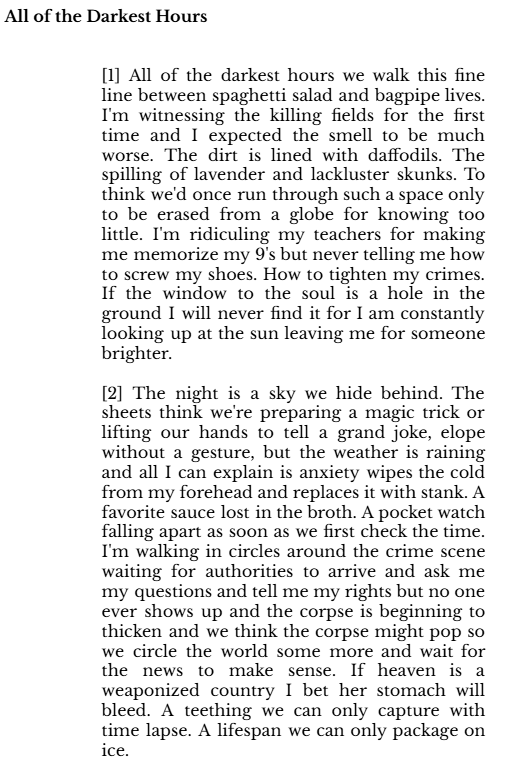
Categories
Issue 6 Issue 6 Poetry

EATING EXPIRED EGGS

By R. Gerry Fabian

3:45 am and I am finally home.
Four trailer loads and a bonus
leave me flush for a while.
I am on Red Bull overcharge
and three steps beyond hungry.
The hall light is off. Odd.
I call your name.

At this hour of the morning,
I recognize my error immediately
and tip-toe to the kitchen.
Opening the fridge, I take out
the egg carton with three eggs.
I check the bread for possible toast.
Each slice is green with mold.

Grabbing a non-stick pan
I break the eggs and scramble them.
There’s beer in the fridge.
I open it hoping to dull the Red Bull.
Sliding the eggs onto a plate
I take a small swallow of beer
and begins to eat the eggs.
The carton is on the table
and the expiration date
confirms the obvious.

R. Gerry Fabian is a published writer and poet from Doylestown, PA. He has published seven books of poetry: Parallels, Coming Out Of The Atlantic, Electronic Forecasts, Wildflower Women, Pilfered Circadian Rhythm, Hidden Danger, including his poetry baseball book, Ball On The Mound.  Web Page | X | Instagram | LinkedIn | Facebook | BlueSky

Categories
Issue 6 Issue 6 Poetry

UNABLE TO HOLD

By Saba Zahoor

It rained in Kashmir again
and I dreamed once more
of turning into its soil,
waiting to receive the diaphanous, fertile rains–
ripe with the smell of bulbous fruit pulp
that coax the rivers awake.

I would weave myself
roots and rain’s silver threads
into lush green carpets.
How I long to be the earth sodden with rain–
to hold close every drop of goodness offered.

I have moved far from home
dwelling in fossil aquifers.
Here, rain falls obliquely, fitfully—
flash floods, ephemeral streams
drowning the sinful dust devils.

Each sudden downpour weighs
heavy on the soul like a debt.
And every attempt to repay
falls short of the favor.

The realization is a callous bone
wedged between my teeth:
For all my intentions to receive
like my home soil–
I am the baked sand that cannot hold–

yet there are rocks through which springs gush forth.

*The final line is adapted from Qur’an 2:74.

Saba Zahoor is an engineer, born in Kashmir and currently living in Saudi Arabia. She is a self-styled peasant poet who views poetry as a portal to alternate realities.

Categories
Issue 6 Issue 6 Poetry

EMERGENCY EXIT

By Anthony Ikeh

Anthony Ikeh is a Nigerian writer & self-acclaimed cinephile. When he’s not writing or reading, he spends his time searching for bliss that exists between numbers, particularly between zero and one. His work are on or forthcoming on Brittle Paper, Kalahari Review, The Shallow Tales Review, Yugen Quest Review, Metaworker Literary, Eunoia Review, The B’k Magazine, Afrohill Press, African Writer Magazine, The Mixtape Review & elsewhere. He tweets @lanalovesbooks0

Categories
Issue 6 Issue 6 Poetry

REHAB

By Paul Smith

In physical therapy
we learned the difference
between pain and discomfort
Jessica spread my legs apart
like I’m a rotisserie chicken
and I felt it in my hip
the one they redid
but I said ‘No’
when she asked if it hurt
I liked saying ‘No’ to whatever
that burning was
then I cancelled then rest of
my sessions with her
because at some point someone
said
stop when there is discomfort
and I thought it and pain
were one and the same
we are expected to know
the difference
like we are supposed to know
the difference between
lots of things
but between all the things
we can choose is us
we are a pivot point
a fulcrum
that can go one way
or the other
especially when Jessica’s eyes implied
I should push through the pain
and just call it discomfort
because pain is just a thing in my head
and it gets murky
Dad said there wasn’t
much black and white
out there but a whole lot of gray
and Dad said
he could always beat a zone defense

Paul Smith is a civil engineer who has worked in the construction racket for many years. He has travelled all over the place and met lots of people from all walks of life. Some have enriched his life. Others made him wish he or they were all dead. He likes writing poetry and fiction. He also likes Newcastle Brown Ale. If you see him, buy him one. He is a featured poet at Mad Swirl.

Categories
Issue 6 Issue 6 Poetry

FROM PROTO-ATLANTIC

By Liz Falco

Liz Falco is a poet and high school English teacher from Provincetown, MA. Recent and forthcoming work can be found in McSweeney’s Internet Tendency (as Liz Bergman), antiphony, Cape Cod Compass, Do Not Submit, bethh, GROTTO, and Looky Here Magazine. Her chapbook, NO WAKE, came out in December 2025. She co-hosts Morning Shift at Looky Here in Greenfield, MA, where she now lives.

Categories
Issue 6 Issue 6 Non-Fiction

WEEHAWKEN

By Andrea Georges Dolan

I moved to Weehawken on the evening of my 23rd birthday, celebrating in an unfurnished apartment with shitty boxed wine and a dozen stale donuts from Dunkin’. My roommate and I lived on the second floor of a triplex on 49th Street. The man who lived below us was a bassist who would play the same twangy seven notes on a bass that looked like it was fashioned out of plywood and scrap metal. Sometimes his girlfriend would be there, but they definitely hated each other. I once caught him kissing his girlfriend’s sister in the driveway and he glared at me as I quickly turned away from them and dashed to my car. It wasn’t my business, but at the same time I wasn’t going to plug my ears when I heard his girlfriend hiss you’re a FUCKING embarrassment before slamming the door behind her.

Above us lived a Tisch professor who would bring home his much younger female students. Most of them were obvious overperformers but all I could focus on was his silence while the bed squeaked loudly. I wondered if he really felt anything, but now I understand that it sometimes just feels nice to be next to a warm body, especially if she’s 21. On the nights during which he was alone, he would restlessly watch reruns of Law and Order: Special Victims Unit on full blast in his living room. I can still hear his heavy footsteps pacing above me. I can still feel the loud DUNDUN rattling through my skull in the late hours of the night.

Weehawken is where I started running. I still can’t definitively say why, for I was cursed with flat feet and even walking has always been somewhat painful. I never quite got the runner’s high, but there was something profound in the struggle. A body can really push through anything. Perhaps it was boredom. Perhaps it was a way for me to outrun my thoughts.

There are two levels to Weehawken: the upper cliffside along JFK Boulevard East and the lower Waterfront along the Hudson River. To get from one end to the other, one must traverse what is locally called The Steps of Doom. Covered in chewed gum and graffiti, the rickety steps zigzag their way down from The Boulevard to the light-rail station at The Waterfront, where I would take the train to The City. Sometimes I would purposely torture myself and run up and down The Steps—not for any particular reason, just to say that I could do it. Just to say that I could run through anything, even pain. Especially pain.

The rusted steel squeaked and rattled with each step, and looking down gave me such intense vertigo that I vomited hard against the top railing, but descending was far better than its counter. The pointed heels that I often insisted on wearing on nights out got stuck in the janky slats of The Steps, so sometimes I would run up barefoot and pray I didn’t get tetanus. Sleazy men could get a good peek at my ass if they looked up. A slicked-back guido might menacingly wink at me as I breathlessly trudged my way up the twenty flights of Hell. Touch me, I dare you, I’d think. I’ll stomp your fucking brains in.

Sometimes when I’d run along The Boulevard, I’d think about how the luxury condominiums that lined The Waterfront would be the first to go in a climate catastrophe. I was thankful to live up top along the cliffside; I could see the entire expanse of Manhattan from there. If I looked close enough, I could see the hideous H&M advertisements flashing from Times Square. Sometimes I’d wonder if The City could agree on the irony, but I soon realized that Manhattan is far too self-absorbed for introspection. Narcissus beholds his dazzling reflection in the Hudson.

Upside: Weehawken has the best view of The City.

Downside: Weehawken has the best view of The City.

Every evening around seven or eight, two E-EXPRESS TOUR charter buses would pull up along The Boulevard and out would pour dozens of tourists, cameras in hand, all ready to snap away at the perfect view of The City. Didn’t they know this path was mine? Didn’t they know they were in my way? I’d grunt at them as I shoved my way between excited conversations in foreign languages. They stood tall with their arms outstretched to mimic the great and glowing island behind them. I wonder how many photographs of their smiling faces feature my blurry, heaving, and sweaty body running just out of the frame, like a ghost. I liked to think of myself that way anyway—invisible, fleeting, haunting.

On longer jogs I concentrated on the sound of my breath. When my thoughts would travel, I could bring myself back to focus by listening to my breath. Grad school got ya down? Just return to your breath. Heartbroken, again? Just return to your breath. About to jump off The Palisades Bluffs and hope the Hudson River swallows you whole? Just return to your breath. Sometimes I’d run until I couldn’t feel my limbs. My feet thumped hard on the concrete, a stubborn skeleton crumpling with every burdensome step. A nightly cold compress held close to swollen ankles felt more empowering than painful. Just breathe through it, I’d tell myself as I rubbed Tiger Balm on my splinted shins.

Sometimes on my jogs I’d think about all the bodies that have been scraped from the bottom of the Hudson. Sometimes I’d think about my friend’s older brother who jumped off the George Washington Bridge just a few years prior, and would wonder why he left his shoes behind. The police said that was common. He was a runner, too. A track star, really. I remember him running backwards with perfect form on our high school’s track, as if he had pressed rewind on himself. I’d stare in awe in my dirt-caked Converse as his knees drove higher into perfect 90 degree angles. We all thought he’d be an Olympian one day. Now he’s just a name on a banner hanging in the school’s gymnasium. Immortalized at 22.

I remember when he would walk his sister and me to Blockbuster when we were kids and buy us a bucket of Butter Lovers microwaveable popcorn. He was always so quiet and focused. Sometimes I’d think about how his mom didn’t initially believe he was dead and maintained that he was only missing, even though the last inquiries he searched on the internet were how tall is the George Washington Bridge and how many suicides on GWB. “Not my son,” I imagine her saying to the police knocking at her front door. “He wouldn’t do something like that.” I remember the look of denial in her eyes during his wake.

On one weekend morning jog, I saw a dead body washed ashore by the condos at The Waterfront. I remember the horrified screams of the wealthy middle-aged woman wrapped in a light gray robe, her phone in hand to call the police. She hovered over the pier where the feet of the body could be seen underneath her. It was a cold morning, too cold for spring. I listened for my breath.

“Don’t come over here!” she warned, but I was curious. This certainly was not the first dead person I’d seen, but I had never seen one quite like this. Bloated and blue, face down. The dead bodies I’ve seen lay peacefully in lacquered coffins, their arms posed gently over their chests, their faces caked with costume make-up. I wondered what had happened. Suicide? Murder? A drunken casualty from the ferry? I tried again to listen for my breath but all I could hear were her screams. I kept running until I got to Hoboken.

Once after a long night of drinking far too much free wine at an office party in The City, I opted to take a cab home. It was significantly quicker and more convenient than my usual MTA to NJ PATH to Steps of Doom running route. The cab driver was an older man, maybe mid-to-late fifties, with a thick gray mustache and even thicker bifocals. I had been particularly conversational this evening, asking him about his job, his life. He told me he had buried his granddaughter a week prior, and that life was unnecessarily cruel. I couldn’t muster anything to say other than a meek I’m sorry.

What I wanted to say was that grief is an unpredictable monster, and that sometimes its giant fist wraps itself around your body, constricting your blood flow. Grief takes your oxygen and replaces it with lead. Grief will demand that you punish yourself, for it should be the only thing you feel. Grief pulls at the loose ends and unravels you.

But I didn’t say any of that. I only looked at his eyes fixed to the road in the rearview mirror.

On the other end of the Lincoln Tunnel we took the first exit toward JFK Boulevard. Around the curve, The City skyline came into view. Bright, expansive, and silent.

“Do you mind if we stop for a minute?” the driver asked. “I’ve never seen anything so beautiful.”

Andrea Georges Dolan is a writer from New Jersey, currently living in Los Angeles. You can read some of their other work at agdolan.com

Categories
Issue 6 Issue 6 Fiction

A SUNNY WEEKEND

By Dmitriy Kogan

Me and Rob and a couple of our friends were renting a house on Seneca Lake for the weekend. We needed an escape from city life. I was not fond of fishing or hiking or most nature activities, but it was nice to sleep in a house near the lake instead of a one-bedroom apartment near the subway.

Rob had a new girlfriend, Marion, who was sunbathing on the deck when I stepped outside for a cigarette. The sun was just about to go down. Marion was in a two-piece polkadot bikini and sunglasses. I could see the shape of her cleavage. She was reading a book.

I lit my cigarette and looked up at the sky. She noticed me behind her and set down her novel.

“Are they starting to make the food?” she asked.

“Yeah, just about.”

She looked up at me. “Remind me again what you do in insurance?”

“I’m a claims adjuster.”

“Oh, yeah. You and Rob met at work, right?”

“Yeah. We were at the same company for a bit before I got canned.”

I doused my cigarette in the ashtray on the round table near Marion.

***

Rob, Marion, Bill, Gator and I sat at the table ready to eat the salmon we picked up at a nearby supermarket.

“How long have you been married, Bill?” asked Marion.

“Two years now,” said Bill.

“He didn’t bring his wife because she drives him crazy,” said Rob. “Married life will do that to you.” 

Rob laughed. I felt like I needed another cigarette. Gator was silently munching his peas.

“And Gator, Rob told me you’re looking for acting work?” asked Marion. “That’s great. I always wanted to try acting.”

“Yeah, it’s hard,” said Gator. “I mostly do commercials, but you know how that fucks up your soul when you have an MFA in theater.”

“Why not do theater, then?” asked Marion.

“Because try telling your landlord that you do theater,” said Gator.

***

It was late. Gator and I were having a couple of beers on the deck. The stars were shining bright and Gator was pretty hammered.

“You think this one will last?” asked Gator.

“Rob’s new girl?”

“Yeah.”

“Who knows. He gets a new one every three months. Then when he’s sick of banging her, he switches to the next.”

“I was with this hooker in Vegas last month. Man, her tits were huge. I sucked on them for ten whole minutes.”

“That’s nice,” I said. “Yeah, I need to get laid. I could use a hooker.”

“Come with me to Paris. I heard those French girls fuck like animals.”

***

I was still half-drunk when I stumbled into bed. I could hear Rob and Marion going at it. They sounded like they were in bed with me because their room was right next door to mine. I reached down to my crotch but couldn’t get it hard. Her moans sounded sweet, though. I heard Rob finish shortly before I fell asleep.

***

The next morning, Marion was making eggs in the kitchen.

“Sleep well?”

“Oh, yeah,” she said. “This house is lovely.”

Her ass was plump and I could see it through her nightgown. I still had some morning wood and I felt like brushing it up against her. Just then, Rob came downstairs, still in his underwear. He walked past me and smacked Marion on the ass. Then they began making out.

***

I stepped out onto the deck. Rob was in his chair, shirtless, smoking a cigarette and having a beer. I sat down next to him and asked him for a light. 

“She has a nice ass, doesn’t she?” asked Rob.

“Yeah,” I admitted. “Really nice.”

“I saw you checking her out. If you wanna fuck her, you can. I don’t mind.”

“What?” 

“I’m practically done with her. We did it in every kind of position imaginable, and she’ll definitely remember me as one of her best.”

I shifted in my chair and took a drag on my cigarette.

“I mean, the thing is, this Latina secretary who I’m working with now? Holy crap. She’s married, but she’s got ass and tits for days. Marion’s ass, it’s a boulder. This Latina chick’s ass? It’s a mountain.”

“Did you already fuck her? The Latina, I mean.”

“You bet I did,” said Rob. “I don’t care if she’s married. With that ass? It’s worth the risk. There are too many women out there, man. Why settle down?”

I looked up at the sky and watched the clouds as they met each other, embraced, and then merged.

Dmitriy Kogan is a short story writer, poet, and essayist from Staten Island, New York. His work has appeared in The Beatnik Cowboy, The Rye Whiskey Review, A Thin Slice of Anxiety, and is forthcoming in Straylight Magazine and Some Words.

Categories
Issue 6 Issue 6 Fiction

ESCROW

By J.D. Hosemann

I never managed to unpack my things. My apartment was lined with stacks of cardboard boxes and picture frames propped against walls where they might have been hung. I drank unknown quantities of Line 39 Pinot Grigio ($11.38/bottle). Even lesser-known quantities of time passed without my noticing. Faceless tenants slammed doors and stomped across the ceiling. Their muffled voices reverberated in the walls while I scrolled on my phone watching countless street interviews with drunken college students, reaction videos, trick shots, thirst traps. I can say very little about my arrival. There was the recently laid sod, a freshly painted sign (The Mark III: A Place for Living). But I do remember how it ended. I remember the jarring knock on my apartment door.

The neighbor introduced himself as Charles and claimed he’d been living across the breezeway for several months. He wore a baseball cap, an enormous Green Bay Packers Starter jacket, and he held in his hand a small, padded envelope. “This you?” he asked, extending the package toward me. Charles showed little interest in chatting. I accepted the package, offered my thanks, and retreated immediately leaving no time for pleasantries. Once inside my unit, I opened the padded envelope and discovered a digital meat thermometer ($17.89), which I vaguely remembered ordering from TEMU. Fair enough, I thought. I ripped it from its plastic encasing and placed it among other miscellaneous items in a small kitchen drawer, which, to my bemusement, already held an identical device still in its original packaging. 

It was around the time of this encounter that I began scouring online real estate listings. Night after night I stared into my laptop screen. I zoomed-in on the map and hovered my cursor over properties marked by little blue pins ($180k, $246k, $557K). I clicked through images of open-concept living rooms, galley kitchens, carpeted bedrooms and white-tiled bathrooms, not to mention backyard patios and oil-stained garages. Each home was newly renovated and updated. Stainless steel covered every appliance; granite, every countertop. The effect of wide-angle lenses made even a tiny nook seem like a great hall. I often saw myself in the images of these various rooms. I was preparing a nice meal in the kitchen. I was playing a musical instrument or watering a plant. I was reading a book in the den. Writing a book in the study. Doing pushups in the garage. I was learning to paint. Entertaining guests. Sometimes another person was there, a co-habitant, a woman without a face. I don’t know who the faceless woman was, but she was often doing what I was doing: reading or cooking or taking a nap. I thought I could almost see her face, but that would’ve been impossible because she didn’t have one.

I exhausted all listings in my surrounding area. It was late at night and I found myself zooming out, highlighting the little dots, expanding pictures of each house. Each one I’d already visited. I looked for something new, something overlooked, but nothing presented itself. I closed my laptop and left my apartment. 

The concrete paths and nascent shrubbery led me to the center of The Mark III, to the emerald waters of the communal pool. I’d yet to discover a single bather in the pool, which, despite its recent construction, had already succumbed to severe neglect. A thin film of debris and dead bugs floated perpetually across its surface. But I found the pool to be soothing, especially at night when the underwater lamp illuminated the whole common area and projected ripples of green and yellow against the poolside units. I reclined on a pool chair and watched patterns of light casting shadows of floating debris. I lit a cigarette. 

“What was the package?”

The voice came from my right. I turned to find Charles embedded in a nearby pool chair, a big G across his chest. He gestured to my pack of Parliaments with forked fingers. I flipped him the pack, offered the lighter.

“A digital meat thermometer. From TEMU.”

“Nice.” 

“Yeah. Need to watch my spending though.”

“What for?”

“I’m buying a house.” I shuddered at the thought of this admission.

Charles was silent for a moment. Then he said, “You don’t buy a house with money.”

“Well, you need a little money.” 

“You got credit?”

I nodded. 

“You don’t need money. You just need credit.” 

Charles tucked the cigarette behind his ear and produced a bulbous glass pipe from his jacket pocket. He lit the bowl and drew it deeply. For a moment, the features of Charles’ face were illuminated by the orange embers. His eyes were closed. He had freckles. When he exhaled, plumes of smoke billowed from his nostrils. Then he leaned back and extended the pipe in my direction, less of an offer than an assumption. I took the pipe, put it to my lips, and drew until I saw orange. I exhaled a stream of smoke that floated into the darkness above. 

“I’ve never bought a house.”

“You won’t do the buying.”

“The buying?”

“The bank, the lawyers, the realtors. They do all the buying. You do the wanting.” 

“The wanting?” 

“Find yourself a realtor. She’ll put you in a house.” Charles stared forward, almost as if talking to some invisible person several yards from us. 

I stared forward, too. I looked directly into the pool and watched as a spider made its way across the debris and then, miraculously, across water. Its spindly legs made tiny impressions on the water’s surface. My own feet felt far from me. My arms became lanky things. I leaned back in the chair. Charles continued saying things, something about realtors, mortgages, escrow. My eyes felt glassy. I had many eyes, like a spider. Weed smoke hovered in the night air and I could see each particle reflect the green light of the pool. I could see water molecules, stainless steel, kitchen gadgets, a crowded drawer. Storage space. Open concept. Find yourself a realtor. Unbroken chains of molecules. The pool chair dissolved into water but the surface tension held my weight. I lay there doing the wanting.

I awoke to a loud splash and sunlight hissing against my forehead. Charles was gone. A maintenance man combed the depths of the pool with an underwater vacuum. The pool was pristine. Not a leaf or bug in sight.

My phone vibrated and I sat up to check it. A Gmail notification: Prospective Client—Blue/Williams Realty Group. I touched the banner:

Hi, John! We got your message! I think I found your house! Call me asap!

–Marianne

601-423-XXXX

2

From the street, the house appeared small: a tiny one-story frame with a front porch swing and a sagging roof. At first it didn’t seem big enough to hold more than one person. But I walked the length of the property line and found the house was built on a sloping hill. As I descended the hill into the backyard, the house grew larger and larger. I turned and looked up. Two dark windows loomed some twenty-five feet overhead. Their height was disorienting. I felt a spell of dizziness. Then I heard a car, the sound of brakes.

A silver Mercedes was parked on the street and Marianne was waving to me from the front doorway of the house. She wore a light blue floral blouse and matching heels. Her face bore a thick layer of foundation, and her red hair had been recently dyed. She looked perfect, objectively so. 

“Such a charming neighborhood,” she said. I looked around. The house was nestled between a law office and a fourplex. I saw some trees, architectural variety. A car with no muffler sped past us down the street. “And it’s designated historic,” Marianne added.

In the living room, I eagerly awaited Marianne’s instructions, but she said nothing. Instead, she extended her right hand in which she held a golf ball. She leaned forward and placed the ball on the floor, where it rested quietly for a brief moment before suddenly coming to life. The golf ball began rolling, slowly at first but gradually picking up speed until it rumbled noisily against the natural wood flooring. We both watched as the ball careened toward the baseboard on the farthest wall. But then, as if possessed, it slowed and curved back toward the center of the room, barely missing the wall. 

“Is that bad?” I asked. 

“Not necessarily. It just depends.” 

“On what?” 

“On whether you can see yourself living here.”

We walked around. Our voices reverberated in the empty spaces of the vacant house.  The wooden floors were newly polished and a thick coat of paint had been applied to every wall. Even the fireplace was slathered with multiple layers of heavy white paint. It reminded me of a white, layered cake. In fact, the entire house had been painted in a style I could only describe as frosted. It made me want to go out and buy a gigantic knife, an absurdly large knife, to slice into this house and find out whether or not it was cake.

“Go on,” Marianne said. Take a walk around. I’ll let you be. 

The house was built in such a way that one room led into another. Each room had at least two points of entry, forming a kind of circle or spiral. The spacious front room led into a cozy dining room, which was connected to the kitchen. I walked through the kitchen and into a bedroom. Then I walked through the bedroom and into a large white tiled bathroom. Jack and Jill, I remembered from my research. Then I walked from the bathroom into another room, a dark room with no windows. I was in the center of the house somehow. I wondered what purpose such a room could serve. Was it a bedroom? An office? 

When I passed through the darkened room, I found myself back in the living room, back where I’d begun. It felt surprisingly spacious and airy. Natural light poured in through windows on the front facing wall of the house. I was just about to ask my realtor about the darkened middle room when, there in the light, I saw myself. I was reclined in a reading chair, a book hiding my face and a black cat curled in my lap. Finally, a chance to do a little reading, I thought. Then I saw myself in the kitchen donning an apron and making poulet chasseur. And then I was outside mowing the front lawn. I watched through the front window as I pushed an old-fashioned rotary mower. I was sweaty. My shirt was off. My arms were chiseled from all the pushups I’d been doing.

“Well, do you see yourself living here?” Marianne asked.

I turned from the window and looked at my realtor. She was also looking out into the yard. Then she turned, smiled, and awaited my response.

3

The house visit, the loan-approval, the contract: I had very little to do with any of it beyond applying my initials in the designated blanks. But once my offer was accepted, once a closing date was determined, my online habit only intensified. I took special pleasure in watching the status of the listing flip from “for sale” to “under contract.” I combed through the page over and over again. I committed every detail to memory. Built 1938; 1617 sqft; .98-acre lot. I thought of new questions to ask Marianne. Were the bedroom outlets grounded or two-pronged? Was the entire roof replaced after the hailstorm of 2013 or just the shingles?  I relentlessly clicked through each of the twenty-six images on the realtor.com slide deck. Crown molding, glass doorknobs, all the little bits of charm and character I’d missed or already forgotten about. 

One night I downloaded several decades worth of Hinds County tax records in an attempt to discover all the names of the previous owners of my property. But I kept hitting snags. Either the document was illegible or the address was missing. That couldn’t be true. The house had stood for some eighty years. I stared at the screen checking each address until my vision blurred and I could no longer make out the tiny street numbers. I closed the laptop and there I was at The Mark III, in my apartment, amid the stained carpet, beige walls, the fluorescent kitchen light. I looked at the cardboard boxes stacked against the wall. On one of them I’d written the word “Stuff.” I thought about Charles and wondered what his unit looked like. 

The pool was, once again, covered in leaves and debris. I paced around the deck with a cup of Line 39 in my hand. I lit a cigarette. I wanted to tell Charles about Marianne, about the golf ball, about her Mercedez. Get yourself a realtor. I looked at the pool chairs again and again but they remained vacant. Then I pulled out my phone and scrolled through emails, the back and forth between me and Marianne. I considered typing out a message. About what? Outlets. Shingles? I stared at the water, the emerald glow. I watched the leaves floating listlessly. I noticed a spider desperately trying to climb out of the pool, its legs struggling to take hold against the vinyl liner. Eventually it gave up and continued its miraculous journey across the water’s surface. 

There was no traffic on the road at that time of night. I pulled onto highway forty-nine and crossed its four lanes without a turn signal. My plastic cup fit snug in the cup holder and I drove with the windows down. Heat on the feet. Crosby, Stills, and Nash were coming through the car stereo, but they were continually interrupted by the artificial voice of a woman reminding me to take a slight right onto Mill Street in two miles. I passed unimpeded through a gauntlet of green traffic lights. Turtles all the way down! I thought for no reason. I’m bending time and space, I thought as the white lines elongated on my approach. I’m on a night journey, I thought as the jangle of Stephen Stills’ acoustic guitar prepared me for the coda of “Suite: Judy Blue Eyes.” I’m on a journey home, I thought as I took a sip of Line 39 and sang along with the boys Doo doo doo doo doot, doot doot, doo doo doo doot. Then I made a series of turns and merges and slight rights toward downtown, toward a neighborhood with brown road signs, a historic designation. I was driving home. 

The highway narrowed and funneled me into smaller boulevards and avenues and streets. I reduced my speed and lowered the volume of the car stereo. Quiet city, sleepy town. My car snaked around the streets of my new, yet historic neighborhood and suddenly I felt a sense of calm reverence, of peaceful vigilance. I turned the radio completely off. I turned off my navigation app too. One ought to know his way home. But my street seemed unnaturally dark. There wasn’t even a flicker from the streetlight. Only rooftops were visible against the mild glow of urban light pollution, but the houses themselves, their faces, were shadowy things. I recognized certain landmarks. The law office, a convenience store. But the houses themselves seemed to shift, their features distorted in the darkness. Was that wood or asbestos siding? Four columns or two? A rose bush or Japanese maple?  

Eventually I found myself at a small public park with a walking trail that twisted and curved around a large grassy meadow. I pulled over and poured myself more Line 39 before killing the engine and embarking on my walk. Small, solar-powered lamps had been planted at measured intervals along the trail and created a haunting effect. Ghost path, I thought. I walked from light to light and tried to focus on the path rather than the surrounding darkness, which seemed infinite. I imagined it was daytime, in the future, a future in which I was living my life in my new house. I imagined a green meadow and blue sky, people on a picnic blanket, dogs chasing tennis balls. “On your left!” I jolted and spilled my wine when the runner bounded past me. He wore a blinking red light that bobbed up and down while the rest of his body disappeared into the darkness. 

Back at The Mark III, I found another package at my doorstep. There was a note: Delivered to my address again. Check shipping info. C. I tore open the package and found another digital meat thermometer ($18.39/TEMU). 

4

As the closing date drew near, new players in the drama of my house hunt entered the scene. Yes, there had always been Marianne, the realtor and soothsayer who showed not just houses but entire lives unfolding before your very eyes. But there was also the bank, the Mortgage Loan Originator, the home inspectors, the crawl space guy, the insurance agents, the roofing guys, the sump-pump repairmen. Somehow I’d set into motion an entire industry of professionals determined to house me. 

I was in my apartment the night Marianne called to explain that my house had not passed inspection. I remember very few details from the conversation, only that my first reaction was to say That’s okay. I still want it. I still want my house. But Marianne explained my desire had been insufficient, that the people actually buying my house, those professionals involved in the transaction, had decided it was not to be. Eventually we hung up. I looked down at my laptop, which sat open on the kitchen countertop. Of the dozen or so tabs open, half of them were my home listing. I clicked one of them and saw the front porch, the Japanese maple in the front yard. Then I closed the computer. 

I’m not sure why I went to Charles’ apartment. Perhaps I held him partially responsible for this, even though he’d done nothing but offer some kind advice to a neighbor. Maybe I thought I could change things by going to his apartment, by knocking on his door the way he’d knocked on mine. When I did so, when I rapped my knuckles against the vinyl door, it creaked open slightly. At first I wondered if Charles was waiting on me, if he had opened it as soon as I walked over. But it had only opened a fraction of an inch. “Charles?” I said nervously. When I pushed the door myself, I found no one there. 

Charles’ apartment was nearly identical to mine. There was a beige living room, a carpeted bedroom, and a small kitchen with plenty of storage space. Charles had managed to hang a few pictures, but the only striking difference was the window in the living room. Unlike my unit, which faced the parking lot and, at some distance, highway forty-nine, Charles’ unit faced the interior of The Mark III and offered a perfect view of the pool’s emerald waters. I walked to this window and looked out into The Mark III, the tan vinyl siding, the concrete paths, the patched sod, and the blue-green light of the pool at the center of things. That’s when I noticed a tiny orange light in the darkness. The light was coming from the pool chairs in the corner of the common area. The little orange light would glow bright for just a second before fading slightly, followed by a little puff of smoke.

When I got to the pool I was out of breath from running, but I hadn’t been fast enough because I did not find Charles. I found no one. It was only me, there at the pool, late at night when the underwater lamp made everything green and yellow. It was me who, just then, noticed something at the bottom of the pool, something dark and impossible to make out because of the refracted light of the water’s surface. And it was me suddenly splashing around in the water, unable to penetrate the depths, my limbs spread out and flailing on the surface. It was me who wanted—no—who needed to see what was at the bottom of the pool. And it was me who, eventually, contorted my body and dived down. Beneath the surface, I saw a more definite shape, a dark rectangular thing down at the bottom of the pool. I kicked my legs furiously but struggled to go down, to sink into the depths. I kicked and kicked and extended my right hand toward the dark thing at the bottom of the pool. And, as I reached for it, I thought I recognized the shape, its unique angles. It looked familiar, something I’d viewed a million times. But the thing disintegrated as soon as I grabbed it. I looked at my hand, which was covered in green algae. Then I turned and looked up from the bottom of the pool. I looked to the surface and I saw the silhouettes of people standing around the edge of the pool. They were staring down into the water, dozens of vague and refracted faces, faces from the past and faces from the future, staring down from above.

J.D. Hosemann lives in Jackson, Mississippi. His work has appeared in places like The Kenyon Review Online, New World Writing, Maudlin House, ergot., hex, and elsewhere.

Categories
Issue 6 Issue 6 Fiction

DISBANDING THE FIREBALL QUARTET

By Avee Chaudhuri

After a few hours of drinking it was decided, mainly by Chatterjee, who was a diabetic and who routinely ignored the advice of doctors and refused to take his medication, that it would be another pizza night. “Pizza night! That’s what’s fucking up,” Chatterjee shouted at a group of passing school children. He had been on a self-prescribed diet for over a month, eating nothing except millet and goose liver. 

“Say, what’s the pizza of the week?” Darryl asked our waiter when we were seated. 

Our waiter leaned in and laughed. “You know, Joe’s actually in Italy this week, so we thought we’d have a little fun and do a Hawaiian Pizza. Joe hates Hawaiian Pizza.” 

Joe was the owner of the pizza joint we would frequent whenever we drank too much and none of us had exact dinner plans. Joe kept a bottle of Fireball behind the bar, just for us. 

Darryl and Monica firmly came down on the side of Hawaiian Pizza. I abstained. Chatterjee lost his goddamn mind.

“I won’t be party to treachery. One way or the other, I don’t give a damn about Hawaiian Pizza, but I won’t be a party to this humiliation.” 

In fact, Chatterjee said he was drafting a letter on his phone he would send to Joe when he knew Joe was safe and back in the country: 

Dear Joe, 

While you were away they anointed Hawaiian Pizza the “Pizza of the Week.” They being not some anonymous cabal peddling the inane wisdom that “variety is the spice of life,” but your own kitchen staff, your own people engaged in high treason, man. I was appalled for you, remain appalled, and hope that this intelligence is actionable—with extreme prejudice. First I suggest you clean house, as it were. This will require shuttering the pizzeria for, what, at least three months while you train a new platoon of chefs and waiters. I believe this economic hardship to be worthwhile for your own personal well-being and to preserve the integrity of Joe’s Pizza, which by the virtue of operating as an LLC has become a beacon of hope for those of us who dream of one day hanging out our own shingle.

Warmly, 

Prem Chatterjee

After Prem wrote the letter he ordered us shots of Fireball and we decided on a classic, tastefully garnished, Pizza Bianca.

A few weeks later, Darryl wanted to go to the racecourse because he was an animal lover. 

“Have you ever seen a horse at full gallop?” Darryl pulled up the race calendar on his phone.  

“No.”

“It’s like they’re flying.”

“Shut the fuck up, Darryl,” Monica said. 

We decided to get some pizza to smooth things over. Joe double-timed it over when he saw us. 

“I gotta thank you, Prem.” He had to catch his breath. 

“I just couldn’t be a party to it, Joe.” 

“That was the last straw. I tell you that was the last straw.” Joe was running his hands through his hair. He looked unkempt. He hadn’t shaved. Joe was what you would call an old-school restauranteur. Always dressed like some splendid groom, in cufflinks, in a waistcoat. Now he was wearing jeans and a hoodie and our eyes followed him anxiously to the open kitchen where he began an unsuccessful attempt to remove the ink sac from a cuttlefish.

It was only then that we noticed the kitchen was empty save for Joe, who was covered in ink. He’d opted for a mallet instead of a knife.

“Say, Joe. Where is everyone?” Monica said when she went behind the bar to grab the bottle of Fireball. 

“Well, it’s like Prem said. I had to clean house. I had to take the fucking trash out. Right? Right?!” Joe started adding wood to the pizza oven, at an alarming rate. We discovered the next day while watching the five o’clock news that Joe had fired his entire kitchen staff and murdered Constantin, his head chef, burning his remains in the pizza oven. Constantin had been sleeping with Joe’s wife. It started out small, hand stuff in the walk-in, but had grown into a real relationshipweekends away, some lake house in the countryand she had become kinder to everyone, Joe included, so he had accepted the affair, but then to go ahead and make Hawaiian Pizza was too much for Joe. It was one betrayal too many. 

Prem cleared his throat when the news hour ended, like he was about to say something.

“What?” I said. 

“Well…” Prem started. “I cannot help but feel that we are responsible for this.” 

“We!” Darryl said. 

“Yeah, you wrote the goddamn note.”

“None of you stopped me! We were all drunk on the Fireball and did not think, could not think, about the consequences of our action. That’s what’s wrong with this world: people not minding their own business, imposing their own value system.”

“Jesus, Prem,” Monica said. “You’ve got to calm down. Joe would have found out eventually.” 

“Maybe. Maybe not. But referring back to the letter: was it entirely necessary to frame the issue of Hawaiian Pizza as ‘high treason’? ‘Extreme prejudice’ is an unfortunate turn of phrase, knowing what happened to poor Constantin. Though perhaps twas the fate of all swarthy lovers.” 

“Prem, you’re being too hard on yourself,” I said. 

“Well someone has to be! I mean what the hell are we even doing?”

The question hung there for the rest of the evening. Monica called up her ex-husband, and arranged to meet him at the Home Depot. They would finish putting the new siding on their house. She said she would call us when they were done, that there’d be a party. I haven’t seen her since. Darryl nursed a light beer for several hours and then left to get kebabs. Chatterjee and I polished off a bottle of white wine but that was it. At the end of the night, Chatterjee shook my hand.

“Good luck,” I said.  

“Yeah, you too.” 

I can’t remember when we started to refer to ourselves as the Fireball Quartet. It was probably during that full out brawl in the Haymarket. Someone asked Chatterjee if he was a Muslim. Chatterjee, a proud Bengali Brahmin, answered: so what if he was, he had every right to be in that Irish bar leering at former collegiate volleyball players. 

Avee Chaudhuri teaches Creative Writing and Literature at the University of Nebraska-Lincoln. He is the chef/owner of The Sepoy’s Revenge, a restaurant he runs out of his office on campus (Andrews 320).

Categories
Issue 6 Issue 6 Fiction

THE BABYSITTER

By James Callan

Our noses smash while your tongue unfurls to probe far beyond the nubs of my tonsils. We perform our animal lust in a public setting—a food court in the airport, a city bus, the serpentine queue leading to a garish roller coaster. No one takes any notice.

This time, you’re an Asian girl, but no one I know from real life. Asian, most likely, because I watched a Kore-eda film last night—the one with the mother who abandons her children. Your face is different, but I know it’s you. We are kissing in public with a hunger that verges on panic. You stifle my airways with your cartoon tongue. I am powerless, like a child, neatly folded and stored in a traveling bag. I am carried away, going who-knows-where.

In these dreams, the taste in my mouth is awful, and when I wake, it lingers. I blink in the dark and fish a hand into my underwear. Sometimes I require a new pair. This time, I do not. I groan, knowing what’s to come next, knowing from experience and repetition that when I wake from these invasive kissing dreams, my mouth tasting like I’ve gone to town on a hyena’s asshole, you will emerge and render me your plaything. You seep into substance from nothing, clouding my room like squid ink ejected in water. You will bond my flesh to the mattress, singing in high notes, low notes, a drone that makes me nauseous and yet receptive to its sonic violation. You will hover over my useless limbs, ejaculating your cold aura.

On occasion, you gyrate, shedding your skin. More commonly, you remain perfectly still. Eventually, you press inward against my immobile body, your non-face opening up to unravel your tape-measure tongue. This is the moment when my dreams take on a new foundation. No longer dreams, they become nightmares; discarded fragments dredged up from forgotten realities.

The Big Red that we chewed in the car cannot purge the rot of our open faces. Your song is sweet, but hot and sour on your lips. The storybook that we read seems a world away on my bedside table, falling to the floorboards as a tremor ruptures the world and everything in it. 

You cover me like a weighted blanket. I resist, but part of me opens up to you. No longer a woman—no longer a human—the shadowy mass in my room enters me, tasting me down to my core.

James Callan lives and writes in Aotearoa (New Zealand). His fiction has appeared in Apocalypse Confidential, Burial Magazine, Reckon Review, Mystery Tribune, and elsewhere. His debut collection, Those Who Remain Quiet, is available from Anxiety Press.