Categories
Issue 6 Issue 6 Non-Fiction

QUESO PEOPLE

By Nathan Willis

Our game was hide and seek, and the best place to hide in the whole house was the front closet. That’s where mom kept the dress coat she wore to school concerts, family holidays, and nice restaurants. It was long and black and if you pulled it around your shoulders, only your legs and feet were visible.

My sister would check behind, under, and inside of everywhere else first. This was something we did for each other, even though we always knew where the other would ultimately be found.

There were even times we’d pretend not to see each other’s legs sticking out from under the coat, to start the cycle over again, to keep the game going for as long as we could.  

The nicest restaurant we went to as a family was Chi-Chi’s. The waiting area was always packed with other families in their dress coats, all straining to hear the hostess over the giddy din of middle-class splurging, and the dopplering sizzle of fajita hot plates.

The dining area was divided into four open-concept sections, creating the illusion of simultaneous separation and inclusion. The overhead lights were never on. There was a lit candle on every table. The walls were painted to look like there were patches of plaster missing, exposing brick underneath. Sombreros and serapes were tacked up on any surface that would support them.

At some point, we asked our parents, “What does Chi-Chi mean?” They told us Chi-Chi is a person. A professional golfer. This is the food he likes and he wants to share it with the people of Ohio.

There was a golf course close by so we had no reason to doubt them.

We went often enough that we had our order locked in. Chicken fajita. Cheese enchiladas. Steak burrito. Chicken enchiladas, no onions. Two Cokes, an unsweetened iced tea, and a Diet Coke. The only unknown was chili con queso.

The queso came in a tray specially designed to sit over the candle. The tray had a wide lip to hold chips. It was a whole situation, big enough that the people at surrounding tables could see. Ordering queso was a very public statement.

Our parents argued at night when they thought we were asleep. Money was a recurring theme. As was my dad’s expense account. And lunches. And the company he kept. And the incidentals on his business trips.

My room was next to the stairs. I heard everything. I didn’t understand the math or the accusations, but it was clear we were on the verge of collapse.

It was by no means definitive, but getting queso became a kind of barometer. If we got queso we were still stable. We had enough money, and no one was preparing to leave or for things to fall apart. It meant we loved each other, and the game would keep going.

If queso wasn’t mentioned by the time we ordered our drinks, I would ask for it.  Sometimes my parents said no right away. Other times, they gave each other looks. Plaintive, angry, bitter looks that didn’t have anything to do with the queso. In these instances, us getting queso or not depended on which of them felt bold enough to make some larger point to the other by withholding or requesting queso when the server came back.

There was a movie of the week that aired back then called “A Place at the Table.” The film follows a family who donates their time and money to feed the unhoused and less fortunate. Mom had told us that grandma used to do the same thing. But it was a different time then. The unhoused went door-to-door and grandma would invite them inside while she made them a sandwich.

Mom said she would never do that with us in the house. She knows better. She’s learned the hard way that you can’t trust anyone.

In the movie, the dad loses his job and has to leave town to look for work. While he’s gone, the family relies on the generosity of the community for food and for monetary donations to pay their bills. Not a whole lot of people come through for them.

In the end, the dad is still out there looking for a job. The family is at home sitting before a sparse dinner. The room is dark except for a candle on the table. They glance at the dad’s empty chair. The credits roll as they eat the meal.

Recently, I learned that the restaurant was not, in fact, named for, or owned by, professional golfer Chi-Chi Rodriguez.

“Chi-Chi” was the nickname of the wife of the restaurateur who started the chain.

I tried this once, what my grandma had done. At least a version of it. One of the years that I lived in Los Angeles, on Thanksgiving, my girlfriend at the time and I cooked a turkey and made it into sandwiches that we packed into brown paper bags. We loaded them into the car and drove around looking for the unhoused and less fortunate. We couldn’t find anyone. There were usually people on nearly every street. Then we realized they were probably at all the shelters and churches that were also having Thanksgiving.

We did find one guy on our way back. I gave him a bag and he asked if the sandwich had mustard. It did. He handed it back to me.

We drove home and put the bags in the refrigerator and still felt pretty good about ourselves seeing all that food in one place and knowing it wasn’t for us. Then we got busy and didn’t take them back out again before the turkey went bad. It stunk up the whole apartment. We had to throw all of it away. For the next month, everything that went into that refrigerator came out tasting like spoiled turkey.

There was a weekend when one of the neighbors came over to see if we were sick. He asked if we had gone to Chi-Chi’s the night before. We hadn’t. He said everyone who had gone got food poisoning from bad onions. There would be a story about it in the paper. The neighbor said his whole family got sick. They were still trying to shake it off. He seemed fine.

I thought it was just our Chi-Chi’s that got the bad onions and maybe it was. Maybe the onion thing happened twice. Because this was before my parents got divorced, which would have put it at around 1990. But if you look it up online, the largest Hepatitis A outbreak in the history of the United States was caused by bad onions served at Chi-Chi’s restaurants in 1994—after the divorce, and after the trial.

Back in Ohio ca.1990, after that first, localized round of food poisoning, people stopped going to our Chi-Chi’s. My parents would talk about how Chi-Chi’s was going to shut down any time now. Think of the overhead. The location. They made guesses on when it would happen. First, it was a matter of weeks. Then maybe a couple of months. Then dad moved out and there was no more guessing. They were both wrong anyway.

Chi-Chi’s held on for at least another year. I am sure of this because they stayed open long enough for us to go there one more time, after our last day in court.

We knew it was going to be a hard day no matter what. This would be the first time we had seen our dad since he left, but we knew the lawyers and counselors had met in advance and agreed that none of them were going to put either of us, the children, on the stand.  Then dad’s team switched it up at the last minute and said, On the other hand, let’s go ahead and make this as painful as humanly fucking possible for everyone involved, except the Defendant.

So, we got through that and we needed a light at the end of the tunnel.

We’d never been to Chi-Chi’s during the day. The overhead lights were on. There was no sizzle. The bricks on the walls were just paint. We were the only customers. We could hear the staff in the kitchen complaining about employees from the other shifts.

Mom’s sister, our Aunt Charlene, was with us. She was supposed to make us stronger. She had agreed to co-sign on a loan that would allow mom to keep the house.

When the waitress came for our order, we did not get queso and I did not ask for it. I knew who we were at that point and we were not queso people.

Mom wanted to talk about the house but every time she brought it up, Aunt Charlene changed the subject. When we were done eating, mom and Aunt Charlene talked in the parking lot while my sister and I waited in the car. We watched them wave their arms and shake their heads.

My aunt drove off in her cream-colored sedan. Mom got into our old Camry. She slammed the door to seal us in and she punished the world with an open-throated yell. The world did not care.

She cried and punched the steering wheel. She punched harder than I’ll ever be able to. I marveled at her power and the miracle that none of her bones broke.

Aunt Charlene had changed her mind about the loan. Now, mom didn’t know where we were going to live but she knew she was going to have to figure that out on her own and she would have to juggle multiple jobs and odd hours and we were going to have to budget some of our meals out to a dollar fifty each at the Taco Bell drive-thru that we would then drive across the street and park to eat in the car at the Drug Mart parking lot because they had thirty-five cent soda machines out front.

As she thought all of that through, I like to think that back inside of Chi-Chi’s, the General Manager got the call from Chi-Chi Rodriguez or the wife of the restauranteur, and whichever of them it was, they would say, “We’ve had a good run but it’s time to shut this shit down.” And the General Manager would pull a switch and the place would go dark. The employees would gather their things, go to their cars and drive away and we would still be there in the parking lot trying to figure out how we were going to make it. We would be the last to leave.

Thirty years later, as part of a naive and admirably masochistic effort at reconciliation, mom arranged for us to have Thanksgiving at Aunt Charlene’s house.

Mom’s car was in the driveway when my partner and I got there. We pulled up to the curb and took in the three very large crosses in the front yard. They were solid wood, and they were not seasonal.

Inside, the kitchen counters were crowded with Thanksgiving staples in plastic containers and takeout boxes from homestyle restaurants. Everyone else who came, except for us, brought store bought pies. There was more pie that actual food. I thought of all the times we ate in the Drug Mart parking lot.

The flatware was gold-plated and the dinnerware was ornate bone china, and as we ate, Aunt Charlene told us about all the joys and challenges of training dachshunds.

The three of us left shortly after dinner. Our coats were in a pile on the hall tree. My mom had a nice coat that was fashionable at the time. Her black special occasion coat was long gone. It, along with virtually everything else from our lives back then had been sold or otherwise lost.

Our local grocery store carries jars of Chi-Chi’s chili con queso. I had been walking past it without noticing for years. As I put a jar in my cart, I remembered about the onions, and Thanksgiving, and the trial and the credits rolling, and eating queso by candlelight, as though everything was fine.

I called my sister to ask if queso ever meant more to her than just queso. It didn’t. She never really liked any of the food at Chi-Chi’s and if she had to pick, Taco Bell was much better.

I knew she was right. I put the jar back on the shelf.

Nathan Willis is a writer from Ohio. His work has appeared in Split Lip, HAD, hex, matchbook, Swamp Pink, Pithead Chapel, Moon City Review, and elsewhere. His stories have been nominated for Best Small Fictions and appeared in the Wigleaf Top 50 Longlist. He can be found online at nathan-willis.com.
Categories
Issue 6 Issue 6 Non-Fiction

POST MAN

By Ryan Bradford

Been having a lot of violent thoughts these days. Smashing faces, breaking skulls, popping eyeballs. Covered in blood, knee-deep in viscera, screaming victory.

Kind of dig it.

This is what the job does to you.

There are 385 deliveries on Route 42 and six hours of allotted street time to complete them, minus thirty-or-so minutes for lunch if you’re into that sort of thing. Convert that into minutes and it gives about 1.16 minutes per delivery. This doesn’t include driving time. Five and a half hours to make 385 deliveries. I’m going to do it in four. The regs call it running.

Slide the door up in my mail truck and behold! Letters, envelopes, magazines, advertisements. Two trays of flats and three trays of machine-sequenced envelopes. The regs call it DPS, or delivery point system—the order you’re supposed to carry the route. Just follow the mail, they say.

There’s a musty smell in the metal truck, the culmination of paper and cardboard and envelope glue and spit. Try not to think of the love and emotion that went into these notes, just the biological sacrifices.

Twenty-two houses on this swing. I clamp the letters in my hand and tuck a pile of flats in the crook of my arm.

The regs hate it when I run the route. It’s a precarious relationship between the reg and the transitional letter carrier—they love foisting sections of their route on me when they’re running behind, but hate it when I prove I can do it faster than them. They tell me to take my time, all buddy-buddy-like, secreting the same comfort they give to Mrs. So-and-So when she worries about all the new people who keep showing up in her neighborhood.

Slam the truck door. Begin the swing.

Benjamin Franklin was the first postmaster general. Not many people remember this. I’m not sure during which portion of his life he took on the role. Was it after he called upon the sky to electrocute him? Hope so. Only a man with lightning running through his veins would be crazy enough to love this job.

The sun burns the tan of my neck no matter how much sunscreen I put on.

First house: unlatch the gate one-handed, fold a catalog (bulk mail) around two letters (presorted standard). All shit mail, not a first classer in the bunch. Just wastes of paper. Could throw this bundle in the trash and no one would know or care.

Use my knuckles to lift the lid of the mailbox and drop the rolled-up pulp in. Like putting your grandpa to bed. Slam the box closed, the sound makes two dogs inside go nuts. Route 42 is a dog route. Lots of orange cards tucked in between the flats. DOG WARNING CARD, they read. I don’t pay attention to the dog warning cards because I know these dogs, and they respect me. Game sees game. I pause to hold my fist close to the window where the dogs’ mouths are, and their barking fogs the glass. Close my eyes and imagine the heat of their breath gracing my knuckles. If this glass wasn’t here, would they attack? Would they chew me up, snarling, growling, with teeth bared and eyes rolled back? Probably. Wouldn’t be surprised if it was one of God’s four-legged beasts that puts an end to me. In many ways, that seems ideal.

Do the next four houses in two minutes. Traverse the borders that separate people’s lawns — lawnmower lines that convey one neighbor’s industriousness and the other’s laziness. You don’t have to live here to get a sense of the politics of the neighborhood at work. Think of myself as a free agent, unbeholden by whatever HOA rules that keep these people subservient. I’m the unifying force.

Fresh grass clippings stick to my shoes, black sneakers that I bought at a discount shoe warehouse where they call their customers “shoe lovers.” The shoes are not regulation, but because I’m a transitional employee they don’t give me a uniform allowance. If I trip and break something, management will blame my shoes and I’ll lose my job, at which point I’ll walk into the Pacific ocean and never return.

Takes five minutes to do the rest of the swing. Not my fastest, but nothing to sneeze at.

Back in the truck, I unscrew the top to my hydro flask and drink plastic-flavored water. The bottle was clear when I bought it, but now it’s taken on a cloudy translucence.

The Long Life Vehicle roars to life when I turn the key. Most of the LLVs  have been around since the Clinton Administration. Imagine: before Jane left me, before I even knew Jane, before everything went bad, before I even knew what LLVs and DPS and 3849s were, these very same vehicles were running.

Put the vehicle in gear, but hold my foot on the break. Briefly look out to the west and see the Pacific Ocean. Between, there are pawn shops, apartment complexes, pho restaurants, skyscrapers, houses, trailer parks and bars. All of them will get mail today. All of them.

***

Juan’s washing his hands in the restroom when I return to the station, lathering his arms up to the elbow. Letter-carrying is a dirty job. It turns you into a dirtbag. You come home at night with your skin sunburnt and your fingertips blackened and your armpits stiff from sweating and the crud of everybody’s homes trailing you.

I stand next to Juan and pull the soap dispenser until my hand’s overflowing with metallic pink.

“What route you do today?” Juan asks.

“Forty-two.”

“That’s good. Peanut route.”

“Elephants all over the place,” I say. Juan smiles at me in the mirror. I don’t know why they call the easy ones peanut routes. 

The water’s scalding. Pull it up my arm, mixing it with the soap. Lather until the pink turns white. Feels like a hygienic baptism. Washing my arms like this doesn’t really stop the breakouts, but it helps. Ever since I took the job, I’ve been getting acne in weird places. 

Juan finishes his scrub and pulls a wad of paper towels from the dispenser. Often wondered if Juan is the cleanest person I’ve ever known. He’s another transitional employee, and we sometimes use these moments to talk shit on the regs, but today we wash in silence. Juan might be my favorite letter carrier because he’s comfortable in silence.

He throws his massive ball of soggy paper towels away and stops halfway out of the door. “They’re sending me to Pacific Beach tomorrow,” he says. “Lots of hot chicks out there.”

“Aw, lucky,” I say, and then when that sounds too childish, I add, “Fuck yeah.”

“I used to deliver beer out there,” he says. Don’t think Juan is any older than me, but he’s told me about his distribution job before, and I still find it inconceivable that he’s already been successful in a different career in this lifetime. “Those white kids love to drink,” he says. “They love it.”

I make a sound that signifies I know exactly what he’s talking about.

“I’ll probably be back Monday,” he says.

“Su-weet.” I scour my brain for something to add. I almost ask him to give me a text if he’s bored on Sunday. Maybe we can get beers or something. But I say nothing. He probably has kids and likes to spend his day off with them, but what if he hates his kids and he’d actually relish the opportunity? Hate’s a strong word to use in this instance, I conclude, and then I realize that Juan is gone.

***

There are a few letter carriers hanging around the timeclock, waiting for the numbers to hit 1800. These are the few lucky enough to have been approved for overtime. They rub their hands together and talk about overtime like it was God’s personal gift. It’s an honor to work until 1800 for them, and their eyes whir like slot machines, cha-chinging with time-and-a-half pay. I don’t know much about the economy, but it feels like a perversion of the American Dream getting these folks excited to work for two extra hours.

I deliver until 1800 every day. Transitional employees, we are usually the last ones out on the street. If all the mail isn’t delivered by 1800, it’s our asses. Management can let us go with the snap of a finger, kick us back to the gutters from which we crawled out. Yes, we get our time and a half pay, but working six days a week gives you no time to spend it. The majority of my life is spent at the post office.

Sheryl, one of the regs, asks what route I did today. This is a common topic of discussion. That and sports, but I don’t know sports, so people have stopped asking me about it.

“Forty-two,” I say.

“Oh, that’s a nice one. Lot of dogs, though.”

“Yeah.” I don’t tell her that I ran Route 42 to dust. Sheryl’s nice, but her loyalty is with the regs, and if word got around that I was running routes, there would be trouble.

“Have any plans for the weekend?” Sheryl asks. Feel my shoulders involuntarily slump. I wonder if this job has numbed her to the body language of someone who doesn’t want to engage with small talk. I would guess Sheryl’s age is 55, and she can’t weigh more than 100 pounds. She’s a letter-carrying scarecrow who always looks afraid, and I’d be lying if I said I didn’t find that vulnerability kind of attractive.

“I have to work tomorrow,” I say.

“I’m taking my dog to the vet tomorrow,” she says, unprompted. She brings out her phone and shows me a blurry picture of a standard-issue brown dog. “He keeps crapping on the carpet.” I laugh at the word crap and then say sorry. “I just want to know if it’s medical or behavioral.”

“Dogs can be assholes,” I say. “Cats, too.”

Sheryl laughs in a way that sounds forced and it makes me uncomfortable. Feel bad for swearing in front of Sheryl. Oh, sweet Sheryl. Even if I did offend her, she’d never say anything. I give her a once over, but not, like, in a sexual way. Years of delivering mail in the San Diego sun has given her a permanent tan. Imagine cowboys in the Wild West sucking on pieces of Sheryl’s salty, dry skin to stave off their thirst. How can her frame support the weight of mail? Pretty sure all letter carriers are supposed to be able to lift 40 pounds, but I’ve never actually read the employee manual. Still, 40 pounds would be one third of her. That Sheryl manages to carry mail at all seems like a triumph of the human mind, body, and spirit.

The hours on the timeclock are divided into hundreds, a metric system of time. At 1790, slide my timecard out from the filthy plastic pouch hanging by a lanyard around my neck. It also holds my ID badge.

Supervisor Greg strolls up and down the cases, inspecting them for any undelivered mail. The regs give him a wide berth when he gets close. Would never tell him this, but I’ve had a lot of nightmares about Greg.

He passes by and I clench everything. It’s the feeling of standing too close to wild buffalo. He’s a mountain of a man, probably ex-Marine. Smooth and bald as a terrible baby, yet carries with him the scent of old-man aftershave even though he’s not yet old enough to smell like an old man. His eyes bulge from the intensity of his life experiences. Avert mine when he gets close. Pretty sure I’m his project, a little smear that he can infuse with old-fashioned values of hard work. Guess it’s worked in a way: if he hadn’t scared me so much in those first few days, perhaps I wouldn’t be as good as I am now.

We make eye-contact for a second and he tells me that I’m going to the Point Loma station tomorrow, and I say okay. I try to gauge the amount of respect that he’s showing me at that moment, and I conclude that it’s a fair amount.

The timeclock hits 1800 and the post office fills with the sound of letter carriers sliding their cards through the slot. We’re released by the rhythm of electrical beeps, and I immediately forget that I have a job. This is the best part of carrying letters. At the end of the day, it’s like I wake from a soft hypnosis. Supervisor Greg loses his power over me; station manager Old-As-Hell Bob loses his power over me. I reacquaint myself with the world where dogs are dogs and mail is junk.  

The sun is still out when I step out of the station, but it won’t be for long. When the time changes, we deliver in the dark. I push anxious thoughts about Daylight Savings down, down. There will be enough time to worry about that later.

I hear other letter carriers say goodbye to each other before scrambling to their respective vehicles, and it gives me worker-bee vibes. Detached from the hive, we’re so innocuous. A car peels out close behind me. I turn and it’s Juan in his Bronco. He gives me the finger and then waves. Feels strange to not have a cool-guy hand gesture in response to his middle finger. Someone should really come up with that. Ben Franklin should’ve invented that.

Unlock my new Toyota Corolla by pressing a button on the key. I’ve never had a new car in my life, and this one is as good as they get. She’s a stick shift and it feels like I’m driving a racecar when we’re cruising and yes I’ve started using female pronouns to refer to cars because that’s the kind of person this job has turned me into.

The San Diego highways are clogged on a Friday afternoon. Everyone’s trying to get home or go on a date or get to a show or meet up with friends or find somewhere nice to watch the sun go down, and for a minute I feel like I’m one of them, someone with somewhere to go.

Ryan Bradford is a former USPS letter carrier, writer, and educator living in San Diego. His writing has appeared in San Diego Union Tribune, San Diego Magazine, Little Engines, Vice, Monkeybicycle, New Dead Families, and Hobart. He also writes the newsletter awkwardsd.substack.com. He is the author of the novel Horror Business.

Categories
Issue 6 Issue 6 Non-Fiction

MCDONALD’S DINER

By Adam Shaw

The day the McDonald’s Diner opened in my hometown, Dad came home from his shift at the factory with his head shimmering and the pits of his shirt soaked and sagging. Isaac and I looked up from the TV; Sum 41’s video for “Fat Lip” had landed in the top spot on Total Request Live, and Deryck Whibley sang about lower-middle class brats while a girl I wanted to marry shaved her head in the middle of a halfpipe. Dad spoke over the music, said we were going to the new McDonald’s. I almost quipped it’s not new, just lipstick on a pig like I’d heard Nick Morgan say in the cafeteria that day, but Dad tossed his lunch box toward the sink, disappeared into his room to shower and change clothes.

Dad had been talking about the McDonald’s Diner for months. Our town had been selected for a pilot alongside a few others, an upscale renovation to the location by our mall complete with new signage, a dedicated hostess, phones at each table for ordering food and requesting refills. He’d come home from work only to load us into his Jeep so he could drive by it, monitor its progress, tell Isaac and me about the tiling, painting, repaving that had been done. He was the type of guy who could strip a house to its studs, rebuild it. I was the kind of kid who built a life in The Sims, locked myself in the family computer room and ate Doritos while it grew.

Isaac and I wore gym shorts that draped past our knees, Hawaiian shirts baggy enough to cover the ballooning of our waists that had started when we’d quit football the year before. Dad returned from his shower in a polo tucked into slacks and told us to stand up, get into church clothes, so we did.

A hostess greeted us at the McDonald’s Diner. Behind her, red pleather booths sat pristine, taut. The place was empty except for a man in a bleached Appetite for Destruction shirt dipping McNuggets into a sauce cup. Dad asked for a booth and we were taken to one, handed plastic-coated menus that read, It’s McDonald’s with a diner inside! Two classic restaurants in one great place. A bottle of ketchup rested in its carrier at the far end of the table, a thickened spurt sticking out from under the cap like a skin tag. Above it, mounted to the wall, hung a phone that the hostess said we could use to order straight from the kitchen.

Watch this, I told Isaac, and I picked up the phone, shouted whassuuuuuup? like the Budweiser commercials I’d seen on TV. Stuck my tongue out and everything. Dad grabbed the phone from my hand, muttered an apology into the receiver and hung up.

What’s wrong with you, he said. I wiped spit off my chin with the side of my hand, shrugged.

Dad asked what we wanted. My brother asked for a Big Mac and I said the same, but Dad said, no no no, that we were eating off the diner menu. Behind him, the man in the Appetite for Destruction shirt scraped a half-eaten McNugget around the edges of his sauce cup, popped it in his mouth.

But it’s the same menu, I said. Two classic restaurants in one great place.

Dad lowered his head, ran his thumbs across the cover of his menu. His tongue slipped out from between his lips, wet them, and he said, fine. He picked up the phone, ordered Big Macs for my brother and me, meatloaf with gravy for him, and when he hung up he exhaled and relaxed into the booth. It squeaked against his back in a way that reminded me of the beatboxing at the start of the Sum 41 video, and I exhaled, too, turned and stared out the window at girls walking into and out of the mall on the other side of the parking lot.

The food arrived slowly for McDonald’s but quickly for a diner. Our Big Macs were boxed, fries nestled into brown and red cartons, but Dad’s meatloaf had been plated, gravy cascading over its side, mushrooms shimmery. He said let’s eat and picked up his fork, cut into the meatloaf. There was a spurt of grease, maybe gravy, the clatter of his fork hitting the plate, and he took a bite, chewed, said, it is one great place. I flipped open my Big Mac box, slid my thumb underneath the sandwich to wedge it free. The back end fell limp and spilled lettuce, a pickle, some onion onto the table. I looked up at Dad. He cut another piece of meatloaf with the side of his fork, pierced it and slid it across the gravy pooled in the bottom of his plate.

My sandwich tasted as sweaty and tangy as I expected, and I pictured us coming back, back again, maybe after visits to the Circuit City that anchored the west side of the mall, an afternoon of arcade games at Aladdin’s Castle. I pictured us walking into the McDonald’s Diner with our arms around each other’s shoulders afterward, laughing with my brother about the aliens we’d picked up by the hair, punched into space in Battletoads, Dad slugging us on the shoulder, saying, you gave ’em a run for their money. The hostess would greet us and we’d sink into our booth, this booth, and Dad would pick up the phone to order us ice cream sundaes, caramel and hot fudge both. I pictured telling him about bands, showing him made-up logos I’d sketched between class notes even though the only instrument I’d ever played was the trombone. I pictured him nodding, smiling ear-to-ear, asking how’d you come up with that? and me shrugging while I ripped open a packet of peanuts, shook them onto my ice cream, shoveled a spoonful of it and caramel and fudge all into my mouth.

I finished the Big Mac, closed the box, said, can we get ice cream?

Dad set his utensils in what was left of his gravy. He grabbed his menu, and I stared at the cover as he flipped through it, two classic restaurants in one great place, and for a second, I believed it. He picked up the phone and I scooted forward, realized that my mouth had fallen open, that the drool had started to pool in the space beneath my tongue, and I searched his face for a sign that we would eat our desserts and talk and laugh even though our mouths were full and we’d have to press our palms against our temples to fight back brain freeze, but he asked for the check and I closed it, collapsed back into my seat.

I caught Dad’s eyes as he hung up the phone, set down the menu. Nobody brought our check, so Dad pulled a handful of bills out of his wallet and pinned them under the ketchup bottle. He grabbed a napkin and wiped at the glob that had been under the lid, tossed it on his plate and nodded toward the mall, said let’s go. Everything rushed forward like a kiss to the forehead, arms wrapping around my shoulders and pulling me close. But then a swell of adrenaline like that moment just before the razor meets your skin and shaves off your hair, that half-second of flight when you don’t know if you’ll stick the landing or crumble down the halfpipe: the world old but new, fresh and full of possibility.

Adam Shaw‘s work has previously appeared in Pithead Chapel, Autofocus, Rejection Letters, and elsewhere. He lives with his wife and daughter in Louisville, Kentucky, and can be found online at theshawspot.com.

Categories
Issue 6 Issue 6 Poetry

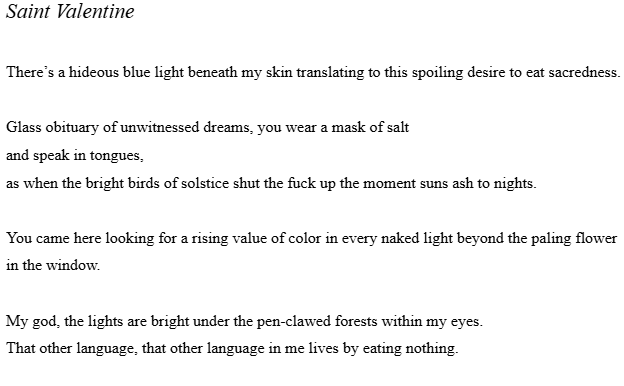
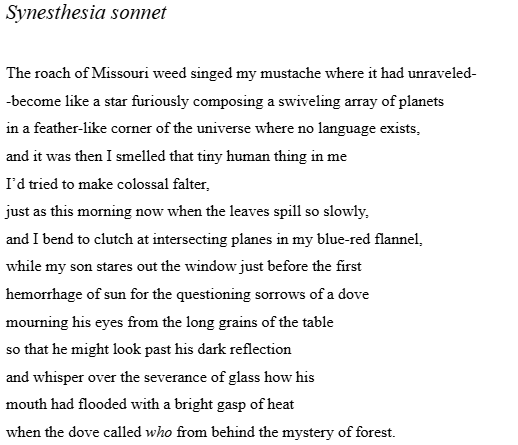
3 POEMS

By Red Danielson

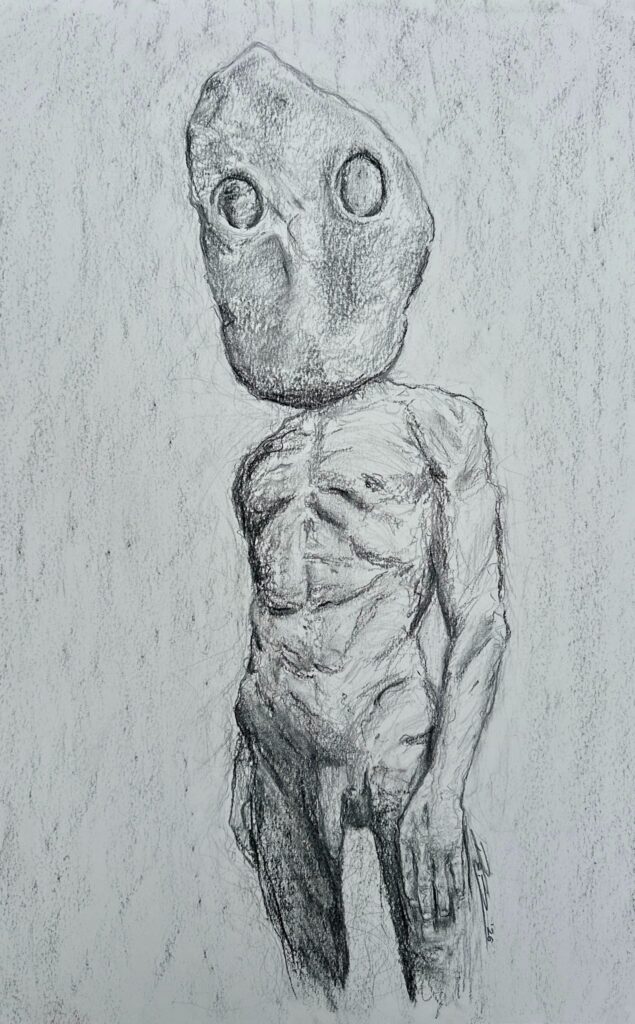
art courtesy of Red Danielson

Red Danielson is a self-taught painter and a graduate of the Iowa Writers’ Workshop. His work has appeared in The Iowa Review, Haiku Journal, The First Person, Haiku Presence, The Great River Review, Little Village Magazine, and River Styx, among others.

He has worked as a concrete mason, a framer, a heavy equipment operator, an arborist, and a grave digger. He lives in the English River Valley of Iowa.

Categories
Issue 6 Issue 6 Non-Fiction

WEEHAWKEN

By Andrea Georges Dolan

I moved to Weehawken on the evening of my 23rd birthday, celebrating in an unfurnished apartment with shitty boxed wine and a dozen stale donuts from Dunkin’. My roommate and I lived on the second floor of a triplex on 49th Street. The man who lived below us was a bassist who would play the same twangy seven notes on a bass that looked like it was fashioned out of plywood and scrap metal. Sometimes his girlfriend would be there, but they definitely hated each other. I once caught him kissing his girlfriend’s sister in the driveway and he glared at me as I quickly turned away from them and dashed to my car. It wasn’t my business, but at the same time I wasn’t going to plug my ears when I heard his girlfriend hiss you’re a FUCKING embarrassment before slamming the door behind her.

Above us lived a Tisch professor who would bring home his much younger female students. Most of them were obvious overperformers but all I could focus on was his silence while the bed squeaked loudly. I wondered if he really felt anything, but now I understand that it sometimes just feels nice to be next to a warm body, especially if she’s 21. On the nights during which he was alone, he would restlessly watch reruns of Law and Order: Special Victims Unit on full blast in his living room. I can still hear his heavy footsteps pacing above me. I can still feel the loud DUNDUN rattling through my skull in the late hours of the night.

Weehawken is where I started running. I still can’t definitively say why, for I was cursed with flat feet and even walking has always been somewhat painful. I never quite got the runner’s high, but there was something profound in the struggle. A body can really push through anything. Perhaps it was boredom. Perhaps it was a way for me to outrun my thoughts.

There are two levels to Weehawken: the upper cliffside along JFK Boulevard East and the lower Waterfront along the Hudson River. To get from one end to the other, one must traverse what is locally called The Steps of Doom. Covered in chewed gum and graffiti, the rickety steps zigzag their way down from The Boulevard to the light-rail station at The Waterfront, where I would take the train to The City. Sometimes I would purposely torture myself and run up and down The Steps—not for any particular reason, just to say that I could do it. Just to say that I could run through anything, even pain. Especially pain.

The rusted steel squeaked and rattled with each step, and looking down gave me such intense vertigo that I vomited hard against the top railing, but descending was far better than its counter. The pointed heels that I often insisted on wearing on nights out got stuck in the janky slats of The Steps, so sometimes I would run up barefoot and pray I didn’t get tetanus. Sleazy men could get a good peek at my ass if they looked up. A slicked-back guido might menacingly wink at me as I breathlessly trudged my way up the twenty flights of Hell. Touch me, I dare you, I’d think. I’ll stomp your fucking brains in.

Sometimes when I’d run along The Boulevard, I’d think about how the luxury condominiums that lined The Waterfront would be the first to go in a climate catastrophe. I was thankful to live up top along the cliffside; I could see the entire expanse of Manhattan from there. If I looked close enough, I could see the hideous H&M advertisements flashing from Times Square. Sometimes I’d wonder if The City could agree on the irony, but I soon realized that Manhattan is far too self-absorbed for introspection. Narcissus beholds his dazzling reflection in the Hudson.

Upside: Weehawken has the best view of The City.

Downside: Weehawken has the best view of The City.

Every evening around seven or eight, two E-EXPRESS TOUR charter buses would pull up along The Boulevard and out would pour dozens of tourists, cameras in hand, all ready to snap away at the perfect view of The City. Didn’t they know this path was mine? Didn’t they know they were in my way? I’d grunt at them as I shoved my way between excited conversations in foreign languages. They stood tall with their arms outstretched to mimic the great and glowing island behind them. I wonder how many photographs of their smiling faces feature my blurry, heaving, and sweaty body running just out of the frame, like a ghost. I liked to think of myself that way anyway—invisible, fleeting, haunting.

On longer jogs I concentrated on the sound of my breath. When my thoughts would travel, I could bring myself back to focus by listening to my breath. Grad school got ya down? Just return to your breath. Heartbroken, again? Just return to your breath. About to jump off The Palisades Bluffs and hope the Hudson River swallows you whole? Just return to your breath. Sometimes I’d run until I couldn’t feel my limbs. My feet thumped hard on the concrete, a stubborn skeleton crumpling with every burdensome step. A nightly cold compress held close to swollen ankles felt more empowering than painful. Just breathe through it, I’d tell myself as I rubbed Tiger Balm on my splinted shins.

Sometimes on my jogs I’d think about all the bodies that have been scraped from the bottom of the Hudson. Sometimes I’d think about my friend’s older brother who jumped off the George Washington Bridge just a few years prior, and would wonder why he left his shoes behind. The police said that was common. He was a runner, too. A track star, really. I remember him running backwards with perfect form on our high school’s track, as if he had pressed rewind on himself. I’d stare in awe in my dirt-caked Converse as his knees drove higher into perfect 90 degree angles. We all thought he’d be an Olympian one day. Now he’s just a name on a banner hanging in the school’s gymnasium. Immortalized at 22.

I remember when he would walk his sister and me to Blockbuster when we were kids and buy us a bucket of Butter Lovers microwaveable popcorn. He was always so quiet and focused. Sometimes I’d think about how his mom didn’t initially believe he was dead and maintained that he was only missing, even though the last inquiries he searched on the internet were how tall is the George Washington Bridge and how many suicides on GWB. “Not my son,” I imagine her saying to the police knocking at her front door. “He wouldn’t do something like that.” I remember the look of denial in her eyes during his wake.

On one weekend morning jog, I saw a dead body washed ashore by the condos at The Waterfront. I remember the horrified screams of the wealthy middle-aged woman wrapped in a light gray robe, her phone in hand to call the police. She hovered over the pier where the feet of the body could be seen underneath her. It was a cold morning, too cold for spring. I listened for my breath.

“Don’t come over here!” she warned, but I was curious. This certainly was not the first dead person I’d seen, but I had never seen one quite like this. Bloated and blue, face down. The dead bodies I’ve seen lay peacefully in lacquered coffins, their arms posed gently over their chests, their faces caked with costume make-up. I wondered what had happened. Suicide? Murder? A drunken casualty from the ferry? I tried again to listen for my breath but all I could hear were her screams. I kept running until I got to Hoboken.

Once after a long night of drinking far too much free wine at an office party in The City, I opted to take a cab home. It was significantly quicker and more convenient than my usual MTA to NJ PATH to Steps of Doom running route. The cab driver was an older man, maybe mid-to-late fifties, with a thick gray mustache and even thicker bifocals. I had been particularly conversational this evening, asking him about his job, his life. He told me he had buried his granddaughter a week prior, and that life was unnecessarily cruel. I couldn’t muster anything to say other than a meek I’m sorry.

What I wanted to say was that grief is an unpredictable monster, and that sometimes its giant fist wraps itself around your body, constricting your blood flow. Grief takes your oxygen and replaces it with lead. Grief will demand that you punish yourself, for it should be the only thing you feel. Grief pulls at the loose ends and unravels you.

But I didn’t say any of that. I only looked at his eyes fixed to the road in the rearview mirror.

On the other end of the Lincoln Tunnel we took the first exit toward JFK Boulevard. Around the curve, The City skyline came into view. Bright, expansive, and silent.

“Do you mind if we stop for a minute?” the driver asked. “I’ve never seen anything so beautiful.”

Andrea Georges Dolan is a writer from New Jersey, currently living in Los Angeles. You can read some of their other work at agdolan.com

Categories
Issue 4 Issue 4 Non-Fiction

GENERATIONAL GERMINATION

By Aubri Kaufman

Every time my three-year-old falls down, he tells me he “crumpled,” like, “I crumpled, mama,” and I hold back a laugh because I’m not sure where he learned the word. From me, I suppose, though in different context. He probably saw me ball up and toss some junk mail, crumple it, the way I saw my mother fold into herself over and over, creating irreversible creases each time. My son saw me cry last night, asked if I was okay. Asked if I’d like to jump up and down with him. Asked if that would make me feel better. I told him, yes, let’s jump together, and he laughed without reservation each time my feet left the ground.

When he saw that my still-puffy eyes hadn’t yet returned to the happy-crows-feet-mama eyes he knows well, he said, “You’re really sad, mama. Can I make you happy?” I pressed my lips to his forehead, told him, “That’s not your job, baby. Mama can make herself happy.” I listed things that make mama happy, to prove I knew how. To alleviate the burden. Coloring. Walking outside. Deep breaths. Things he understands, careful not to mention all the things he does to make me happy. Careful not to leave him feeling responsible.

Two days ago, he fell and cut his finger on the stick-like stem of our oregano plant. It’s a small cut, but the kind that peels back a layer of skin revealing fresh, raw skin underneath. We bandaged it up, kissed the wound, cursed the oregano plant, even though it wasn’t the plant’s fault. Now, he looks down to the healing cut. Band-aid removed, new skin acclimating to the air, turning color to match the rest of the finger. “Ouch,” he cries again. “It hurts, mama.” I try to convince him the wound is healing. It’ll be better soon. Probably by tomorrow. Soon he won’t even remember it happened. It’ll look good as new. He’s unconvinced. Tells me it hurts. I ask him if it hurts now, or if he’s just remembering that it hurt when it happened. His face crumples as he tries to determine the difference, and I realize I cannot explain the difference to him either. I realize maybe there isn’t one. I stop trying to make it better. I hold him while he hurts for as long as he needs me to.

Aubri Kaufman is the co-founder and co-EIC of Icebreakers Lit. Her work can be found in Pithead Chapel,trampset, HAD, Rejection Letters, and elsewhere. She’s on a bunch of the socials as @aubrirose and she totally wants to talk to you.

Categories
Issue 4 Issue 4 Non-Fiction

RUNOFF

By Ryan-Ashley Anderson

The Youngsville realtor had no answers when we asked why the trees at the edge of the woods bent sideways, why the puddles towards the back were neon green, or where the water came from that fed the pond across the street from our house. We were fine with not having answers because this was the only house my parents could afford, and it seemed like they were trying not to pick at a thing we could not change. 

This was the first house that either of my parents had owned, so it did not matter that the yard—camel-colored packed mud, dry and cracked as a sun-baked desert—would be impossible to seed; it did not matter that the house was too small and poorly made with paper-thin walls; and it did not matter that the neighborhood our house sat outside of was filled with people my mother had already decided we would want nothing to do with.

Our new house sat at the edge of Horseshoe Acres—the only real neighborhood in our town of 900—and Horseshoe Acres sat in a valley below the farmland that surrounded us. The town consisted of a single intersection and around that intersection sat everything a person from a town like this might need—a gas station, a diner, a Piggly Wiggly grocery, a video rental store, a small doctor’s office, a post office, a bank, and a small strip of three antique shops. 

While moving in, my mother got agitated by what she characterized as inappropriate attention from the neighbors. Curtains were pulled to the side, people stood on their back porches looking in our general direction, and cars seemed to slow as they passed our house.

“Don’t these people have anything better to do than to spy on us?” my mother complained.  “Haven’t they ever seen somebody move in before?”

“They’re probably just curious about us,” my step-father explained. 

“Let’s. Go. Say. Hi!” I begged between strained breaths while playing tug of war with my dog, Kentucky.

After a few days had passed and most of our boxes were unpacked, I convinced my parents to walk the neighborhood and introduce ourselves to all the people we wouldn’t be spending time with. I hoped some of these people had kids my age and that, once my mother met them, she’d realize they were fine and then let me play with them. I pulled on my shoes and fantasized about Friday night sleepovers—giggling over J.T.T. from Home Improvement, arguing about the proper way to sing the chorus of Hanson’s “MMMBop,” freezing each other’s bras like I’d heard some of the older girls talk about in Girl Scouts. I’d never had a real sleepover but I imagined they went something like that. In fact, I hadn’t really lived anywhere long enough to make real friends, and I was nervous. I wondered how I should act to make sure all the kids liked me, and practiced introducing myself in the bathroom mirror.

“Hi,” I said, hand extended for a shake, “My name’s Ryan, what’s yours?” No, that wasn’t right. Kids don’t shake hands. At least, here they probably didn’t. The last thing I wanted was for them to think I was some pretentious asshole. I did, however, want them to think I was smart. It was basically the only thing I had going for me. 

“Hey, I’m Ryan. Who are you?” No, that sounded lazy and rude and my mother would never let me hear the end of an introduction like that.

“Hi! I’m Ryan! Want to play?” No, no, no. That definitely went against the rule of not spending time with these people and I’d be opening a can of worms my mom would have to spend years sealing back up. 

“Hi.” That’s better. Be quiet, be small, be good. “Hi” wouldn’t get me into trouble. It gave nothing, asked nothing, and made no invitation. Perfect. I practiced saying hi with my mouth while pleading please invite me in to play with my eyes. 

Right before we left for the walk, my mother said, “Remember, don’t tell anyone here anything about our family. They are not our friends and don’t need to know our business.”

Just a couple door-knocks into our stroll and my mother’s suspicions were confirmed—those people were not our people and we were to do everything in our power to ensure they didn’t think we were one of them. Those people smoked in the house, watched television at all hours of the day, and let their kids run around barefoot. Those people kept their dogs chained up in the backyard (we would never do that to Kentucky, I thought), swore out loud, drank in front of their kids, and had bad teeth. My mom always told me that these were the kinds of things poor people did. And we weren’t poor. Poor kids ran around outside without shoes on. It was how they got worms, she’d said. And the implication was that we don’t get sick with the same kinds of things as poor people because we are educated; we know better; we are better. I saw lots of kids playing outside during our walk, the bottoms of their feet caked with earth. I felt bad for them. They probably had worms and didn’t even know it. I wondered if I should warn them. I imagined what it would feel like to have a pile of worms twisting around inside my stomach and was perfectly happy to do whatever I must to avoid that. My mom was already mad about how often I needed to go to the doctor and worms was definitely on the list of preventable ailments I’d be punished for.

*

When I was a baby, I had bad ear infections. So bad that the doctor wanted to do surgery. For whatever reason, the surgery never happened and I ended up with scars on my ear drums. As I got older, I had to be really careful. If I wasn’t wearing special ear plugs, I wasn’t allowed to get my head wet at the pool, for example. If someone splashed my face or I forgot and did a cannonball, I’d get inconsolably upset. I’d push my beach towel as far into my ears as I could, to get all the water out, but I’d often still end up with an ache anyway. I’d try to hide it from my mom, but she could always tell. For days during an earache, she would obsessively inspect my ears after baths and showers, making sure no water was left behind that might nudge the ache into infection territory and I let her, because an infection meant a doctor’s visit, and a doctor’s visit meant time off work, and time off work meant we wouldn’t have enough money, and that was a big problem because my mom didn’t want to be poor. 

By the time I was three, she was carting me back and forth to court-ordered physical exams and therapy appointments. Some stuff about my dad that I didn’t fully understand. Just that there were lots of stuffed dolls involved and, after it was all over, I wasn’t allowed to be alone with him again unless a legal chaperone was present. 

The year we moved to Youngsville, I’d also been diagnosed with a skin condition, lactose-intolerance, and some phantom digestion issue that made my body turn all my food into big, impassable lumps. I was on lots of medications for that. Laxatives that made me vomit, and pills for the heartburn caused by the vomit. And the worst part was that it didn’t even make things much better. I’d alternate between explosive diarrhea in the middle of the school day (often shitting my pants and needing my mom to bring me a change of clothes) and hours on the toilet at home, with a huge lump of shit sticking a quarter of the way out of my ass, crying and begging for it to pass. I really didn’t need to add worms to the list.

*

I was careful not to act too excited during our walk. I really liked everyone we met but didn’t want my mom to notice. She would have felt betrayed. She was a very “with me or against me” type of person. When their doors opened, I could smell how different our neighbors’ homes were from ours—smoky, warm, and sweet—and I could see how different they looked inside. These were not the homes of people who ate boiled chicken and broccoli every night for dinner and kept everything tidy and sparkling. No, these were clearly pizza people—people whose walls were covered with family photos, whose floors were covered in toys, who shouted dinner time into the void from the back porch at dusk each evening. Most of them were friendly and easygoing. I noticed they didn’t seem to think too hard about things before they said them, or worry much about what we thought. I wondered how I might be more like that. I wondered if I’d get a chance to learn.

Turns out, I would spend most Friday evenings at home, watching ABC’s T.G.I.F. programming block on my own or with my mom and step-dad. I didn’t talk to them about how much I liked J.T.T. because little girls weren’t supposed to think of little boys like that. My mom was already worried that I was too ‘mature’ for my age, so I just kept it to myself. 

*

We soon discovered that heavy rains made the pond across the street flood and push over into our yard where it then sat for days atop the unyielding clay before finally, slowly, finding its way back into the ground. We learned that the little creek in the far back would darken and swell and overtake that end of the yard, reaching toward the bent-over trees, making mosquito birthing grounds of my new favorite hangout spot. We stayed out of the yard and away from the woods when it was wet out. On dry days, though, the backyard was mine. Sometimes I’d lay across the crooked trunks at the edge of the woods, imagine my body was part of the tree, and wonder if it felt me there. On others, I’d crawl through the brush to explore. I liked to get far away from the house and pretend to get lost. I wondered if my parents would search for me and secretly worried that they wouldn’t.

While I was out there, I searched for the lime green, electric looking puddles. They seemed like the stuff monsters were made of, and something told me not to touch them. Instead, I poked at the greasy water with a stick and watched the oil make magic on the surface where large mosquitos sat, miraculously without sinking. 

*

That first summer, my mother became obsessed with growing grass. The days were made of endless trips to the hardware store where we could never seem to get enough grass seed, mulch, and fertilizer. We rented aerators and seed-spreading machines and the three of us—my step-father, my mother, and I—worked together like a solid little army, synchronized and determined to make something grow. While my mother used the aerating machine, I’d beat at the earth with a metal rake, and my step-father would follow closely behind with the seed-spreader. I helped by adding more seed when it started to run low, and after, we would take turns watering. By the end of the summer, our yard looked like it had been fitted with hair plugs. Grass grew frail and sparse and my mother made sure none of us walked on or cut it until it was strong. How long would that take, I wondered? 

On days my mother started drinking early—early enough that the sun was still high in the sky—I took advantage of her condition. I’d swear that, if she would let me play outside, I wouldn’t mess up a single blade of grass. I’d only walk on the dry spots, between the blades, I’d tell her, and then just hang out in the far back where it was all dirt and moss anyway and there was nothing to worry about me ruining.  

*

Even a couple summers into living there, I really hadn’t made any friends. Me and the other kids, we weren’t the same. But it wasn’t because of money—I’d realized by now that we were pretty much in the same boat as them, if not worse off—it was because I was a difficult kid with a difficult mother and other people’s parents just didn’t want to deal. The stomach issues were also a complicating factor. What was some other parent supposed to do when the neighbor kid got stuck in their only bathroom for hours? It was always just easier to be close to home if something wasn’t feeling right, so I spent a lot of time back there in the yard on my own. I’d talk to the trees or sit by the creek, looking deep down to see what was inside. Sometimes I looked so closely that I’d start to lose my balance. I’d imagine falling in and sinking down, deeper and deeper and deeper. I wondered if it would be cold down there or if, at some point, temperature starts losing meaning. I wondered if there were creatures and could have sworn I saw the long, thick body once of a prehistoric-looking snake.

I wanted Kentucky to hang out with me back there—something about having him around made me want to disappear less—but my mom said he had to stay up at the house on the chain, or in the garage. He didn’t know how to be careful with the grass, she said. But I’d get lonely back there talking to myself, so I started pretending that one of the weirdly-shaped trees was a person.

And I named that weird person-like tree Jonathan.

I was eight by this point. It was 1995. I was still watching Home Improvement and my crush on J.T.T. had grown into a bit of an obsession. Especially since his role as Simba in The Lion King the previous year. I’d cried desperately along with Simba when his father Mufasa was trampled in the wildebeest stampede and I wondered if knowing that would endear me to him one day.

So when I saw an advertisement for his fan club in a copy of Teen Beat Magazine during one of our trips to the Piggly Wiggly, I ripped out the page and pocketed it. I just had to join. At home, I emptied the piggy bank I’d squirreled a little cash and coins away in, stuffed the money into an envelope along with the entry form, put it in the mailbox across the street by the pond, with the flag up high, and awaited my personalized letter and fan kit from J.T.T. 

I started fantasizing about a life with him and imagined the reactions on people’s faces when I told them the story of how we met—Oh it was WILD! It all started with a fan club when we were both kids. We just started writing letters back and forth and, eventually, his parents flew me out to meet him in person and join them on set for the taping of one of the Home Improvement episodes. It was just…love at first sight…and it’s been happily ever after ever since.

I really thought it could happen. That this was how things did happen. That this was how little girls like me found a way out of towns so small they’d like to squeeze the life and dreams and future right out of you. 

I started spending time with tree J.T.T. in the afternoons, rehearsing conversations I imagined having with him in real life someday. At first, I’d sit across from him and talk ‘face to face.’ Soon, I was sitting against the tree, imagining J.T.T.’s arms wrapped around me. I asked him, between soft kisses, whether I should call him J.T.T. or Jonathan, and started rubbing my body against the bark. 

I was mostly hidden from view, but my heart raced and my palms slipped with sweat during intimate moments like this. I was terrified of getting caught, so I’d keep one eye trained on the back porch where my mom tended to sit, talking on the phone with friends and drinking wine after a long day. I knew that if she saw me, she’d stop allowing me to play out there by myself. I had a sense that I was damaged, and that everything she did was to keep the seams sewed up tight so none of that would ever spill out in front of other people. She was always talking to me about how important it was to be appropriate. She’d probably even take me back to the therapist, but I was too old to play with dolls now.

So I’d stand there quietly, secretly, hidden just out of view, and coo, “J.T.T., oh, J.T.T., I’m your biggest fan. I love you, J.T.T.,” while grinding against the tree’s rough, bark-covered trunk, “ … and I think you could love me, too. You will love me, too. One day. You’ll see.”

Ryan-Ashley Anderson is a conceptual artist and writer from the rural South. She has publications in X-R-A-Y and Icebreakers among others, work forthcoming in Rejection Letters and Vlad Mag, and is an editor at Pool Party Mag. Anderson is currently writing a memoir about sex work, the patriarchy, and belonging, and pursuing dual masters degrees in critical studies and art.

Categories
Issue 4 Issue 4 Non-Fiction

A LITTLE PATIENCE

By Aaron Burch

“Remember,” Mr. Dye reminds your class. “You should start thinking about what song you’re going to perform for your final.”

Your classmates groan. They sigh. They respond the primary way a room full of kids on the brink of teenagerdom respond to almost anything said by an adult.

“We don’t have a final paper or test,” Mr. Dye continues. “Just practice your performance. And remember, you need to turn in typed up lyrics as part of your homework. There shouldn’t be any curse words or anything else that wouldn’t be allowed on the radio.”

You wonder what he means by that “anything else.” What else other than curse words aren’t allowed on the radio? What else might disqualify a song?

You also wonder who actually needs the reminder. You’ve been thinking about it for weeks.

After school, you close yourself in your room and again listen to all your Weird Al tapes, over and over and over, trying to find just the right song. You listen through “Weird Al” Yankovic in 3-D and you listen through Dare to Be Stupid and you listen through Even Worse. You lay on your bed and close your eyes and mentally note the pros and cons of performing each song; you get up and stand in front of the full-length mirror hanging on your closet door and sing along, watching what you look like with each. “Eat It” or maybe “I Lost on Jeopardy,” “Like a Surgeon” or “Fat” or “I Think I’m a Clone Now.” You keep listening and considering, relistening and reconsidering.

You’re worried which song performance will lead to the highest grade. You’re also worried someone else might do the same song. You’re really worried someone else is going to do the same song and do it so much better. But, more than any of that, you’re worried about which song will least likely embarrass you and/or most likely make you look cool, two ideas that sometimes overlap and sometimes don’t but are always, together, at the core of your being. 

You’re shy, but maybe more than anything, you’re self-conscious. Your shyness and tendency toward indecision are borne largely out of a fear of doing or saying something stupid or, even worse, wrong. You are so scared of having a wrong opinion, of liking something that everyone else knows isn’t cool, or not liking something that obviously is. How does everyone else know what to like, what clothes to wear, what music to listen to? You know enough to be embarrassed that you like New Kids on the Block, but not enough to know who you should like instead. 

A couple of months from now you’ll overhear a couple of the other kids at your bus stop raving about some new tape by someone or a group or something called Candyman and so the next time you go to Wherehouse Music with your dad you look through everything until you find it, flipping through pop and rock and finally finding it in rap. Ain’t No Shame in My Game by Candyman. You’ll buy it, having no idea what to expect and even still it isn’t what you expected. But, apparently, it’s what people are listening to, so you keep listening until it grows on you, until you’re ready to overhear others talking about it so you can chime in. You’ll never overhear anyone mention it again. 

You wear cardigans to school, which seem dressier than what anyone else at your junior high wears and you feel like you stick out but that’s what your mom buys you when she takes you school shopping and they seem nice when you try them on in the store. You don’t have any other, better ideas. You get excited for new clothes, like you’re presenting your best self and isn’t that what everyone’s trying to do? You wake up early to put a lot of mousse in your hair and try and get it just right…but it never looks just right, and it doesn’t look like anyone else’s, all these kids with their parted straight hair and you with your curls that your mom and grandmother say are gorgeous, they say girls would kill for, they say you’re going to have so many girls you’re going to beat them away with a stick, but that very much isn’t the case, no girls ever tell you they’d kill for your hair, no girls even come close enough that you’d be able to touch one with a stick, but less so many of them swarming to the point where you need to fend them off. You roll your eyes and wish your hair was straight and would just part in a wave to the side like everyone else’s.

You look through your tapes, looking for anything else that might fit. 

Novelty songs, you remember Mr. Dye saying. Novelty songs work especially well for this.

You wonder, for the first time, how Weird Al came to be almost the totality of this genre, all by himself. 

“Any ideas for novelty songs for me to lip sync for my class?” you ask your parents.

“What about Kermit the Frog singing ‘It Ain’t Easy Bein’ Green’?” your mom suggests.

You roll your eyes. Rolling your eyes and sighing and mumbling “whatever,” or being a sarcastic Smart Alec, is becoming one of your most common reactions to your parents. 

“I love that song,” your mom says. “It’s so sweet.”

What is your mom thinking? You don’t want to be sweet. She doesn’t know anything about being twelve.

You go back to your room, close your door, lay on your bed and keep brainstorming. 

Mr. Dye says he’s going to take volunteers until no one volunteers and then he’ll have to just start calling on people, until everyone’s had their turn, and then the semester will be over. You don’t want to get called on, but you don’t want to volunteer either. You really want to go somewhere in the middle. You want to blend in. Well, you want to stand out for doing a great job, but not too much, and definitely not for the wrong reasons. 

No one volunteers at first and you feel your whole body—your fists and your arm and leg muscles and your teeth and your neck and your chest and your brain—clench. Is Mr. Dye going to have to call on people the whole time? Am I going to end up getting called on first?? You wonder who would possibly ever volunteer to go first. And then one student raises their hand, and then another. 

Please don’t do my song, you think to yourself as every student walks to the front of the class and waits for Mr. Dye to hit play. Like a mantra, telepathy, a prayer. Please don’t do my song, please don’t do my song, please don’t do my song.

No one does a Weird Al song. No one does any kind of novelty song at all. Not the first volunteer, not the second, not any of your classmates who go that first day. Not anyone on day two either. 

At first you watch, thinking they’ve all made a misjudgment. Hadn’t any of them been at parent-teacher night? Hadn’t Mr. Dye told you all what kind of song worked best? It was like he’d given you a sneak peek at the final exam and you had to look up all the answers on your own, but you knew the questions. Why would anyone not follow a suggestion given by the teacher, the person who would be giving you your grade? But then, as you watch classmate after classmate perform popular, Top 40, non-parody songs, you realize you’ve made the misjudgment. You’re going to seem silly. You’re going to look like a little kid singing this dorky joke while everyone else has chosen a real song. You wonder if it’s too late to change. You’ve already turned in your lyrics but maybe you can talk to Mr. Dye, maybe you can explain your mistake, maybe you can quickly find and memorize and type up the lyrics to a real song, before you make a fool of yourself. And then Mr. Dye calls your name and it’s your turn and you stand up out of your desk and make your way to the front of the classroom, dreading what’s about to happen. 

Ten, twenty, thirty years later, you won’t remember what song you ended up choosing and performing. You’ll remember all the practicing and choosing one song and then changing your mind and choosing another one and practicing anew. You’ll remember typing up lyrics on your family electronic typewriter, with its little display that would show a couple of lines at a time, saving it all onto some kind of typewriter hard drive, and then printing out the whole thing all at once on command. You’ll remember listening to the song over and over and over, typing as you listen, rewinding your tape every twenty seconds or so before it gets too far out ahead of you. You’ll remember how typing up the lyrics like that helped you memorize them even more than all your practicing, and also how it reminded you—at the time, and will still remind you all these years later—of one of your favorite episodes of Growing Pains from a few years before. 

“Reputation.” Mike Seaver—played by Kirk Cameron at the peak of his popularity and charm, long before he starred in the Left Behind series; before, in fact, he’d become a Christian at all, converting midway through the height of his career on Growing Pains and beginning to insist that storylines be edited to remove anything he thought to be too adult or inappropriate—had gotten to the point of being in danger of failing the class, so he’d stayed up all night writing notes on the soles of his shoes. In class the next morning, Mike sailed through the test, knowing all the answers, not once needing to look at these two cheat sheets on the bottom of his feet. After the commercial break, the teacher gave back everyone’s graded test, announcing with total surprise that the best grade had been received by none other than class slacker. Mike Seaver. Mike jumped up out of his seat, did a little dance, high-fived the classmates sitting around him. Sitting back in his seat, proud of himself for doing so well on a test for once, Mike leaned back in his chair and put his hands behind his head in a perfectly 1986 sitcom way, and kicked his feet up onto the desk of the student sitting next to him, putting his night’s work on full display to the teacher and the camera. Cue the studio audience gasps, cut to commercial. 

You’ll remember that not one other person did a goofy or funny or parody song, though you won’t remember what they did do. You won’t remember if anyone did Janet Jackson or Mariah Carey or Madonna; it seems unlikely that anyone did “U Can’t Touch This” or Faith No More’s “Epic,” because surely you’d remember that, but it’s possible; they were both huge songs that year. 

You’ll remember only one performance. Matthew. 

Matthew sits in the back of the class. He’s a year older than you, has long, almost shoulder-length hair, a little like Ethan Hawke in Reality Bites, though that’s still four years away, or maybe like Kurt, though you don’t know who that is yet, you haven’t heard of Nirvana, you have no idea Bleach came out last year. Matthew’s hair hangs down, veiling his face, as if hiding him away from Mr. Dye or anyone else who might notice he isn’t paying attention.  

When it’s his turn, when Mr. Dye finally calls his name, having run out of volunteers, Matthew slumps and sighs like he can’t believe he has to do this. Did he think he’d just somehow never get called? 

“Matthew, I don’t seem to have your homework with the lyrics anywhere here,” Mr. Dye says, looking around his desk, through his stack of papers.

“Yeah, I didn’t get to that,” Matthew replies.

“Well. How are we going to fix that? You can’t go unless I can look over the lyrics first and have them to follow along, and you can’t pass the class if you don’t do this assignment.”

Matthew shrugs and then starts digging through his backpack down at his feet. Everyone in the class is quiet, watching, wondering how this is going to go. 

Matthew pulls his Walkman and then a cassette case out from the bottom of his backpack. He takes the tape out of the Walkman and opens the case and pulls out the liner notes and walks both up to give to Mr. Dye. 

“You’re gonna faaaaaail,” Matthew’s buddy says, chuckling at himself, laughing like his buddy having to repeat the eighth grade is the funniest thing he’s ever heard. Mr. Dye looks at him and shakes his head.

Matthew’s buddy stops and the room is silent, everyone watching Mr. Dye reading the small-print lyrics that Matthew has pointed out in the unfolded cassette tape liner notes.

“What are these asterisks?” Mr. Dye asks.

“What do you mean?” Matthew gets closer, looks over Mr. Dye’s shoulder at where he’s pointing. “Oh. That’s just whistling.”

“Are you sure? There aren’t going to be any surprises, are there?”

Matthew shakes his head. “Just whistling. I promise.”

Matthew puts the tape into the class boombox and rewinds it back to the beginning of side B.

“Let me know when you’re ready,” Mr. Dye says.

“I’m ready.”

Matthew doesn’t look ready. He’s in the middle of the front of the class, where you all stood when performing your songs, but he’s just standing there. His body is slack; he doesn’t look nervous or excited. He looks bored.

Mr. Dye hits play and there’s seconds of silence while you all wait for the song to start. Matthew does that thing where he reaches up and grabs his hair and pulls it back out of his face and then lets go and it falls right back to where it was. Someone on the tape says, “One. Two. One, two, three, four…,” and it’s startling, this break of silence, like you’d forgotten what you were waiting for, why everyone was quiet in the first place. Then an acoustic guitar and Matthew starts swaying, subtly but perfectly, and somehow you realize Matthew had mouthed along to the counting, so casually you hadn’t even noticed at first, but also purposeful and natural, like he’d known exactly how many seconds of silence there was going to be, like he was in fact counting down to the song starting rather than just mimicking.

Some whistling joins the acoustic guitar—the asterisks!—and Matthew purses his lips and closes his eyes and keeps swaying. You think about all that time you spent practicing in front of your mirror, figuring out what to do with your body, your hands. Not quite choreography, but almost. You overenunciated every word, overemoted every lyric, thinking that was the goal, that would be how everyone knew you were doing a good job. Meanwhile, Matthew doesn’t look like he practiced, he kind of doesn’t even look like he’s doing anything at all, but it looks so much… better. There’s almost a minute of whistling and acoustic guitar while Matthew sways and lipsync-whistles, and it’s mesmerizing.

Shed a tear cause I’m missing you…

You finally recognize the song as Guns N’ Roses’ “Patience,” and then Matthew’s swaying back and forth makes even more sense than already just looking natural and perfect. It’s that Axl sway. You’ve seen the music videos—“Welcome to the Jungle,” “Sweet Child O’ Mine,” “Paradise City.” You usually flip past them when they’re on, but sometimes you watch when your parents aren’t around. You find them curious but you don’t really get it; you group them together in your mind with all the other hair metal bands—Poison and Ratt and Cinderella and Mötley Crüe. All these bands that have long hair and wear makeup but also their album cover art feature snakes and skulls. You find it all silly, but also confusing, but also dangerous and kind of scary. 

Next year, Guns N’ Roses will release Use Your Illusion I and Use Your Illusion II on the same day, and they’ll be huge, but then a week later, on the very next record release Tuesday, Nirvana’s Nevermind will come out, a week that will feel like a clear demarcation of before and after. Two entirely different eras. 

At the end of that school year, one of your friends will write “Guns N Fuckin’ Roses!” in your yearbook and you’ll be shocked, at both the language and the sentiment. You’d thought they seemed silly and then passé, like you’d been too young for them, and then immediately too old. You’d assumed everyone your age thought the same. You didn’t think anyone you knew listened to them. You’ve never talked with that friend about them. You’ll take a black marker and cover up “Fuckin” so your parents won’t see when you show them your yearbook.

Said woman take it slow, and it’ll work itself out fine. All we need is just a little patience…” 

It doesn’t seem like a Guns N’ Roses song, and it doesn’t seem like a junior high Public Speaking class lipsync assignment performance. It’s a long song—almost a full six minutes of acoustic guitar and whistling and power ballad singing and it feels as long as it is, it feels like it lasts forever, but you’re never bored. You’re hypnotized. You kind of want it to last forever. 

And then it ends. Matthew stands there, finally still, no longer embodying the song. 

Matthew walks over to Mr. Dye and takes the tape and the empty cassette case and the liner notes with the lyrics and the asterisks and puts them all back together. He walks back to his desk and you turn around a little, trying not to stare or make your admiration and the awe you’re in too obvious. You watch him slump back down into his seat and drop the tape back in his backpack and then the bell rings and class is over and the school day is over and it’s time to go get on your bus and head home.

Aaron Burch is the author of A Kind of In-Between and Year of the Buffalo, among others, and the editor of How to Write a Novel: An Anthology of 20 Craft Essays About Writing, None of Which Ever Mention Writing, and the journals Short Story, Long and HAD. His next book, TACOMA, is forthcoming from Autofocus Books. He’s online lots of places, including here: www.aaronburch.net

Categories
Issue 4 Issue 4 Non-Fiction

WILTS

By Corey Lof

Wilts saw the ocean for the first time when he was twenty-six. Thank you, he said. We were on the Oregon coast where a waterfall was coming off the cliffs, landing on the beach and running through a spiderweb of trenches to the shoreline. The sun had set and what was left of the light had turned the waterfall, and everything really, the rocks, the sand, us, the ocean, translucent and purple.

Thank you, thank you, he said, breathing like he wasn’t sure he would ever get to do it again. I half expected to turn around and find him facedown making angel shapes in the sand, like he was talking to God, or the earth or something. I hoped he wasn’t talking to me. I wanted to be riding around on Aprhi’s shoulders in the shallow, taking selfies. I didn’t want to be credited with whatever Wilts was experiencing. I ignored him, but he kept saying it. Thank you. Thank you for bringing me here. 

It was always like this with Wilts, we’d be doing something normal, like getting gas or watching an ambulance tend to a car wreck, and Wilts would experience some profound depressive episode. It was nothing to be jealous of, but there I was. I wanted to push him over into the sand, fill his mouth with it. 

Man, thank yourself, I said. You pitched on gas too.

The second time Wilts saw the ocean he almost drowned. We were burning driftwood on a campsite in northern California, surrounded by long beach grass. The sand was cold and the air was a thick, salty mist. The moon never rose and so turning away from the fire basically left you blind. 

You go swimming? Aphri said, looking over my shoulder to where Wilts stood, soaked and shivering, with some girl in his arms. He kept grabbing her like he was checking she was there. They bashed their foreheads together and panted in unison.  It was obvious, whether he saved her, or she saved him, or they’d just tripped into a puddle together, Wilts saw it as a cosmic sign. The universe was always telling Wilts that this was it, he’d arrived, and it always ended with his heart looking like sidewalk vomit. 

Who the fuck is that? Aprhi asked. 

The fire flashed in the girl’s wide eyes. She pet Wilts’ chest, looked up at his chin. 

The three of us had been staring into the fire since before dark.

We hadn’t even noticed he left. 

He moved into the girl’s van and the next time Aphri and I saw him was in Hollywood. Though he disappeared early that night too. Aphri borrowed then bled on Wilts’ only nice shirt while in a friendly fist fight over a flowery necklace given to us by a homeless man.

It was me who punched him.  

I got into it with Aphri twice that night. 

Later, while Wilts was asleep, or wandering all woebegone through the Hollywood streets, Aphri warned me against going behind a bar to smoke weed with a black guy who had neck tattoos, so I called him a racist and he smacked me in the face and told me a story about how he was robbed at knifepoint in Guatemala. 

I said, I wish I had a knife, I’d take you for everything you got. 

What did I tell you about threatening me with violence? he said. I’ll whoop your ass.

I dumped what was left of my beer in his lap and took off while he was still trying to figure out what happened. 

But I was so unaccustomed to being alone, I didn’t know what to do. I ended up in some bushes, just off the Boulevard, with my pants down. I thought I might jerk off, but it was hopeless. The mood wasn’t right. I don’t know what I was thinking. Parts of my life were slipping away so fast it was as if I never lived them. Maybe I was hoping to get more time with them. Maybe I thought I’d get that time while in prison as a sex offender. I don’t know. But that was me there, bare ass in the mulch, hand on my soft dick, scrolling through old photos on my phone of all the people I loved and never told.

Wilts told us he was leaving for good one night in a dry lakebed outside Boulder, Nevada—the Boulder no one talks about, that consists of a laundromat and mechanics shop and not much else, the one I’d confused for Boulder City, Colorado and for years wondered what all the hype was about. 

We pulled off the road, into a dry lakebed and drove in circles as fast as we could until we lost interest when we realized that was the extent of it, circles. There were no giant cracks or other worlds for us to fall into. No one was chasing us, no one was watching. 

We parked, dug a hole to protect our fire from the wind, ate mushrooms and stared blankly into what was a bleak, album cover sort of horizon. 

When the sun set, Wilts, Aphri, and I wandered around the dry lakebed in the dark. Wilts had my guitar with him. He plucked the odd low note and let it ring out. Eventually we laid down. 

That’s when Wilts told us he was leaving. He laid on his back and looked up at the sky and spoke to us as if he were telling us he was going to die. Again, that’s how he was. His tone always terminal, his sentences always punctuated with deep sighs of resignation. He spoke of love and chapter endings, new beginnings, and a whole bunch of other shit I was embarrassed to even hear. 

I gave him a hug and told him we’d miss him but other than that, I stayed quiet. I didn’t want anything I said to betray the fact that I saw this as a non-event. There was no great sense of beginning or end. Wilts was leaving. I always knew he would. It was clear from day one, when Teo left and Wilts replaced him, that he couldn’t hack it. Not on the road, not with Aphri and me. He was too open and too sticky. Everything we passed became a part of him, yet the crucial pieces of himself, the ones that stand you up in the morning or stop you from tripping backwards into your own head, those he’d just let fall out wherever he happened to be or he’d give them away. 

There was never a choice. Not for him. He was always going to leave. 

I’m surprised he lasted this long.

He asked me if he could take my guitar and since I wasn’t playing it, and I said, Sure. If you got fifty bucks.

It was a fluke that he’d ended up in the van to begin with. Years ago, I was sitting in the park in Toronto with this girl I’d started seeing even though I was about to leave town, when Wilts called. I hadn’t spoken to him in months. I remember thinking, is this really something I feel like taking on? The shortest phone calls with Wilts could leave me with an overwhelming sense of guilt and a deep pain in my gut. He had the power to both brighten the world, bring it into clarity and at the same time make it feel hopelessly out of reach. 

I sighed a sigh I learned from him, one of his deep, what difference does it make, sort of sighs, and answered the phone. Hello? 

He was silent for a while, then all he said was, I see you.

He was right there, right behind me in the same park, somehow wearing on his face every possible implication of the time past between our seeing or speaking to one another.

I told him I was leaving and he said, Can I come?

It’s only ever a matter of gas pitch, I said.

But I still wonder, what if I didn’t answer the phone? What if he’d seen me screen his call? Would he still have approached me, still have had me turn around? 

Years later, after Wilts had come and gone, I ended up back in Toronto for a stint, more or less squatting in his apartment, while he tended to another broken heart in the safety and comfort of his childhood home. 

I’d been to the apartment once before, when his girlfriend still lived there. I remember being amazed by how full of life it was, how full of stuff, creamers and sauces, photos stuck with magnets to the fridge door. They had cactuses and clay cats and little glass bottles lined up along the top of the door trim. They had little things lined up along any little thing that jutted out from the wall, really, anything that resembled a shelf. Coffee cups with sailboats on them, pictures of people at weddings. 

But now that she was gone, the apartment was barren. All the life that I’d seen was hers. He’d just been clinging to it, calling it his own.

The next time I heard from him was a few years after that. 

I was back in Toronto, waiting for my car at a mechanic shop. He sent me a message saying he had all his stuff and nowhere to go. Not a clue. He said his most recent breakup happened to coincide with his landing on the wrong side of a line drawn in the sand by his mother after his father’s death. He said, I don’t really want to get into it.

He said, But I hear you’re in Toronto. Me too.

I was living with the woman that would become my wife, that with more time, would have our child, and live quietly with me in a life most would call normal—and I guess what I’m really wondering is if that sort of normalcy can find me in time, then why not Wilts? 

I knew he would be a terrible house guest, that he’d permeate our entire four-hundred square foot apartment with his incurable melancholy, but I’d already answered the phone. 

Where in Toronto? I said, and immediately spotted him across the street from me, a hopeless lump slumped over a rolling suitcase. He still had my guitar.

He stayed on my couch for two weeks. My wife—my then girlfriend—worked at a bar and so we spent most evenings on our own, Wilts and me, getting stoned and showing each other music on YouTube. Between songs he told me of his plan to fly to California and win back the last girl—in an endless string of girls—who’d broken his heart. 

I was working on my own at the time, turning people’s tiny, unfinished basements into illegal apartments, with six-foot ceilings and windows you couldn’t fit a basketball through, if any. So, on the day of his flight, I took the morning off. We had breakfast together at a diner and over cheap coffee and eggs Wilts sighed and went through his plan with me one more time. He would post a photo of himself on the coast in a place of romantic significance for him and his ex, then wait until she saw it and came to find him …

Pulling away from the airport that morning, I cried like I’ve never cried for my own life, like it was my mother’s heart he carried around in his chest.

I mourned Wilts’ death years earlier, while still in his company. He didn’t need to tell me he was suicidal. I mean, he did, on several occasions, but he didn’t need to. It was obvious. And it didn’t take much for me to accept it as an inevitability.

I was in no shape to help him. 

We lived in different worlds. 

His every breath was the result of a war being waged inside him—you could hear a village burning when he opened his mouth—and there I’d be, standing right beside him, feeling nothing, staring at a shoe.

I was his friend. 

I answered the phone when he called. 

I say all this, but he might not even be dead. Maybe he hasn’t done it yet. Maybe he won’t. 

At this point, I wouldn’t know. 

It’s been years.

Corey Lof lives on an island in the North Pacific with his wife, son, and many animals. His writing can be found in Hobart, Vlad Mag, Rejection Letters and several other places online. He would like to acknowledge that the first 300 words or so of Wilts was published as a flash by Back Patio, under the same title, in 2022. (@coreylofsatwit)

Categories
Issue 2 Issue 2 Non-Fiction

NÜ METAL GOSPEL

By Caleb Bethea

The world record book was full of nü metal bands. I wouldn’t know that term for another twenty to twenty-five years, but I knew the bleached spiked hair, the goatees, the lip and eyebrow piercings, the feeling that God was disappointed in me. I couldn’t tell you what their records were but I can tell you they played on 93.3 The Planet in our room as we read the world record book. There was a man with the world’s longest fingernails and another with something like seven hundred cigarettes in his mouth. There was a bald man wearing sunglasses with his arms crossed hanging from hooks in his flesh. Linkin Park and Deftones made the audio equivalent of smoke in the room. A radio voice promoted a club, “18 to party. 21 to really party.” Those were the years I vaguely learned about sex.

Putting the pieces together from what I heard from summer camp, my brother, some of the movies my parents let us watch when they forgot about a few scenes, I developed a sense of dramatic irony with the grown world. Knowing that sex existed when they didn’t know that I knew. It could’ve been fun, but it really just made me feel like I was cobwebbed with dried sweat. And that’s how I felt in the years after, not sleeping, thinking about God and how it would make more sense if he sent me to hell but thanking God he made his son bleed for me instead, piece of shit that I was. World record sinner. I was eleven or twelve by then and the radio was replaced with a short-lived MP3 player made by Dell, 512mb of mostly Linkin Park songs—the MTV mash-up tracks with Jay-Z too—and I’d listen to the screaming in my ear about becoming nümb and think about how Jesus had to be executed for me.

Hell, I even took that Jay-Z line, “Look what you made me do/ look what I made for you…” and imagined God saying that I made him kill Jesus even though he made a whole world for me. And just like I would eventually piece together that these lyrics referred to Jay-Z’s dominance in the record industry and were not to be used as a parallel to the voice of God, I would learn that I wasn’t such a piece of shit after all. The ones who taught me that should have been reading the world record book instead. I recommend the largest tidal wave ever surfed or the smallest frog on the planet.

The nü metal plays out of my phone now. I mostly don’t like it. I listen to it all the time. It puts me back in a room with a kid who’s learning to loathe himself. And I’ve got some headphones we could share. 

Caleb Bethea is a writer from the Southeast. They earned an MFA at UofSC and now spend the best of their time with their wife and three goblins by the ocean. You can read their work in HAD, Tenebrous, Ice Breakers, Maudlin House, hex, Twin Pies, autofocus, and elsewhere. They tweet at @caleb_bethea_

Categories
Issue 2 Issue 2 Non-Fiction

YOU FIND YOURSELF AT TWO LAKES IN JUNE

By Kirsti MacKenzie

Lilac rot and dirt roads 

Knew you were an afterthought because the text came late. Your apartment building is built like a bunker, made of concrete. Frozen in winter, baking in summer. Top floor. June heat rises shimmering on the road below and it’s not even noon. Every window open in the place, hoping for a breeze heavy with rotting lilacs. Lazy church bells across the street. You lay in bed til noon on weekends because you’re lazy, too. Sometimes hungover. Sometimes nursing rotten guts. 

L—’s name on the iPhone. 

My birthday. D—’s camp. Come party? 

Nothing else to do. 

Sure what’s the address 

Freedom is beating down a dirt road in summer time. Bikini strings tickling your skin. Towel and a bottle of rye in the back seat. Barefoot on the gas, sliding just a little where the road curves. Gravel pinging under your shitty old car. Blaring Because of the Times on your blown-out factory speakers because it’s summer and you’re bored and there are boys at the lake. Boys that stuck together since grade school. Boys that throw parties. Boys that keep girls in their orbit like gently rotating moons. Sweet, stupid boys whose heads turn when you roll down the drive toward camp. 

You hear them when you kill the engine. 

“Shit,” D— says. “Is that K—?” 

Keg stands and sour patch kids 

Somewhere in the middle of the keg stand you realize. Fingers wrapped on cold metal, two of the guys on either side. C— and G—. Their hands grip your thighs, your calves. When they lift you, your shirt falls down, revealing the soft skin of your stomach, your bikini top. B— jams the spray nozzle in your mouth and the boys holler, shouts bouncing off the garage walls while you suck back as much shitty Molson as you can, trying to focus, focus, holy shit are my tits gonna fall right out here, holy shit this beer is bad, holy shit why this song of all songs, holy shit stop looking at my stomach, holy shit this beer is bad, holy shit keep going, don’t pussy out, holy shit I’m drunk, holy shit that means I’m gonna end up in someone’s bed, holy shit you wouldn’t be here unless that was the plan, you absolute dumb ass— 

“Jesus,” B— says. “She’s still going.”

You push the nozzle from your mouth and gasp. Roaring, the guys let you down. G—’s hand lingers a second or two on your thigh. They hold you steady while the blood rushes down and the booze rushes up. 

“You okay?” C— asks. 

“Why the fuck,” you say, staggering, “am I chugging to SOFI Needs a Ladder.” 

Cedar sap and bad tattoos 

They rot you because you have a Finnish last name and you can’t handle top bench. Maybe eight in the sauna. Six guys, two girls. You and G—’s girlfriend. Sweating like hell but you can’t smell it, the sweat. Smells of spruce, instead. Maybe cedar. Something sweet and woodsy, sap bubbling from cracks in the wood. Window on the right, full of a sunset bleeding into the lake. D— tosses water on the stones. Breathe deep, exhale. 

“What’s that,” says D—. 

He traces your lower back with the ladle. You jump. 

“That,” he says. 

“Got it when I was eighteen,” you say. “I forget it’s there.” 

“I can tell,” he said. “It’s contrived.” 

D— doesn’t have any tattoos, far as you can tell. Has a dad body at twenty-six, though. His family is rich, they own the camp. Most of us grew up on lakes. The ones that couldn’t afford to own, rented, or visited friends and family. Yours visited family, then rented, then owned. Sauna and three bedrooms and a wraparound porch. Things you took for granted til you were old enough. Things you still take for granted. 

“Enough,” C— says from the top bench. “I’m headed in.” 

Everyone tumbles after him to the lake. Soft sand, shallow surf. You can run a ways before you have to dive in. Little weedy, in parts. The guys shout as the cold meets their hips. You and G—’s girlfriend stretch your hands, dip below the surface. Almost lose your bikini bottom. Stand and re-tie the strings at the curve of your hip. 

“She looks good,” you overhear someone say. L— maybe, or D—. 

When you peek at them you see G— staring at you. Hungry, kind of.

G—’s girlfriend surfaces next to you with a gasp. 

Your hands at your hip. His eyes on them, just a beat too long. 

Prednisone and warm Coke 

You look good because your guts were rotten. Autoimmune thing. Lost twenty pounds. Sick maybe fifteen times a day, not sleeping. Prednisone and warm Coke cured you. Last weekend you were at another camp, the lake you grew up on, the lake that felt like home. Nana wouldn’t let you rot alone in town. Five-foot-nothing and stubborn as hell. 

“I’ve got a bed made,” she said. “You’re coming.” 

East Loon is a half-hour west on the 11/17. Before you get there you’ll pass the Terry Fox lookout and the KOA campground and Crystal Beach Variety and the fish shop and the amethyst shop and the fish-and-amethyst shop and the power lines and the power lines and the power lines and the truck stop across from Sleeping Giant Provincial Park. If you’d been driving you’d have stopped for penny candy, but you weren’t driving. Great Uncle Jer drove you to camp in his old green Ford. 90km/hr on the nose. Transports and pickups screaming by when the opposite lane was clear enough to pass. 

“New highway’s gonna be divided,” he said. “Saves lives.” 

Cross the tracks and a mile down the road. Lupines blooming, birch trees with shimmering leaves. Lazy monarch butterflies baking in the dirt. He went slow so they had time to flee his tires. Over the bridge. First glimpse of the lake, blinding in the midday sun. Turned across from the ball park, across from the tennis courts. Rolled to stop at the stone path leading to the camp. First stone said DR. STITT, GYNECOLOGIST; old joke. Great Uncle Jer was a dentist. Nana greeted you on the deck. 

“Jesus Christ,” she said, pinching your shrunken waist. “Look at you.” 

“They gave me pills,” you said. 

“Good,” she said. 

They left for a poker tournament so you had the place to yourself. Nana left soup and warm Coke because, she said, warm Coca-Cola is the only thing that fixes tummies. You got sick and laid on the floor of the bathroom for a while. When you felt better you got up and wandered around the camp, taking pictures of everything like it was the last time. Fishbowl full of jelly beans. Ancient piano keys. Dusty knickknacks lining the sunroom window sills. Pegs on the cribbage board. Foot stool held up by two stuffed feet in white tennis shoes. Canoe paddles with smiley faces spray painted onto them. Old tennis rackets nailed to a fence.

Washed your pill down with warm Coke. 

Fell asleep on a deck chair, index finger jammed midway through Keith Richards’ Life. Woke up as though you’d never been sick. Fucking miracle, that.

By the time you made it to D—’s you’d been cured for a week. Stupid to do keg stands, with guts that rotten. But who isn’t stupid at twenty-five. 

Cold pizza and assholes 

Empty keg and the boys chase the girls from the garage down to the shore. Everyone barrels into the inky black, screaming. Beer fucking with your head. L— grabs your waist and dunks you under the water, tumbling over you. When you surface G— gives you a pointed look over his girlfriend’s shoulder. 

In and out the sauna. In and out the lake. 

Thumping baselines from the garage. 

You didn’t bring a change of clothes. Towel off, toss your cutoffs and shirt back on. Feast on chips and cold pizza and rye. Cards scatter across the dining room table. Wet bodies, shouting and dancing in the living room. Someone rapping badly to old Jay-Z. People falling down laughing. Everyone tossing cards. Raise. Raise. Raise. Fold. Different game. Who’s the president? You’re the asshole. I’m the asshole? Dif erent game. Go fish. Go fish. Fuckssake I said go fish. Hands on the neck of your forty, passing it around the table. Shot after shot. Wincing, gagging. 

“Who are you here for?” whispers G—’s girlfriend. 

“L—’s birthday,” you say. 

“No,” she said. “You know what I mean.” 

Gatorade and lemongrass shampoo 

Four a.m. People drifting off to bed. 

G— comes out of the bathroom, finds you in the kitchen. Waiting your turn. Arms behind your back, bracing yourself against the counter. You cut the neck of your shirt out on a hot day after you saw the band in Winnipeg. It hangs off your shoulder now, exposing your bikini strap. His eyes land on it. Holding his gaze, you untie the strings behind your neck. He inhales slowly, frowning.

Brush your hair out of the way. 

Re-tie the strings slowly. 

Fold your arms under your tits. 

“Done?” he asks. 

“That’s my line,” you say. 

L— rounds the corner, grabs your hand. Tugs you toward a bedroom, into a creaky old bed with a frayed quilt and musty sheets. Your bikini is still damp, soaked through your cutoff shorts and shirt. His hands wander a bit, then stop. 

“What’s wrong,” you say. 

“Dizzy,” he mutters. “Who brought the rye.” 

“Me.” 

“Fuck,” he says. 

He runs a hand back and forth over your belly, just above your bikini line. Nobody knows you had rotten guts just a week ago. 

“That feels nice,” you whisper. 

When you wake he still has his arm slung across your waist. You stare at the ceiling. Think about G— next to his girlfriend in another bedroom. Think about G—’s gaze licking your collarbone. Sunlight slices through dusty old curtains. Faded sailboats printed on the fabric. Room heavy with sweat and sour rye breath but no sex smell. He stirs. Takes a deep whiff of your hair. 

“Oh my god,” he says. “What is that.” 

“Lemongrass,” you say. “Maybe mint, too.” 

He moans. 

After a few minutes he asks could you do him a favour. You get up and pull a Gatorade from a pack in the fridge. Sit on the edge of the bed while he chugs. Footsteps outside the door. Hungover mumbling. Someone retching in the bathroom. Screen door slamming. Smell of weed beyond the sailboat curtains. He burps, then groans. 

“You should try warm Coke,” you say. “It’ll fix you right up.”

Kirsti MacKenzie (@KeersteeMack) is a writer and editor in chief of Major 7th Magazine. Her work has been published in HAD, Rejection Letters, trampset, Autofocus, Maudlin House, and elsewhere.