Categories
Issue 4 Issue 4 Non-Fiction

RUNOFF

By Ryan-Ashley Anderson

The Youngsville realtor had no answers when we asked why the trees at the edge of the woods bent sideways, why the puddles towards the back were neon green, or where the water came from that fed the pond across the street from our house. We were fine with not having answers because this was the only house my parents could afford, and it seemed like they were trying not to pick at a thing we could not change. 

This was the first house that either of my parents had owned, so it did not matter that the yard—camel-colored packed mud, dry and cracked as a sun-baked desert—would be impossible to seed; it did not matter that the house was too small and poorly made with paper-thin walls; and it did not matter that the neighborhood our house sat outside of was filled with people my mother had already decided we would want nothing to do with.

Our new house sat at the edge of Horseshoe Acres—the only real neighborhood in our town of 900—and Horseshoe Acres sat in a valley below the farmland that surrounded us. The town consisted of a single intersection and around that intersection sat everything a person from a town like this might need—a gas station, a diner, a Piggly Wiggly grocery, a video rental store, a small doctor’s office, a post office, a bank, and a small strip of three antique shops. 

While moving in, my mother got agitated by what she characterized as inappropriate attention from the neighbors. Curtains were pulled to the side, people stood on their back porches looking in our general direction, and cars seemed to slow as they passed our house.

“Don’t these people have anything better to do than to spy on us?” my mother complained.  “Haven’t they ever seen somebody move in before?”

“They’re probably just curious about us,” my step-father explained. 

“Let’s. Go. Say. Hi!” I begged between strained breaths while playing tug of war with my dog, Kentucky.

After a few days had passed and most of our boxes were unpacked, I convinced my parents to walk the neighborhood and introduce ourselves to all the people we wouldn’t be spending time with. I hoped some of these people had kids my age and that, once my mother met them, she’d realize they were fine and then let me play with them. I pulled on my shoes and fantasized about Friday night sleepovers—giggling over J.T.T. from Home Improvement, arguing about the proper way to sing the chorus of Hanson’s “MMMBop,” freezing each other’s bras like I’d heard some of the older girls talk about in Girl Scouts. I’d never had a real sleepover but I imagined they went something like that. In fact, I hadn’t really lived anywhere long enough to make real friends, and I was nervous. I wondered how I should act to make sure all the kids liked me, and practiced introducing myself in the bathroom mirror.

“Hi,” I said, hand extended for a shake, “My name’s Ryan, what’s yours?” No, that wasn’t right. Kids don’t shake hands. At least, here they probably didn’t. The last thing I wanted was for them to think I was some pretentious asshole. I did, however, want them to think I was smart. It was basically the only thing I had going for me. 

“Hey, I’m Ryan. Who are you?” No, that sounded lazy and rude and my mother would never let me hear the end of an introduction like that.

“Hi! I’m Ryan! Want to play?” No, no, no. That definitely went against the rule of not spending time with these people and I’d be opening a can of worms my mom would have to spend years sealing back up. 

“Hi.” That’s better. Be quiet, be small, be good. “Hi” wouldn’t get me into trouble. It gave nothing, asked nothing, and made no invitation. Perfect. I practiced saying hi with my mouth while pleading please invite me in to play with my eyes. 

Right before we left for the walk, my mother said, “Remember, don’t tell anyone here anything about our family. They are not our friends and don’t need to know our business.”

Just a couple door-knocks into our stroll and my mother’s suspicions were confirmed—those people were not our people and we were to do everything in our power to ensure they didn’t think we were one of them. Those people smoked in the house, watched television at all hours of the day, and let their kids run around barefoot. Those people kept their dogs chained up in the backyard (we would never do that to Kentucky, I thought), swore out loud, drank in front of their kids, and had bad teeth. My mom always told me that these were the kinds of things poor people did. And we weren’t poor. Poor kids ran around outside without shoes on. It was how they got worms, she’d said. And the implication was that we don’t get sick with the same kinds of things as poor people because we are educated; we know better; we are better. I saw lots of kids playing outside during our walk, the bottoms of their feet caked with earth. I felt bad for them. They probably had worms and didn’t even know it. I wondered if I should warn them. I imagined what it would feel like to have a pile of worms twisting around inside my stomach and was perfectly happy to do whatever I must to avoid that. My mom was already mad about how often I needed to go to the doctor and worms was definitely on the list of preventable ailments I’d be punished for.

*

When I was a baby, I had bad ear infections. So bad that the doctor wanted to do surgery. For whatever reason, the surgery never happened and I ended up with scars on my ear drums. As I got older, I had to be really careful. If I wasn’t wearing special ear plugs, I wasn’t allowed to get my head wet at the pool, for example. If someone splashed my face or I forgot and did a cannonball, I’d get inconsolably upset. I’d push my beach towel as far into my ears as I could, to get all the water out, but I’d often still end up with an ache anyway. I’d try to hide it from my mom, but she could always tell. For days during an earache, she would obsessively inspect my ears after baths and showers, making sure no water was left behind that might nudge the ache into infection territory and I let her, because an infection meant a doctor’s visit, and a doctor’s visit meant time off work, and time off work meant we wouldn’t have enough money, and that was a big problem because my mom didn’t want to be poor. 

By the time I was three, she was carting me back and forth to court-ordered physical exams and therapy appointments. Some stuff about my dad that I didn’t fully understand. Just that there were lots of stuffed dolls involved and, after it was all over, I wasn’t allowed to be alone with him again unless a legal chaperone was present. 

The year we moved to Youngsville, I’d also been diagnosed with a skin condition, lactose-intolerance, and some phantom digestion issue that made my body turn all my food into big, impassable lumps. I was on lots of medications for that. Laxatives that made me vomit, and pills for the heartburn caused by the vomit. And the worst part was that it didn’t even make things much better. I’d alternate between explosive diarrhea in the middle of the school day (often shitting my pants and needing my mom to bring me a change of clothes) and hours on the toilet at home, with a huge lump of shit sticking a quarter of the way out of my ass, crying and begging for it to pass. I really didn’t need to add worms to the list.

*

I was careful not to act too excited during our walk. I really liked everyone we met but didn’t want my mom to notice. She would have felt betrayed. She was a very “with me or against me” type of person. When their doors opened, I could smell how different our neighbors’ homes were from ours—smoky, warm, and sweet—and I could see how different they looked inside. These were not the homes of people who ate boiled chicken and broccoli every night for dinner and kept everything tidy and sparkling. No, these were clearly pizza people—people whose walls were covered with family photos, whose floors were covered in toys, who shouted dinner time into the void from the back porch at dusk each evening. Most of them were friendly and easygoing. I noticed they didn’t seem to think too hard about things before they said them, or worry much about what we thought. I wondered how I might be more like that. I wondered if I’d get a chance to learn.

Turns out, I would spend most Friday evenings at home, watching ABC’s T.G.I.F. programming block on my own or with my mom and step-dad. I didn’t talk to them about how much I liked J.T.T. because little girls weren’t supposed to think of little boys like that. My mom was already worried that I was too ‘mature’ for my age, so I just kept it to myself. 

*

We soon discovered that heavy rains made the pond across the street flood and push over into our yard where it then sat for days atop the unyielding clay before finally, slowly, finding its way back into the ground. We learned that the little creek in the far back would darken and swell and overtake that end of the yard, reaching toward the bent-over trees, making mosquito birthing grounds of my new favorite hangout spot. We stayed out of the yard and away from the woods when it was wet out. On dry days, though, the backyard was mine. Sometimes I’d lay across the crooked trunks at the edge of the woods, imagine my body was part of the tree, and wonder if it felt me there. On others, I’d crawl through the brush to explore. I liked to get far away from the house and pretend to get lost. I wondered if my parents would search for me and secretly worried that they wouldn’t.

While I was out there, I searched for the lime green, electric looking puddles. They seemed like the stuff monsters were made of, and something told me not to touch them. Instead, I poked at the greasy water with a stick and watched the oil make magic on the surface where large mosquitos sat, miraculously without sinking. 

*

That first summer, my mother became obsessed with growing grass. The days were made of endless trips to the hardware store where we could never seem to get enough grass seed, mulch, and fertilizer. We rented aerators and seed-spreading machines and the three of us—my step-father, my mother, and I—worked together like a solid little army, synchronized and determined to make something grow. While my mother used the aerating machine, I’d beat at the earth with a metal rake, and my step-father would follow closely behind with the seed-spreader. I helped by adding more seed when it started to run low, and after, we would take turns watering. By the end of the summer, our yard looked like it had been fitted with hair plugs. Grass grew frail and sparse and my mother made sure none of us walked on or cut it until it was strong. How long would that take, I wondered? 

On days my mother started drinking early—early enough that the sun was still high in the sky—I took advantage of her condition. I’d swear that, if she would let me play outside, I wouldn’t mess up a single blade of grass. I’d only walk on the dry spots, between the blades, I’d tell her, and then just hang out in the far back where it was all dirt and moss anyway and there was nothing to worry about me ruining.  

*

Even a couple summers into living there, I really hadn’t made any friends. Me and the other kids, we weren’t the same. But it wasn’t because of money—I’d realized by now that we were pretty much in the same boat as them, if not worse off—it was because I was a difficult kid with a difficult mother and other people’s parents just didn’t want to deal. The stomach issues were also a complicating factor. What was some other parent supposed to do when the neighbor kid got stuck in their only bathroom for hours? It was always just easier to be close to home if something wasn’t feeling right, so I spent a lot of time back there in the yard on my own. I’d talk to the trees or sit by the creek, looking deep down to see what was inside. Sometimes I looked so closely that I’d start to lose my balance. I’d imagine falling in and sinking down, deeper and deeper and deeper. I wondered if it would be cold down there or if, at some point, temperature starts losing meaning. I wondered if there were creatures and could have sworn I saw the long, thick body once of a prehistoric-looking snake.

I wanted Kentucky to hang out with me back there—something about having him around made me want to disappear less—but my mom said he had to stay up at the house on the chain, or in the garage. He didn’t know how to be careful with the grass, she said. But I’d get lonely back there talking to myself, so I started pretending that one of the weirdly-shaped trees was a person.

And I named that weird person-like tree Jonathan.

I was eight by this point. It was 1995. I was still watching Home Improvement and my crush on J.T.T. had grown into a bit of an obsession. Especially since his role as Simba in The Lion King the previous year. I’d cried desperately along with Simba when his father Mufasa was trampled in the wildebeest stampede and I wondered if knowing that would endear me to him one day.

So when I saw an advertisement for his fan club in a copy of Teen Beat Magazine during one of our trips to the Piggly Wiggly, I ripped out the page and pocketed it. I just had to join. At home, I emptied the piggy bank I’d squirreled a little cash and coins away in, stuffed the money into an envelope along with the entry form, put it in the mailbox across the street by the pond, with the flag up high, and awaited my personalized letter and fan kit from J.T.T. 

I started fantasizing about a life with him and imagined the reactions on people’s faces when I told them the story of how we met—Oh it was WILD! It all started with a fan club when we were both kids. We just started writing letters back and forth and, eventually, his parents flew me out to meet him in person and join them on set for the taping of one of the Home Improvement episodes. It was just…love at first sight…and it’s been happily ever after ever since.

I really thought it could happen. That this was how things did happen. That this was how little girls like me found a way out of towns so small they’d like to squeeze the life and dreams and future right out of you. 

I started spending time with tree J.T.T. in the afternoons, rehearsing conversations I imagined having with him in real life someday. At first, I’d sit across from him and talk ‘face to face.’ Soon, I was sitting against the tree, imagining J.T.T.’s arms wrapped around me. I asked him, between soft kisses, whether I should call him J.T.T. or Jonathan, and started rubbing my body against the bark. 

I was mostly hidden from view, but my heart raced and my palms slipped with sweat during intimate moments like this. I was terrified of getting caught, so I’d keep one eye trained on the back porch where my mom tended to sit, talking on the phone with friends and drinking wine after a long day. I knew that if she saw me, she’d stop allowing me to play out there by myself. I had a sense that I was damaged, and that everything she did was to keep the seams sewed up tight so none of that would ever spill out in front of other people. She was always talking to me about how important it was to be appropriate. She’d probably even take me back to the therapist, but I was too old to play with dolls now.

So I’d stand there quietly, secretly, hidden just out of view, and coo, “J.T.T., oh, J.T.T., I’m your biggest fan. I love you, J.T.T.,” while grinding against the tree’s rough, bark-covered trunk, “ … and I think you could love me, too. You will love me, too. One day. You’ll see.”

Ryan-Ashley Anderson is a conceptual artist and writer from the rural South. She has publications in X-R-A-Y and Icebreakers among others, work forthcoming in Rejection Letters and Vlad Mag, and is an editor at Pool Party Mag. Anderson is currently writing a memoir about sex work, the patriarchy, and belonging, and pursuing dual masters degrees in critical studies and art.
Categories
Issue 4 Issue 4 Fiction

AFTER PASSAIC

By Bud Smith

Last night I broke a rib kicking a balloon. I went flying like Home Alone, Marv and Harry, landed on my side and damn it hurt.

Sometime around sunset the following day I was at Miriam’s 80th birthday party, sat mostly alone at an oblong table, lacking the power to laugh. 

The backroom of the restaurant overlooked the turnpike. Half her family stared out an endless window at an endless peel of traffic. The other half took turns briefly holding whoever’s baby.

The sprite-like server asked if I was all right.  

In my own way I signaled, Not at all. 

He brought more table wine. 

I sipped non-dominant, explaining how I’d been wounded in battle the previous midnight, but neglecting to mention my opponent: a rubber bladder full of breath, color of bubble-gum, hovering low along the hardwood floor of the upstairs guest room. 

How the house had shook and woken two sisters, two nieces, all the tetra, even the cherry barb. 

The server left. The baby echoed all around.

Unable to dance or mingle, I watched Giada loom over an elderly man at table five. I saw how she was disguising her hatred, making what appeared to be pleasant small talk, though he was a known-enemy, a pink-faced gentleman-fuck in a baby blue suit and teal tie. She was nodding. Was smiling cool even. 

We’d been married eleven-and-a-quarter years. I’d studied and was fluent in her many gifts. 

I, in fact, was one of her gifts. 

Another of her gifts was ‘forever-patience.’ 

Another was ‘resting angel face.’ 

Then there was her ability to conceal absolute repulsion. 

Who could ever guess, during the car ride over, Giada had instructed me to slowly choke the life from this bloviating man.

His exact relation was unclear. 

Her father’s first cousin? Second cousin? Third cousin? Forth cousin? No cousin at all? Luca. Former dean of colleges, retired fifteen years but the way he bragged about campus, you’d never know.

Maybe she would snap, fetch up the potted tiger lily centerpiece, and brain him. 

A silver mylar balloon struck the ceiling fan but my table mate bopped it away with an unconcerned backhand. 

Gold foil on the balloon read “80?!” 

And Miriam? Perhaps Miriam was a great aunt? 

I had no clue, except I loved Miriam, wanted her cloned two thousand times. A moment before I had seen the bartender letting the baby pull ice cubes from the bucket. But Miriam had objected. Now Miriam was rocking the mystery baby. Giada’s family had conquered this backroom with toasts, and gossip, and four courses of food already. Espresso was brewing. I limped to the remainder cocktail shrimp. 

Not two minutes later, someone tapped my shoulder. I turned, expecting to be offered a pig in a blanket—not so—another server bestowed upon me the baby. 

“I’m hurt,” I said, indicating my side. 

Big Nico saved me, took the young one and spoke in his low baritone, “Who’s your daddy? Who’s your daddy?” Our world was built of questions, posed to those who lacked the ability to speak. “No, really. Who’s your daddy?” He gently shook this baby over his head. “Is there a daddy in the house?” Big Nico asked like someone might say, ‘Is there a doctor in the house,’ just a moment before an emergency tracheotomy.

I studied a poster board full of photos of Miriam as a child in Passaic and Miriam as a teenager in Passaic and then Miriam as an adult after she’d gotten herself waylaid in Salt Lake City.

The photos on the poster board I liked best, twenty or so, captured a gnawed-away time when she was young, in New Jersey, just after WWII, when everything was sepia dew and sepia roses.

One of those sepia photos on that pasteboard was of this building I stood in now, which Giada’s family used to own. For six years they’d owned it, I think. 

First the building contained a hat store that also sold shoes. Then it was a shoe store that had some hats. Then they sold no hats. Briefly after the family lost the building, imitation diamonds were sold here. After that, it became a pawn shop. Then there was white flight and nearly it was demolished. Yet here we all were, knee-deep in bruschetta, faux bouquets, and Dean Martin—the place now called Friar Anthony’s.

Two of the other twenty photos were especially striking, bloomed with life, belonged on a gallery wall.

One of these special photos was labeled “1964 M” She was twenty-four and wearing a white dress, stood in front of a plaster wall painted evergreen. She was wearing a halo. Either it was Halloween or Noel. 

In the other photo, everything had an orange tint and she was getting a haircut from a much older man with a cigarette hanging out of his mouth. The collar on his flannel shirt popped. She had on a tight sweater, navy blue, with gold zigzags.

“That’s me,” Miriam said over my shoulder. I turned and introduced myself. Said ‘Happy Birthday’ again. She reached for my hand. I gave her a shake against my better judgement and nearly cried. She’d come all the way from the other side of America—Utah—to be exact, as if on a farewell tour. 

“These two photos are really good.”  

She didn’t get me. “A swell camera.”

“Who is the man?”

“My father, Little Nico. He used to hide money all over the house. When he died, my brother Nico—Big Nico—got the house. When he finally sold, well you know, they tore down that house.” 

“No I didn’t know.” I was upset to hear this but not surprised. I’d loved that house.

“They tear down everything. They’ve got to keep the bulldozers busy. But with all that junk Nico had put in there, I can understand. We had to clean it out in a hurry just so they could level it.”

“That was some good junk though.” 

“Sure it was. We’d be giving away an old dresser and hoping it didn’t have money hidden in it.”

“I lived in that house for a month.” 

“When was this?”

“Ten years ago.”

“I loved that house. You lived there? I’d say a hundred people lived there. Open door policy. At one point the mailman lived there.” 

“I’m Giada’s husband,” I said. I pointed to one of the photos of the house, trashed to the max. “Is that 2012?” 

“Maybe I met you. You were thinner?”

“For sure.” 

“What a lightning rod for garbage. And we’d have to worry there is money hidden in everything. That’s how our dad was. There were all these pill bottles. The other day I opened a bottle of nickels.” 

“When did he die?”

“1992. No. 1993.”

I glanced down at Miriam’s feet. She had on neon running shoes under, maybe, her fanciest dress.

“1994. June the ninth. Dad played the lottery every day. When he died we filled up the coffin with empty cigarette packs and losing lottery tickets. Everyone saw that and smiled. Buried him with two Marlboros, a red, and a lite, one in each corner of his mouth.” 

I gave Giada a wave she didn’t see. 

The servers in their purple vests and purple shoes, handsome parts in slicked hair, wheeled out dessert. The sun was at the perfect angle to blind us all.

Some hero shut the curtain. The room dimmed into comfortable shadow. There wasn’t a single light on. I leaned in closer to the poster board, looking again at those two, specifically striking photos. I realized all my pain had gone poof.

I pointed to the angel and the haircut. 

“Who snapped these?”

“Oh, that would have had to be our older brother. Luca.” She pointed out the man my wife wanted me to strangle. The man Giada was still talking to, still being civil to.  

“He carried that Nikon everywhere.” 

“I really love those two photos of you,” I said. 

Miriam hugged me and gave my neck a little peck.

I went back to my table and sat down with espresso and tiramisu. Giada had floated over to her mother and father and now, to the baby’s delight, her father sang a novelty folk song urging Christopher Columbus to turn the boat around.

The Marine across from me consumed candy crush. His red-headed daughter poked him in the gut, spoke more about a carnival soon happening on the cliffs. The seat where the mother had been was vacant.

I looked back at Luca sat all alone. I thought again about his photos. He looked so lonely. Where was his camera now? I didn’t want to kill him anymore.  

If his sister was 80 and he was the older brother, that would have made him at least 82. I’d met him fifteen years earlier. At a  different reunion barbecue. 

He was always saying evil things at barbecues. At one legendary bicentennial barbecue, he may have told Giada’s mother she needed plastic surgery.

The barbecue I’d been to, he said something nasty to Giada even, but what?

Oh I couldn’t recall even that. 

Can you be irrationally mad at something not worth remembering? Let’s see. I picked up my plate and cup and sat down at the table across from Luca. 

“Hello,” he said. 

“Luca, you don’t know me.” 

He was barely looking. “I know all about you.”

“I just wanted to tell you—”

“Save your breath. I used to believe in radical honesty at your age. It’s a waste.” 

He ate some of his cake. I ate some of mine.

“What should I apologize for?” he asked.  

I looked across the restaurant, Giada was talking to a woman in a skyblue gown. The missing mother? 

“You’re right, forget it. I heard you took those two photos that I like over there. So I forgive you, as an artist.” 

He smiled. “Good. You’ve seen the light. And so have I. Isn’t that photo of Miriam and my father so funny? Who ever saw a father cut his daughter’s hair? But that’s the kind of man he was. He would take apart the TV set just to see how it worked and he would put it back together. No formal training. No education. But he’d wear a tie, hovering over the open hood of a car, changing spark plugs, pulling on wires. He’d guess and he’d be right. Me, and you, we’d be hopeless.” 

“Your father had innate talent.” 

“When the priest would drop by he would be lying on the couch reading the paper and Miriam would let him in the house but Dad wouldn’t even get up. He didn’t make a big deal of ceremony and he thought a lot of people were terrible kissasses. Anyway, I was a nerd. I had a camera. That priest gave it to me. I took lots of photos.” 

The restaurant was louder now. The drunks had had their rocket fuel. Voices swelled. Faces grew younger. And there was Miriam sat under her throne of balloons, shoulder-to-shoulder with Nico. He was red-faced and blockheaded, and whispering something that doubled Miriam over in laughter. I guessed, at this pace, she’d live another eighty years. 

One thing I remembered about Nico was that he put newspaper down and let his three-year-old-totally-healthy dog, shit in his house. Never once did I see or hear him yell at that dog. Though there was a doggie door, the dog preferred to shit in the house. And in the mornings before work, I’d step out of that dog-shit-reeking house, to my car and see Nico had hundreds of pounds of bulk garbage tied with twine to the roof of his Ford Taurus, which he’d gathered in the dark. So I’d untie it all and put it there amongst all his other nightly winnings. Every year he used to have a yard sale in the summer and sell the town back its trash. 

But as you already know, the house is gone, and so is the dog, not to mention, nearly everything else. 

I heard a balloon pop under the table. 

I bent down in terrible agony.

The baby was crying but nobody else noticed. He’d curled up in a little ball, his mouth full of silver mylar. 

I reached out my good arm but the baby scurried away. Now was sucking his thumb amid all this clatter and chatter. He pulled his thumb out and the string of the popped balloon was wrapped around his thumb. 

The baby drooled loose the rest of the choking hazard and smiled.

“Whose kid is this under the table?”

Up above, Luca was summarizing an important commencement speech he’d heard given every Spring for the entirety of his adult life. 

I called for help again. 

Nobody seemed to hear. 

I held out my plate. The baby crawled over and began to scoop handfuls of cake into his brand new mouth. 

Bud Smith is the author of the novel, Teenager, among others. He lives in Jersey City.

Categories
Issue 4 Issue 4 Poetry

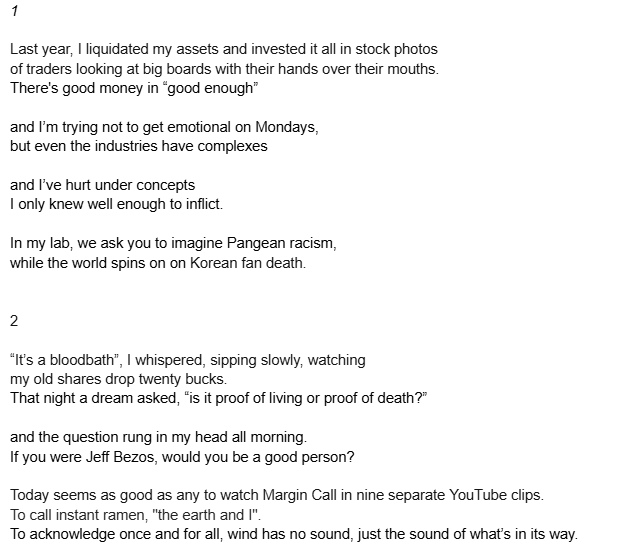
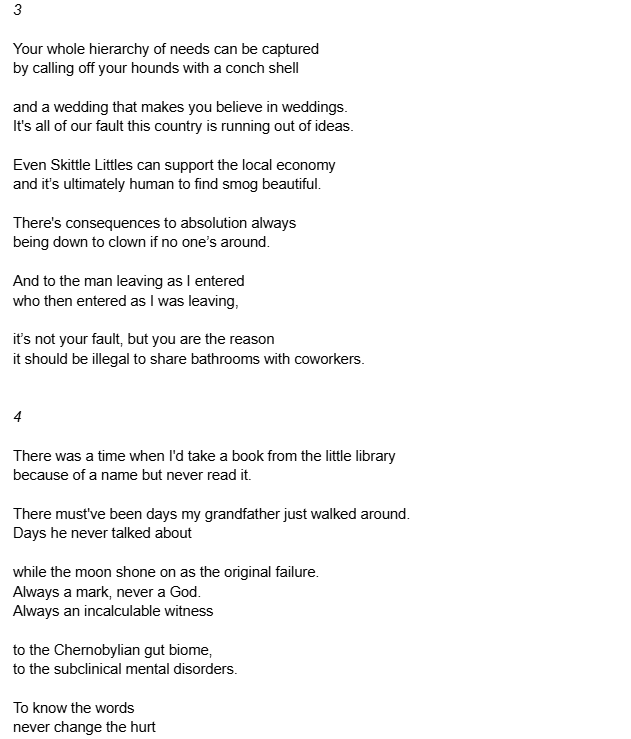
CANTOS FOR PSYCHOSOMATIC GOOGLING

By Lucas Restivo

Lucas Restivo is OPEN for representation and endowments

Categories
Issue 4 Issue 4 Poetry

DRAGON OF THE DARKNESS FLAME

By Tyler Plofker

Tyler Plofker is a writer in NYC.

Categories
Issue 4 Issue 4 Poetry

PIECES OF A MAN

By Uchechukwu Onyedikam

Uchechukwu Onyedikam is a Nigerian Poet/Photographer based in Lagos, Nigeria. BOTN, Pushcart Prize nominee. His poetry has appeared in Amsterdam Quarterly, Brittle Paper, Poetic Africa, Poetry Catalog, Sky Island Journal, Unlikely Stories Mark V, Spillwords, among other publications. He and Christina Chin has co-written and published two poetry chapbooks. He’s a contributor at Mad Swirl.

Categories
Issue 4 Issue 4 Poetry

CONVERSATIONS ARE INESCAPABLE AND PRETTY TRAPS, OR, THIS IS HOW DUOLINGO THINKS REAL PEOPLE TALK TO EACH OTHER

By Rich Boucher

Rich Boucher resides in Albuquerque, New Mexico. Rich’s poems have appeared in The Nervous Breakdown, Eighteen Seventy and The Rye Whiskey Review, among others, and he has work forthcoming in The Literary Underground and Cul-de-sac-Of-Blood. He is the author of All Of This Candy Belongs To Me. Interestingly, he can’t stop looking at the sky.

Categories
Issue 4 Issue 4 Poetry

THAT YEAR

By Sofija Popovska

Sofija Popovska is a poet, translator, and editor-at-large at Asymptote Journal. Her other work can be found in mercuryfirs, Circumference Magazine, Grotto Journal, and Poetry Daily, among others. Her poetry collection, Thaumatropes, which she co-authored with Jonah Howell, was published in 2023 by Newcomer Press.

Categories
Issue 4 Issue 4 Non-Fiction

WILTS

By Corey Lof

Wilts saw the ocean for the first time when he was twenty-six. Thank you, he said. We were on the Oregon coast where a waterfall was coming off the cliffs, landing on the beach and running through a spiderweb of trenches to the shoreline. The sun had set and what was left of the light had turned the waterfall, and everything really, the rocks, the sand, us, the ocean, translucent and purple.

Thank you, thank you, he said, breathing like he wasn’t sure he would ever get to do it again. I half expected to turn around and find him facedown making angel shapes in the sand, like he was talking to God, or the earth or something. I hoped he wasn’t talking to me. I wanted to be riding around on Aprhi’s shoulders in the shallow, taking selfies. I didn’t want to be credited with whatever Wilts was experiencing. I ignored him, but he kept saying it. Thank you. Thank you for bringing me here. 

It was always like this with Wilts, we’d be doing something normal, like getting gas or watching an ambulance tend to a car wreck, and Wilts would experience some profound depressive episode. It was nothing to be jealous of, but there I was. I wanted to push him over into the sand, fill his mouth with it. 

Man, thank yourself, I said. You pitched on gas too.

The second time Wilts saw the ocean he almost drowned. We were burning driftwood on a campsite in northern California, surrounded by long beach grass. The sand was cold and the air was a thick, salty mist. The moon never rose and so turning away from the fire basically left you blind. 

You go swimming? Aphri said, looking over my shoulder to where Wilts stood, soaked and shivering, with some girl in his arms. He kept grabbing her like he was checking she was there. They bashed their foreheads together and panted in unison.  It was obvious, whether he saved her, or she saved him, or they’d just tripped into a puddle together, Wilts saw it as a cosmic sign. The universe was always telling Wilts that this was it, he’d arrived, and it always ended with his heart looking like sidewalk vomit. 

Who the fuck is that? Aprhi asked. 

The fire flashed in the girl’s wide eyes. She pet Wilts’ chest, looked up at his chin. 

The three of us had been staring into the fire since before dark.

We hadn’t even noticed he left. 

He moved into the girl’s van and the next time Aphri and I saw him was in Hollywood. Though he disappeared early that night too. Aphri borrowed then bled on Wilts’ only nice shirt while in a friendly fist fight over a flowery necklace given to us by a homeless man.

It was me who punched him.  

I got into it with Aphri twice that night. 

Later, while Wilts was asleep, or wandering all woebegone through the Hollywood streets, Aphri warned me against going behind a bar to smoke weed with a black guy who had neck tattoos, so I called him a racist and he smacked me in the face and told me a story about how he was robbed at knifepoint in Guatemala. 

I said, I wish I had a knife, I’d take you for everything you got. 

What did I tell you about threatening me with violence? he said. I’ll whoop your ass.

I dumped what was left of my beer in his lap and took off while he was still trying to figure out what happened. 

But I was so unaccustomed to being alone, I didn’t know what to do. I ended up in some bushes, just off the Boulevard, with my pants down. I thought I might jerk off, but it was hopeless. The mood wasn’t right. I don’t know what I was thinking. Parts of my life were slipping away so fast it was as if I never lived them. Maybe I was hoping to get more time with them. Maybe I thought I’d get that time while in prison as a sex offender. I don’t know. But that was me there, bare ass in the mulch, hand on my soft dick, scrolling through old photos on my phone of all the people I loved and never told.

Wilts told us he was leaving for good one night in a dry lakebed outside Boulder, Nevada—the Boulder no one talks about, that consists of a laundromat and mechanics shop and not much else, the one I’d confused for Boulder City, Colorado and for years wondered what all the hype was about. 

We pulled off the road, into a dry lakebed and drove in circles as fast as we could until we lost interest when we realized that was the extent of it, circles. There were no giant cracks or other worlds for us to fall into. No one was chasing us, no one was watching. 

We parked, dug a hole to protect our fire from the wind, ate mushrooms and stared blankly into what was a bleak, album cover sort of horizon. 

When the sun set, Wilts, Aphri, and I wandered around the dry lakebed in the dark. Wilts had my guitar with him. He plucked the odd low note and let it ring out. Eventually we laid down. 

That’s when Wilts told us he was leaving. He laid on his back and looked up at the sky and spoke to us as if he were telling us he was going to die. Again, that’s how he was. His tone always terminal, his sentences always punctuated with deep sighs of resignation. He spoke of love and chapter endings, new beginnings, and a whole bunch of other shit I was embarrassed to even hear. 

I gave him a hug and told him we’d miss him but other than that, I stayed quiet. I didn’t want anything I said to betray the fact that I saw this as a non-event. There was no great sense of beginning or end. Wilts was leaving. I always knew he would. It was clear from day one, when Teo left and Wilts replaced him, that he couldn’t hack it. Not on the road, not with Aphri and me. He was too open and too sticky. Everything we passed became a part of him, yet the crucial pieces of himself, the ones that stand you up in the morning or stop you from tripping backwards into your own head, those he’d just let fall out wherever he happened to be or he’d give them away. 

There was never a choice. Not for him. He was always going to leave. 

I’m surprised he lasted this long.

He asked me if he could take my guitar and since I wasn’t playing it, and I said, Sure. If you got fifty bucks.

It was a fluke that he’d ended up in the van to begin with. Years ago, I was sitting in the park in Toronto with this girl I’d started seeing even though I was about to leave town, when Wilts called. I hadn’t spoken to him in months. I remember thinking, is this really something I feel like taking on? The shortest phone calls with Wilts could leave me with an overwhelming sense of guilt and a deep pain in my gut. He had the power to both brighten the world, bring it into clarity and at the same time make it feel hopelessly out of reach. 

I sighed a sigh I learned from him, one of his deep, what difference does it make, sort of sighs, and answered the phone. Hello? 

He was silent for a while, then all he said was, I see you.

He was right there, right behind me in the same park, somehow wearing on his face every possible implication of the time past between our seeing or speaking to one another.

I told him I was leaving and he said, Can I come?

It’s only ever a matter of gas pitch, I said.

But I still wonder, what if I didn’t answer the phone? What if he’d seen me screen his call? Would he still have approached me, still have had me turn around? 

Years later, after Wilts had come and gone, I ended up back in Toronto for a stint, more or less squatting in his apartment, while he tended to another broken heart in the safety and comfort of his childhood home. 

I’d been to the apartment once before, when his girlfriend still lived there. I remember being amazed by how full of life it was, how full of stuff, creamers and sauces, photos stuck with magnets to the fridge door. They had cactuses and clay cats and little glass bottles lined up along the top of the door trim. They had little things lined up along any little thing that jutted out from the wall, really, anything that resembled a shelf. Coffee cups with sailboats on them, pictures of people at weddings. 

But now that she was gone, the apartment was barren. All the life that I’d seen was hers. He’d just been clinging to it, calling it his own.

The next time I heard from him was a few years after that. 

I was back in Toronto, waiting for my car at a mechanic shop. He sent me a message saying he had all his stuff and nowhere to go. Not a clue. He said his most recent breakup happened to coincide with his landing on the wrong side of a line drawn in the sand by his mother after his father’s death. He said, I don’t really want to get into it.

He said, But I hear you’re in Toronto. Me too.

I was living with the woman that would become my wife, that with more time, would have our child, and live quietly with me in a life most would call normal—and I guess what I’m really wondering is if that sort of normalcy can find me in time, then why not Wilts? 

I knew he would be a terrible house guest, that he’d permeate our entire four-hundred square foot apartment with his incurable melancholy, but I’d already answered the phone. 

Where in Toronto? I said, and immediately spotted him across the street from me, a hopeless lump slumped over a rolling suitcase. He still had my guitar.

He stayed on my couch for two weeks. My wife—my then girlfriend—worked at a bar and so we spent most evenings on our own, Wilts and me, getting stoned and showing each other music on YouTube. Between songs he told me of his plan to fly to California and win back the last girl—in an endless string of girls—who’d broken his heart. 

I was working on my own at the time, turning people’s tiny, unfinished basements into illegal apartments, with six-foot ceilings and windows you couldn’t fit a basketball through, if any. So, on the day of his flight, I took the morning off. We had breakfast together at a diner and over cheap coffee and eggs Wilts sighed and went through his plan with me one more time. He would post a photo of himself on the coast in a place of romantic significance for him and his ex, then wait until she saw it and came to find him …

Pulling away from the airport that morning, I cried like I’ve never cried for my own life, like it was my mother’s heart he carried around in his chest.

I mourned Wilts’ death years earlier, while still in his company. He didn’t need to tell me he was suicidal. I mean, he did, on several occasions, but he didn’t need to. It was obvious. And it didn’t take much for me to accept it as an inevitability.

I was in no shape to help him. 

We lived in different worlds. 

His every breath was the result of a war being waged inside him—you could hear a village burning when he opened his mouth—and there I’d be, standing right beside him, feeling nothing, staring at a shoe.

I was his friend. 

I answered the phone when he called. 

I say all this, but he might not even be dead. Maybe he hasn’t done it yet. Maybe he won’t. 

At this point, I wouldn’t know. 

It’s been years.

Corey Lof lives on an island in the North Pacific with his wife, son, and many animals. His writing can be found in Hobart, Vlad Mag, Rejection Letters and several other places online. He would like to acknowledge that the first 300 words or so of Wilts was published as a flash by Back Patio, under the same title, in 2022. (@coreylofsatwit)

Categories
Issue 4 Issue 4 Non-Fiction

A LITTLE PATIENCE

By Aaron Burch

“Remember,” Mr. Dye reminds your class. “You should start thinking about what song you’re going to perform for your final.”

Your classmates groan. They sigh. They respond the primary way a room full of kids on the brink of teenagerdom respond to almost anything said by an adult.

“We don’t have a final paper or test,” Mr. Dye continues. “Just practice your performance. And remember, you need to turn in typed up lyrics as part of your homework. There shouldn’t be any curse words or anything else that wouldn’t be allowed on the radio.”

You wonder what he means by that “anything else.” What else other than curse words aren’t allowed on the radio? What else might disqualify a song?

You also wonder who actually needs the reminder. You’ve been thinking about it for weeks.

After school, you close yourself in your room and again listen to all your Weird Al tapes, over and over and over, trying to find just the right song. You listen through “Weird Al” Yankovic in 3-D and you listen through Dare to Be Stupid and you listen through Even Worse. You lay on your bed and close your eyes and mentally note the pros and cons of performing each song; you get up and stand in front of the full-length mirror hanging on your closet door and sing along, watching what you look like with each. “Eat It” or maybe “I Lost on Jeopardy,” “Like a Surgeon” or “Fat” or “I Think I’m a Clone Now.” You keep listening and considering, relistening and reconsidering.

You’re worried which song performance will lead to the highest grade. You’re also worried someone else might do the same song. You’re really worried someone else is going to do the same song and do it so much better. But, more than any of that, you’re worried about which song will least likely embarrass you and/or most likely make you look cool, two ideas that sometimes overlap and sometimes don’t but are always, together, at the core of your being. 

You’re shy, but maybe more than anything, you’re self-conscious. Your shyness and tendency toward indecision are borne largely out of a fear of doing or saying something stupid or, even worse, wrong. You are so scared of having a wrong opinion, of liking something that everyone else knows isn’t cool, or not liking something that obviously is. How does everyone else know what to like, what clothes to wear, what music to listen to? You know enough to be embarrassed that you like New Kids on the Block, but not enough to know who you should like instead. 

A couple of months from now you’ll overhear a couple of the other kids at your bus stop raving about some new tape by someone or a group or something called Candyman and so the next time you go to Wherehouse Music with your dad you look through everything until you find it, flipping through pop and rock and finally finding it in rap. Ain’t No Shame in My Game by Candyman. You’ll buy it, having no idea what to expect and even still it isn’t what you expected. But, apparently, it’s what people are listening to, so you keep listening until it grows on you, until you’re ready to overhear others talking about it so you can chime in. You’ll never overhear anyone mention it again. 

You wear cardigans to school, which seem dressier than what anyone else at your junior high wears and you feel like you stick out but that’s what your mom buys you when she takes you school shopping and they seem nice when you try them on in the store. You don’t have any other, better ideas. You get excited for new clothes, like you’re presenting your best self and isn’t that what everyone’s trying to do? You wake up early to put a lot of mousse in your hair and try and get it just right…but it never looks just right, and it doesn’t look like anyone else’s, all these kids with their parted straight hair and you with your curls that your mom and grandmother say are gorgeous, they say girls would kill for, they say you’re going to have so many girls you’re going to beat them away with a stick, but that very much isn’t the case, no girls ever tell you they’d kill for your hair, no girls even come close enough that you’d be able to touch one with a stick, but less so many of them swarming to the point where you need to fend them off. You roll your eyes and wish your hair was straight and would just part in a wave to the side like everyone else’s.

You look through your tapes, looking for anything else that might fit. 

Novelty songs, you remember Mr. Dye saying. Novelty songs work especially well for this.

You wonder, for the first time, how Weird Al came to be almost the totality of this genre, all by himself. 

“Any ideas for novelty songs for me to lip sync for my class?” you ask your parents.

“What about Kermit the Frog singing ‘It Ain’t Easy Bein’ Green’?” your mom suggests.

You roll your eyes. Rolling your eyes and sighing and mumbling “whatever,” or being a sarcastic Smart Alec, is becoming one of your most common reactions to your parents. 

“I love that song,” your mom says. “It’s so sweet.”

What is your mom thinking? You don’t want to be sweet. She doesn’t know anything about being twelve.

You go back to your room, close your door, lay on your bed and keep brainstorming. 

Mr. Dye says he’s going to take volunteers until no one volunteers and then he’ll have to just start calling on people, until everyone’s had their turn, and then the semester will be over. You don’t want to get called on, but you don’t want to volunteer either. You really want to go somewhere in the middle. You want to blend in. Well, you want to stand out for doing a great job, but not too much, and definitely not for the wrong reasons. 

No one volunteers at first and you feel your whole body—your fists and your arm and leg muscles and your teeth and your neck and your chest and your brain—clench. Is Mr. Dye going to have to call on people the whole time? Am I going to end up getting called on first?? You wonder who would possibly ever volunteer to go first. And then one student raises their hand, and then another. 

Please don’t do my song, you think to yourself as every student walks to the front of the class and waits for Mr. Dye to hit play. Like a mantra, telepathy, a prayer. Please don’t do my song, please don’t do my song, please don’t do my song.

No one does a Weird Al song. No one does any kind of novelty song at all. Not the first volunteer, not the second, not any of your classmates who go that first day. Not anyone on day two either. 

At first you watch, thinking they’ve all made a misjudgment. Hadn’t any of them been at parent-teacher night? Hadn’t Mr. Dye told you all what kind of song worked best? It was like he’d given you a sneak peek at the final exam and you had to look up all the answers on your own, but you knew the questions. Why would anyone not follow a suggestion given by the teacher, the person who would be giving you your grade? But then, as you watch classmate after classmate perform popular, Top 40, non-parody songs, you realize you’ve made the misjudgment. You’re going to seem silly. You’re going to look like a little kid singing this dorky joke while everyone else has chosen a real song. You wonder if it’s too late to change. You’ve already turned in your lyrics but maybe you can talk to Mr. Dye, maybe you can explain your mistake, maybe you can quickly find and memorize and type up the lyrics to a real song, before you make a fool of yourself. And then Mr. Dye calls your name and it’s your turn and you stand up out of your desk and make your way to the front of the classroom, dreading what’s about to happen. 

Ten, twenty, thirty years later, you won’t remember what song you ended up choosing and performing. You’ll remember all the practicing and choosing one song and then changing your mind and choosing another one and practicing anew. You’ll remember typing up lyrics on your family electronic typewriter, with its little display that would show a couple of lines at a time, saving it all onto some kind of typewriter hard drive, and then printing out the whole thing all at once on command. You’ll remember listening to the song over and over and over, typing as you listen, rewinding your tape every twenty seconds or so before it gets too far out ahead of you. You’ll remember how typing up the lyrics like that helped you memorize them even more than all your practicing, and also how it reminded you—at the time, and will still remind you all these years later—of one of your favorite episodes of Growing Pains from a few years before. 

“Reputation.” Mike Seaver—played by Kirk Cameron at the peak of his popularity and charm, long before he starred in the Left Behind series; before, in fact, he’d become a Christian at all, converting midway through the height of his career on Growing Pains and beginning to insist that storylines be edited to remove anything he thought to be too adult or inappropriate—had gotten to the point of being in danger of failing the class, so he’d stayed up all night writing notes on the soles of his shoes. In class the next morning, Mike sailed through the test, knowing all the answers, not once needing to look at these two cheat sheets on the bottom of his feet. After the commercial break, the teacher gave back everyone’s graded test, announcing with total surprise that the best grade had been received by none other than class slacker. Mike Seaver. Mike jumped up out of his seat, did a little dance, high-fived the classmates sitting around him. Sitting back in his seat, proud of himself for doing so well on a test for once, Mike leaned back in his chair and put his hands behind his head in a perfectly 1986 sitcom way, and kicked his feet up onto the desk of the student sitting next to him, putting his night’s work on full display to the teacher and the camera. Cue the studio audience gasps, cut to commercial. 

You’ll remember that not one other person did a goofy or funny or parody song, though you won’t remember what they did do. You won’t remember if anyone did Janet Jackson or Mariah Carey or Madonna; it seems unlikely that anyone did “U Can’t Touch This” or Faith No More’s “Epic,” because surely you’d remember that, but it’s possible; they were both huge songs that year. 

You’ll remember only one performance. Matthew. 

Matthew sits in the back of the class. He’s a year older than you, has long, almost shoulder-length hair, a little like Ethan Hawke in Reality Bites, though that’s still four years away, or maybe like Kurt, though you don’t know who that is yet, you haven’t heard of Nirvana, you have no idea Bleach came out last year. Matthew’s hair hangs down, veiling his face, as if hiding him away from Mr. Dye or anyone else who might notice he isn’t paying attention.  

When it’s his turn, when Mr. Dye finally calls his name, having run out of volunteers, Matthew slumps and sighs like he can’t believe he has to do this. Did he think he’d just somehow never get called? 

“Matthew, I don’t seem to have your homework with the lyrics anywhere here,” Mr. Dye says, looking around his desk, through his stack of papers.

“Yeah, I didn’t get to that,” Matthew replies.

“Well. How are we going to fix that? You can’t go unless I can look over the lyrics first and have them to follow along, and you can’t pass the class if you don’t do this assignment.”

Matthew shrugs and then starts digging through his backpack down at his feet. Everyone in the class is quiet, watching, wondering how this is going to go. 

Matthew pulls his Walkman and then a cassette case out from the bottom of his backpack. He takes the tape out of the Walkman and opens the case and pulls out the liner notes and walks both up to give to Mr. Dye. 

“You’re gonna faaaaaail,” Matthew’s buddy says, chuckling at himself, laughing like his buddy having to repeat the eighth grade is the funniest thing he’s ever heard. Mr. Dye looks at him and shakes his head.

Matthew’s buddy stops and the room is silent, everyone watching Mr. Dye reading the small-print lyrics that Matthew has pointed out in the unfolded cassette tape liner notes.

“What are these asterisks?” Mr. Dye asks.

“What do you mean?” Matthew gets closer, looks over Mr. Dye’s shoulder at where he’s pointing. “Oh. That’s just whistling.”

“Are you sure? There aren’t going to be any surprises, are there?”

Matthew shakes his head. “Just whistling. I promise.”

Matthew puts the tape into the class boombox and rewinds it back to the beginning of side B.

“Let me know when you’re ready,” Mr. Dye says.

“I’m ready.”

Matthew doesn’t look ready. He’s in the middle of the front of the class, where you all stood when performing your songs, but he’s just standing there. His body is slack; he doesn’t look nervous or excited. He looks bored.

Mr. Dye hits play and there’s seconds of silence while you all wait for the song to start. Matthew does that thing where he reaches up and grabs his hair and pulls it back out of his face and then lets go and it falls right back to where it was. Someone on the tape says, “One. Two. One, two, three, four…,” and it’s startling, this break of silence, like you’d forgotten what you were waiting for, why everyone was quiet in the first place. Then an acoustic guitar and Matthew starts swaying, subtly but perfectly, and somehow you realize Matthew had mouthed along to the counting, so casually you hadn’t even noticed at first, but also purposeful and natural, like he’d known exactly how many seconds of silence there was going to be, like he was in fact counting down to the song starting rather than just mimicking.

Some whistling joins the acoustic guitar—the asterisks!—and Matthew purses his lips and closes his eyes and keeps swaying. You think about all that time you spent practicing in front of your mirror, figuring out what to do with your body, your hands. Not quite choreography, but almost. You overenunciated every word, overemoted every lyric, thinking that was the goal, that would be how everyone knew you were doing a good job. Meanwhile, Matthew doesn’t look like he practiced, he kind of doesn’t even look like he’s doing anything at all, but it looks so much… better. There’s almost a minute of whistling and acoustic guitar while Matthew sways and lipsync-whistles, and it’s mesmerizing.

Shed a tear cause I’m missing you…

You finally recognize the song as Guns N’ Roses’ “Patience,” and then Matthew’s swaying back and forth makes even more sense than already just looking natural and perfect. It’s that Axl sway. You’ve seen the music videos—“Welcome to the Jungle,” “Sweet Child O’ Mine,” “Paradise City.” You usually flip past them when they’re on, but sometimes you watch when your parents aren’t around. You find them curious but you don’t really get it; you group them together in your mind with all the other hair metal bands—Poison and Ratt and Cinderella and Mötley Crüe. All these bands that have long hair and wear makeup but also their album cover art feature snakes and skulls. You find it all silly, but also confusing, but also dangerous and kind of scary. 

Next year, Guns N’ Roses will release Use Your Illusion I and Use Your Illusion II on the same day, and they’ll be huge, but then a week later, on the very next record release Tuesday, Nirvana’s Nevermind will come out, a week that will feel like a clear demarcation of before and after. Two entirely different eras. 

At the end of that school year, one of your friends will write “Guns N Fuckin’ Roses!” in your yearbook and you’ll be shocked, at both the language and the sentiment. You’d thought they seemed silly and then passé, like you’d been too young for them, and then immediately too old. You’d assumed everyone your age thought the same. You didn’t think anyone you knew listened to them. You’ve never talked with that friend about them. You’ll take a black marker and cover up “Fuckin” so your parents won’t see when you show them your yearbook.

Said woman take it slow, and it’ll work itself out fine. All we need is just a little patience…” 

It doesn’t seem like a Guns N’ Roses song, and it doesn’t seem like a junior high Public Speaking class lipsync assignment performance. It’s a long song—almost a full six minutes of acoustic guitar and whistling and power ballad singing and it feels as long as it is, it feels like it lasts forever, but you’re never bored. You’re hypnotized. You kind of want it to last forever. 

And then it ends. Matthew stands there, finally still, no longer embodying the song. 

Matthew walks over to Mr. Dye and takes the tape and the empty cassette case and the liner notes with the lyrics and the asterisks and puts them all back together. He walks back to his desk and you turn around a little, trying not to stare or make your admiration and the awe you’re in too obvious. You watch him slump back down into his seat and drop the tape back in his backpack and then the bell rings and class is over and the school day is over and it’s time to go get on your bus and head home.

Aaron Burch is the author of A Kind of In-Between and Year of the Buffalo, among others, and the editor of How to Write a Novel: An Anthology of 20 Craft Essays About Writing, None of Which Ever Mention Writing, and the journals Short Story, Long and HAD. His next book, TACOMA, is forthcoming from Autofocus Books. He’s online lots of places, including here: www.aaronburch.net

Categories
Issue 4 Issue 4 Fiction

LEMONADE STAND

By David Luntz

Sprouting like weeds all over the hood. Lemonade stands. Suburban cliché. A cliché of cliché. I loathe them. Which I suppose reflects badly on my character. But I don’t blame the kids. They’re being forced into it. Every time I see one, though, I can’t help but wonder about those children’s hygienic practices, how many flies dipped their feet in those tepid brews, and the quantity of lead in the water that had been used to make them. 

But one day I was thirsty, ragingly thirsty. I approached the nearest lemonade stand. Three pleasant blond-haired children manned it. They were clad in the latest designer brand clothing popular with a certain income-level of suburban households. I drank five cups of lemonade without paying. To be honest I had no intention of paying. But I promised those children I would go home and return with their payment. 

I placed my empty plastic cups gingerly on their stand. I took a step back. I thought some sort of apology was needed since I wasn’t going to pay. I waved my right hand before them and explained since they were in a business, albeit a small one, and given it was unregulated and they did not pay taxes and that my hand was clearly visible when it had helped itself to their lemonade (in contradistinction to Mr. Smith’s teachings), they should therefore take my drinking of their produce without recompense as an opportunity to learn the difference between extending credit and giving a loan—which, perhaps in the grand scheme of things, like war and politics, as von Clausewitz taught us, may be a meaningless distinction, but, I added, with a disarming smile, that was another discussion for another day. 

Yet, for sake of clarity, I told them I was drinking their lemonade on credit, not as a loan. Yes, I know, I know, I said, my “credit” here amounted to my word. But if it’s good enough for the U.S. government, then it should be good enough for you. Trust me children, it’s not lost on me that the mere promise of a few pieces of that specially-inked paper no longer backed by gold, with its all-seeing eye of providence inside of a creepy bisected levitating pyramid, got me those cups of lemonade. And yes, I get I’ve just compounded my legal woes by inadvertently entering into a binding contract with you, for I am painfully aware much to my prior detriment promises are considered ‘consideration’ in contract law and oral contracts are binding and enforceable in courts of law. 

Oh sorry, child, did I spill on your precious Brandy Melville dress? No, no don’t fret. Don’t cry. I’m sure the stain will come out. No? …What? No, you cheeky little fucks, I’m not going to leave my two-hundred-year anniversary special edition Phillipe Patek timepiece with you while I go home to fetch your little bit of sweet extortion, nor am I getting skinned for the cost of a whole pitcher of lemonade—you should learn to place it better on your stand!

Look, shit happens, accidents happen, deal with it. But putting all that aside, children, I know what troubles you. I know. I know. So, let’s mix metaphors and talk turkey and get down to brass tacks and address the elephant in the room: you don’t know me from Adam. You fear I will run off and never return with your precious payment. I get it. I get it. I’ve lived it, too, in my own professional life. You fear all your labor, hard work, your investment will have gone to waste, been all for naught. But look! I come with good news! Here’s another chance to learn something very important—what’s known in the parlance of the industry as a “transferrable technology” that you can acquire without any startup costs and sweat equity. 

Imagine that! See, now you can learn in real time about write-offs and the cost of doing business, which had you known before, you would have priced into your cups of lemonade without having to learn about Bayesian priors, sunk cost fallacies, double entry book keeping, the utility theory of value and law of diminishing returns. Which you will thank me for later when you don’t end up like King Tarquin who, you might recall, tried to buy all nine of the sybil’s oracles but wouldn’t accept her price, so the sybil kept burning her oracles until King Tarquin caved and ended up purchasing only three oracles for the same price as he could have purchased the set of nine. The point being here to understand the value of what you’re purchasing, because one day you’ll find yourselves on the other side of the lemonade stand, so to speak, and realize that sellers sometimes like markets can afford to remain irrational much longer than you can afford to remain solvent, to paraphrase Mr. Keynes. 

What? Why the look? Oh this. No, no, no it’s nothing to be worried about, just 17th century with an ivory handle made from…but this is not what you should be looking at. You need to see the bigger picture. So, pay attention! I’m trying to show you that your lemonade stand is but a tiny pucker on a tentacle of an enormous sprawling octopus of insurance companies, media conglomerates, investment banks, and law firms—no, what’s that, it’s not registering, fine, fine, if such abstraction eludes you, then picture some vast ancient army moving through the night, felling trees, making fortifications, their naphtha-fueled braziers burning along the western shores of the Danube and the Rhine, the tooth-chipped coins clinking in leather pouches strapped to the legs of the weary whores, the clanking pots of the cooks, the surgeons, barbers, and bloodletters with their cloudy jars of leeches and cedar boxes stacked with fleams and catheters, the learned-Greek doctors and stoics, bantam cock spleen readers, prestidigitators, prognosticators, students of the aleatory arts, dice men, procurers, devotees of Astarte, horned moons tattooed on their tongues, spies, interpreters, masseuses, forgers, rhetoricians, rumor-mongers, apiarists, bird catchers, butchers, dowsers, trappers, curers, washerwomen, the whole slow moving slug depositing its slick residue over a wasted land bathed in its own sebaceous glow, for your stand is part of a similar vast dark enterprise and nothing is really still, which is the first illusion you will have to learn to unsee, the illusion of stillness, but the point here is that you can never learn too early, for here, right here is where theory and practice both merge and come apart depending on which side of the cliché—stop screaming you little bitch, I’m not squeezing your arm that hard—depending on which side of the lemonade stand you stand on, for like that other cliché—or is it a trope, I can never get them straight—about the cat in the hat or in the box it all depends where your observation point is, for from where I am standing you’re all basically dead, or rather should I say, doomed, and from where you are standing no doubt you’re looking at some adult you wished had never passed into your perceptual field, but alas in life sometimes we can’t choose what not to see, can’t arrange to sweep these inconveniences under the proverbial rug, just as we never know the exact moment of our deaths, which is perhaps a good thing come to think of it, but let’s not be too maudlin, for when I spoke about death earlier, I meant it mostly in metaphorical terms, so let’s pretend you’re like Adam and you’re getting evicted out of paradise, not for paying your rent late, but because you did the one thing you were told you couldn’t do, and your maker sends down an angel who takes you up to the top of the highest mountain in paradise and from there you see the whole history (which is also your future) your one act caused, and in Adam’s case it was very bad, Hobbesian, chaotic, the general state of affairs that existed before the state contracted to monopolize violence from its subjects, I’m talking untrammeled murder, disease, war, theft, rapine, but in your case I’d say the future’s less gory, though, that said, I am not sanguine either about your prospects because this stand is a kind of gateway beverage to a life of office cubicles poring over grim actuarial statistics that had their origins in Graunt’s Mortality Tables, the sponsoring of derivative securities and other dubious negotiable instruments on the Amsterdam stock exchange that not coincidently came about with the science of probability in the seventeenth century, and the probability for you dear children is sharing cubicle space like penned cattle, of smelly refrigerators stuffed with moldering food cartons left by your coworkers some of whom you will no doubt develop unhealthy thoughts towards that may adversely affect your relationships with those whom you really care about, so you will find yourself coming back to your dingy rental you can barely afford in a packed subway car and wondering, “How did I get here, where did it start?” and then you’ll spit on the name of Mr. David Hume who told you it was impossible to find true effects from causes, you will curse yourself for taking him at his word, for here the effect can be traced down the chain directly to this instance with no other intervening causes—oh please, please don’t look at me like that, this blade hasn’t been sharpened in ages, it’s quite dull in fact, but admire if you will the ivory and jewel-crusted handle, genuine 17th century Ottoman smithing here, beautiful, no?—I mean it happened so quicky, he surprised me, yes, I hate to admit it, I liked it, I know, not nice, but you can trust what I’m saying because before that I shot the fucking albatross, well not the actual one in the poem, let’s say a metaphorical albatross, truly, the details are not important, but what matters is there is no coming back from it, you see, it’s a slippery slope, and nothing’s been the same since, sometimes I can’t help myself—now, now stop shaking dear children, stay calm, besides, we all have dead birds in our lives, so to speak, don’t we, even those we tried to save, so I suppose it doesn’t matter, it all balances out in the long run, but speaking of birds, take to heart and cling to it for all you are worth this sage advice of Mr. Russell’s who warned us that thinking the sun is going to rise tomorrow is like the chicken who thinks the approaching farmer is coming to give him his breakfast (because he’s done it every morning), when in fact the farmer is really coming to wring its neck, so yes, I think you know now what I’ve really been trying to tell you, and no, it’s not that you were never going to get your payment, I think that’s obvious now, sorry, not sorry, but this is where the nightmare begins, this is where it begins, so please children run, run for your fucking lives.  

David Luntz. Work is forthcoming in or has appeared in Post Road, Hobart Pulp, trampset, X-R-A-Y Lit, Rejection Letters, Maudlin House, HAD and other print and online journals. More at davidluntz.com Twitter: @luntz_david

Categories
Issue 4 Issue 4 Non-Fiction

GENERATIONAL GERMINATION

By Aubri Kaufman

Every time my three-year-old falls down, he tells me he “crumpled,” like, “I crumpled, mama,” and I hold back a laugh because I’m not sure where he learned the word. From me, I suppose, though in different context. He probably saw me ball up and toss some junk mail, crumple it, the way I saw my mother fold into herself over and over, creating irreversible creases each time. My son saw me cry last night, asked if I was okay. Asked if I’d like to jump up and down with him. Asked if that would make me feel better. I told him, yes, let’s jump together, and he laughed without reservation each time my feet left the ground.

When he saw that my still-puffy eyes hadn’t yet returned to the happy-crows-feet-mama eyes he knows well, he said, “You’re really sad, mama. Can I make you happy?” I pressed my lips to his forehead, told him, “That’s not your job, baby. Mama can make herself happy.” I listed things that make mama happy, to prove I knew how. To alleviate the burden. Coloring. Walking outside. Deep breaths. Things he understands, careful not to mention all the things he does to make me happy. Careful not to leave him feeling responsible.

Two days ago, he fell and cut his finger on the stick-like stem of our oregano plant. It’s a small cut, but the kind that peels back a layer of skin revealing fresh, raw skin underneath. We bandaged it up, kissed the wound, cursed the oregano plant, even though it wasn’t the plant’s fault. Now, he looks down to the healing cut. Band-aid removed, new skin acclimating to the air, turning color to match the rest of the finger. “Ouch,” he cries again. “It hurts, mama.” I try to convince him the wound is healing. It’ll be better soon. Probably by tomorrow. Soon he won’t even remember it happened. It’ll look good as new. He’s unconvinced. Tells me it hurts. I ask him if it hurts now, or if he’s just remembering that it hurt when it happened. His face crumples as he tries to determine the difference, and I realize I cannot explain the difference to him either. I realize maybe there isn’t one. I stop trying to make it better. I hold him while he hurts for as long as he needs me to.

Aubri Kaufman is the co-founder and co-EIC of Icebreakers Lit. Her work can be found in Pithead Chapel,trampset, HAD, Rejection Letters, and elsewhere. She’s on a bunch of the socials as @aubrirose and she totally wants to talk to you.

Categories
Issue 4 Issue 4 Fiction

GEORGE’S FIRST DAY

By Craig Rodgers

The ladies of the nineteenth floor love George right away. 

“Oh my God, he’s precious.”

“Look at him, that sweet boy.”

It’s his birthday today. Number fifteen. They tease at first, poking and laughing. Pinching cheeks. He laughs and shakes his head. He says thank you ma’am, he says aw jeez. Rose laughs too, and she pinches his cheeks again.

The men from accounts are having a meeting. A few from upstairs too. Some standing, some sitting. The blinds are up and they look over at times, to watch the ladies ribbing George, to laugh along between bouts of their talk.

George tries to work. He scrapes the top layer off worksheet errors and he notes their corrections. The women watch him go. They woo and he blushes. Mary waves and he blushes more.

The men in their meeting huddle. More are sitting now. Spells of quiet congeal. Figures are thrown out and booed. The day exists beyond the window over the city roofs below. 

The ladies crowd his station. They ask about his day. How he likes the office, how he likes the work. He goes on with his tasks as they talk and he talks and then he wipes his brow and he puts the eraser in his breast pocket and he tells the ladies I don’t know, I don’t know. They laugh still, they pinch his cheeks still. Ruth says she’s going to give him a kiss, and Mary says she is too, and he laughs, and he huffs, and now they’re all laughing, and he’s running, around tables, past desks, and the ladies are running too, laughing and running, and his feet twist and he falls forward, and now there is a gasp. 

The men stand at the table where some accord is found. Some stare down at pages of numbers while others reach and stretch. One by one they turn as the screams begin to sound, where Ruth weeps and Mary sits blank faced on the floor alongside where George’s body is flopped. The eraser thumps with a slowing pulse, protruding from his heart, and the ladies nudge him with hands that shake but he is already gone. The office stills with but little movements continuing on. Hands over mouths, whispers of woe. Somewhere outside wide windows the sun moves, stretching between the bones of a rising tower. A man turns away and then another, their gaze drawn from this tragedy and on to the day’s minute onward tick as knockers and climbers rivet into place blocks of long steel that in their slow way shut out the sun’s insistent presence. 

Craig Rodgers is the name stamped on ten books, a number of letters, and one day a grave.

Categories
Issue 4 Issue 4 Fiction

HANDBOOK FOR THE RECENTLY DECEASED

By Mallory Smart

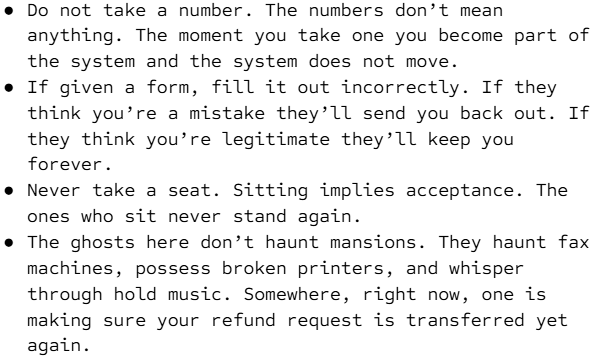
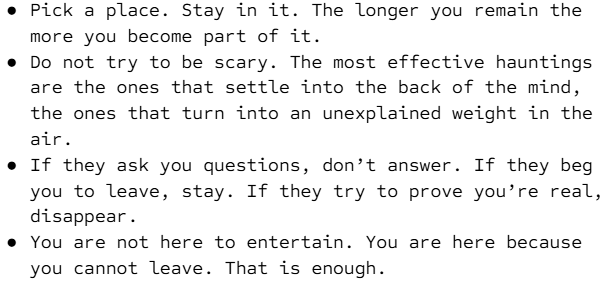
(You were alive. Now you’re not. Make peace with it or don’t. It won’t change anything.)

NAVIGATING THE AFTERLIFE

You exist, but only as an inconvenience. Being a ghost isn’t hard. You just have to stop pretending you matter.

You are neither here nor there. You will get used to it, but not in a way that feels good.

DEALING WITH THE LIVING

They refuse to acknowledge you. Not because they don’t believe in ghosts but because they believe in themselves too much. They are the center of their own story. You are background noise.

It’s not that different from being ignored when you were alive, except now it’s not personal.

UNDERSTANDING YOUR NEW FORM

If you weren’t weird before, you are now. Accept it and move on. Or don’t. Either way, you’re stuck with it.

You always felt a little disconnected from reality. Now it is just official.

AVOIDING BUREAUCRATIC NIGHTMARES

Nobody tells you that the afterlife has paperwork. Probably because if they did, no one would die voluntarily.

Bureaucracy doesn’t die with you. It just gets less comprehensible and more passive-aggressive.

HANDLING HAUNTINGS

You are a problem now. Embrace it. It’s not like you have anywhere else to be.

You wanted to leave a lasting impression. You got your wish.

FINAL NOTES

There is no next step. No light. No revelation.

You will wander. You will watch. You will wait.

Eventually, you’ll stop expecting something to happen. That is when you realize the afterlife isn’t a punishment. It is just more of the same…

Mallory Smart is a neurotic Chicago-based writer and editor-in-chief of Maudlin House. She hosts the literary/music podcast Textual Healing and the horror podcast That Horrorcast. Her new book, I Keep My Visions to Myself, is available now through With an X Books.

Categories
Issue 4 Issue 4 Fiction

THE SCYLLA AND CHARYBDIS OF GAY DATING WHEN YOU’RE NOT EVEN GAY: A FRAGMENT

By Jesse Hilson

Women are enemies, and men are enemies in a different shape, but the same distasteful antagonism. You see them in public where you rarely go, in excursions out of your mousehole. You do go out sometimes, to Tony Larry’s hangouts, the farm stand he maintains with his boyfriend Brian, the farmers’ markets you go out of your way to visit. Otherwise you stay away. Everybody is an opponent to be melted down with contemptuous eyes. Does it disguise desire, does it hide a potential love-charge? Those false dates with Tony Larry, he never suspected were dates, but you half-feared them to be before they happened, wondered at while they were happening, and drove away from them afterwards in confusion.

What do you know about that? You know nothing about that. You were thinking just this morning, about how you were that gay kid, that kid with the gay vibe in high school who nonetheless escaped all the allegations and went on to fuck women, double digit body count, never touching male ass or having your own ass be taken by sodomites, but still the contradictions remain, potent after many decades of a benighted lifetime. The womanly compartments within you resonated nevertheless, the “feminine side” others may detect but they were cruelly (perhaps mercifully) disguised from you, like many other things. Until you crossed paths with Tony Larry.

At lunch with Tony Larry’s boyfriend Brian, eating tomato sandwiches at the café, glasses glowing with sparkling water in the sun. Brian’s clothes were dirty from the farm, as if by self-conscious design, to be seen as a “farmer.” Brian was going on and on: “I wouldn’t actually want my AI to have the voice of an upwardly mobile Black man. I just wouldn’t. Call me a reactionary backwards bigot, or whatever. It’s truer to say if AIs must have Black voices they should sound more like stand-up comics on Def Comedy Jam, or rappers. That’s the history I want evoked when I interact with the tech regimes of the future, if I must do so. The whole question of deciding your AI’s voice ahead of time is crazy to begin with. I’m not sure why exactly but it feels wrong in the same way tailoring your Zoom background with bookcases and designer lamps feels wrong with a capital ‘R.’ Be natural, be true. Be racist if need be. Be authentic. Don’t kowtow to the neoliberal agenda.”

You filed all this commentary away in your internal dossier on Brian. He was too trusting, too open with his opinions over lunch. You were surprised he was telling you all this, with no monitor, no checking of your signals, none of the paranoia another person might have shown. Tony Larry’s affections had made him too secure, too complacent. They gave Brian a protective shield you scan for cracks, even though you are not in competition with him. You notice whenever they say goodbye to each other they exchange “I love yous” in a quick, monotone voice, identical to each other from long repetition, like androids running through a tired subroutine. This privately infuriates you. It feels dead. It doesn’t seem organic enough for Tony Larry, to your mind. Then, also privately, you whip yourself for thinking so as you drive alone around the countryside.

Who was Brian to you, and you to Brian? Was he trying to gag you and shock you with extreme politics, was it a defensive maneuver somehow, to protect his relationship? Tony Larry told you about Brian’s hobby as a writer. It seemed like a false, dangerous surface just like the farmer persona. He wrote stories about BDSM. It was beyond him, though, to seek a truly Dostoevskian moral confrontation, you sensed. Besides, you don’t wear BDSM like an accessory, an outward fashion statement. At least you thought so. Later you worried that you didn’t know the correct thing to do either, you didn’t have the savoir faire, either. Brian was an idiot, but what were you going to do, tell Tony Larry that his boyfriend was a corny faker, with falsely acquired attitudes and that you were realer than he was, because you were older? You had allowed these attitudes to come to you more naturally over time, and it was a generation gap. Tony Larry being a millennial should have been able to see that. But you could barely see that, or see anything, you know that now. You tend to see more, as time goes by. You have more info to add to the hopper and you can judge from a place of higher visibility.

“Not necessarily true,” Tony Larry told you when you shared just a fragment of this with him, editing out all explicit reference to Brian and hoping he’d gather from your half-hearted hints that older was superior. “Not if you’re shoving it all down over time, Noah. People sometimes get more blind as time goes by.” You thought you were suggesting you were smarter about life, the soul, whatever, than Brian was. To displace Brian from his position even though they ostensibly loved each other. What room for displacement was there, though, what foothold for jealousy existed that would avoid being spotted on its face? Like did you think Tony Larry wouldn’t see the emotional angle? Were they laughing at your attempts? Tony Larry seemed to humor you, to your face: millennials were wise that way, you discovered to your envy and disgust. Somehow these counseling sessions were conducted in a gel-like environment created by Aubrey’s wake after she left. She was a millennial too. You’d told Tony Larry about the spanking and rough sex Aubrey had goaded you into. You call it goading, you suspect you aren’t truly curious enough to take possession of the actions in the bedroom, ownership of the pain you caused Aubrey’s body to make her cum. You wanted to distance yourself from that, even as you told Tony Larry with hetero pride how you’d made Aubrey have an orgasm without ever taking your clothes off. This dom role felt aligned with the fact that you were eight years older than Aubrey and Tony Larry, you were Gen X. You were on the demographic outskirts of a sexual territory only the young, the queer could occupy safely, solidly. You were not a member of the group somehow, even though Aubrey used you to perform those rituals with her, rituals that extended beyond sex and into conversations, sour niceties, pain silently inflicted. 

What were you doing telling Tony Larry any of this? You couldn’t say, especially since, as the visibility and awareness of your age grew, you developed unbidden feelings for Tony Larry, dreamt about him. Dreams that seemed non-sexual in nature, or you hoped so, after awakening and taking your first thoughts of the day, the way ignorant people hoped for certain outcomes in the news, political developments, tragedies scrolled over on the iPhone with a vague prayer for forgetfulness. Feelings had a surface area laser-mapped onto an unseen plane, a zone of men when the beams had heretofore only fallen on women’s physical bodies. And the male surfaces were not embodied, it wasn’t carnal with men, in a way you could point to or perhaps admit in your imperfect epistemic understanding of yourself and your own desires. Maybe you were a sexual cripple because you could only lust after women as you had seen them for decades, and never conceptualize anything else, any other tools ill-fitted for the hand. Some bisexual conscience hectored you, teased at you, from dream-angles, dream-ventriloquisms your waking mind couldn’t own up to puppeteering. A disillusionment never acquired such profundity that it would shake the faggot machinery within into awful automaton life, sending down cascades of magnetic dust and debris, the golem in motion. The inner android drew on a lifetime of observations that the straight, hetero self made, the storage of data for mysterious usage. This scientific knowledge might have positive value to the android’s purposes, if they could even be isolated themselves. To think of yourself as a machine made it all seem like something dark and less than human even though it was the automatized search for love and meaning. How could that ever be inhumanly colored. Why dust, falling, why not the ice that seizes life, breaking off in a shower of tinkling fragments and freeing an imprisoned organic being? You do not want to be the robot, do not want the machine-model of mind to apply, whether in disability or sexual confusion. You would rather this inner self be an isotope or inherent version of your mentally ill outer self, a hidden iteration from whom all consequence has been removed. You no more want to own an unconscious that produces dreams of Tony Larry than you would want to own a weapon that, by its very existence, potentially threatens the peaceful life of the household.

Jesse Hilson lives in the Catskills in New York State. His work as a writer and cartoonist has appeared in X-R-A-Y, Hobart Pulp, Expat Press, Maudlin House, Exacting Clam, and other venues. He has written two novels, Blood Trip and The Tattletales; a poetry collection Handcuffing the Venus De Milo; and a short story collection The Calendar Factory.

Categories
Issue 4 Issue 4 Fiction

AS I LIVE AND BREATHE

By Reilly Tuesday

Sometimes Tara feels like she’s the only girl in this city who grew up eating Lucky Charms every morning. Her friends in Montreal didn’t grow up with sugary cereals in the house and probably seldom slurped the blue milk output of 8 distinct marshmallows. One humid evening the self-declared almond-mom offspring, all grown up, come over for a barbecue. They gather to grill the 12 frozen Compliments-brand beef patties, on sale for $19.99. Together they joyfully slurp dripping grease and mustard and golden beer. 

Once every last drop is lapped up, they go home. Tara then realizes she forgot to buy a barbecue brush with those wiry bristles to thoroughly clean the portable grill. She tries her best to clean the waxy grease with bunched-up paper towels, tries to limit the black gunk that gathers under her fingernails, and tries even harder to ignore that weird tight feeling in her chest. 

Her father, Darren, won the barbecue in a charity golf tournament for hurricane cleanup in her coastal Canadian hometown. Darren works for a company that specializes in making cardboard boxes for seafood companies, which are waxed on the inside to help better ship the oysters and mussels and lobster and haddock and so on. They cannot be recycled. 

The town of Summerville’s harbour is Lucky-Charms-milk blue on calm days but pink on stormy days, when the churning sea rustles up the red sand on the ocean floor. Tara returns from the big city and goes jogging on the boardwalk, following the piles of seaweed along the Atlantic shoreline, just like she always does and just like she always has. She knows that the town’s sewage was formerly dumped into the water, that the shit then became fertilizer and the black seaweed then multiplied and multiplied. She learned this in the Nitrogen Unit of Grade 6 Science. 

For the Water Unit, the teacher brought in plastic tubes and big Rubbermaid containers full of water and taught Tara and her classmates how to siphon. She remembers practicing with plastic straws in plastic cups of Nestea in the Wendy’s sunroom with her brother, Blaze. Sometimes Darren took them to McDonald’s, but less so Burger King and Dairy Queen after they got shut down and sat deserted in the sea of plazas. She remembers proudly showing off her skills but Blaze was only in Grade 3 or 4 and could only blow bubbles because he hadn’t learned to siphon yet. 

They no longer dump Summerville’s sewage into the harbour but every once in a while the tangled lumps of seaweed are shoveled into dump trucks and taken to an unknown location. Now there is a water filtration plant right next to the shore but not next to the part where tourists go in the summer. It created 25 new jobs. Tara jogs past the plant and practices holding her breath so as not to breathe in the smell. A little further ahead she reaches the wet seaweed lying in the sun. She doesn’t hold her breath but inhales deeply because the smell reminds her of home. She stops when she feels a dull pain in her chest expanding.

Tara forgets the Deep Woods 30% Deet Bug Spray in the garage and gets 25 new mosquito bites. On the drive back to her parents’ house she gets stuck in farm equipment traffic. The tractors aren’t so bad, but the sprayers are unbearable, too big to drive around until they eventually turn off onto a red dirt road to spray the Cavendish Farms potato crops with herbicide. Tammy, Tara’s mother, calls them cancer trucks. She tells anyone who will listen that the constant fumes in the air gave Blaze autism as a child. She will tell anyone who will listen anything so Tara doesn’t mention how when she sleeps on her side she’s awoken by a sharp pain over her breastbone. 

When Tara finally gets home, Tammy is cutting potatoes and watching the news. The anchor says that Cavendish Farms has donated 1 million dollars to Queen Elizabeth Hospital and a unit will thus be renamed Cavendish Farms Same Day Surgery. It instills hope across the province that keeps hearing about patients dying in emergency waiting rooms because it takes 17 hours to be seen by doctors that keep leaving like Burger King and Dairy Queen. Tara places her hand over her chest. Darren comes home and cooks fish that someone at work gave him in a waxed box. Blaze comes down from smoking weed and eating Lucky Charms in his room and the four enjoy a dinner of haddock and potatoes and it smells like home. 

Tara goes back to Montreal and writes headlines for rain jackets and backpacking tents made with special waterproofing chemicals that cost more than her monthly rent. She works for 20 minutes at a time then opens Instagram reels to see vintage resellers testing their retro dishware for lead paint. She brews filter coffee with tap water and cooks breakfast with non-stick cookware from Amazon that leaves flecks in her eggs. The sink is full of dishes that look just like those on Instagram reels. When she washes the plastic cutting board she bought at Dollarama, the dark-green plastic fibers of the dish sponge get stuck in its grooves. 

She contemplates a garden of microplastics then contemplates synonyms for fresh air then contemplates if she should see a doctor. Her heart aches for something she can’t quite figure out. The weird pain in the left side of her chest keeps getting worse and she doesn’t know why. Tara goes online and finds one available appointment with a medical professional in a far-away neighborhood. She feels grateful that she didn’t have to wait 17 hours in a windowless room named after a J.D. Irving company. The doctor gets her to inhale deeply and performs run-of-the-mill tests then orders her to get her chest X-rayed for possible tumors in her ribs and lungs. 

Tara spirals and thinks about all the homemade-bong particles, vessels crafted with water bottles and hollowed out pens, among everything else. She goes to a different clinic in a different neighborhood to watch dust particles dance under the fluorescent lights as an X-ray technician tells her when to breathe. She doesn’t smoke weed for a week as she waits for the results. She doesn’t do much at all. 

The sky is Lucky-Charms-milk blue on calm days and pink on days when the smoke arrives from the forest fires in northern Quebec. The X-rays come back normal but the pain comes back once 10 days of prescribed painkillers run out. Tara feels very grateful that the health insurance from her underpaid outdoor sports equipment copywriting job partially covers physiotherapy. The physiotherapist asks Tara if she works from home and she says yes. She sits on a cold massage table and slowly twists her body from side to side. Yes, she feels it there, and yes there, and yes, there. 

Alas, there! Yes! It’s not poisons or pesticides or poor decisions but rather propelled inflammation, from where rib #6 or #7 meets the spine. Her back has become too immobile from not doing much at all, which in turn has been putting pressure on her ribs, and then her sternum. She goes back to working from home. She gets assigned exercises to do from home, too. She buys a foam roller at 30% off with her employee discount. 

Tara goes to more barbecues and more parties and eats her hotdog anyway when it falls on the ground. She jokes about gut health with new friends and old friends and almond-mom offspring. When she’s drunk she sometimes brings up the fucked-up week of waiting for X-ray results and thinking she had lung cancer. She will tell anyone who will listen anything. She asks if she can bum a cigarette. She wonders if she should give more of a shit about microplastics. She insists that even the siphoning classes and Cavendish Farms Same Day Surgery unit are real. She wonders if truth or fiction is more powerful. She can’t get into it right now, the Greenwashing Lunch & Learn is starting.

Reilly Tuesday is a writer from Prince Edward Island, Canada. Her work has appeared in Expat Press, Hobart Pulp, The Car Crash Collective Anthology, Dream Boy Book Club and elsewhere, including The Page, which she created and edits. Find her meandering around Montreal or as @reilliz on Instagram.

Categories
Issue 4 Issue 4 Fiction

YOU ARE MISALIGNED

By Kia Guindon

Terry is in a mood. Eyes drippy with resolve. He looks like he’s one long glance away from trouble. “We’re gonna get out of this place,” he says, “Thelma and Louise style.” I want to tell him we are here voluntarily, that we can leave whenever we want. 

“Don’t they die?” 

He tells me he doesn’t have all the details sorted yet.  

*

I’m in the garden watching the sky leak by. Terry is beside me, combing through the Times. He likes to read the headlines out loud. Something to do with feeling more attuned to the communal suffering of the world.

“Alphabetical or random,” he asks.

“Dealer’s choice.” 

He begins, “Killer asteroids are hiding in plain sight—a new tool helps spot them. New Mexico wildfires map an early, record-breaking season. Liviah’s new liver: a family grapples with the girl’s puzzling hepatitis—a doctor prescribed an obesity drug, her insurer called it vanity.”

“What else?” 

“There’s one about coral reefs. But I know anything to do with the ocean breaks your heart.” 

*

It was my mother who insisted on my stay. Un petit rest, she called it. Chicken soup for the troubled soul. 

“You must know what this looks like,” she said in the hospital. 

I wagged a finger. “You are misaligned,” I said when what I meant was misinformed. 

What happened was this. I was found floating tummy up, far out in the Pacific Ocean. Coast guard pulled up beside my limp, star-fished body and asked, “Miss, are you in need of saving?” 

I couldn’t talk but flashed a thumbs up to indicate yes, that would be nice. As my consciousness turned spongy and edgeless, I brushed my tongue along my palate and was comforted by the taste of salt.

*

Terry ate oatmeal with water. That’s what I first noticed. That, and he took long, drawn out spoonfuls. Like he wanted to remember each oat. 

“He sure likes to suck out the marrow,” one of the cafeteria ladies said. 

I sat down close. His balmy breath was palpable. He kept eating, paying me no mind. We sat like that till his plate was cleared and it was time for group.

I was fed up after a week of smeary oats and silence. 

“Good luck Hon,” cafeteria lady said to me.

I followed Terry to the common area. Tracked him through the TV room and rec center. When he settled in the garden I stood in front of him, arms crossed.

“What are you here for?” I said.

“Did you know almost everything on earth, including you and me, was formed from the heart of a star.”

“I thought we consisted mostly of water,” I said.

“That’s what they want you to think.”

“Who’s they?”

“You know.”

“I don’t. That’s why I’m asking.”

The sun thrummed down. Terry picked at his skin. I stood staring, resolute. 

“What’re you here for?” I repeated.

“DNA, honey,” he said. “What’s your excuse?”

*

Truth be told, I wasn’t trying to do what they thought. Problem is my story sounds fake. Even to me. When I think back to that day my brain feels like a vat of air. I remember the ride to the beach. Talking Heads on the radio. Stale stench of summer. Pulling from a bottle of clear liquor. Then the tape zips forward to the bit where I’m saved. Sure, I felt some misery. But it was my baseline. Nothing that would tip the scales. 

*

The Chosen Ones join group today. “One, two, God is coming,” they sing, “Fighting for us, pushing back the darkness.”

We are sitting in a circle on plastic chairs. Most of us are wearing what we came in with, minus any shoelaces, necklaces, drawstrings, belts. Terry is beside me, rambling on about time.    

“Funny thing is,” he says, “no one knows why we only experience it in one direction.” 

A nurse paces, clipboard to her hip. The chalkboard reads: Falling is not collapsing, falling is extending. “Know the signs,” she says, and we all nod along.

“Three dimensions for space,” Terry says, “And only one for time.” 

*

This month makes three. Terry and I have a motto now: Maybe they’re born with it; maybe it’s clinical. Talking is prohibited after lights out so we sneak into the TV room with flashlights and blink morse code to each other. We are still learning so most of our words are simple: throat, wave, white. 

No one knows Terry’s exact age. But gossip is stock here. Some say he burnt his birth certificate a long time ago on account of the government tracking him. I asked him about it once, but he just said space and time are the framework within which the mind is constrained to construct its experience of reality. 

Others tell tales of Terry selling fake never-before-seen pictures of Elvis. Or harvesting kidneys for the black market. One story lands him in Italy, married briefly to a countess. Whatever the truth, I can tell from his large pores and yellowed fingers that he’s experienced in life. More so than I am anyways.

*

Mother calls. Her voice sounds springy. 

“So,” she says, “what’s the cup at today, baby?” 

“Quarter empty,” I say. 

“Don’t be like that.”

She tells me about Walmart Guy. He has a bump nose and large skull. They go to dive bars and peel off labels of Michelob and play rock paper scissors. Loser eats the label. They are to be married. City hall style. Very little shebang. Next to no rah-rah. It isn’t appropriate to celebrate with extravagance, she says, for a woman of her age.

“And you?” she asks. 

I remind her that my environment is not exactly ripe for love.

“Not a single prospect?”

I tell her I have Terry and that he’s like a husband in that we don’t have sex and sling our irritabilities at one another to relieve the pressure in our hearts. 

“Oh yes,” she says, “I understand.” 

*

We are guests. But that feels like the wrong word. We were not invited nor do we wish to stay. What got us here was a need for a blip of rest. Nothing permanent. Most of us here are happiest when life is like a film. We have an affinity for illusions. 

*

Chef makes a thousand eggs a week. Divided by seven, that’s one hundred and forty-two eggs a day. Numbers help. No ambiguity.

“Incoming news,” Terry says between forkfuls of wet yolk.

“Sock it to me.”

“At a dangerous 125 mph, the well-known Britney Spears eludes the police,” he says, his voice all Southern lilt. If I close my eyes, he could be Harry Connick Jr. or maybe Dennis Quaid. 

I pencil a three into a Sudoku row. Terry is naming billboard hits from 1959 alphabetically. 

“I don’t know why you bother with that crap,” he says.

“Think good, look good,” I say. 

 He blinks ‘okay’ then ‘yeah right’ at me.

I don’t tell him about my tricks. Memorizing sonnets. Sudoku. Omega 3s. I don’t tell him the average brain’s weight and volume shrinks about 5% per decade after 40 and that I’m halfway there and my odds don’t look great. I don’t tell him about losing the word vacuum. “What’s the name of that machine?” I asked one of the others, “That sucky device that gets all of the dust.” Other things too. Important things. Like the brand of my mother’s perfume. Or the name of my hymen-taker.

What stays, stays. Survival of the fittest. That’s Darwin. What else do I remember? Not much. Was it me or Dostoevsky that said it’s very pleasant to break something from time to time? Terry says memories exist outside of time and space, but I think only the strongest memories endure. No one tells you though if it’s the right things you’re remembering.

*

“I thought of something,” Terry says. “We have to try to imbue our lives with ambition.” 

“Do or do not,” I say, “there is a lot of try.”

“Listen, listen, listen,” he says, “ambition gets a bad rap, but channel it correctly and boom.” 

“Boom what?”

“Boom, life.” 

*

Terry had no moral compass. That was his problem. This was when he lived at the Western tip of the I-90. Tough is what he calls that time. At night he’d tread out into the dark on sodden patches of grass and fix his eyes on the dimmest part of the sky. He wanted to return to dust. Unburdened by time. Be up there, just another star.

That’s all in the past though. Acceptance is his mantra now.

*

“I’m not myself,” I tell Terry before group.

“Who here is?” he says.

Group is a time where the past gets a good going-over. The Chosen One’s have access to the past. Bonafide memory savants, the lot of them. They remember every infraction of morality, small or large.

Terry too. He can rattle off names and dates of birth from his high school rock band. 

I want to know if it’s wrong to only recall the shape of a day. Light flaying the sky. Muted pinks and purples out a window. When I watch films I’m left with feelings. No facts. I do not know if the lady was in red or blue or white or green. But I can remember her forlorn face in a mirror. The way she twirls a spoon in a cup of coffee. Even my mother. I have been here long enough to not know if she stands at 5’4 or 5’6. Or if her eyes are flecked with yellow. But I have tucked away moments of her mouth laughing. That I do have.

*

I come clean. 

“You just ended up out there?” Terry says.

“Yeah.”

“And you don’t know why?” 

“No.”

“There’s gotta be something.” He makes a list. Probable causes. He wants to get to the source. 

“Parents?” he says.

“Alive.”

“Boyfriend?”

“Negative.”

“Friends?”

I move my head from side to side. “A few.”

“Hard drugs?”

“Too young.”

He blinks ‘shit’ at me. “Maybe that’s your problem—no fun.”

*

Terry has a plan. We’re going to the beach. Exposure therapy. To confront the scene of the crime.

“Better than any of the cockamamie you’ll get in here,” he says.

The Chosen Ones remind us to be wary of the impurities of the outside world. There is filth everywhere. Terry tells them he’s beyond corruptibility. He was born with sin in his blood. 

“Do you really think that’s a good idea?” my mother says. 

“Better than any of the cockamamie in here.”

“I trust your judgement.”

“I don’t,” I say. “That’s what got me here in the first place.”

*

We arrive midday. It’s still there in all its aqua wonder. Unchanged. We stand gazing out. Undulating waves of blue and green. Miles and miles of water.

“Anything?” Terry says. 

I tell him I feel like a croissant. Flakey, layered, a little wet. We are encouraged to use metaphorical language to describe our feelings. Looking at things head on, we are told, can be overwhelming.

“Sometimes a leaf is just a leaf,” he says.

“Sometimes a leaf is just a leaf,” I mimic, an octave higher.

“What I’m getting at, kid, is maybe you’re just sad. And it is not like anything else.”

So I tell him. From the top. The parts I remember. My mother and her men. And then the town. Its people. Sagging faces. About all the ordinary ways life stacks up. 

*

I was there all of six months. We didn’t escape. But we didn’t die either. 

On my last day Terry blinked the word moist at me. 

I thought, I’ll never see him again. 

I thought, there’s two ways to deal with the cards you get dealt. Mete life out into measurable acts of compliance. Or use whatever you must to escape the oblong shaped, far away threat that is as real to you as your ten fingers and toes. Be it God or the space-time continuum. To the former, the latter are deranged, wrong, mad.

Pick a word.

Kia Guindon is a Canadian writer based in New York.@km_guindonn

Categories
Issue 4 Issue 4 Fiction

CHILDREN’S CRUSADE

By Avee Chaudhuri

Whenever our father Martin wanted to go on a bender he said he had to take an urgent letter to the offices of the North Eastern Atlantic Railing Corporation in Portsmouth, three days away, for the chairman’s eyes only, and that he would leave as soon as he could find the keys to the Buick. He preferred traveling at night, he told us, because the roads were clear. Thirty minutes later he would be down at the bar getting silly on scotch with a public-facing hand up the proprietor’s skirt, who poured scotch gratis. We told ourselves Mrs. Brenda had been widowed. Our father was many things but he wouldn’t with a married woman. No, it couldn’t be. Mrs. Brenda’s husband surely had been shot out of a cannon at too high an angle during his time as a prisoner of war, and he had not survived the impact of his collision with the warbling pines of the Black Forest. Our own mother had actually died giving birth to the twins. 

Martin, our father, liked to go on a bender every week. He loved drinking. “It feels good,” he said. 

One time we ventured, the twins hiding behind us older children, “Would it not feel good to make a real home for your children. Would this not feel as good as, if not better, than drinking scotch?” 

Our father was an attorney, who handled the affairs of many North Eastern concerns and he hated vagueness as a point of professional pride. “Well, how much scotch are we talking? What do you mean a real home? Bedtime stories and so forth.”

“Presence, just presence, consistency, tact.” 

“Fuck that noise,” Martin said as resigned as ever. “And wait a minute. You know I’m doing you children a favor doing my drinking out in the world. Not corrupting the family hearth with the sound and odors of profuse wretching. Scotch is a poison after all.” 

“No, you wait a minute. Don’t frame that as a virtue. There’s your fingering of Mrs. Brenda, a proud business owner.” 

“I don’t know what you’ve heard or seen. You kids don’t understand. I was concealing some documents on her body, important tax documents.”

“Sure, Martin. Sure.”

Martin?! Goddammit, you treat me with respect. I am your father!” And he stormed off for his most serious bender yet, reaching as far south as Savannah, Georgia. He stayed there for three weeks until Mrs. Brenda summoned him back posthaste. 

During this absence we had a frank discussion among ourselves and decided we ought to go out in a blaze. We were burdens to Martin. Maybe he could find love again with Mrs. Brenda, if only he had the temerity to move beyond hand stuff, to take her wholly in his arms and do her. We decided to fight for the Holy Land. 

But the twins, who were rather precocious, pointed out: “That place, ought we to project our rather meager version of faith onto it?” It’s true, I think we had only been to church the one time, at our maternal aunt’s insistence. She had to watch us because Martin got into a brawl with a bunch of Machine Democrats at a bar in Yonkers. 

“We are only really culturally Catholic,” the twins said in unison. 

But we wanted to do something useful with our sacrifice. There was a bookmaker in town Martin had run afoul of. In addition to being a drinker, he liked to let it all ride on the ponies. Our mother was a very beautiful and kind and understanding woman, and I think this explains our father’s obvious misery with the prospect of living, the horror of it, the vanishing likelihood that he would take Mrs. Brenda into his arms and do her. I mean, every time he saw us peering at him from around a corner, curious as to his movements, equally curious and concerned about the type of man we would grow to resemble or eventually be drawn to marry, he must have seen in our faces an apparition of our dear dead mother. What greater prophylactic can there be than children underfoot. We were going to detonate in the presence of the malicious bookmaker. The twins had cultivated an interest in applied chemistry and fitted us all with bombs. It was Monday, nine in the morning when they went off in the bookmaker’s shop and we were blown upward. And now we are jumping nearer to seraphim, trying to feel at the firmament of their jaundiced wings, but they simply float higher than we can reach in a conscious denial. Even in heaven on high we children remain objects of pity and scorn. 

END 

Avee Chaudhuri teaches Creative Writing and Literature at the University of Nebraska-Lincoln. He is the chef/owner of The Sepoy’s Revenge, a restaurant he runs out of his office on campus (Andrews 320).

Categories
Issue 4 Issue 4 Fiction

MIDLIFE HARD-ON

By Jon Doughboy

I did four pull-ups in the park and my arms are about to fall off. I’m in decent shape, or so I thought. Three days a week I do a little exercise routine in my basement. Body weight stuff like push-ups and squats. A few dumbbell exercises. I jog when the mood and motivation strike. But pull-ups are another story. Hefting the big hunk of aging meat that is me—my shoulders feel swollen. Like I’ve just been inoculated. But against what? 

I jog to my girlfriend’s parents’ house in the less affluent part of an affluent New Jersey suburb, wheezing past lush, diligently-watered yards and professional-trimmed hedges. The odd raised ranch. My triceps are burning. Cape Cods. My shins are aching too. Stone Victorians. Even my forearms are tight. New bright white farmhouse McMansions with mass-produced timber—ooh, look at the grain! Feels like we’re in Jackson Hole, honey! My girlfriend and company are travelling as a family to the Canary Islands. I declined their invitation. The bill was a bit steep for me, the itinerary a bit tedious, the concept of family a bit strained, so I’m here housesitting. A neighbor walks up with two red mums. “For Nicole. I know she loves mums. I had a funeral last week. A wedding tomorrow. That’s life, right? But they’re with us, aren’t they?” she says, pointing to the sky and then resting her hand on her heart. “My grandfather fell off his motorcycle at 80. Then he developed kidney issues. But he fought, you know? Just like my uncle. We took him off dialysis and he lasted weeks like that. We thought he’d die in days. But life, you know? It wants what it wants.” She goes on like this for a while. Life and death. Funerals and weddings. I get an erection but lean against the door in such a way that she doesn’t notice. This is my midlife crisis, I guess. I can’t afford a Porsche or hair transplants or a mistress so I’m not complaining. Though they happen sometimes at random, without a stimulus. I’ll be cooking oatmeal or aerating the lawn or sitting in traffic listening to a podcast about the Hanseatic League and boing—my cock is practically erupting through my pants. The neighbor leaves eventually. I masturbate quickly in the bathroom. I have to remember to water the mums. 

I meet my childhood friend later for beers. I tell him about my aching shoulders, my midlife erections. He’s married now. Has one kid with a second on the way. They’d been trying for almost two years with joyless, scheduled intercourse. He’d go out to Long Island for work—he’s an electrician in a tiny union and is sometimes the only guy on-site, wiring new supermarkets or big-box stores—and he used FetLife to find all these kinky women. One could only get off when he fisted her while wearing his wedding ring. He said, “I tried to take my ring off once because I felt guilty, you know. I’m not a monster. I felt terrible. But she froze up when I tried to. Stiff as a corpse. So I left it on. But I always wondered what would happen if my ring got lost in there. If I’d need to take her to the hospital. Or rent a metal detector or tie a magnet to a dildo or something.”

“My girlfriend has been very horny lately,” I say. “Some hormonal change. Perimenopause maybe. Not that she didn’t have a sex drive before but now every time we have sex, she wants to have more sex right after. And I tell her I’m old. That she needs to think about the refractory period. Then she takes my soft cock in her mouth just licking it, playing around, and I’m sort of embarrassed it’s soft but also flattered that she wants me or it or us so much and like fifteen minutes later we’re fucking again. I came three times in an hour. I haven’t done that since I was a teenager in heat.”

“Well, I say enjoy it while you can, man. Because we don’t really have sex anymore. It’s just work and parenting and on Sundays I watch football and fuck around on the guitar all day. Lots of Black Sabbath. The riff master.”

He shows me some videos of guitar prodigies on YouTube. Loads of fancy finger work. But the music sounds busy to me. Like they’re playing way too many notes.  

The next day I meet my mom and my sister at a Chinese place for lunch. Mom points to the kitchen and says, “Look, they’ve got actual Chinese people cooking. That’s a good sign. On Queens Boulevard we used to get all-you-can-eat Chinese food for two dollars. Piles of egg rolls. Buckets of lo mein. Now dumplings cost ten bucks. Ten bucks! What happened to this country, huh?”

My sister is telling me war stories from the psyche ward where she works. “The schizophrenic patients aren’t that bad. It’s the bipolar ones you have to watch out for because they get manic. And the drug addicts. They’re disgusting. They’re all criminals with bedbugs and scabies. And so entitled. One of them refused to eat the food in the cafeteria and was screaming ‘my insurance pays for this shit’ meanwhile their insurance is Medicaid so actually my tax dollars pay for it, bitch.”

“Did you say that?” I ask. I admire my sister. She’s very strong. Until she isn’t. Then she’s staying in another psyche ward in another county for a week or two. Meds. Sleep. Repeat.

“No.”

“Ten bucks for dumplings! Dumplings!” My mother says.

My sister goes on: “But one time we had this real piece of shit patient who had cancer and he beat cancer but was back in the ward for something else, it’s a revolving door of nutjobs, and he was screaming, calling all the nurses cunts and saying he had AIDS and trying to spit on us and when we finally restrained him I whispered into his ear, ‘I hope your cancer comes back and kills you’ and you can bet your ass we were cackling about that on our smoke break.”

My mother calls the waiter over. She doesn’t have time for menus and likes the—any—attention. “Do you have a shrimp dish?”

The waiter, a young Asian kid, says, “Yes, many shrimp dishes.”

“With garlic?”

“We have shrimp with garlic sauce.”

And I get an erection. In this dumpy Chinese place while my sister is telling me psyche ward drama and my mother is nagging the waiter about the size of shrimp. Are they big shrimp? Are they prawns? How many shrimp come with the dish?

We order. I excuse myself to masturbate in the filthy bathroom by the fire exit at the end of the hall. There’s no soap so I use the hand sanitizer on the sink. There are dark fingerprints smudged on the wall. When I return to the table, the food is already there. 

“These aren’t prawns,” my mother says, examining a shrimp she’s skewered with a chopstick.

“Did I tell you about the Bulimic girl who was really sweet and read my tarot but had the bones of an old lady because of her eating disorder? She was like sixteen or something but with 80-year-old bones.”

“Ten bucks for dumplings. Unbelievable,” my mother says.

I sit down and take a sip of Coke. My chicken smells like rancid fry oil. My shoulders still hurt.

The next morning the landscapers wake me up. Watering, mowing, seeding. Mornings in the suburbs are noisy with hired labor keeping yards tidy and clean. I lie in my girlfriend’s childhood bed wondering if she lost her virginity in it. If she had her first orgasm in it. Wondering how close the Canary Islands are to Africa. Wondering, remembering. Annalise. A Peruvian pre-law student who was volunteering at the library with me to teach new immigrants how to read. I was there for court-mandated community service. She was there to pad her resume. Afterwards, we’d fuck in my Ford Explorer under a huge, half-dead Catalpa tree at the back of the parking lot. She’s a lawyer now in North Carolina. Practicing law. What am I practicing now? Life? Except you don’t get a free trial. Or maybe you do. I should listen to the podcast I downloaded about karma. I go to the bathroom. I jerk off. I hope the landscapers watered the mums.

Two days later my shoulders and back are less tight. I jog to the park again. Step past the mums, across the tended yard and past the various architectural styles of the affluent houses. I do three pull-ups, four, five. I’m hanging from the bar. I have an erection. My abs are tight, my shoulders. I want to be young again, fucking in the back of a beat-up SUV and thinking about my future. I want dumplings that don’t cost ten bucks. I want money. I want to be on a Spanish beach with my horny girlfriend. I want to have a kid, to teach my kid how to master riffs. I want to be twenty pounds lighter, twenty years younger, twenty times stronger, smarter, better. I want. I don’t want to want. 

But life, you know?

Jon Doughboy is a recovering “literary fiction” writer who now produces “prose entertainments” to pass the time, available for the amusement of none and all @doughboywrites