Me and Rob and a couple of our friends were renting a house on Seneca Lake for the weekend. We needed an escape from city life. I was not fond of fishing or hiking or most nature activities, but it was nice to sleep in a house near the lake instead of a one-bedroom apartment near the subway.
Rob had a new girlfriend, Marion, who was sunbathing on the deck when I stepped outside for a cigarette. The sun was just about to go down. Marion was in a two-piece polkadot bikini and sunglasses. I could see the shape of her cleavage. She was reading a book.
I lit my cigarette and looked up at the sky. She noticed me behind her and set down her novel.
“Are they starting to make the food?” she asked.
“Yeah, just about.”
She looked up at me. “Remind me again what you do in insurance?”
“I’m a claims adjuster.”
“Oh, yeah. You and Rob met at work, right?”
“Yeah. We were at the same company for a bit before I got canned.”
I doused my cigarette in the ashtray on the round table near Marion.
***
Rob, Marion, Bill, Gator and I sat at the table ready to eat the salmon we picked up at a nearby supermarket.
“How long have you been married, Bill?” asked Marion.
“Two years now,” said Bill.
“He didn’t bring his wife because she drives him crazy,” said Rob. “Married life will do that to you.”
Rob laughed. I felt like I needed another cigarette. Gator was silently munching his peas.
“And Gator, Rob told me you’re looking for acting work?” asked Marion. “That’s great. I always wanted to try acting.”
“Yeah, it’s hard,” said Gator. “I mostly do commercials, but you know how that fucks up your soul when you have an MFA in theater.”
“Why not do theater, then?” asked Marion.
“Because try telling your landlord that you do theater,” said Gator.
***
It was late. Gator and I were having a couple of beers on the deck. The stars were shining bright and Gator was pretty hammered.
“You think this one will last?” asked Gator.
“Rob’s new girl?”
“Yeah.”
“Who knows. He gets a new one every three months. Then when he’s sick of banging her, he switches to the next.”
“I was with this hooker in Vegas last month. Man, her tits were huge. I sucked on them for ten whole minutes.”
“That’s nice,” I said. “Yeah, I need to get laid. I could use a hooker.”
“Come with me to Paris. I heard those French girls fuck like animals.”
***
I was still half-drunk when I stumbled into bed. I could hear Rob and Marion going at it. They sounded like they were in bed with me because their room was right next door to mine. I reached down to my crotch but couldn’t get it hard. Her moans sounded sweet, though. I heard Rob finish shortly before I fell asleep.
***
The next morning, Marion was making eggs in the kitchen.
“Sleep well?”
“Oh, yeah,” she said. “This house is lovely.”
Her ass was plump and I could see it through her nightgown. I still had some morning wood and I felt like brushing it up against her. Just then, Rob came downstairs, still in his underwear. He walked past me and smacked Marion on the ass. Then they began making out.
***
I stepped out onto the deck. Rob was in his chair, shirtless, smoking a cigarette and having a beer. I sat down next to him and asked him for a light.
“She has a nice ass, doesn’t she?” asked Rob.
“Yeah,” I admitted. “Really nice.”
“I saw you checking her out. If you wanna fuck her, you can. I don’t mind.”
“What?”
“I’m practically done with her. We did it in every kind of position imaginable, and she’ll definitely remember me as one of her best.”
I shifted in my chair and took a drag on my cigarette.
“I mean, the thing is, this Latina secretary who I’m working with now? Holy crap. She’s married, but she’s got ass and tits for days. Marion’s ass, it’s a boulder. This Latina chick’s ass? It’s a mountain.”
“Did you already fuck her? The Latina, I mean.”
“You bet I did,” said Rob. “I don’t care if she’s married. With that ass? It’s worth the risk. There are too many women out there, man. Why settle down?”
I looked up at the sky and watched the clouds as they met each other, embraced, and then merged.
Dmitriy Kogan is a short story writer, poet, and essayist from Staten Island, New York. His work has appeared in The Beatnik Cowboy, The Rye Whiskey Review, A Thin Slice of Anxiety, and is forthcoming in Straylight Magazine and Some Words.
After a few hours of drinking it was decided, mainly by Chatterjee, who was a diabetic and who routinely ignored the advice of doctors and refused to take his medication, that it would be another pizza night. “Pizza night! That’s what’s fucking up,” Chatterjee shouted at a group of passing school children. He had been on a self-prescribed diet for over a month, eating nothing except millet and goose liver.
“Say, what’s the pizza of the week?” Darryl asked our waiter when we were seated.
Our waiter leaned in and laughed. “You know, Joe’s actually in Italy this week, so we thought we’d have a little fun and do a Hawaiian Pizza. Joe hates Hawaiian Pizza.”
Joe was the owner of the pizza joint we would frequent whenever we drank too much and none of us had exact dinner plans. Joe kept a bottle of Fireball behind the bar, just for us.
Darryl and Monica firmly came down on the side of Hawaiian Pizza. I abstained. Chatterjee lost his goddamn mind.
“I won’t be party to treachery. One way or the other, I don’t give a damn about Hawaiian Pizza, but I won’t be a party to this humiliation.”
In fact, Chatterjee said he was drafting a letter on his phone he would send to Joe when he knew Joe was safe and back in the country:
Dear Joe,
While you were away they anointed Hawaiian Pizza the “Pizza of the Week.” They being not some anonymous cabal peddling the inane wisdom that “variety is the spice of life,” but your own kitchen staff, your own people engaged in high treason, man. I was appalled for you, remain appalled, and hope that this intelligence is actionable—with extreme prejudice. First I suggest you clean house, as it were. This will require shuttering the pizzeria for, what, at least three months while you train a new platoon of chefs and waiters. I believe this economic hardship to be worthwhile for your own personal well-being and to preserve the integrity of Joe’s Pizza, which by the virtue of operating as an LLC has become a beacon of hope for those of us who dream of one day hanging out our own shingle.
Warmly,
Prem Chatterjee
After Prem wrote the letter he ordered us shots of Fireball and we decided on a classic, tastefully garnished, Pizza Bianca.
A few weeks later, Darryl wanted to go to the racecourse because he was an animal lover.
“Have you ever seen a horse at full gallop?” Darryl pulled up the race calendar on his phone.
“No.”
“It’s like they’re flying.”
“Shut the fuck up, Darryl,” Monica said.
We decided to get some pizza to smooth things over. Joe double-timed it over when he saw us.
“I gotta thank you, Prem.” He had to catch his breath.
“I just couldn’t be a party to it, Joe.”
“That was the last straw. I tell you that was the last straw.” Joe was running his hands through his hair. He looked unkempt. He hadn’t shaved. Joe was what you would call an old-school restauranteur. Always dressed like some splendid groom, in cufflinks, in a waistcoat. Now he was wearing jeans and a hoodie and our eyes followed him anxiously to the open kitchen where he began an unsuccessful attempt to remove the ink sac from a cuttlefish.
It was only then that we noticed the kitchen was empty save for Joe, who was covered in ink. He’d opted for a mallet instead of a knife.
“Say, Joe. Where is everyone?” Monica said when she went behind the bar to grab the bottle of Fireball.
“Well, it’s like Prem said. I had to clean house. I had to take the fucking trash out. Right? Right?!” Joe started adding wood to the pizza oven, at an alarming rate. We discovered the next day while watching the five o’clock news that Joe had fired his entire kitchen staff and murdered Constantin, his head chef, burning his remains in the pizza oven. Constantin had been sleeping with Joe’s wife. It started out small, hand stuff in the walk-in, but had grown into a real relationship—weekends away, some lake house in the country—and she had become kinder to everyone, Joe included, so he had accepted the affair, but then to go ahead and make Hawaiian Pizza was too much for Joe. It was one betrayal too many.
Prem cleared his throat when the news hour ended, like he was about to say something.
“What?” I said.
“Well…” Prem started. “I cannot help but feel that we are responsible for this.”
“We!” Darryl said.
“Yeah, you wrote the goddamn note.”
“None of you stopped me! We were all drunk on the Fireball and did not think, could not think, about the consequences of our action. That’s what’s wrong with this world: people not minding their own business, imposing their own value system.”
“Jesus, Prem,” Monica said. “You’ve got to calm down. Joe would have found out eventually.”
“Maybe. Maybe not. But referring back to the letter: was it entirely necessary to frame the issue of Hawaiian Pizza as ‘high treason’? ‘Extreme prejudice’ is an unfortunate turn of phrase, knowing what happened to poor Constantin. Though perhaps twas the fate of all swarthy lovers.”
“Prem, you’re being too hard on yourself,” I said.
“Well someone has to be! I mean what the hell are we even doing?”
The question hung there for the rest of the evening. Monica called up her ex-husband, and arranged to meet him at the Home Depot. They would finish putting the new siding on their house. She said she would call us when they were done, that there’d be a party. I haven’t seen her since. Darryl nursed a light beer for several hours and then left to get kebabs. Chatterjee and I polished off a bottle of white wine but that was it. At the end of the night, Chatterjee shook my hand.
“Good luck,” I said.
“Yeah, you too.”
I can’t remember when we started to refer to ourselves as the Fireball Quartet. It was probably during that full out brawl in the Haymarket. Someone asked Chatterjee if he was a Muslim. Chatterjee, a proud Bengali Brahmin, answered: so what if he was, he had every right to be in that Irish bar leering at former collegiate volleyball players.
Avee Chaudhuri teaches Creative Writing and Literature at the University of Nebraska-Lincoln. He is the chef/owner of The Sepoy’s Revenge, a restaurant he runs out of his office on campus (Andrews 320).
Our noses smash while your tongue unfurls to probe far beyond the nubs of my tonsils. We perform our animal lust in a public setting—a food court in the airport, a city bus, the serpentine queue leading to a garish roller coaster. No one takes any notice.
This time, you’re an Asian girl, but no one I know from real life. Asian, most likely, because I watched a Kore-eda film last night—the one with the mother who abandons her children. Your face is different, but I know it’s you. We are kissing in public with a hunger that verges on panic. You stifle my airways with your cartoon tongue. I am powerless, like a child, neatly folded and stored in a traveling bag. I am carried away, going who-knows-where.
In these dreams, the taste in my mouth is awful, and when I wake, it lingers. I blink in the dark and fish a hand into my underwear. Sometimes I require a new pair. This time, I do not. I groan, knowing what’s to come next, knowing from experience and repetition that when I wake from these invasive kissing dreams, my mouth tasting like I’ve gone to town on a hyena’s asshole, you will emerge and render me your plaything. You seep into substance from nothing, clouding my room like squid ink ejected in water. You will bond my flesh to the mattress, singing in high notes, low notes, a drone that makes me nauseous and yet receptive to its sonic violation. You will hover over my useless limbs, ejaculating your cold aura.
On occasion, you gyrate, shedding your skin. More commonly, you remain perfectly still. Eventually, you press inward against my immobile body, your non-face opening up to unravel your tape-measure tongue. This is the moment when my dreams take on a new foundation. No longer dreams, they become nightmares; discarded fragments dredged up from forgotten realities.
The Big Red that we chewed in the car cannot purge the rot of our open faces. Your song is sweet, but hot and sour on your lips. The storybook that we read seems a world away on my bedside table, falling to the floorboards as a tremor ruptures the world and everything in it.
You cover me like a weighted blanket. I resist, but part of me opens up to you. No longer a woman—no longer a human—the shadowy mass in my room enters me, tasting me down to my core.
James Callan lives and writes in Aotearoa (New Zealand). His fiction has appeared in Apocalypse Confidential, Burial Magazine, Reckon Review, Mystery Tribune, and elsewhere. His debut collection, Those Who Remain Quiet, is available from Anxiety Press.
Steve Gergley is the author of a bunch of books and a lot of weird writings of an indeterminate nature. His most recent book, There Are Some Floors Missing, was published by Bullshit Lit on February 20th, 2026. He tweets @GergleySteve. His fiction can be found at: https://stevegergleyauthor.wordpress.com/. He’s also the editor of scaffold literary magazine.
I picked up my tickets at will-call and saw Robert Earl Keen’s guitarist pleading with the window to let his two guests in. They didn’t think he was in the band. I got in the door and heard an organ wailing. It was Geoff Hilhorst. It was Ryan Boldt singing soft like Orbison and the band was The Deep Dark Woods. They crushed with originals like Two Time Loser, All The Money I Had Is Gone, and a rollicking Peggy-O. REK came out and made a joke about them being from Saskatoon and their moose shitting all over the tour bus.
I kept in touch with Ryan. We bet Flyers vs. Oilers games. He said Dave The Hammer Shultz tried to pick up his mom in high school. I bought every record they put out. I paid attention to what he was playing on his Radio Hour podcast. Ryan has a Rainman-like knowledge of traditional songs, and his original arrangements bring the achingly beautiful sound of The DDWs while staying true to the song.
The new album feels very much like all the best parts of Ryan’s sound in one spot. From the early songs like Hallelujah to today’s The Circle Remains Unbroken, there feels like a throughline in his work. He writes of slain lovers and unrequited love, big cities and back alleys, whoring around and trading in your name––and, always in the background, birds softly singing.
Boldt and his many band iterations are Canadian Folk Award winners (2009, 2012), Western Canadian Music Awards Roots group recording of the year (2009, 2012), and a Susan Lucci amount of noms including Junos, Americanas, and, for Boldt himself, a songwriter of the year nod in the 2012 Western Canadian Music Awards.
Go out and buy Winter Hours and The Place I left Behind and Jubilee and lock into the groove that Hilhorst and Boldt lay down. Swipe the new album, The Circle Remains, from Victory Pool Records and go see them live.
When introducing The Deep Dark Woods to friends, it’s always one of two songs, depending on the friend. Since I don’t know what kind you are, I’ll suggest both River In The Pines and Teardrops Fell.
Thanks to Ryan for doing this. Thanks to The Deep Dark Woods for being the soundtrack of my life the past 15 years.
-Rob Kaniuk
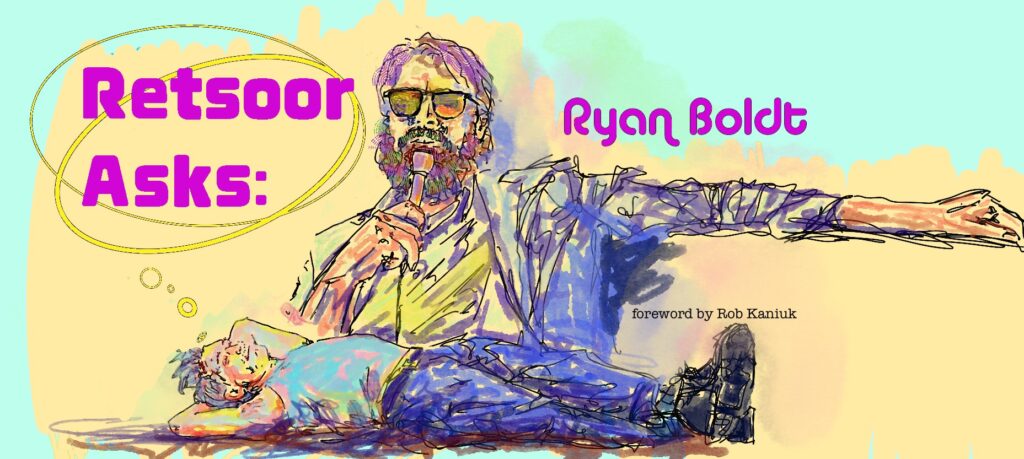
Retsoor Asks: Ryan Boldt of The Deep Dark Woods
Retsoor: Can people change?
Ryan Boldt: Of course! I’m a different person upon return from each tour. It can be hard, sometimes I’m a person I like, and other times I can’t wait to get back on the road so I can come home again and hopefully be the type of person I like and others like, especially my wife and daughter. If I’m home too long without any scheduled tours, I start slowly changing in a negative way. I have to keep my mind straight and not watch news programs or sit on my phone looking at all the hellish garbage happening across the world. That’s the most important way to preserve the person I like when I return home.
I believe that in order to be a good artist, you have to allow yourself to age and change, or else you’ll end up like so many 1970s rock stars that still want to be 20 years old, which can be quite nauseating.
RS:Is the belief in God a choice?
RB: It starts off as inherited, and then as you age, you have to make a choice whether you believe in God or believe in nothing. I’ve made my choice, so, yes.
RS:Is everything singular or plural?
RB: We have choices throughout life, but those choices accumulate into one event.
RS:What percentage of the world is evil?
RB: It’s a lot more than I would’ve thought a couple of years ago. It’s quite depressing, to be honest.
RS:What % of your personality can you choose?
RB: I didn’t choose any part of my personality. I’m a mashup of all of my ancestors. I try to tame certain parts of my personality and nurture the good parts, but that can be hard, especially when we’re bombarded with hateful and angry internet content at all times. I have to get rid of my phone, but I keep making excuses to myself, and I never do it.
RS: How has mental health affected your creative life?
RB: It is the driving force behind most of my songs. Making music is a way to help with my mental health issues. When I’m playing music and writing, I try to achieve an almost trance-like state of mind where my body and my brain feel kind of numb and relaxed, like I’m high or something. When I’m playing piano at home, I get that feeling often. Onstage, as of late with the current band lineup, Geoff Hilhorst on organ and Mike Silverman on drums, I’m able to zone out most nights. The high I get lasts for several weeks after I return home. This is the reason I play music. It’s a hard thing to explain to someone who has never experienced it. I’m very lucky to have a very understanding wife who has also experienced that same state of mind.
RS:Which parent do you sound like when you’re angry?
RB: Both my parents are very calm when they get angry. I, on the other hand, get angry, and I’m not exactly sure who it came from.
RS:What % of utility have we lost or gained from the internet?
RB: Most of it. We’ve lost our empathy, creativity, and curiosity. We’ve lost our ability to forgive people and converse with people that we disagree with. It’s mainly the social media that has made us lazy and useless. The internet was fun when it was only available on a desktop computer in the corner of your dining room. Now we have been poisoned with a hellish anger that has been caused by the internet. I liked the world prior to the invention of the laptop computer.
RS:Do you do what you do so you don’t get sad or because you are?
RB: I started off playing music and writing songs because I was sad, but nowadays I have to play it to keep myself from being sad. I have to know that there are shows booked and recordings to be made in order to keep myself from being filled with dread. Aside from my family, it’s really the only thing that keeps me feeling sane, that and playing with electronics.
RS: Does answering questions in a public forum worry you or inspire you?
RB: It worries me. I change a lot, and I’m embarrassed by things I’ve said in the past, so I’m usually quite quiet and don’t say a whole lot. That being said, I find these questions much more inspiring than usual questions like “How did you come up with your band name?”
RS: Which list is longer: a list of everything wrong or a list of everything that isn’t?
RB: A list of everything wrong. I should probably change that and start looking at more of the positive things in life, I’d probably be a happier person. It just seems like the world is getting worse. It’s becoming harder and harder to make a living making music. I’ve been forced to work other jobs and after 15 years of being a full-time musician, that can be upsetting. That being said, my life is much happier than it was 10 years ago, I’m not sure if that’s because I’m not constantly on the road or what.
RS:If you had the choice, wouldyouchoosetoliveagainwithoutknowingyouweregivenachoice?
RB: Yes. Maybe I would have become an electrician. I would’ve liked to have been an electrician.
RS: Bonus question: Drugs?
RB: No, thankfully.
RS: Bonus Jeopardy: one small regret (big ones also welcome) I have is:
RB: Wasting my time with people that have taken advantage of me over the years. I’ve realized that, unfortunately, some people aren’t as loyal as I’d hoped.
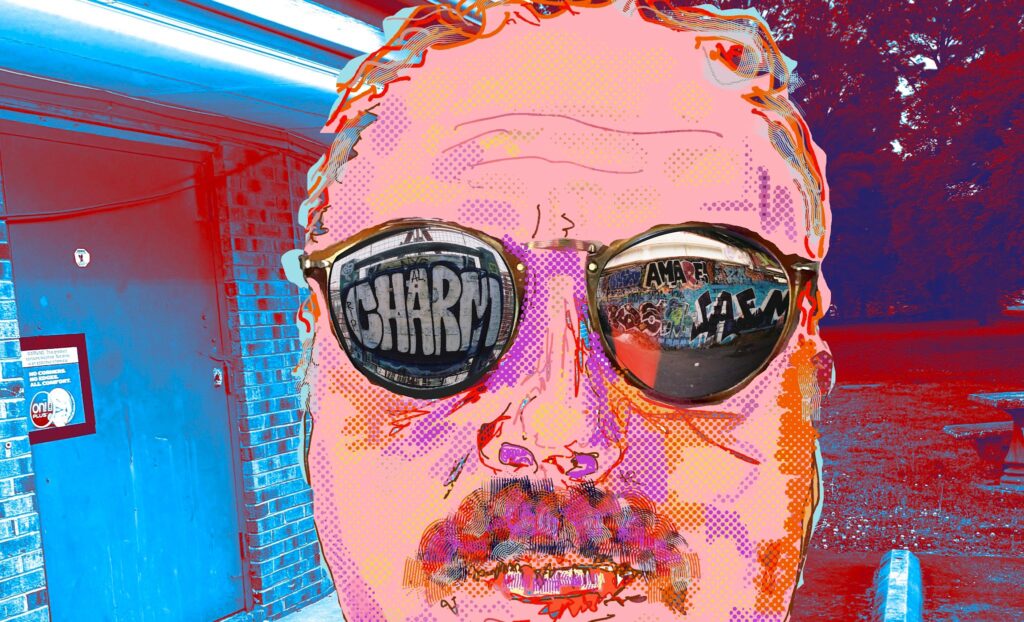
Ryan Boldt is the lead singer and songwriter of the Canadian roots band The Deep Dark Woods. He lives in Ontario Province with his wife, their child, and dog where he spends his spare time curing meats.
Jason Sebastian Russo is a founding member of Mercury Rev, Hopewell and numerous other bands and creative spaces. He holds an MFA from Bennington, was named Lead Scout, holds positions of spiritual guidance with several institutions, and runs the Retsoor accounts, worldwide.
Rob Kaniuk lives in Drexel Hill, Pennsylvania with his wife, Erin, and their dog, Virgil Caine. He runs FT.
At 30,000 feet in the air, on my escape from Fajardo, I began drying out and replaying certain scenes in my head. The conversation with the ferry captain, for one. I had occasion to spend several mornings and cups of coffee with the ferry captain. The ferry runs on the hour from the El Conquistador resort to their private island, Palomino. “Every day back and forth.” He hated his job, bored out of his skull. The emerald waters, craggy coastline. He hated it all with every sinew of his being. “Every day back and forth.” Here he was shepherding rich tourists each day to a private island amidst some of the world’s most serene, natural beauty and the route was poison for him. He looked at the waters and the coastline like an office worker might look at a Microsoft Teams message. I thought about this for a long time.
April 3, 2026
Back at the King’s Motel, mid-Atlantic squalor. The recession has begun.
U.S. fighter jets (2) shot down over Iran. Scant details. Conflicting reports. At least one soldier was successfully rescued and evacuated. Oil up, markets down, Easter weekend.
The United States and Israel are unsure of the new Supreme Leader’s health and have not, at least publicly, acknowledged receiving any proof of life. Iran reported he was injured in the initial strike that killed his father, the old Supreme Leader, and his wife. There has been no evidence he is alive or conscious or well. Dear Leader has mentioned, on several occasions, talking to new people in Iran. While the internal politics of the current regime, in place since the Islamic Revolution in 1979, may be incredibly complicated, shifting suddenly, roles reconfiguring, the Islamic Revolutionary Guard Corps has decidedly proven their skill, power, cohesion, and creativity. Ownership of the Strait of Hormuz is no longer a theoretical question, an incredibly powerful economic and geopolitical victory for Iran. Sanctions against Iran, levied by America, have been lifted, by America, in a desperate attempt to keep oil and jet fuel prices down (and markets up) by allowing Iranian oil to fill gaps in the market. Billions and billions of dollars, now flowing daily into the country that were entirely absent when America started the war. The war it cannot get out of and cannot win, some are saying.
War brings out the beast in people. I am certainly no exception. My ex-wife wants to see me. I do not recall where we last left off or what I last shared. I must be honest: I have been taking a lot of drugs (mostly painkillers and whippets, kratom but that’s to take the edge off, a clinically insane amount of weed but that’s prescribed to me, or was prescribed to me at a tarot reading, three different types of benzodiazepines mostly prescribed though not taken as) and have not written or followed the war or edited or sold my novel (Wartime Author, awaiting press, 2027) or even found someone interested enough to simply say “hey, saw your column. Sometimes it is good. Send me some pages and a synopsis with a couple comps but no more than twenty pages.”
So I have no recollection of what I have shared in these parts and what I have collected for myself to stew on and misinterpret ungraciously at some later date. Where we stand is: the (absurd, ridiculous, there are two sides to every story, no one is a saint, who amongst us, etc…) TRO has been lifted by her at her request. My father, or whoever was giving me shit about it last, can eat a bag of dicks. I am not a danger to myself and others, and the State of Maryland concedes this. I am codified. Look me up, Dad. Your son is so far from a danger to himself and others that there are notarized court documents attesting to such. I mailed her the storage key but I have not gone to Bethesda to claim anything yet. My work gives me occasion to travel to Washington, DC to the center of power of the failing falling American empire in its hedonistic, foul last gasps of a lion era. I will visit a storage facility in Bethesda, Maryland on my next reporting trip. Farewell Transmission covers all expenses, has been nothing but kind. She wrote me the letter. I recited the first line. I still do. I sing it around my room. The temperature changes here so suddenly and drastically in the mid-Atlantic onset of Spring, and I have to constantly change settings on the heating and air unit. The rest of the letter was not terribly incising. I have written her worse. Certainly, and always, longer, which any writer’s partner will tell you is its own suffocating, nasty punishment. We punish each other. We always have. It has at times turned us on and at times turned us off. She will meet me, she thinks, in May, on a beach in New Jersey I have never heard of and whose name I cannot recall. I immediately wonder where the wars will be when I attend to my small, personal battle in May on a beach in New Jersey and I immediately wonder what she might be wearing.
April 4, 2026
Pooh Shiesty got out of jail, linked up with his Dad and robbed Gucci Mane.
I have given up betting on basketball. I am back to my roots, betting on a fight between two men in the ring. But only the sweet science. I have never enjoyed watching men wrestle. Tonight I put two weeks rent at the King’s Motel on Sam Goodman knocking out Rodrigo Ruiz. I know nothing about either fighter. It is just what’s on television right now and I liked the look in Goodman’s eye in the corner and the +400 odds. Round 4 ends and the fight is likely tied. But it’s a twelve round fight. If I lose this I have to find a mail room gig through the office services temp agency this week. If I win I can avoid this psychic damage. Tomorrow is Easter.
The fight goes the distance. Monday I will have to call Carol. Carol controls the couriers, the mail rooms, the corporate caterers in this sputtering downtown. I will have to take whatever she can find me, and pray I do not have to shave.
The pilot from one of the downed fighter jets is being hunted by the Americans and the Iranians. The Israelis as well. The mighty American military, so far losing bigly in this war (Iran more powerful as a state regardless of regime, strained international relations and loss of any trust and faith left with all of our allies except, notably, Israel, loss of American lives, serious ongoing economic costs, etc.) claimed to have destroyed Iranian air defenses. They are apparently still able to shoot our planes out of the sky. Pray the man is found alive by his men.
Dear Leader gives a new deadline for Iran to re-open the Strait of Hormuz: 48 hours. Speculation Dear Leader is at the hospital, a recurring bit.
Conspiracies are usually leaks.
April 5, 2026
12:48 am – Dear Leader announces the missing service member has been rescued, injured but will “be just fine.” It is Easter today.
Dear Leader rises on Easter morning and proclaims to the Iranian people, and the world: “Open the Fuckin’ Strait, you crazy bastards, or you’ll be living in hell – JUST WATCH! Praise be to Allah.”
April 7, 2026
“A whole civilization will die tonight, never to be brought back again,” he promises.
He changes his mind. Announces a two week ceasefire instead. The ceasefire lasts one minute and 39 seconds.
The ten point plan being discussed to end the war calls for the United States and Israel to stop attacking Iran, for Israel to leave Lebanon, for Iran to open the Strait of Hormuz and receive a $2 million toll for each ship’s passage (it will split these fees with Oman) in lieu of war reparations to further enshrine control over the rules of passage in Hormuz (prior to the war it was an Internationally governed body of water), and all sanctions will be lifted against Iran. An appropriately humiliating defeat for America and Israel.
April 8, 2026
Israel attacks Lebanon. Iran closes the Strait.
April 9, 2026
Days of bed rot, unable to shower or leave my room, I begin to suspect the world as it is and my existence are somehow incompatible. At odds. In a tussle.
An impasse, uneasy truce.
My ed. texts me an article of a parking garage collapse. 1 dead, 2 missing. Incoherent string of texts, i told them this would happen1.
April 11, 2026
There are less hours in a day then you might want, and sometimes far more.
Or else it was some phrase in German. It doesn’t matter. You forget how to write. It happens. Sometimes it happens that you forget how to write. It happens to the best of us.
The worst person you can imagine is purchasing a $1.50 pimento cheese sandwich at Augusta as we speak.
The Vice President, a certified creep, a professional loser and bestselling author (the bastard), is in peace talks with Iran this Saturday while the markets are closed and the strait is closed and my ex-wife has moved in (temporarily) with me at the King’s Motel (primarily for sexual research) and I have become obsessed with Helen DeWitt who revealed this week she turned down a $175,000 literary prize from Yale (no strings attached) because she could not make the promotional (the strings attached) demands work on account of some logistical issues with wifi and European data roaming plans in Berlin and signs of severe depressive episodes and an almost artistically enviable lack of executive function and I come up for air very little as I immerse myself in her words and work, poring over her novels, interviews, profiles, personal history.
Last month’s column was poor form, I think we can all admit this. I was more comfortable in a European war, I will admit. My editor reminds me Russia is at least partially in Asia and I hang up on him. He has left me a voice note begging forgiveness and explaining that “even the greats had bad periods! You are just in a temporary lull. The war has taken a lot out of you!” He’s not wrong, but he’s still an asshole.
Helen Dewitt never had a bad period, I text him. Of course she did, and many at that, but her work never suffered for it. She never would have submitted the putrid piece of shit column I wrote last month, purporting to cover a war and merely relaying headlines often days (sometimes weeks) behind. She would have told Farewell Transmission to go toss itself.
What interests me about Helen DeWitt and why am I fucking my ex-wife again? Both excellent questions I am in no state to answer.
My editor sends me a voice note: they are LAUGHING at you in BATH HOUSES across EUROPEAN CAPITAL CITIES.
April 12, 2026
I think Dear Leader called the Pope a piece of shit or thereabouts. I am trying my damnedest to stay away from the news. I allow myself certain periods with the phone and it must be dedicated to correspondence and crosswords (but not more than two or three a day, ideally). I break my own rules often or pretend to conveniently forget them and accidentally see the United States Navy has been ordered to block the strait of Hormuz and American leaders are talking all kinds of shit about the Pope.
April 21, 2026
We blockaded the blockade and there was a cease fire and there was a threat of decimation, desalination plants, power plants, bridges and there was another cease fire and a ship was seized and ships turned around and a ceasefire was in place and then was not until it was extended.
Dear Leader, his bottom rubbed with baby oil by Israeli Prime Minister and Raging War Criminal Lunatic Netenyahoo, started a war in Iran he can’t get out of and he can’t win. Iran’s air defenses are decimated. In exchange all sanctions are lifted and they get a toll bridge to print money and everyone in the world knows not to fuck with Iran.
These are the relevant, serious truths about the war. My serious truth is I would like to transcend the war. I would like to find a publisher and move out of this motel and I would like the Ukraine war to end so I can stop covering wars on screens, constantly a flow of massacres and human suffering, information, misinformation, lies and propaganda, images of dead schoolchildren and drone footage, missile strikes, cluster maps, and I started to write a novel where I would follow the war from beginning to end and somewhere in the middle there was no end in sight. I was sent to hospital. Now I live in a motel. My ex-wife is still staying here. She rents a co-working space downtown and makes phone calls all day. She tried to do it here once and she slapped the shit out of me for an hour (I liked it) for projectile vomiting and fucking up her call, ruining her life, being a disgusting freak and subhuman and then she left to buy some cigarettes. That was a weird week. Ultimately kratom was a mistake and things are (thankfully) different now.
April 22, 2026
Iran seized three ships in the Strait, fired on three.
April 23, 2026
Ordering bottle service at the club. Velvet booth, the DJ is playing Tom Wait’s The Earth Died Screaming. Several antelope sit down at the table next to me. It has not rained here in months.
A United States soldier on the Madura mission was caught using his classified information to make $400,000 on polymarket betting on the capture of Madura. Dear Leader announces a ceasefire between Israel and Lebanon (we are in a war with Iran).
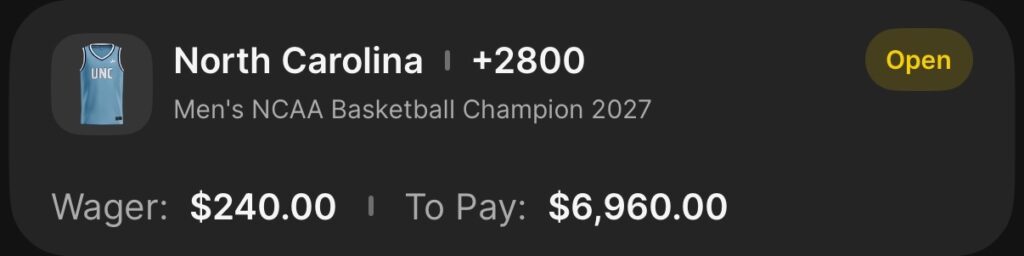
My birthday present to myself was a futures bet on the North Carolina Tarheels winning the men’s national basketball championship in April of 2027.
April 24, 2026
My ex-wife left yesterday. She will be back in a few weeks. It was amicable, very amicable. But in less than 24hrs I am back to old devices, feeling disrupted. I was supposed to copy and paste from one thought to another and forgot. This is the state of American letters. Everyone is very sorry. They gave us screens to look at that fit in our hands. It’s basically over, already. We won. We basically, it’s almost over. It’s almost over already so I don’t understand what the big deal is.
Do you know how much we lost not being present? Not accepting and learning to be bored? To sit with that. To sit with yourself without constant distraction, companion, mahjong tiles, crossword puzzles, and porn in your motherfucking pocket. Don’t worry, it will all be over soon and your services will not be needed.
April 25, 2026
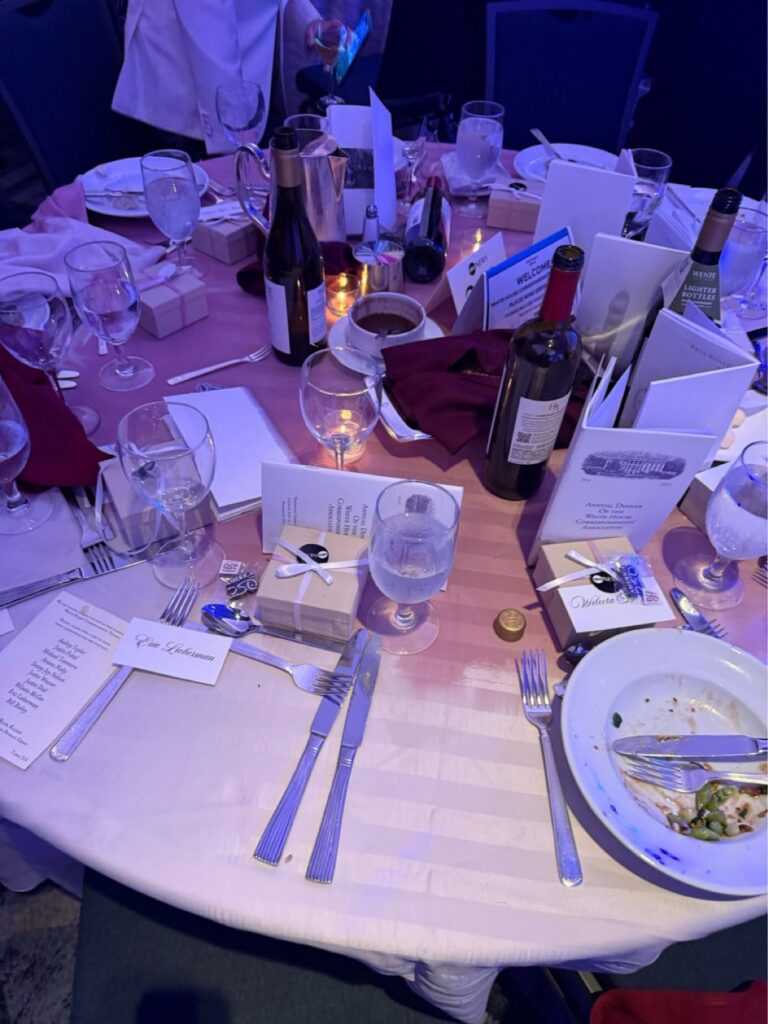
The shooter at the White House Correspondence Dinner has been apprehended.
CNN reports Dear Leader and his cabinet are safe and the dinner program will resume soon.
Events of the evening at the Washington Hilton hotel.
The dinner program will not resume. Dear Leader will give his speech in the White House briefing room.
image courtesy of Secret Ballot
April 26, 2026
Dear Leader says this is why we need the ballroom.
In the initial wave of attacks on Iran, to kick off the war, up to fifty Iranian leaders in the regime were terminated. The new Supreme Leader is disfigured, badly burned and immobile. He receives news by post by horseback. The Iranian republican guard is firmly in control of the Strait of Hormuz and, with it, the fate of the country. Likely we have replaced one hardline violent regime with a new, more ruthless regime. The Middle East, and the world, are significantly less secure.
The White House Correspondence Dinner shooter, Cole, because history demands a failed would-be assassin in the year 2026 be a ‘Cole,’ wrote a little over a thousand words attempting to morally justify the act he set out to do, some history he saw himself performing, a hero, a moralist. Of course it was all bullshit. Political assassinations are never morally good because no one can predict the externalities, butterfly effects, landscape shifting monumental world history moving consequences. Violence is our worst communication means as humans. It does not matter what policy or person or perversion you support. Deportations and displacements are down an estimated 30% since ICE murdered two American citizens a few war columns back. The violence, while celebrated and justified by the hard right, harmed their own political project. We were violent with Iran. A country now controlled by the most extreme islamists to ever rule a country and they have a cash cow toll and world economic disrupter in the Strait of Hormuz. A man, a ‘Cole,’ a tutor from California, takes a train to Washington, DC and checks into the Hilton in DuPont Circle to assassinate the President of The United States and members of his cabinet at the lowest point of Dear Leader’s political career, fails and unifies. Violence is abhorrent even when justified (and here it was most certainly not), often igniting the aims of those you wish to eradicate.
April 28, 2026
Build the ballroom! Open the pools!
I thought I would learn something. I thought something would reveal itself to me. Nothing ever did.
At the sound bath tonight, in the Womb Room of a local yoga studio, I lie in the back, pills kicking in, sobbed silently uncontrollably and realized I cannot fight or write my way out of this, or any, war.
I have to go to bed early tonight and I have to wear my cpap machine because tomorrow I have to meet with Carol and shuffle papers in one of the dimly lit aggressively air conditioned hell box big glass buildings downtown. My gambling led me here and I deserve it. It’s even a little good for the soul, I’d argue, to simmer in the goop of it all for a while. Its numbing powers are transcendent. Perhaps that is exactly what I need? What war? What novel? I have hundreds of readers and several secret admirers. And if the North Carolina Tarheels win the national championship 11 months from now I will have seven racks. I wish someone would bet against me.
Derek Maine writes about the war for Farewell Transmission.
A parking garage being built in the Grays Ferry neighborhood of Philadelphia collapsed. It occurred in a stairwell when a precast section of the roof failed, which had a pancake effect, rendering the multi-level structure unsafe to enter. One member of Ironworkers 401 was pulled from the collapse, but died in hospital shortly after. Two others would be exhumed from the stairwell after demolition made it safe to enter the site. The Children’s Hospital of Philadelphia pushed this project through a rigorous schedule, and harsh resistance from the community. Pre cast is huge concrete sections made off-site, often years in advance of a project, then stored, often outside, in the cold rain and snow, to be deployed on schedule, by a convoy of big-rigs, lifted by crane, and set by highly skilled iron workers. Steel bends. You can burn a new hole, use the end of the wrench and drift a piece (essentially bend) into place so all the bolts line up. Concrete doesn’t. It also takes sometimes months to cure, so this way you can have it built in a third the time. Unless it fails and you have to start over. The city will find blame in this matter, but those who’ve been on these sites know the one to blame is the one who made men who bend steel for a living go and bend concrete. Because it was cheaper. ↩︎
Vegas heat is oppressive. It makes shoe rubber melt into asphalt. The kind of heat that requires dog owners to put literal shoes on their canine’s paws in the summertime.
I drive to Smith’s Food King to buy some Monster Energy drinks. The white ones. I get the drinks and put them in my cart.
I slouch down a few more aisles with no real goal. The cereal aisle screams with loud colors and cartoonish fonts. I add a box of Trix to my cart. A man starts talking to me, and I wish I had my AirPods in.
“None of this stuff is good for us, but here we are, right?”
“Right.”
“Health is the most valuable thing there is. It’s not money. If we’re rich but sick, then what do we really have.”
“That’s a good point.”
“Have a good one, brother.”
“You too.”
I escape the aisle and head for checkout. Gotta get out before another impromptu conversation. Without AirPods, it’s too risky to be in here like this.
The Dalai Lama once said that the ultimate source of happiness is not money and power, but warm-heartedness. But the Dalai Lama is rich. His net worth is 150 mil––so much for that vow of poverty. And before you tell me about how it’s held in a foundation and that he doesn’t have access to it, et cetera, et cetera, what I know is this: his rent is always covered, he has book deals, and that pad in Dharamshala isn’t exactly a dump.
I feel myself atrophy in the parking lot. The palm trees look like candles on a birthday cake, waiting to be lit by the waves of heat radiating off parked cars and abandoned shopping carts on Tropicana.
Conrad Joseph Walsh writes fiction and essays exploring disillusionment, absurdity, and the quiet pressures of modern life. His work has appeared in Expat and elsewhere online. He lives in the American Southwest.
I’m not giving up, but I won’t lie to you: I’m starting to get really tired
It feels like we’re going backwards. No, I know we’re going backwards. Everyone believes we’re the generation that’s going to fix this, but I don’t think we will. I don’t think we ever will.
My dad might still have his November 2008 copy of the Chicago Defender, and I am still able to walk freely in the halls of these ivory towers because Brown V Board passed barely a decade after my father was born, and yet every single day I wonder if all my fuck ups are going to be the reason why the next incoming class in my med school might have no Black students.
The bold, defiant tone I speak with is somehow more hated by third-term Obama liberals I know as my fellow peers than the white man that called me a nigger when I went to pick up my chipotle order the other day. How broken must we be that when I scroll my social media I see more people crying over the fact that we will likely never live under an institution ruled by another Black war criminal. How broken must I be that I, who openly calls that man a war criminal, am still willing to waste 270 characters defending said war criminal in a tweet, because that term has been reduced to another dog-whistle; another word and phrase that I’ve come to hate, alongside “well-spoken,” “educated,” “polished.”
“Akata.”
How broken must we be that we’re going backwards because my people have always moved forward; that we are capable of occupying the spaces built by our own blood, at the cost of the morals and sufferings of our past ancestors being used in speeches about inclusion and progress, as we are now able to participate in imperialistic bombing campaigns and rewriting laws that if we had not undone, we would not be able to be the ones undoing them because we’d still be blocked.
I still hold sympathy for my people who once believed we could change the evil of this world, only to find themselves complicit. Even as I watch families torn apart and children born beneath rubble, I’m still getting text messages from my classmates who are more concerned with the language I use to fight oppression than recognizing the privilege of never having to have fight for the basic civil liberty of sitting down and studying for fifteen hours straight to take a poorly written med school midterm.
Hush little baby please don’t cry, I want you to dream of lights and stars tonight.
When I was a child, I used to have this nightmare about a dinosaur chasing me. If my mother wasn’t shaking me awake, it would often be my sudden jolt and eruption of sobs that would cause her to wake up. My dad would rush in from the living room to help my mom calm down my non-stop babbling about how I don’t want the dinosaur to kill me. Eventually, I would fall back asleep, clutching my favorite brown teddy bear, hoping she would absorb the nightmares.
When I’d wake up the next morning, I could feel how puffy my eyes were. Sometimes as an extra present, I’d have more snot than usual falling down my nose. Though most notably, once I truly was awake and aware of my surroundings, I could recognize physically and mentally that something had shifted; I felt this notable disorientated feeling. At age four I did not know nor use that word, so in four-year-old terms, I felt “crummy” and “bleh.”
Sometimes, my mom was still asleep in her bed or the couch (depending on where I was sleeping that night), or she was already in the kitchen cooking breakfast (or lunch if it was a really bad cry that tired me out). I slowly walked to the bathroom, aware that my vision was slightly worse than normal, especially when I’d bump into the corner of the brown dresser in the room. When I looked at myself in the mirror, it was more terrifying to see how a silly dream that I made up in my head could put me in such a state in which I looked so awful. I felt like I was looking at a shell of myself. I was one year shy of seeing Evanescence’s “Everybody’s Fool” music video but it’s almost uncanny how I created the mirror scene on my own—minus smashing my hand and cutting myself. I’d touch the bags under my eyes, thinking if I pushed down hard enough, the bags would deflate. I’d try to smile and bring back the image of myself that I was used to seeing; one that wasn’t this disheveled. It was futile. The smile would dissipate, and it felt like I was looking at a horror scene. I knew if my mom saw how I looked, she’d worry. So I’d splash cold water on my face (I didn’t know about the ice-cube/spoon-in-freezer trick yet) to reduce the puffiness. Once my mom was awake or done in the kitchen, I’d call her to help me brush my teeth and get ready for the day. She never really asked me more about the nightmares. In retrospect, I’m glad she never did; it almost felt quite nice to leave the nightmare behind and simply move on. She’d walk away to get an extra towel for my bath, but in the seven seconds she was gone, I’d look back in the mirror, touch those eyebags once more and turn away.
I couldn’t swear away nightmares, but I certainly wanted to do whatever I could to avoid them. So, my bright idea: constantly do things that made me happy in the day. I would beg my mom to let us go on a walk in the park across the street or head to the playground two blocks away from the Jewel-Osco we bought groceries at. It was the distraction I needed. If we couldn’t get time to go out, I’d reread some of my favorite books (while complaining to my mom we needed another dollar tree or library run) to my teddy bears and barbies till it was TV time and I could watch Cyberchase. Ultimately, I was distracted, and it felt freeing. I felt so sure that as long I kept this routine up, the nightmares would cease.
And then I joined the gifted program in kindergarten and learned that nightmares could happen in the day and come in the form of other kids. In 1st grade, the arguments turned into yelling, and I started to fall in love with silence. In 2nd grade, I looked for new coping mechanisms and found sharpening a pencil and digging it into my right arm gave me the relief I needed. In 5th grade, I started hoping and begging my mind to give me the dinosaur nightmares in place of watching my home fall apart, and the fast-growing apathy and hate I felt towards myself.
I don’t remember when I stopped being afraid to see what I looked like in the mirror. All I know is that I started to become grateful to wake up and see my disheveled state.
It meant that I was still alive.
I want to be a mother
I want to be a mother. I want to be a good mother. I want to be a better mother than my mother was, not that she wasn’t good or that she didn’t love me, but that I don’t want my daughter to end up like me. I want my daughter to never think about the number of calories in a frappe. I want her to never fear telling me how she feels. She should be able to complete her sentences and not just fall into silence, keeping her true feelings to herself. I want her to always believe in Santa Claus and the Tooth Fairy, maybe not forever, but longer than age 6. Maybe till she’s 10. That might be too old. I don’t know what age you’re supposed to stop believing in those things, but I know I didn’t believe long enough. I want her to walk in sneakers and heels, or whichever one she likes more, I’ll get her as many as possible in all her favorite colors. I want her to never wake up with the walls of her bedroom rumbling from audio vibrations, if so, it must only come from the TV, never from my voice or her dad’s. I want to nurse all her tummy aches, sing her songs even after she’s fallen into REM, and dance with her even when I don’t want to get up from the ground. I hope she never finds my pill bottles. I hope she never asks about the girls in old photos of mine that I don’t know anymore, and I can spare her from learning the complicated dynamics of friendships and the heartbreak that it can come with. Maybe she’ll know how to make friends better than me, so she’ll never have to learn how to heal from losing what you thought would be life long-friendships. Maybe she won’t have to learn that it will take about a year before you can talk about those people and recall memories without feeling that ache in your stomach and tears welling up in your eyes. Frankly, I hope she wakes up from nightmares about dinosaurs and unintelligible objects, and never from the things I said to her, or the things she says to herself in her head. I want to be a mother. I want to be a good mother. I want to be a better mother than my mother was, not that she wasn’t good or that she didn’t love me. I just don’t want my daughter to wish that her mother would’ve taken SSRIs and believed in therapists as much as she believed in the Lord. I don’t want my daughter to end up writing stupid prose poems at 11:28pm on a Saturday about how she hopes she doesn’t fuck up as a mother, not because I think my mother fucked up. But because I am fucked up, for a lot of reasons. Some of those reasons just happen to include my mother.
Dread without the Jenga Pieces
1:23am:
I can sometimes be a scaredy-cat. Isn’t everyone? No, well, okay then. No, it’s fine, I might as well just be honest here. Yes, I am a scaredy-cat. Anytime I play Mario Kart with my cousins, I request levels that don’t have any of the chain-champers or whatever those fucking creepy blocks are called that fall on your head. Thwomps? Thwamps? Whatever. It is not even fear in a jumpscare manner. It’s just, like, seeing a face turn angry and move quickly to attack that freaks me out. I’m not explaining this right but whatever. Overall, I’m not into scary games or scary movies, though I know a lot about the Five Nights at Freddy’s games from watching all my favorite YouTubers play it. Their reactions to the jump scares are funny so it seems weird that I can handle that type of content, but I can never play any of the complicated Mario Kart levels with the things that scare me or I’ll cry.This is a really stupid confession. I don’t know, I have so many other things that I’m scared of, but I feel like they are things I bring up that inevitably separates myself from people. I’d rather confess about Mario Kart than all the intrusive thoughts I’m fighting back acting on every single moment. But it’s so hard, you know?
You’re supposed to be able to talk to your friends about how you’re doing. I want to tell people that I’m not doing okay. I want to tell people that I’m not really suicidal. I’m not suicidal, like, I’m not. I guess there are times that I just want everything to stop and be silent, but not in a dead kind of way. Or sort of in a dead kind of way. I know they say to reach out to your friends and be honest, but I think I share too much that it scares people or stresses them out. I become the stressful friend, instead of the strong friend confessing I’m having a rough time and I just want someone to know I’m working on it but I’m struggling. I don’t want to push people away, but I also don’t want to keep being open and honest with people about how I’m doing, just to wake up the next morning to discover I’m blocked. It’s a double-edged sword. When I keep everything in, I get hurt. When I decide that I need to free up some gigabytes of storage, I let the choir sing, echoing in a long, empty hall. I share, I laugh, I sob, and end up alone. I get even more hurt waking up to find out that the people I thought I could trust decided I was too much and completely deleted a relationship like it was nothing. Like those years of laughs and hugs was all for nothing. Like my honesty was some kind of contagious disease people needed to protect themselves from.
I just want to be like everyone else who has these struggles but can maintain friendships. What is wrong with me? Was there just some unspoken guideline everyone else got at the beginning of adulthood that never got updated for me? I really want to tell others how I’m doing but it’s nice having people to text and I don’t want my phone to go dry again. Please, I just need someone to tell me what the fuck I should do so this doesn’t dissolve once more.
“…… [chat gpt generating a response].”
Naa Asheley Ashitey is a Chicago-born writer and MD–PhD candidate at the University of Wisconsin–Madison. A first-generation, low-income Ghanaian-American and University of Chicago alumna, she writes at the intersection of race, medicine, and belonging.
Her creative and editorial writing examines how policy, media, and academia reproduce structural violence—and what it means to resist with truth.
Her creative work appears or is forthcoming in Eunoia Review, BULL, Hobart, Michigan City Review of Books, and editorials for The Xylom, MedPage Today and KevinMD. She has been nominated for multiple awards, including Best Small Fiction. More at NaaAshitey.com.
The DJ has just started a new job on a new radio station that plays Tori Amos and makes people in the small town very angry.
The reporter lives in the small town and has noticed that the radio is playing Tori Amos instead of oldies.
One of the things the DJ likes about the radio station is how he simply projects into cars and rooms he will never see if he doesn’t want to, which mostly he does not.
The reporter clandestinely listens to him in one of these rooms. It is the Computer Room. The reporter is 14.
#
The DJ lives in one of those townhome developments off the highway. He doesn’t yet know anybody in town, and his life is a vector between his townhome and the station. He is a little lonely but mostly fine.
The reporter lives in a different development on the other side of town, one that is lush with sodded bluegrass carpets and Bartlett pear trees that shower rubbery leaves all over the damp sidewalk on days like today.
The reporter’s parents have taken the modem from the Computer Room. I hate them, she thinks.
Across town the DJ is cozy at work in the studio, sipping herbal tea between the different little on-air bits he does. “Hey, I’m The Oracle and that was Tori Amos, of course, with ‘Crucify.’”
The DJ likes that record but honestly he’s a little pissed off about the new mandate he’s gotten from the media conglomerate who bought the station. He looks with disdain at the printout that lists the mandatory top 25 rotation, all of which he must fit in “organically” during his slot. “And next up? We’ve got Suzanne Vega with ‘Tom’s Diner.’”
The reporter comes home and stomps up to her room and turns on her radio and she is SO HAPPY when she hears “Tom’s Diner.”
The DJ looks at his watch and is worried that if he doesn’t have enough time left to get through the mandatory top 25 rotation, he’ll get put on DJ probation. This would not be good; it has happened to him once before. In that case he was simply reading a public service announcement and made some unfortunate flourishes with language that were not appropriate for the time of day.
The reporter is pacing around her room, thinking about all the instant messaging she could be doing were the modem not in modem jail. Recently, she has obtained an internet boyfriend and is now more eager even than usual to hear that clickity clack static and the “YOU’VE GOT MAIL!”
Sometimes when her father wants to make her angry he teases her by announcing “YOU’VE GOT MAIL!” whenever he enters a room.
#
After school the next day the reporter comes home to find that her parents have relented and the modem is plugged back in. No one is home to tell her otherwise so she logs in, finds no mail, clicks around a bit.
Inspired by her growing stack of SPIN magazines, she has started to make her own website, accessible via the World Wide Web. She has figured out that she can make Word documents and save them as .html files. She likes trying out different backgrounds. She has learned how to loop an image over and over and over. She can, for example, make a page with a background that looks like stars in an infinitely scrolling sky. It’s hard to read the writing on that particular background, though.
Once she has her home page arranged enough, she opens her email and writes the DJ. He is going to be the first interview for her new online magazine on the World Wide Web.
#
The DJ wakes up to start his Saturday, and feels the paunch of middle age sliding down his hips when he gets up from the couch. He thinks he should start exercising soon, probably. He lights a cigarette and gets coffee going.
He goes over to the computer and logs in. “WELCOME! YOU’VE GOT MAIL!”
TheOracle107@aol.comclicks on his inbox. He skims the subject lines, deletes some scams. There is a note from an address he hasn’t seen before. He opens the email.
Dear Mr. The Oracle,I am looking to interview respected figures in music culture for my magazine. I really enjoy listening to your show and have found a lot of my favorite artists because of you. Do you think I can interview you? We can do this over IM. Respectfully, Laurel M.”
He cackles. Dear Mr. The Oracle!
“Sure,” he writes the reporter. “Call me Dave, though. IM is fine. I’m around today.”
Sent. Whoosh.
“YOU’VE GOT MAIL!” comes the call to the reporter’s post in the computer room. After she opens her mailbox and reads the note, she checks and sees that TheOracle107 is online!
“Hey,” she types into the void.
“Hi,” the DJ answers back.
They get to talking. The morning zips by. The reporter’s questions are a bit timid. The DJ imagines she’s maybe just out of college, doing her first internship at a radio station somewhere.
The reporter cannot believe her luck. What a coup for the first issue.
They chat for a while, mostly about the music itself but a little about themselves, what they like, what movies they’re watching lately. The flow of their rapport makes the DJ relax a little bit too much and he catches himself complaining about work, about how that’s changed. He realizes he’s holding his breath when he thinks about that.
After the conversation winds down, the reporter copies and pastes the chat transcript into a Word doc, which she plans to edit later.
The reporter asks the DJ if he has a bio.
“Sure,” he types. “All celebrity DJs do.”
#
Later that night, the reporter is still situated in the Computer Room when she hears the shrill demand for her to appear at the dinner table “right this minute.” She complies.
“I will take this to go,” she says, grabbing the Schwann’s breaded chicken patty with rice pilaf accoutrement. “I am working.”
Back in the Computer Room, enraptured by the sallow light of the cathode ray tube, the reporter can feel a piece of herself float up from the top of her head and dissipate into a realm that knows neither time nor space. This piece bears little relation to the crepuscular creature in the chair.
She opens the 30 second sample clip of “I’ll Be There For You” by the Rembrandts that she downloaded and plays it a few times in a row.
The DJ is alone again in his apartment. I should try harder to make friends, he thinks. Instead, he makes his way to his desktop and clicks the icon.
“WELCOME!”
There is always a little pause between the welcome and the announcement of mail. In this pause, hopes and dreams are made and crushed; the reporter knows this as well, if not better, than the DJ. The reporter is in the throes of a full-blown internet addiction, whereas the DJ is just a bit bored.
The DJ has no mail, but sees the reporter’s handle in the chat box.
The reporter is busily typing a very long-winded fiction to her internet boyfriend about her daily activities. In the fiction, she has been invited to a party, and she’s going to the mall with some friends to pick out an outfit. It’s hard sometimes to keep the reality from straining into the fiction, especially when she’s nearing the time of day when she has to shut everything down and prepare for the next morning. The mornings are firmly grounded in a horrible reality, with no room for the fiction.
Because she is no dummy, she also includes a critique of a long, old book she has not read.
Satisfied and clicking “send,” she is surprised when she sees a new window, an invitation to converse with Mr. The Oracle.
“Hey!” she writes.
“Sorry to bug.”
“Not bugging.”
“Wondering if you needed anything else. For the magazine.”
“Hmmm I haven’t really finished the article just yet. Been really busy at work.”
The reporter re-enters her body. Her eyes flash around the room, as if some source of information could possibly leak details of her appearance or her life through IM.
“Oh yeah cool cool,” he says.
The DJ thinks he sounds dull. Why does he care?
“I’m really close though, like going to finish it soon. It’ll be great.”
“Yeah.”
“How are you? Are you doing well, or are you also staring directly into the meaningless nothing?”
He laughs, out loud, at that, and starts typing again.
#
For a few days in a row now, the reporter has been corresponding with the DJ in short bursts on instant message. They haven’t gone too deep on any one thing; mostly she talks to him about music she likes. She gets some recommendations from him and tells him a few lies to make her reading life sound smart.
She tells him about how, at Circuit City, she sometimes hides CDs in the wrong alphabetical order so that they will be there the next time she comes, and that is when he asks her: “Do you want to grab a drink?”
She blinks.
Her cheeks redden. Even though she knows the doors are closed, she looks over her shoulder. She is smart! She is desirable! She is, as her internet boyfriend told her while they were having “cyber” yesterday, “so sexy.” The DJ wants to go get a drink with her.
Don’t worry. This is not that kind of story.
Her mind doesn’t go to the after school special place where older men take advantage of girls, kidnapping them from sleepy midwestern towns and making them their slaves in some creepy cabin in the woods. She’s not even thinking about age at all, or questioning the DJ’s motives, or remembering that she’s been frequently told she comes off as older and more mature in her writing.
Instead, her thoughts go to a different place, a softer place. There is heat there, and she feels some possibilities opening up to her that she’d never before considered. In her life, there is an unbreakable wall that separates her from the notions of desire, and from being desired. In her internet life, she is the recipient of genuine feelings from her internet boyfriend, and also she begins to inhabit the life that she projects to him. When she wakes up in the morning, there is a small, clouded window of time when she is no longer inhabiting her life, but her other life, and her other life is exactly how she wants it.
When her internet boyfriend ::leans in and plays gently with hair::, she feels the flutters in her heart that all the adult contemporary radio programming has promised there would be.
She feels that finally, here in the other space, she has become desired, desirable.
“Soooo ummmm” she types, and adds a smiley face with a nose, which seems less flirtatious than the smiley face without the nose. “I have a boyfriend actually, sorry.”
Across town, the DJ is listening to the new Soundgarden record and flipping between windows of his web browser when he registers the sound of her response. He had gotten deep into a Usenet forum rabbit hole and had totally forgotten he had offered the reporter a date.
It bloops again. “Sorry, r u mad?”
“Oh no haha all good,” he assures her, then closes the window.
Jenn Salcido is a writer from Los Angeles. Her short fiction has appeared in Vlad Mag, Zac Smith’s Chrismzine, X-R-A-Y, JAKE, and Back Patio Press. You can read her work at www.jennsalcido.com.
Here we plumb the depths of human misery, the shape of our national boredom.
For the second time in a week bad actors have taken control of my social accounts, this time on the convenient cusp of my new war column. I have too many things to do to pay their ransom or fight this intrusion. My glasses, for one, are broken. I have to call the glasses company and make an appointment. Life is filled with such indignities. I am also, of course, keeping a pulse on the international mood, shipping routes, airspace, the flow of capital, oil, and human atrocities. Some take to the streets to celebrate, some to protest. Reports of a school being bombed in Tehran. A council of clergy has convened, called to select the new Supreme Leader of Iran.
Outside my room at the King’s Motel, on the Lord’s Day and before noon at that, I ask a suspiciously clean, well-dressed teenaged boy, clearly lost or trying his hand at a weekend runaway, what his people on the ground were saying about the war in Iran. Instead of answering my question, he looked at me with cold, fish scale eyes, and said “There’s a healthy debate to be had, but I take the side that Clavicular was not brutally frame mogged by the ASU frat leader.” I immediately went inside my room and took more drugs.
March 2, 2026
America struck a girl’s elementary school in Iran over the weekend, killing at least 50 schoolchildren.
Operation Epic Fury. The Department of War. Everything sounds like a bad marketing slogan for a failed video game in this reactionary circus world, here in the early days of the second quarter of the century. It is impossible to follow a war on the local news these days, I can promise you. My phone is submerged in the bathtub. I am still locked out of all my social media accounts and have been since Operation Epic Fury began.
Dear Leader said the war will end when our objectives are met. The drunk Secretary of War rambled incoherently when asked what the objectives of the war are, stumbling through a mealy mouthed response of nonsense, first ignoring the question until mid-monologue he’d clearly forgotten it entirely. The largest American military operation in a generation. Objectives unclear.
Dear Leader, last night, on a phone call, says he got the Supreme Leader before the Ayatollah could get him. He said they tried twice and failed.
A shooter in Austin wearing a shirt with the Iranian flag and the words “Property of Allah” in large font initiated a mass casualty event at the center of Austin’s joyous, raucous, West Six Street, hits sixteen, three deceased (as of this hour) and thirteen injured and, the shooter, a 53 year old Senegalese man, naturalized American citizen, is killed on scene by the responding officers. A man with almost no past. In 2022 a vehicle collision in Texas. Warrants out at a home in Pflugerville.
March 3, 2026
Instructions to American citizens stranded in Israel while airspace is closed were to listen to evacuation orders and shelter in place, delivered cheerfully by the white-bearded GLP-1 goober and absolute boob Mike Huckabee, U.S. Ambassador to Israel. The Italians chartered a plane to bring their citizens home.
“Objective? You don’t need no objective in war,” Charles laughed at me tonight when I suggested America’s lack of objectives in the war we just started was concerning. “War is the objective,” he told me. “Always.”
The spam calls are increasing by the hour. I turn my phone over and stare at a larger screen instead. Maps, hot zones, cluster graphs, topologies, troop movements, casualty counts sear into me. I take several doses of gummy bear drugs at once before I swallow a pill then a second. The rest of my ex-wife’s letter was thematically consistent with its first line. My war is small and over and I lost resoundingly.
March 4, 2026
There are so many insane people, delusional, just certified whackos and it’s so beautiful. These are the prophets.
March 5, 2026
For our 250th birthday, the 250th anniversary of a country, born of conquering and colonization, that still became an idea, a promise, a dream, a super power, will celebrate by fighting war in the Middle East. I have only lived 44 of those 250 years (17.6%) but most of them my country has spent tax dollars and blood in the Middle East. I have been thinking about this lately.
The people came to the Oval Office to lay their hands on Dear Leader and pray. The camera crew, the whole production. We watched so much television, in America, we became television.
I shut it all off and spend the day reading BLT, the website listing all BASE jumping deaths.
March 6, 2026
The influencers are under fire in Dubai.
March 8, 2026
There are signs of spring everywhere, even in the cracks of the sidewalks. The dogwood trees are in full bloom. You will come to understand, if you stick with me on this ride1, how important the seasons are to me. I structure my life around them.
Iran has selected the Supreme Leader’s son to be the new Supreme Leader. You will see, these things happen. The son usually inherits the father’s friends, enemies, debts public and private, and wars.
The United States will, of course, be asking OpenAI, the once non-profit large language model artificial intelligence institute, to precisely locate and kill the son.
March 9, 2026
Hundreds of young girls, schoolchildren, under ten.
They are talking about “drinking water and AI” on Bloomberg News tonight. “But first, Stacy, let’s take a look at the headlines. Of course there’s a war in Iran, we’ll get to that, but it is an election year and we had our first primary…” I hang up and eat three cigarettes. I make a Manhattan to calm myself down. I am expecting a young dame to call for my help finding her husband any day now. I put a sign on my red door, room 26, “Private Investigations.”
The rest of the letter didn’t hurt as much as the first line, which always was her problem as a writer. She’s a quipper. She quips. She listed her demands. I may have listed them here already. I forget them just now. She has every right to, of course. All these things and more are under serious consideration. I need time to consider. Space, your therapist called it.
Sudden realization that I cannot run for office.
Too much heat.
Dear Leader tells the news station the “war is pretty much over now.”
The war is done basically almost, he says. We have destroyed them. We double tapped a girl’s school on the first day, killing 165. First the children and then the parents that came running for their children. We did this on the first day of the war we started against Iran alongside Israel. Iran elected the Supreme Leader’s son, the hardline 57 year old whose wife and father were just killed by American and Israeli strikes to set off the war, on the same day of the school strike, to be the new Supreme Leader. Dear Leader says it’s almost done (basically is) but also there will be strikes TWENTY TIMES HARDER if they fuck with the Strait of Hormuz. Dear Leader does not fuck around when it comes to oil, the market, and real estate. ‘Death, Fire and Fury will reign upon them,’ he says and I believe him.
All of life, too, is energy, of vastly varied sizes and configurations, bouncing off each other, just as we bounce off each other and it is painful and beautiful, incredibly difficult, true suffering and true love, but it is a temporary dance for us souls, as we bounce off each other, our ultimate destination a return to the one soul, and we will see separateness is a cosmic illusion along with time, but a real one we feel here on earth, all of us, and a real clock we deal with on earth, all of us, least of which is our own mortal countdown, the agony, despair, hatred, and contempt we feel down here is real but we shall one day, hopefully long after I have sold Wartime Author to a publisher, reunite with all other bouncing souls as one energy, one love, unshackled from the tyranny of time and space.
March 10, 2026
“Very complete, pretty much.”
In the last few hours America destroyed ten ships in the Strait of Homuz, with Dear Leader publicly boasting more to follow. Inactive mine laying boats. And/or ships. Who knows? It’s war.
America is always the insurer of last resort. Often of their own crimes.
March 11, 2026
The FBI warns Iran may strike California with drones2.
Pentagon reports to Congress the first week of the Iran war cost “more than $11.3 billion.” Gas prices are up. There has been no regime change. California is under warning. Sleeper cells are being activated as we speak, the news screams at me. We started this war.
March 12, 2026
A Lebanese American rammed his vehicle into a Michigan synagogue. There were no injuries. Mahomed Bailor Jalloh, who spent eight years in prison for giving aid to the Islamic State, yelled “Allahu Akbar” in a classroom and starting shooting at Old Dominion University. He was subdued and killed by ROTC students. The news channel reports “the domestic terrorist was unalived by the unarmed students.”
Even our language is embarrassed by our bloodlust, necessary as it sometimes may be. Iran’s new Supreme Leader gives his first statement, not appearing on camera after being injured in the first strikes of the war. He assures everyone that Iran will not refrain from avenging the blood of their martyrs.
March 15, 2026
I have been spending my life outside of the trenches, actively avoiding the war. I bought new designer Italian sunglasses instead. A season is getting ready to turn over and I operate on a seasonal schedule. My employers know this. My bosses at Farewell Transmission are kind, supportive souls. The publisher, the top guy who sits behind the desk and everything, he calls me himself the other day and says, “It’s a twelve month contract, Derek. You can be forgiven a bad month or three. Nobody’s expecting Graham Greene. But we do need copy, we need something. You’re the wartime author, but you cannot just use the pages of this publication, and steal the time of our valued readership, to say nothing of our advertisers and various benefactors, using our space to try and sell your novel. Give me news of the war!”
The beginning of the message was quite kind and soft. By the end I was terrified. Too terrified to write. Research was out of the question. Too terrified to be jumping into a war screen. Unsettled. It’s nothing some magnesium a Klonopin and a little weed won’t cure.
Peter Thiel is in Rome prophesying about the Antichrist.
Dear Leader says we’ll handle Cuba next. He has a prominent Cuban-American in his cabinet. Iran warns the UAE to evacuate ports. America is attacking Iran’s Kharg Island, an important oil hub. Outside of a steady, healthy oil flow to China, still no shipping going through the Strait of Hormuz, choking the global energy economy. Japan, Korea are suffering. Their oil flows through the Strait. Russian oil is off-limits. Can we interest our Asian allies in Venezuelan black gold?
March 16, 2026
The Strait has never been fully closed. Numerous threats to close it, and partially closed during the Iran-Iraq war in the 80s. It was not closed during the war in Afghanistan. It was not closed during the Lebanese Civil War, the First Intifada, either Gulf War. It closed officially on March 2nd, two weeks ago. America is back, this time with Israel officially, to war in the Middle East. It likely never ends in my lifetime. America comes and kills, sows chaos, leaves a whole wake of destruction, radicalizes some, frees others, gets her dirty hands in religious, political, tribal, and regional rivalries she’s is in no position to resolve or speak on, and America accidentally strikes elementary schools twice, and America is not directly threatened by Iran. Iran is just a murderous, evil regime in a world full of them. America should know.
March 17, 2026
Twenty-five hundred American marines, boots on the ground, are headed to Kharg Island. American allies have refused to join the war. The press secretary said yesterday Iran was not a threat to America and today she said it was, or perhaps the other way around. I refuse to recall at this late hour.
Dubai arrests anyone reporting on the war, an influencer reports.
Western tax evaders are leaving their pets behind in Dubai.
March 18, 2026
I wake up to the news: Cinnabon has cut ties with “The Bachelorette”
March 19, 2026
Israel and America are targeting energy infrastructure and desalination plants in Iran. Israel is also, in its war with Iran, bombing Beirut (in Lebanon).
Iran strikes Saudi Arabia and Qatar energy infrastructure in kind.
Supreme Leader tried to kill Dear Leader, failed, and then Dear Leader killed Supreme Leader. Now he’s stuck in a war, fighting for Israel’s aims. It is a global economic crisis. Dear Leader needs to find a way to claim victory and get the fuck out. Likely the markets will force his hand.
March 21, 2026
There is war and I am supposed to be covering it. But there are so many and I’m usually tired. I need distilled water for my CPAP machine, but have been too depressed to leave my room for at least sixty hours, likely more. I am surviving on a bulk purchase of freezer pops and benzos. A modern cliche. A middle-aged divorce man with a room at The King’s Motel and a monthly column. I keep waiting to wake up and realize I am living my life.
March 22, 2026
The war in Iran is causing fissures in the downtown scene.
Dear Leader issued an official warning to the Iranian state. Iran has 48 hours to re-open the Strait of Hormuz or he will obliterate their power plants, starting with the biggest one first. 48 hours in all capital letters. From this exact time, it says, released by the White House at 8:40 pm yesterday. Everyone loves a countdown. The world stage plays out like a network reality show because America is run by a network reality show host and America always places her thumb on the world stage’s scale.
March 23, 2026
Nevermind. Dear Leader rescinds the threats mere moments before the oil market opens. Cites productive conversations with Iran.
Iran says there have been no conversations.
You would think the markets, by now, would not move at every Dear Leader pronouncement or threat. He is the Boomer’s P.T. Barnum and the Doomer’s idea of anarchy. Of course he is a thief, a liar, a conman, grifter, and is losing his mind live on television (‘and it wasn’t such a great mind to begin with,’ he’d quip), controlling an army (several at once), and now of course he is sending ICE agents to the airports five days before I take a flight to Puerto Rico. This concerns me, keeps me up at this late hour. I tend to travel with drugs. Dear Leader was in Graceland today. He signed a replica of a guitar Elvis used in his 1973 ‘Aloha from Hawaii’ concert. I forget why I am needed in Puerto Rico, but I’m sure I’ll find out when I get there.
March 24, 2026
Dear Leader announces the war is over. Israel seizes part of Southern Lebanon. 1,000 U.S. troops from the 82nd airborne are being deployed to the Middle East. The United States is also increasing the maximum military enlistment age from 34 to 42.
A present from the Iranians arrived today according to Dear Leader. It has to do with oil and gas. He does not want to say what it is. It has to do with oil and gas. It is an extremely nice prize. Now we know we’re talking to the right people, he said.
To keep gas prices down, to hide the cost of war in a midterm election year, Dear Leader lifts sanctions on Iranian oil, an estimated $14B windfall for the country America is at war with.
We don’t know who we are talking to, but we know they are the right people.
March 25, 2026
I wake up free of the war. Who am I to quibble? Who am I to argue with the man who started the war? Am I not a model citizen? Dear Leader says the war is over and we won. Excellent news. The cost of winning included, among other losses, the elementary school we bombed twice on the first day and now clear certainty that Iran does, in fact, control the Strait of Hormuz. What was once a theoretical question is now resolved and Iran’s power as a nation, in proving its ability to disrupt global trade and economics, increases greatly. We managed to kill the Supreme Leader (86) and have him quickly replaced by his son, the more hardline of the two and a man whose wife and father we just killed. Israel says the war goes on, and will go on until Iran’s military capabilities are entirely decimated. Dear Leader says the war is over, and we won. Most suspect the troops headed there will attempt to take Kharg Island over the weekend, when the markets are closed. It’s over and we won. You can just say things. You can say anything. Say it with your chest. Anyone who disagrees is an enemy and will be treated as such. Another war won for America in its continued, moral mission to make the world in its image.
Thank God for this country.
I recall screaming most of this as I was being forcibly removed from the vape shop. I recall little else of last night, and today has been spent sleeping it off. I depart for Puerto Rico in three days, basically two. I have been avoiding my editor, but he will be on my ass sooner rather than later for copy.
March 26, 2026
Dear Leader extends his deadline for Iran to open the Strait of Hormuz (again). My editors are not as pliable. My own deadline is tomorrow, regardless of the state of international shipping.
The White House official social media accounts are posting cryptic highly pixelated images of Dear Leader and his deputies. It’s almost the weekend for the war and it’s almost Puerto Rico for me.
March 27, 2026
Tiger Woods was always a tragic figure.
Iran’s missiles strike America’s Prince Sultan Air Base in Saudi Arabia, wounding ten American soldiers. Dear Leader demands Tiger Woods be pardoned immediately. Two of the soldiers are critically wounded.
March 28, 2026
In a cabinet meeting, amidst the backdrop of our war in Iran, Houthi rebels striking Israel from Yemen, anxious global markets, tolls for safe passage through Iran’s Strait of Hormuz, Dear Leader extolls the virtues of the humble sharpie.
My flight is boarding. Walls close in. The air pressure. An unsettling realization I have let my readers down, my editors down, and am floating through the whims of history uselessly, noticing everything, capturing nothing.
Derek Maine writes about the War for Farewell Transmission.
the twelve contracted months I will be writing this war column, desperately hoping for a publisher, editor, or tastemaker to come along and publish my war novel on the strength of this widely read and critically acclaimed war column. ↩︎
Possible setup for false flag op. Lucky Larry bought the WTC a couple months before they fell and made billions. It is also the only day he ever missed work. Same with Lutnick. Wild put option volume funneled through A.B. Brown, which was formerly run by at-the-time Exec Dir of the CIA, Buzzy Kronard. Mayo Shattuck, who officially ran the shop, resigned a day later. In the wake of the tragedy, the US gov’t issued terrorism insurance (TRIP) in case it ever happened again. TRIP, which covers 80%, expires 12/31/2027. Lucky Larry recently bought the second tallest building in L.A. and took out a massive insurance policy, per the TRIP clause. ↩︎
I hope you and your family are well and looking forward to the Labor Day weekend. The sun is so warm this time of year. This is Jimmy Granes of the Baltimore Orioles. The reason for this letter is to apprise you of my efforts in identifying the Fifth Hit. I hope you will be patient with me; I do not want to leave anything out or anything unclear.
Being a student of the game yourself, you will recall that during Game 1 of the 1886 World’s Championship Series, Chicago White Stockings’ cleanup hitter Fred “Dandelion” Pfeffer was thrown out at second base trying to stretch his RBI single into a double. It is my contention that Pfeffer’s mistake was not an unintentional baserunning blunder, but rather, the first public attempt at finding the Fifth Hit. Before Game 7 of the 1925 World Series between the Washington Senators and the Pittsburgh Pirates, the infield dirt was doused in gasoline and set on fire; ostensibly to dry the rain-soaked diamond, however, contemporaneous records paint a different picture. The diary entry of William McKeen (second-in-command groundskeeper) for October 15th, 1925, reads simply, “It did not work.” Again and again, these trials show up. Aparicio’s fall at third. Germany Schaefer and his steals of first. Manny being Manny? More accurately, in my view: Manny being an astute and diligent investigator of the Fifth Hit.
Single, Double, Triple, Homerun. Single, Double, Triple, Homerun. When did the thought of a fifth emerge? Infielder Mike McGeary and Third Baseman Warren White’s letter correspondence from the years 1885–1891 provides the earliest written evidence. McGeary writes of his ideas (“[A] plump Belgian Draught, salivating on an autumn day”) and White gives his own. McGeary rails against the fools who accuse him of “game-fixing.” White writes, “Time is no longer of a benefit to us.” I have seen these letters, have been allowed to study them through the goodwill of their descendants. White’s great-great-great-grandson, Paul, is a fabulous baker, a wonderful baker; the man can really bake.
In the 1930s, there were a number of ballplayers—dimwits, morons—who argued that the Fifth Hit was merely an inside-the-park homerun; i.e., that the homerun can and must be separated into inside-the-park and outside-the-park and, therefore, five hits. But this was rightfully and forcefully mocked by their successors, and is clearly absurd—inside-the-park and outside-the-park are two different manifestations of one kind of hit, in the same way as one can have a ground-rule double and a traditional double, or a single and a bunt single. These are different flavors of the hit they correspond to, not entirely new ones. Dobermanns and Shih Tzu are both types of dogs. I am sure you agree, Mr. Manfred.
I learned of all of this—though unconsciously, I feel it must have been with me from the start, from the very beginning—only this past off-season. Reading Christy Mathewson’s 1912 baseball history/instruction manual/collection of anecdotes, “Pitching in a Pinch; Or, Baseball from the Inside,” I was struck by this passage:
Then Lobert, the tantalizing Teuton with the bow-legs, whacked out a home run into the left-field bleachers and slowed at third with a mocking smile on his face which would have gotten the late Job’s goat. You would have thought he’d done something more than knock a four-bagger.
“[S]omething more than knock a four-bagger.”
From there, I simply followed the thread. Clear on the history, from the first day of this year’s spring training, I began.
I have attempted more than could possibly be listed here. I have concluded a triple by springing up on my left foot and then striking the base with the intermediate phalanx of my right pinky. I have—and I’m sure you’ve seen the footage—I have hit a bouncing single up the middle and marched, half-step, straight from the bag to the bleachers in center, pulling up my uniform, revealing my pale belly, slapping it as if a dholak drum. I have hit a smoking line drive while visualizing the preposterous mustache of Dr. Thomas Wang (more on the languid doctor later). I have smashed (absolutely barreled) balls with all manner of things in my mouth. A grape. A roofing nail. A hornet. One night, with no one else in the ballpark, I sliced a ball down the line, slid prone into second base, and slowly and meticulously gyrated my groin against it until fruition; but, while a pleasurable double, the hit remained, no less and no more, a double.
Once, on an off day, I thought I found it in the maneuvers of a gas station attendant. I had hit what appeared to be an infield single the day before—could every moment since then, every step and every breath, the shoveled putout in the bottom of the inning, the bumper-to-bumper drive home, the morning coffee with too much Sweet’n Low, could it all have been part of it, part of the Fifth Hit which had now just ended with my gas station attendant, a Mr. Francisco Marcello Capionne—whose hair leaves a lot to be desired—a Mr. Francisco Marcello Capionne, jiggling the aluminum nozzle free, letting the gasoline drip and drip and drip onto the back wheel of my 2024 Lincoln Navigator? But the thought left me as quickly as it came. No, not this time. I paid the man in banknotes.
You know, of course, that I am slashing .314/.427/.658, good for a 193 wRC+, Mr. Robert Manfred? I am leading the league in fWAR by a two-win margin. Over the last three seasons combined, I have accrued almost 28% more value than the man behind me. This is to say: the manager lets me do what I want. Old Tony Mansolino does not believe, but he does not stop me. “Keep it mostly in blowouts,” he says. “I’ll try, skip,” I say, winking. Yesterday I licked home plate clean.
Sometimes I have doubts. Sometimes I wallow. Sometimes the thought pops into my head that this life is nothing but an inexhaustible maze of horrors. But then I remember Mike McGeary’s 28th letter to Warren White, McGeary’s 28th letter to White in which he states, “I know it in its absence.”
In the 17th chapter of the first Book of Samuel it is written, “And he took his staff in his hand, and chose him five smooth stones out of the brook, and put them in a shepherd’s bag which he had, even in a scrip; and his sling was in his hand: and he drew near to the Philistine.” Plato claims the five regular polyhedra—tetrahedron, hexahedron, octahedron, icosahedron, dodecahedron—to be the fundamental building blocks of the physical world. The Hadith enumerate five distinct pillars of Islam. The Pandava brothers (Yudhishthira, Bhima, Arjuna, Nakula, Sahadeva) of the Mahabharata number five. The Fir Bolg chieftains of the Lebor Gabála Érenn number five. Celestial mechanics describes five points, referred to as Lagrange points, where the gravitational pull and centripetal force between any celestial masses are necessarily and always in perfect equilibrium. There are five basic human senses. Five fingers to a hand, five toes to a foot. The Five Holy Wounds of Christ.
Let us not beat around the bush any longer, my esteemed, handsome, well-groomed friend. Let us put all the marbles from the bag onto the end table. The fact is this: My languid, hilariously-mustachioed Dr. Thomas Wang, he of the curled, trembling upper lip and eyes like golden rubies, told me a week ago what I already knew: I am dying. My pancreas is not cooperating with the rest of my body. My remaining time is best denominated in months. You, as such an intelligent baseball man, Mr. Manfred, may have noticed the 193 wRC+ mentioned above, while exceptional, is a whopping 34 points lesser than what I was running as of the end of July. My production will continue to dip and soon I will no longer be able to play; soon I will be counting scuffs on the ceiling and my only hits will be into the bedpan.
Really, this letter is not a briefing; it is a request. If I do not find the Fifth Hit in my dwindling inhales—and I may not, I have no doubt I may not—this letter is a request. Open the fields, Mr. Robert Manfred. Open the fields. That is my request. Fields across this great, lush, green country; men and women and children swinging, experimenting. Making the rules up as they go. New rules no one has ever thought of and old ones no one is left to remember. Thousands and thousands of baseball diamonds, at every school, at every campground, at every workplace. At every prison and every hospital courtyard. In the abandoned alley behind P.S. 112 and in the middle of the White House South Lawn. Long-tressed women snorkeling in Chesapeake Bay. Maybe there is a horseshoe crab. Men of all sizes giving yellow-throated birds something nice. Perhaps a small bear filled with sand. Young girls eating cotton candy through their nose and wiggling out their last baby tooth, tossing it, hitting it real good alright with a metal bat. Little boys hopped up on Shirley Temples, so many Shirley Temples, outrageously above any reasonable serving size recommendation of Shirley Temples, jitterbugging wild to Songs of the North American Bullfrog. A film projector that doesn’t work well. Big-time scrapes, thorn bites left unbandaged. Pencils. Become the commissioner of the Fifth Hit, Mr. Robert Manfred, help us find it. It will require a great deal of funding, I understand. I understand that. Start at the top. Reach out to the President. If the fool can get but one thing right, let it be this. And if he refuses, turn to local government, private money. Problems there, then turn to the charity and the goodwill of the people. The people, Mr. Manfred. Get the funds however you must and build. If you don’t want to admit what the push is for, that is okay. If you don’t think the public is ready for that, that is alright. Just say the initiative is to “grow the game” or to “positively impact health.” The people will understand, intuitively, what needs to be done. You, Mr. Robert Manfred, born into a family of five—mother, father, brother, sister, and you, born a boy and now the commissioner of the Major Leagues—you, Mr. Robert Manfred, know that better than anybody.
Grass is something to smell. The sun is so warm this time of year.
When I was a kid, David Zuidema would pump our septic tank. Each lawn in our neighborhood had a container full of sewage buried in it. He told my mother to get my sisters to stop taking such long showers. Said they were making him rich. But they never stopped. Teenage girls have needs that younger brothers and the septic tank man can’t fathom. I took normal-length showers. I liked to stand under the red heat bulb recessed into the ceiling. It felt like a second sun up there. Maybe that’s how God feels to His faithful. I don’t know. I’m not religious. But it’s cold where I’m standing now, and I want to believe in something.
Quantum Leap
My sister is visiting for Thanksgiving. My girlfriend C. is drunk but managing. I put in the Quantum Leap DVD I borrowed from the library. Sam leaps through time, righting historical wrongs. My sister and I watched it as kids. The house has all the right smells. Turkey. Stuffing. Various casseroles. C. is drunker. Rambling and scattered. She thinks she’s charming. My sister eyes C., me, asking a question too complicated to answer. We watch one episode, another. We think about leaping through time. Think about fixing our lives. We’re on the edge of our seats. A crashing sound from the kitchen. C. swears. Fumbles with something. We miss the parade. The dog show. The football games. Miss all that might have been. I put in the next DVD.
Kent Kosack is a writer with work forthcoming in Subtle Body Press, the Heavy Feather Review, Magazine1, L’Esprit Literary Review, and 3:AM Magazine. You can find some of his essays, reviews, and short fiction at kentkosack.net
Archie Cruz moved from Greenwich Village to Williamsburg, then from Williamsburg to Bushwick, and eventually to Fort Lee. Each relocation felt less like a move than a gradual subsiding, a slow fizzing-out, like champagne left open overnight.
The retreat hadn’t been entirely voluntary. Archie had worked in finance, living by the old grammar of ratios and balance sheets, the faith that hid in the small, haunted pauses between trend lines. He’d built his career the traditional way—patiently, with a restraint that now seemed almost anachronistic. In the altered order of things, this steadiness passed for a defect.
Artificial intelligence arrived with a different tempo. It came into the world like a polished guest at an overcrowded party, fluent and ingratiating. It charmed executives, soothed analysts, and slipped into Archie’s chair without ever needing to announce itself. What others welcomed as innovation looked like a form of extinction—a quiet undoing of human sovereignty.
Archie was replaced suddenly and with a kind of surgical neatness, the way a tiger removes the throat from its prey. The machines hadn’t seized the world; they’d been invited in, settled at our desks as if we’d always suspected we were an interim species and deserved to be replaced.
For a time, Archie’s unimpeachable reputation kept him afloat. The company offered a new title, a new set of responsibilities—a gesture of continuity more than anything else. He was to “oversee” the machines, a phrase that carried its own quiet joke. Human oversight, they called it, though the term made him wince. What he actually did was stand guard over the forces responsible for his disappearance. The euphemism of the day was that he provided a human touch, though everyone knew that the only thing a person could reliably add was delay and the occasional mistake.
His presence functioned less as labor than as sentiment, a ceremonial remnant of the old order.
The demotions came for others with the steady rhythm of tides. Titles dissolved, duties floated away, offices migrated without explanation. The structure of his career thinned out, until finally he resembled a forgotten filing cabinet someone had neglected to push to the curb.
Then came the call. A short meeting. Polite regret. No hard feelings. And with that, he was dismissed—sent out to pasture with the gentleness reserved for things no longer needed.
After that, Archie drifted—lightly, almost politely—toward the edge of his own life. Later he would say it was the closest he’d ever come to despair. For most of his adulthood he had moved through the world in a confident stupor, buoyed by the unexamined belief that things, in the broad run of time, would work out. He had been, in the plainest sense, a cheerful man.
The collapse of his career stripped his defenses. He lost his footing in stages. The absence of steady income, the fading prospect of marriage, the quiet death of the family he once imagined—all of it pressed on him in ways he couldn’t articulate, a set of blurred weights that made each day feel slightly narrower. The future no longer seemed indifferent; it felt adversarial.
His finances were pitiful. He had six, maybe eight months of rent in a savings account. After that, New York—his city, his arena—would cast him out. The odd jobs kept him afloat only in the way aspirin steadies a fever: briefly, symbolically. A delivery route for a week. A stint as a nightclub bouncer. Painting work in Kips Bay. None of it added up.
If he couldn’t find something that restored both solvency and a sense of self, he would be pushed to the perimeter of the map: Newark, Trenton, Bridgeport—places that felt less like destinations than sentences.
Now and then Archie caught himself making peace with his status as an exile—not only geographic, but existential. He wandered through ideological cul-de-sacs, dipped into digital subcultures devoted to grievance and squandered promise. At one point he even considered whether “incel” might be his new station in life, though the forums rejected him outright.
He was, they insisted, too fit, too credentialed, too conventionally presentable. Someone accused him of “aesthetic fraudulence.” He decided to take it as a compliment.
It was in this suspension between former usefulness and looming irrelevance that Archie met a new kind of sadness. And with that sadness came the bridge.
Late spring. The sunlight felt provisional, the air unsure of its own warmth. Archie left his apartment in Fort Lee and went for a run. It wasn’t fitness he was chasing but escape, the hope that motion might quiet the mind.
He usually avoided the George Washington Bridge. The vast steel colossus had a way of amplifying his darker thoughts. But on this afternoon he made an exception. The views, he told himself, were worth the risk.
Halfway across the bridge, shirt damp, breath thinning, he saw her—a woman gripping the rail, disheveled and trembling. For a moment he couldn’t tell whether she was resisting the drop or reaching for it.
His body acted before thought arrived. He pulled her back. They went down hard on the walkway.
The wind tangled her hair like ivy across her cheeks. She was beautiful. Her name was Mendi, an Ivy League graduate.
Later, over dinner, she tried to explain.
“I wasn’t trying to die. Not exactly. It felt like… something inside me stepped forward, and I couldn’t step with it.”
“Like you wanted to be near the edge, not past it.”
“Yes. Yes. God. Exactly. I wasn’t jumping—I was leaning. I just didn’t know how to step down.”
“Most people don’t.”
She watched him then, her eyes glassy yet alert.
“So what are you? A guardian angel in gym shorts?”
“No. Just unemployed.”
Her laugh burst out of her, small and sudden, like a hiccup of joy after a long illness.
In the weeks that followed she brought him fruit baskets, as though the debt of being pulled from the brink could be settled in kiwis and candied pecans. The deliveries grew increasingly ornate.
One came with a note: Thank you for standing between me and the wind.
Archie Cruz began returning to the bridge. Not every day, not even with intention, but often enough that a ritual took shape. He stood there in the evenings, collar raised, keeping watch.
It surprised him how many others came. People approached the bridge the way some approach confession: not always to jump, but to take stock. Many resembled him—tired, decent-looking, strangely invisible. Former executives, displaced engineers, solitary figures with shoes too polished for the lives they were living. They weren’t there to die, not exactly. They were there to test the drop. To confirm its existence.
Archie spoke with them, first with clumsy concern, then with something steadier. He grew familiar with the signals: the twitching hands, the gaze slipping past the skyline, the unnerving quiet that seemed to detach from the person producing it. Listening became its own discipline.
In time he constructed an education for himself. He read late into the night, studied case files, took online courses in crisis intervention. Slowly, almost accidentally, he became a presence on the bridge—a secular priest tending to the threshold. He talked to people on the verge of their own disappearance, coaxing them back toward the ordinary daylight of their lives.
He never accepted a payment. The work was compensated in another currency, one that renewed something in him that the world had written down to zero.
Inadvertently, Archie Cruz had stumbled into a vocation. He grew so skilled at talking people back from the edge that a magazine sent a reporter to profile him. Soon he was a local hero. A television crew followed, filming him in winter light as he walked the length of the bridge.
The story kept expanding. The mayor presented him with a ceremonial key. A billionaire, stirred by his improbable compassion, offered several million dollars to help Archie establish an institute to study and counter the social fallout of the AI revolution.
The institute evolved into a foundation. Then came a Time Magazine profile. After that, the opportunities multiplied. Through it all, Archie carried himself as though he were only incidentally involved in his own success, standing a little offstage, bemused by the spectacle. He considered himself fortunate, knowing that others had not been so lucky.
Archie and Mendi married in a small ceremony overlooking the Hudson, their vows composed not of promises but of recognition. In the farmhouse they bought upriver, they grew tomatoes and raised daughters. This, he felt, was the one certainty he could hold without reservation: his loyalty to his family. Everything beyond that—the weather of the future—remained unstable, a rumor of a world still waiting for its proper name.
He never entered politics, though overtures came. The notion of campaigning struck him as faintly indecent. Instead, he finished his PhD and began teaching at NYU, offering courses on social entrepreneurship and the ethics of intervention. For him these subjects were not abstractions but continuations of the work that had reshaped his life.
Students adored him. In their online reviews they mentioned his quiet voice, his understated humor, and the sense that he was a modern prophet pointing the way forward.
Once, a perceptive student asked him what had saved him at the bridge. Archie paused, as if testing the question for sincerity.
“Nothing saved me,” he said. “I just kept showing up.”
Albert Rodríguez is a Brooklyn-based emerging writer whose fiction has appeared in Litro Magazine USA, Five on the Fifth, White Wall Review, Platform Review, Across the Margin, Mr. BULL BULL, Modern Literature, INK Pantry, Literally Stories, and other outlets. A graduate of Borough of Manhattan Community College, he draws on his years working as a handyman in Manhattan’s historic buildings, a vantage that continues to shape the texture and temperament of his work.
He was sure the banging outside his door was one of those dreams within a dream. He had planned too diligently to get a full night’s sleep: the last coffee of the day before two PM, a six PM dinner with low acids, an eight PM wine, a double dose of the sleeping medication at ten and, an hour before swallowing little pill after little pill, abstaining from any screens, even for telling time, which he substituted by getting up from bed to squint at the little green numbers ticking away on the microwave until it was ten-thirty, by which time the medication would move everything into a slow motion frame and put him to rest.
He resisted the urge to lay down at eight-thirty after the tipsiness of the large glass of barolo began to lull the room around him into one giant warm velvet curtain by reading a light novel that required little work and was in the category he regarded as entertaining but not informative. His eyes burned when they closed and opened in slower and slower intervals, but he resisted until he urinated at least twice more, not wanting to be woken up by the urge to pee until at least five AM, from which he could slowly start the day in the bronze, purple dawn of the morning and set the coffee maker to brew a bold, rich, perfectly opaque cup.
He settled under the covers, with the automatic temperature controls set to a perfect sixty-eight degrees of a hotel room. The coolness of the linen envelope him. He put on the satin eye mask from the luxury airline he used to fly back and forth to Paris, where in his second home, he drew the curtains at six AM with a strong dark tea, and would run along the Seine until the museums opened and he could be first in line to say hello to Monet in the l’Orangerie, accompanied, of course, with the complete Das wohltemperierte Klavier through his noise canceling headphones. Would listen to completion day after day, until his stomach called for a meal, until autumn called him back to New York, where by five PM or so the sun already set.
It would’ve hardly been possible that anything outside of an earthquake, which didn’t occur here, would wake him up. The noise continued for a few moments. Was that the trash compactor? What, he thought, could possibly be the significance of the trash compactor activating in his dream. A trash-like smell of leftover meals floated into his room. Dr. Stevenson had warned that vivid lucid dreams could be a side effect of the medication, which he welcomed as they occasionally inspired a small painting he could make while sitting on his window ledge, using the period of uninterrupted natural light between one and three PM in the afternoon, and kept him busy even if they would never be seen in a gallery, but could be given as unsolicited gifts to the doormen or the women he encountered in cafes who had not heard of his writing. The trash compactor continued to chew, now accompanied by the opening and closing of an apartment door, letting out a whirl of clanking champagne glasses and boisterous, inaudible bursts of conversations. A party? Which hardly would occur without him having known about it or at least being alerted to it on courtesy. Usually, he’d find a cream-colored envelope regrettably, but kindly, informing him of a soiree with a live musician from the Juilliard school hosted to play Chopin’s Nocturnes, all of them, on the baby grand piano that occupied its very own room in the four-bedroom penthouse that sat across from his studio. He was welcomed if he wanted, but they knew he preferred Schubert to Chopin when it came to nocturnes, an irreconcilable difference that had caused him to clamor with zest at the first party such that he spilled red wine onto the white coat of the mr. host, and since had received the cream-colored envelopes informing him of the parties, rather than the ultramarine ones inviting him. It continued to clap, the trash compactor, for what must have been half an hour, which of course in the dream could have been only a few minutes or several hours, he forgets which way it goes, and of course may not have been the trash compactor at all, but some nightmare of Chopin being chopped into clunks by a Juilliard student, which was a possible side effect of the double dose of medication.
In this part of the dream, he rose from the bed naked and watched his shadow splay on the ochre floor, fast like a demon, as he drifted across the room to get his computer, which according to Dr. Stevenson should sit on the opposite end of the room when it was time to sleep as the new studies showed that a ten foot radius from anything electronic was best for full REM recovery, a discovery by one of the billionaires investing in living forever. The night mode of his screen shed a mild yellow light around him in an abbreviated aura that lit the upper half of his body. He searched for a while about the significance of trash in dreams, coming to some conclusion or the other that it had to do with cleaning up, cleansing, resetting, a perfect premise for a perfect night’ sleep. Reassured, he went back to sleep in his dream, watching the shadows of fanciful animals cast by the WiFi router sprint across the ceiling, counting them one by one.
In the next dream, he woke around midnight.This time it was his door. What is the significance of that, he wondered. Squinting through the eyehole, a man in a short beanie cap and round glasses peered inward. He had seen this man before, a patient of Dr. Stevenson’s, buzzing into the apartment directly next to his. The man must have been having another late-night episode. Wrong door, he whispered from inside, as the door began to visibly shake with each knock, as if it was going to shatter. Hadn’t the resident manager received his note about Dr. Stevenson’s patients visiting outside business hours? It hardly felt appropriate. This was a home, after all. Perhaps in the dream, he hadn’t yet written the request to the resident manager. He found his phone, buried in the drawer and unlocked it through one squinting eye and a hand partially shading himself from the brightly lit background of his self-portrait on top of the white snowy mountain, a photo chock-full of symbolism. He drafted the email, sent around one AM, and received an immediate automatic reply that the request would be addressed within business hours starting Monday at nine AM, and if it was an emergency to please dial 9-1-1.
He laid back in bed, squarely into the four plump pillows, which again surrounded him in coolness. This was refreshing. Hadn’t Dr. Stevenson told him no scrolling? Oops, didn’t even realize he took his phone to bed. The medication had worn off, and a warm sweat began to displace the coolness around his body, which we refreshed in intervals by rolling side to side. Scrolled through the new videos that had been posted since yesterday evening. Oh wow, hadn’t seen that comedian in a long time, thought he was a goner. He propped the computer up on his knees and watched the old comedian’s new routine, letting out little laughs in bubble-like exhales. Through one of the three tall windows, a bright white light blared. That goddamn neighbor again, doing whatever he does on that big computer all hours of the night. Doesn’t this guy ever stop? Hardly a neighbor, as he didn’t live in this building, but the newer apartment one building over. It was one of those modern ones like a sideways shipping container. He stepped onto the window ledge, like a model in some sort of display window and banged against the glass naked, his body swinging in motion to get the attention of the neighbor who sat in a headset back in a chair with a video game controller. A woman in a bra and underwear came and went in the background, making eye contact with his fully naked body, dodging away and yelling to the man from behind the wall, directing his eye contact upward towards the window. Dr. Stevenson knocked at the door. He just got a call from the resident manager. You promised me no more nude flashes if I prescribed the sleeping meds, he called from right outside the room. His shadow dissipated as he walked away. He let out a little laugh. Dr. Stevenson said sometimes he would make an appearance in these dreams, but not to take it at face-value. Don’t forget to have some fun, it’s just a dream, right? A thump thundered from under him. What, had the floor below him been turned into a nightclub? It blurted out in bursts of bass-heavy thumping. He hadn’t danced in a while. Have some fun, he thought, feeling the house music thud on his spine. Dr. Stevenson had reminded him to now and again throw in a boogie or twist. Ah, that’s right, he mouthed, wiggling his body in bed to the ambiguous thump that seemed to shake the walls into a rhythm. This vibrated his body and its associated shadows against the wall cast by the WiFi router, and then subsided. The sheets became cool again. That was refreshing. A cream-colored envelope slid beneath the door. Tonight, he was informed, regrettably but kindly, of a reading by Flaubert. Well, that didn’t make any sense, he thought. He wasn’t in Paris until spring.
Last time I heard from God, he started reminiscing about the kinks of the early Franciscans. Hang tight, buddy, I said, hang tight, let me grab my recorder. By the time I got back to the phone with it, he was chuckling about a couple of characters named Hansel and Gertrud. Here’s the transcript of his monologue:
This was in January of 1299, or maybe 1300, in Vienna. A medieval backwater then. He was a monk — cute boy, wise beyond his years, but hormonally still very much a teenager. She lived near his church with other beguines — a supposedly celibate community of women, bundled up in ridiculous habits like nuns, but with no permanent vows, no obedience to anyone up the Catholic food chain. A pope soon tried to squash them, of course. She was in her mid-fifties. Gaunt and feisty. Old enough to be his grandmother.
Hansel wasn’t a priest yet, so he couldn’t hear confessions. Not that Gertrud was seeking to confess. What burdened her mind were visions, not sins. The older monks had grown awfully weary of her. Some questioned her sanity, especially when she reported seeing licentious clerics shrieking in a pit of brimstone. That sort of thing. Hansel, however, was intrigued. And an excellent listener. We should all be so fortunate as to know a Hansel.
Now, Gertrud didn’t just want a sympathetic ear. She wanted to leave a record of her sojourn upon the earth. But she couldn’t write. Most people couldn’t, women especially. So he became her scribe. They’d made significant progress toward completing a manuscript when her nerve seemed to fail. Then she sent word that she was ready to try again, which led to this scene:
Hansel is reaching into the embers of a fireplace, clutching a thick beeswax candle like his most beloved body part. He lights the wick, impales that meager cure for darkness on a pricket, puts it on the dank room’s one table. Now he adjusts his mud-brown robe and sinks to his knees. Dear Lord, he tells me, gazing at the crucifix on the wall as if it were more than an object, I know I am unworthy even to speak your name, but nonetheless I beg you, please, extend your mercy to the virgin Gertrud, give her strength to endure her weakness, weakness to temper her strength. And dear Lord, guide my hand today so that what I set down will be pleasing to you, and true to what the sister at last may tell me of your son. Amen.
He’s crossing himself when there comes a rapping on the door. Who is it? he asks, although he knows. Without answering she glides in. And they carry on like this:
O Sister.
O Brother.
Thank you for returning.
Thank the Lord for giving me another hour of life.
My God and my all, Hansel says. He lays a log on the fire, motions to a chair, takes the one opposite. Their dark eyes meet. He opens an enormous book with his left hand, and with his right dips a goose feather into an inkwell. Silently she begins to weep. He offers no consolation, as he did at their last meeting. That had driven her away. Now he just starts writing about the tears.
Fear not! Gertrud almost shouts, raising her bony hands from beneath the table, squeezing them together and then wiping her cheeks. Fear not! That is what the Lord our God told me.
He spoke to you? the monk asks, looking up wide-eyed, even as his right hand races on across the page.
Yesterday, as I prayed. But he did not speak in words.
Is there some other way?
In love, she says, flashing a smile of pity that the kid doesn’t see. She waits for more questions, feeling freer to answer than to offer. He also waits, quill still moving. He already understands the power of silence, of discomfort.
A great rushing love, Gertrud says, the words fast and fierce and whispery. Rushing through every part of my body. Flooding me with heat and light, making me shudder.
[Not transcribed here are a tasteless crack I made about the Big O, and God’s rather stern request not to be interrupted again.]
It is this love that frees me to speak to you, the sister says.
Again she halts, again he waits.
No, it doesn’t free me, she says. It compels me.
And Hansel asks, Have you experienced this rushing before?
No, she says, then takes a vast breath before continuing. But ever since I was a young girl, a lowly peasant’s daughter in a world of reeking muck, I have cried joyously and inconsolably as the feast of the circumcision approaches. I cannot eat, I cannot sleep. All these years. It never changes.
Another burst of weeping and wiping ensues.
I’ve always pictured the blood, she says upon resuming, the blood our blessed savior spilled for us not during the Passion but on his eighth day outside the blessed womb. The blood, the blade, the screaming baby. A scarlet prophecy. Last week, though, when I went to mass on the feast day — here she closes her eyes and opens her mouth wide, as if to reenact the ritual. Then her hands cover her face.
Hansel catches up on his writing, taking his time. Finishes, fidgets, eventually feels unable to outwait her again. What happened, Sister?
Gertrud drops her hands back to her lap and says, As I knelt before the priest and he brought the host toward my face, my mind’s eye beheld nothing but Christ’s severed flesh. Washed clean now. Anointed with oil. I closed my mouth and walked away, without receiving the bread. Questions fell upon me like hailstones. What did Mary do with that tiny hood? Did it ascend alone to wait for her son, or did it go with him thirty-three years later? Could it properly join with the fully grown member? Will our Jesus be whole when he returns?
Did any answers come to you?
Not in words. Nor in thoughts.
In love, then?
This is what I was most afraid to tell you.
Fear not, Sister!
Fear not, Brother! The answer that came to me, as soon as I reached my room, was the holy foreskin itself.
You think you saw the true relic? Not just the image?
I felt it. Here, she says, touching her pale lips.
Oh my.
[another tasteless crack from me, another stern request from God]
And I knew I had to taste it. So sweet! Sweetness that could turn honey bitter with envy. Sweetness that could tame a forest full of wolves.
Now she leans her head back and howls. Isn’t the human imagination glorious? One of my greatest creations? Ah, but I digress. Hansel steals a glance at Gertrud, goes right on writing. His hand begins to tremble a touch.
Then I swallowed it, she says.
O my my my.
But soon it came back into my mouth, as sweet as before.
[another tasteless crack, another stern request]
O heavenly angels, he says, and right then a big log collapses in the fireplace. Sparks shower the hearth. Both of them look over, diverted only briefly.
So I swallowed again, she says.
He stifles another exclamation, struggles just to keep his shaky right hand moving. His left hand, which has been on the table, slips below. For hopeless suppression purposes of its own. Poor boy.
It went on and on like that, she says, growing moist herself — but accepting it, even enjoying it. On and on and on, she says.
How many times, do you think?
A hundred? she replies. A thousand? A hundred thousand?
Holy Virgin. Holy Virgin.
And gradually it grew. So it could join properly, I feel sure.
[tasteless crack, stern request]
Yet you still could swallow?
With no trouble. When I tried to touch it, alas, I could not. It always moved down my throat, out of reach.
O Sister, where is it now?
O Brother, I do not know. But by the following morning, it had left me. I fell into the deepest emptiness I’ve ever known. I lay on the floor for days, denied myself the bed. Finally I rose and reached for my cherished tool.
Here she does exactly that: pulls a leather sheath from a hidden pocket, slides out a knife. Caresses the edge. Slides it across the palm of her other hand, drawing several drops of blood. The monk stops writing, transfixed. If I were anyone other than God, I might well have held my breath.
I began to clean my teeth with this, Gertrud says, beholding the implement. I scraped out all manner of dead insects — flies, locusts, moths — and an angel’s voice said, Just as they sicken you, so your sadness sickens the savior.
Yes! Hansel cries, grateful for the erection-melting effect of her story’s twist. Yes!
That revelation is what inspired my last visit to you, she says, when I couldn’t quite find my voice. So yesterday I prayed some more, prayed for the foreskin’s return, and lo, there it was, for one perfect moment, on my tongue. And with it came a message, Brother: that the Lord will grant you special blessings for your service to me, as well as the power to vanquish the darkest temptations.
Amen, they say in unison. He puts down the quill. She puts down the knife. They join hands, her blood smearing his skin.
Jesus H. Christ, I said. And right then my recorder ran out of juice. Gotta go buy some batteries now, I told the big guy. Call me back whenever. He let out another of his divine chuckles and said something like, Let’s talk about the Jesuits next time, OK?
Brooks Egerton is the organizer of Sewanee Spoken Word.
I bet too much money (three weeks at the weekly rate for my room here at the King’s Motel) on Teofimo Lopez knocking out Shakur Stephenson tonight. Shakur won easily.
A large batch of the Epstein files were released, posted on a government website then quickly removed. Dear Leader is splattered throughout the files, forcing underage girls to perform sex acts on him, discussing disappearing and even murdering witnesses, families, and any young girls that talked. Affidavits, police reports, bawdy emails with Jeffrey Epstein, the financier. The Patriots play the Seahawks in the Super Bowl1.
2.2.26
“Another morning of the Number 9 bus not showing up,” my man in the statehouse screams into my voicemail.
He is moving money around, and suggests I do the same.
Because of ai, which no one asked for and no one wants, it’s impossible, in the ten minutes of screen time I allow myself every four hours (weaning is a process, and I have fallen into old habits – reader(s), I beg your patience), to determine if one of the thousands of Epstein e-mail screenshots are real and which are fake. I am having the documents printed out and delivered to me by the courier. He has located a FedEx Kinkos by the state college in town, and guarantees it by this weekend. Not a single fiber of me wants to read this, see this, learn this. But someone has to locate the pulse. Someone has to sort through the paperwork. Who is up reporting at this hour? Charles, who walks up and down the parking lot tonight at the King’s Motel shouting Revelations, is all we’ve got. I have to step up. I have to study the files.
2.4.26
Some time has passed for me, some of the worst hours of my life.
Sick. I am sickness, sitting here four days with printed Epstein files spread out over my duvet cover. Wretchedness. Pure evil. Sick. I have become sickness, crater of worlds. The sick do need to be quarantined. It is best not to let it spread.
Would the sordid details serve you? Would it do to know at all?
I know. Knowing changed me, hardened me, corrupted my sense of hope, decency. The foulness and stench of these powerful, rich, disgusting pricks. Each of them more powerful, more wealthy, more untouchable than the last and all of them paying far, far less in taxes as a percentage than the financial analyst who comes to work every day to be screamed at by department heads for not adjusting their revenue numbers. In decent times these pig men would never show their faces in public, would be jailed or broken and broke and on the run or mightily disfigured by a crowd at a town square or be banished out of society for their crimes, their flaunted, sadistic degeneracy. These are not decent times. If there ever were. They rule the world instead and catalogue each opposition to them to be sent to a data center in Indiana marking Derek Maine as “unfriendly to Dear Leader’s Regime.” They control every lever of power. They know how to use it. They like using it. It got them here, to the top of the world, Masters of the Universe, and a guy still staying across from the bus station listening to Charles scream Revelations every night, doesn’t stand a chance against them.
2.7.26
At the public library where I spend my days writing and napping, to give myself the illusion I have places to be outside of room 26 at the King’s Motel, they have taken down the American flag. It does not fly half-mast. It just disappeared, now an empty flag pole towers above the library. It must mean something.
2.8.26
All things are true at once; in this era everyone is correct.
Silence on my part does not signify a lack of events. Somewhere something sinister happens every second. Something beautiful too. Mostly mundane minutes marching through cities, souls, weeks, office buildings. I am in search of all of it. Intrepid reporter. But the contours of what I’m covering are crooked. There are entire weeks I spend anchored to my bed at the King’s Motel, chewing bubble wrap. Nights I am studying the Fall of the Byzantine Empire, too stoned on weed and Valium to remember any of it in the morning. I trust the Fall of the Byzantine Empire is seeping into my subconscious, settling in, and will reveal its purpose in fiction, in time, as always happens. There are somewhere between eight and thirteen active wars at the moment and over 150 areas of active armed conflict across the globe.
“We lay like slats of meat at the end.” Charles tells me this tonight while I’m smoking outside my room. Charles has been coming around for a few weeks now, which is pretty close to old-timer status in this temporal zone. The bus station is across the street. The train station is across the street. Tent cities fill every empty space across the tracks. The population here is not stationary. These are not stationary times. I told Charles this, tonight actually, and he agreed. He agreed with everything I said the entire time we smoked my joint and my last few Marlboro lights. I like this about Charles. The world is too disagreeable. Everyone is arguing. Everyone is right. Everyone has a point. More men need to learn agreeability, simple courtesy. Charles is in the same war and also other wars we couldn’t imagine. We all are always, and it’s worse than ever everywhere. Charles knows this too. “You don’t get a lot of years,” Charles tells me, under motel moth lighting. “You start to counting them until you wish you’d forget how the hell to count,”
We don’t get a lot of years, Charles, that’s exactly right. We get a lot of seconds though. Innumerable seconds! Don’t spend too many of them whining about already missing them. My friend missed his whole life that way, true story, Charles. He couldn’t make it to twenty-two for fear of nothing existing forever (not even blackness). I gave Charles a pill sometime after I said some of this stuff in a stoned slurp. I am in my bed now. Some things likely happened in the world today, in one of the wars. Charles happened today. Every speck of human experience happened today, somewhere. It was someone’s turn to carry this, and it was someone’s turn to carry that, and we all pass these things around and share in pains and joys, sex and soup, and we have, all of us – all of us who came before, all of us here now, and all of us to come, shared this sacred duty with each other. We will do this until the last one of us lives. Whether the bomb or the sun explodes, science promises us an ending. It is a beautiful thing, this life and this living.
Also: Russia says Poland was behind the assassination attempt of its top general. U.S. military strikes another boat in the Pacific Ocean, killing two. Official death toll for the U.S. military operations in the high seas is at 121 since the strikes began last September 2nd. The United States has staked this legal authority by declaring “armed conflict” against drug cartels. The United States has sidestepped any judicial review simply by labeling all souls killed “unlawful combatants.” The system is power, paid in blood.
2.10.26
A handsome talking head sliced open my eyeballs, crashing through the screen and into my room, wagging his finger at me, “As a percentage of GDP, corporate taxes have never been lower. As a percentage of GDP, wages are at a 40-year low. As a percentage of GDP, corporate profits have never been higher.”
I chased him around with a fly swatter slapping his ass while he giggled until he sucked himself back in the box television. I just took another Valium. This night has to end. A call from Baltimore. Last thing I needed. She wants me to find a key to a storage center in Bethesda. My favorite couch is in there. I travel light, own very little. I do not know where a key to a storage center in Bethesda, Maryland is and she will not consider dropping the TRO until I locate it. Everything is a side quest, everything must be done at once or not at all.
2.11.26
My editor says I am leaving too much on the cutting room floor. My doctor says I am well on my way to an almost complete recovery (canker sores). A nutritional deficiency. Something else to work on. My ex-wife says nothing, which is for the best.
I have not located the storage key, nor have I tried. I slept all day instead.
2.13.26
The El Paso airport is shut down for a week after Secretary of War Pete Hegspeth mistook a get well soon balloon for a Mexican cartel drone and shot it down.
2.17.26
Germany has run out of air defense missiles for Ukraine. Today was the first day of US-brokered and mediated peace talks in Geneva between a former Culture Minister of Russia and Ukrainian national security secretary. Not the kind of emissary you bring in for serious talks. Ukraine has made some gains, their most impressive gains in two and a half years of the war, turning four in a week which was supposed to last three days.
No one ever made the rich richer and the poor happier. Dear Leader is a savant of our times, the character history demanded.
2.19.26
Clavinder? Clarinet? Whatever the situation, it’s my job to follow along and take notes.
My editor sends me a picture of a stained business card, crinkled all to fuck, of a Mr. Ross Martin from SK literary agency (New York City address of course). My editor writes, “he remembered you, will take a call.” I give it the thumbs up.
I order two large frosties (one vanilla, one chocolate) from the Wendy’s by the Greasy Monkey waiting on them to change my oil. I eat the vanilla frosty in the waiting room. Curling is on.
The few of us stuck in there stopped scrolling and watched together. I almost started the Pledge of Allegiance. I felt that strongly. We shared a moment. I ate the chocolate frosty in the parking lot after my oil change, crying uncontrollably, listening to a podcast about data centers. Jared Kushner is going to make a killing in Gaza. The assholes are always winning, in America and probably everywhere.
There was raucous dancing outside tent city this morning by the train tracks at the edge of downtown across the street from my smoking room at the King’s Motel, number 26. Vagrants know before we do, always. They feel it in their knees, like the first snow. They search for higher ground and it’s too late for most of us. I keep my eyes peeled, my fork tuned.
2.22.26
I came to the woods to live dutifully. For two days. I am duty bound to deliver a column to my editor every month. I have spent too many days watching curling in my room at the King’s Motel and taking benzos. Subsisting on egg rolls. Applying nicotine patches and sucking nicotine lozenges and smoking cigarettes only once an hour. The whole nine yards. Ever since I read the first line of the letter, and the only line I needed to read before I burned the letter (and almost my mattress), my ex-wife sent from Baltimore, “I tried to love you, and I pray every day no one makes the same foolish mistake.”
My editor, thankfully, wakes me from my winter nap and reminds my column is due on the “22nd or 23rd.” He is a task master. He has advertisers to satiate, his own demands to meet. He must spend all day tracking down writers and their excuses. A pathetic lot!
I checked into a tiny house, rented for two days, in the woods in Eno, outside Hillsborough. I have to resolve the exterior lighting situation and then I can produce a column worthy of their attention.
10:33 p.m. The exterior lighting situation is as good as it’s going to get. I need to follow William Burroughs’ advice and smoke a joint to summon the creative spirits.
11:42 p.m. I came to the woods to gather my thoughts then get them down on paper. My thoughts on what? Most of the things we think we never say aloud, or we never write down. They are just piles of fleeting thoughts discarded. Each of those thoughts could have been an ice cream shop. The first time Dale mortgaged the farm his two nephews came to help him mow the fields, fix a fence post, take the cattle from one field to the other and so forth. The new style is hide all of it, speak a language only you know. How else while they use all the water and the energy to sound like us? To sound like a soul is living here right now, in a throng of other souls, a crush even, sometimes, but always alone in the experience and fully aware of the pain this temporary separateness causes. The second time Dale mortgaged the farm, the boys took the cattle. The third time the whole spread, mineral rights and all. There is a lesson in this somewhere, but it won’t apply and isn’t worth digging up.
11:57 p.m. I need to drink more sparkling Pellegrino and eat something green. I need a sound bath. This would fix me. I need to do a few things less, some things more, and at least one thing never again. My track record is poor.
I need to accept the days smoking in the kitchen with my mother are days past, and they were, indeed, lovely days, and I loved the smell of her coffee and cigarettes. I need to not try and recreate it for thirty more years. I need to accept my mistakes, and my limitations. I need to accept my powers. My style. I need to let the motherfuckers know I’m what’s what and I’m right now. I need to shower more often. I need to stop smoking. I need to run or at least go on walks. Hikes. I need to see trees again. I may need to move out of the King’s Motel and into my adult son’s townhouse, my adult son who sells plastics in Fort Lauderdale. I have to consider it at least.
All of my travel expenses are paid by Farewell Transmission, and my job here is to write a monthly column. I came here to do that, and I came here to edit my novel. I came here to write an e-mail to an old friend. I need to find a publisher for this novel. I think he may have some advice, perhaps even a name or two of a small publisher willing to take a risk on my strain of insanity. I do not know how to start the e-mail or what to put in the middle or how to end it. I do not know how long the sentences should be. I need to think about all of these things. But first I have to make my living.
The United States hockey team defeated Canada in the Olympics tonight. The American hero is dating Canada’s Tate McRae. He is a center for the Devils. His brother was heavily involved as well, and appropriately chugging beer in celebration, and he plays for the Devils too. My editor says I should tape my mouth shut at night. A man in a suit walked the entire line of Canadian silver medalists and handed them each a small plushy of gratitude in a humiliating ceremony. The Olympics is about sport and ceremony and geopolitical power. The Olympics is always and always has been about war. Two fists in the air times two can change a nation. Wars keep nations out, wars rename nations to keep themselves in. The Ukrainian team was led out this winter by a Russian ex-pat in opposition to the war. A Ukrainian skeleton racer was disqualified from competing in the Olympics for refusing to race without his helmet depicting images of his friends killed in the war. The International Olympic Committee would not allow it, and disqualified skeleton athlete Vladyslav Heraskevych of Ukraine.
This will always be the Olympics America defeated Canada for the Gold and the Silver medalist Canadian hockey players were handed plushies in Milan. This is the kind of image America loves, devours.
I did not watch a minute of it. I did not count on hockey figuring into this. I do not have a sports reporter on staff. The staff is stoned. The staff is of no use. The staff steals spare change and fentanyl test strips. The staff is ill-equipped, not qualified. The staff is sorry, in every sense of the word.
2.23.26
Dear Leader announces 15% tariffs. El Mencho, Mexicans most wanted drug lord, is killed by the Mexican military. U.S. tourists are ordered to shelter in place. Military helicopters fly over Puerto Vallarta. A twenty one year old armed man was shot and killed driving through the secured perimeter at Mar-A-Lago. One Battle After Another won six BAFTAS including Best Picture. The world is unfolding much like Our Man in Havana. I will read the rest of the letter next month but no one can make me go to a storage facility in Maryland.
The attention economy, the loneliness economy, the sex economy, the mints and matches by the door economy, the economy of fear, the wartime economy, obviously, and of course, the computer economy, the computer, the buttons, screen image, text language economy.
I am neither authorized nor qualified to tell this story.
A string of bad horse racing bets sends me into a spiral before ten am. There is violence in Dubai.
2.25.26
I am still on the lam from my editor. I have not turned in my column. The woods rerouted my energies. Someone hacked my accounts. They are demanding $100.
2.26.26
Reports are coming in from several directions at once. My identity was (briefly) compromised and my accounts controlled by agents (provenance unknown, but I am covering several wars at once and fronts are constantly in motion, so any stereotype you prefer and would bolster your correct worldview please do insert your preferred provenance), held for ransom. Two and a half days. They tried to call me over dinner. They tried to call me while I was placing AL East futures bets. Absolute monsters. I regained control and the haters of American letters can suck on their tears. Dead, rotten fallen angels they are. Reports are coming in, from the courier and across every wire at once, Americans have killed an American citizen in their ongoing seafaring mission striking a Cuban boat alleged to, I’m certain, be smuggling in the drugs our country is desperate for. Our man in international waters.
In the woods I could hear them, the coyotes, at night. The coyotes by the King’s Motel are mostly scavengers. They subsist on the side of the road. Out here they hunt live stags in packs, howling through late winter under a thin moon. My typewriter arrived today, a new model. I am testing it out. My editor asks if I had been waiting for the state of the union before filing my column. Yeah, that’s it. I reply. I don’t tell him I was removed from the public library this morning. My accounts are frozen. My assets are dwindling. I found your stupid storage key, but I am in no rush to get to Bethesda. I am being blackmailed. I don’t tell him they found me running down the side of the highway with nothing but socks on, screaming “I am the wartime author.”
2.28.26
The United States has attacked Iran. Dear Leader says to be prepared for American casualties. Dear Leader says this is what happens during wartime. Sam Altman strikes a deal with the Department of War mere hours before the attack. He sells his autonomous weapons and surveillance state to some of the greediest, morally deficient perverts and power hungry whores the world has ever seen.
Dear Leader, in a video address sporting a gauche white “USA” flat brim baseball cap, encourages the Iranian people to overthrow their government. “The hour of your freedom is upon you.”
Of course I turned in my monthly war column yesterday and of course no one is answering at the printing press. Presumably they are tied up in pamphlet production.
War is always an acceptable distraction. Markets rejoice, world leaders congratulate, murder machines buzz and click, America goes boom.
Derek Maine writes about the war for Farewell Transmission.
1Editor’s Note: Palintir ran ads for voluntary mass surveillance under the guise of finding lost dogs with Ring doorbells. The partnership has since been dissolved.
Adam Soldofsky is the author of the poetry collection Memory Foam, recipient of an American Book Award and Telepaphone, a novella. His latest collection, Three Short Novellas, is available here.
I’m somewhere in Meath or Kildare with a man to assess an insurance claim.
we’re discussing the injury – somebody walking apparently tripped.
the drain has been patched over since.
with cement to stop anyone tripping.
he wants to know why, because that’s evidence.
I have nothing to say except “somebody tripped” so we look at the path and repairs. around us.
it’s a housing estate out in Newbridge and never not raining.
there’s guys up on ladders, clearing the gutters of caked-earth.
Joe says hello and curses the damp in his gloves.
the insurance man doesn’t comment.
he is no mystic – no mind toward the future.
he jigsaws together what has already happened.
and who should have known it might.
Solstice
standing in sunset
behind the brick back wall of maintenance dispatch
on saturday.
the motorbikes are stacked in the bay
like teeth on an old five-comb.
we take a minute
while the phones at our desks ring other emergencies,
and talk about what we would rather
be doing.
matt offers cigarettes to each of the boys
and to ciara.
I hurry one down.
you can almost tell time by the shadows of buildings.
light between stones at a neolithic solstice
the staggered approach of shift-change.
An unpolished shoe
they work together
carefully, cutting up weeds between cobble
like surgeons attacking a tumour.
fresh, healthy sunburn has thickened their cheeks
to something approaching the toe on an unpolished shoe.
I meet them onsite – ask what they’ve done
and where they still have to get to.
I don’t like to criticise their work.
they do it better than I ever could,
these healthy young immigrant men.
felipe’s getting married this summer.
we have to find someone
to take over his round for the week.
DS Maolalai has been described by one editor as “a cosmopolitan poet” and another as “prolific, bordering on incontinent”. His work has been nominated fourteen times for BOTN, ten for the Pushcart and once for the Forward Prize, and released in three collections; “Love is Breaking Plates in the Garden” (Encircle Press, 2016), “Sad Havoc Among the Birds” (Turas Press, 2019) and “Noble Rot” (Turas Press, 2022)
I noticed it the night my first child was born. I was nursing her, in awe of her tiny hands, my stomach rumbling but no food in reach, when I realized I could see the blue hospital blanket right through my fingers.
Turning my hand forward and back I could see bones, muscles, tendons, and beyond, the blue patterned blanket.
It wasn’t clear like glass. More like an early morning mist, so thick you can only see rooftops, the hint of a window, but you know there’s a building there.
It got worse as my child grew. By the time she was six months old, both my hands were transparent. On her first birthday, my arms were completely see-through. I could still hold her, which was the oddest thing. I kept expecting her to fall through my embrace, but she didn’t. She gripped my arms with her tiny hands, chewing and sucking on my invisible fingers as if nothing was wrong.
And maybe nothing was. Nobody else seemed to notice. When I held up my arms for my partner, he shrugged and said, “Everyone gets that way with the first kid.” No panic. Just a smile as he turned back to his computer. “Give it a few more months and you’ll feel better. Everyone says this part’s the hardest.”
Maybe they did. I didn’t know a lot of people with kids.
We had another soon after that. We’d always wanted two, as close in age as possible, and though I had second thoughts when the time came to push, it was too late to back out. Soon we had a son, a tiny, mewling creature as different from our first as he could be. She’d been quiet, an easy sleeper, but he came into this world screaming as if he knew his mother’s see-through arms weren’t right and he wanted everyone else to know it too.
Within a day, it spread to my waist, then into my chest. I felt constantly chilled, as if the foggy autumn air had pierced my skin and settled in my bones.
When my jaw went clear, I woke my partner up. He was asleep in the living room now, otherwise the kids kept him up. We’d agreed that since I was staying home and didn’t need to be alert, I could deal with them at night.
And during the day, too, apparently, since he left before breakfast and came home after they were asleep.
He woke when I shook him, sitting up with a frown. “Who’s there?”
“It’s me. I’m really worried.” I held my arms out. “It’s way worse. All the way to my chin.”
“Hello?” He looked around, his eyes moving through me. Then he lay back down and rolled over, pulling the blankets up.
I glanced at the mirror over the couch. Fear shivered through me.
I was completely gone.
I rushed back into the bedroom and over to my son’s crib. He looked up at me with those huge eyes, not blinking.
“Can you hear me?” I whispered.
He cheeped.
Relief barreled through me so hard I had to sit down on my bed to catch my breath. “I don’t know what’s happening to me. I don’t know how to make it stop.”
My daughter sat up in her crib. “Mama sad?”
“Love, can you hear me too?”
“Hear Mama,” she said, nodding.
My son cheeped again. He raised a tiny arm, reaching for me. I bent down to kiss him and he grabbed my invisible chin and squeezed.
In the morning, my partner woke up, made coffee, and packed his bag for work. He kissed each kid and left the apartment without a word. He didn’t feed them, or call a sitter.
I chased him down the stairs, shouting his name. He brushed his hand across his face as if he’d walked into a spider web, but didn’t seem to feel me grabbing his arm or beating on his back.
Life wasn’t much different after he stopped seeing me.
He left for work early, came back late. I spent my days with the kids, as always. We couldn’t go out in public, but I took them into the small green space out back and we sat in the sun together. The heat felt amazing on my invisible body. I took my shirt off and lay back. Why not?
I watched the kids enjoy the bright, quiet day, and smiled. “I love you both so much.”
They looked up at me with their large eyes, so like my own, almost as if they could see me.
Sophia Krich-Brinton (she/they) lives in Colorado with her partner, kids, and cats. They write weird stories at dawn when the world sleeps and the cats try to sit on their keyboard. Her work has appeared or is upcoming in HAD, The Argyle, Moss Puppy Mag, and more. When not writing, she boxes, plays the banjo, and goes backpacking. Find them at sophiakbrinton.com or on Twitter/Instagram at @sophiakb_writes