By Dan Duffy
Painting houses in the Delta, the fumes like pale cancer. Whiskey sick in the morning yard, I slung a can of mint against the failing Deering clapboard. The slim bastard Rick wouldn’t shut up about Drew Brees. Mike found me and gave me a cigarette. Told me it happens. He liked me because I’d read a little Bukowski after Ole Miss and wasn’t racist.
“Take two weeks,” he laughed. He had the face of a good father. “No one’ll die if you ain’t a painter.”
I packed, and my dog Harry got in shotgun. We took my eight year old Impala down 61 to 49—Shaw to Indianola, Inverness to Belzoni, Yazoo City to Jackson—Gram Parsons and Emmylou—the King at Stax and Camel Blues—little rivers, creeks, flashing black and gold through the hardwoods on the edges of the cleared corn, the cotton, the soy. The casinos rose out of the sand at the end of everything, past where the world turns to pine.
My parents’ place backs up to the bayou in Ladnier, Mississippi. They built it back up on stilts after Katrina. I helped a little. They always welcome me back like some tarnished angel when things go south, and I head, likewise, to kneel at their brightened door. I drank beers on the back deck, watched the sky go dark over Pascagoula Bay, slept till noon, ate their food and waited for God to tell me whether or not to go back to work in Bolivar County in the fall.
One night my little brother Peter got sick after he got home from Ochsner. He was wretching in the bathroom. It sounded like a soul departure. Mom covered her eyes and tapped her foot by the door. Mamaw leaned against the crown molding. She was wearing a shirt with a painting of the pileated woodpecker on it. It said “Lord of the Forest.” Mom looked like a younger, darker headed Mamaw.
“Lord he’s sick” Mom said.
“Well, Joe,” Mamaw smiled, “I reckon it’s back to New Orleans we go.”
Peter drug his feet to his room and refused to get out of bed. He had the comforter pulled up over his bottom lip, his little blonde head sticking out like a thumb. My big brother and I stood on either side of him like disciples of Christ. We held his little damp hands and coaxed him out of bed.
“We love you Peter,” we said.
We walked him down the wraparound stairs to the van. We watched them fade into the dark of Graveline. We stood in a short silence until my big brother, Saul Diamond, asked if I wanted to get drunk.
We found a sixer of Dad’s good Kolsch. Saul’s buddy Johnny Miller called and asked us to come and pick him up. We drove north through Ladnier. We crossed Highway 90 to get to Johnny’s mom’s trailer up on Martin Bluff. It was dark in the trailer save for amber streetlight through the kitchenette window. My brother asked if I wanted to trip. I said sure. Johnny nodded. He was wearing a lotus flower shirt and fishing shorts. He disappeared and reemerged from the black hall. We each gave him five bucks. Saul put a little clear capsule in my palm. I held it up close. It was filled with tiny blister pellets. I washed it down with the Kolsch.
Our faces and hands were bathed in the calming sea green ceiling lights of my Impala. Johnny spoke of small town conspiracy: a drug detective beating a woman friend of his senseless, the mayor’s penchant for younger men, the plague of harms the Baptist Church had visited upon him and his friends as kids. We stopped under the royal blue canopy protecting the pumps of Keith’s Superstore. We got a case of Miller.
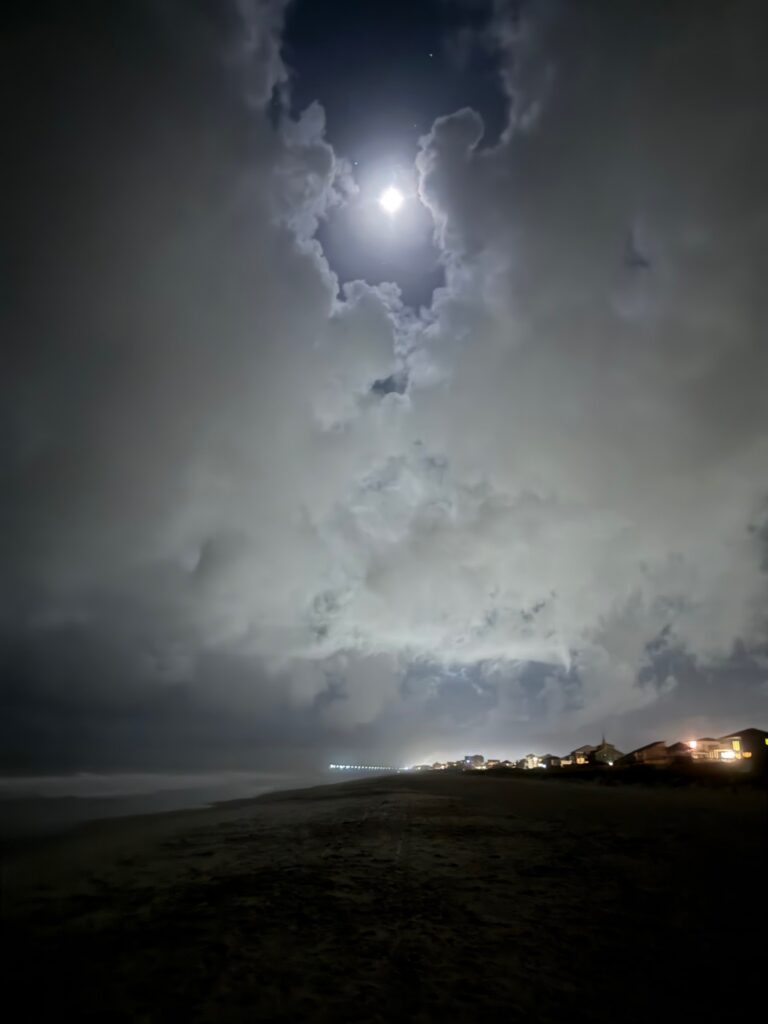
The Corn Moon rose over U.S. 90. Euphoria mainlined my face. I drove us back under the oaks at the mouth of the Singing River. Johnny turned the radio way up. Saul lit a joint he’d finished rolling. We were back south of town. The gravelled railroad out our window flashed grey, black through pines, skinny oaks, the occasional magnolia. Limbs interlaced like cloaked fingers over the blacktop. We banged over the tracks and passed the field of scrub bush and sand live oak the railroad company had bought and fenced in where the old creosote plant used to be. Dad told us the railroad company bought it back to cover their asses. Said the ground was rotten from the plant. Said it would be a long time before it ever came back. Said the company bought it from the Boatman for a million dollars. All the beat up old boats were gone from the field. The grass was growing long. The Stones sang Sway. My mind melted in the moonlight.
Back at the house, coming up the stairs, Saul stopped me and told me whatever I do, don’t offer Johnny any beer. He didn’t drink. He said he used to drink a case of Pabst a day. We sat on the fiberboard deck under the porch light. Johnny drank Cokes while me and my brother drank cheap gold tequila and Millers. Johnny spoke of the moon: how it symbolized death and birth in the same face. A friend of theirs named Jeff Avery showed up. Jeff was half Japanese: an American artist from Biloxi. He’d just returned from Los Angeles after winning an art contest to live in the compound of a famous Korean American muralist. He spoke of the game show environment and the spiritual experience of it all. He said the great artist had shown him special attention. Jeff brought a bag of drop biscuits from his job at the Green House with him. We ate them like cowboys on hardtack in a circle under the porch light. I looked up. The live oak limbs, digitized into millions of violet and lime traced particles, wavered at their edges.
I stumbled in the house keeping a hand on the railing. I looked in the bathroom and got lost in the mirror. I went to the bedroom and clicked back and forth between pictures of me on Facebook. I laughed a bright, mature laugh. The whole big picture show made sense. I could see South Carolina from where I sat. I could see my mother. I could see my father. I could see the masks I’d painted hanging from hooks on the wall of my father’s office. One was a dark, youthful clown. One, a stalwart normie. I wallowed in the universe rushing out to deep space from my fingertips. Infinity!
I sat in this inner light in the darkness on the back deck overlooking Bayou Pierre. The lights from the shipyard a white array in the black water on the horizon. I could feel the barrier islands like nodes of the earth’s nervous system out there in the dark. Harry curled at my foot.
The first light spread pink over the popcorn trees on the little peninsula below on the other side of the bayou. The first mullet launched headlong and hung angled in the air like a long jumping skier.
The gnats swarmed in balls in the sky over the yard. A pogie popped. Then ten thousand pogies popped. The shrimp kicked up in storms. Mud minnows ran in streams along the edges. The trout began to feed on the pogies. Two night herons emerged from the popcorn trees and began to strike the water with their daggermouths. The pink light covered everything. The water turned blood red brown. The water boiled to life. A mosquito hovered between my face and the lemon trees in cedar planters. Its clear wings laced oilsheen blue.
Harry was a brown and tan lab mutt I’d rescued from a friend’s garage. He stood between my knees with his chest bowed out. He stared up at me, still as a monk. He had one lavender eye and one black eye. There were flecks of gold in his irises. The light cleared the shadows from our faces. His coat bright, his old man whiskers. His eyes went all the way back to heaven. I swam through them and found he knew my name, my history.
I wrote poems and read a little of Saul’s Brecht. The one book I could find. I laughed a short, unbelieving laugh. A beer held loose in my hand at my side. I squinted across the water to the green islands ambered in the dawnlight. I lost count on the beers. I took my beer into the bedroom and lay down. I heard Dad’s footsteps in the hall.
I woke after sunset, well rested, without a hangover. I showered and put on a clean shirt. I listened to my parents and Peter quietly eat dinner. I sat and thought about things. I felt warm, complete. I noticed I never wanted to smoke again. Everything still made sense.
I thought of Serenity. Two years older than me from Biloxi. A volleyball prodigy from high school. I saw my sins against her as a perfect list. I messaged her on Facebook telling her what a coward I’d always been. It was like the message was writing itself. She messaged back and asked what I was doing. I told her I was sitting on my bed at home. She asked if I’d moved back home. I told her no, I was just back for the end of the summer, but I was thinking about it. She told me to meet her in Biloxi.
I drifted under the gold and red lights of the casinos, past the ragged men and their carts, the businessmen and their women. I pulled into the parking lot of Big Play. The blacktop was new. A go cart track wrapped up in the air around a fake red barn and aluminum water tower. The doorman, somewhere north of six four, curly headed, in a black polo, with the acned face of a pilgrim, checked my age and put a black light smiley on my hand. I walked in under the black and neon lights. A rainbow of stuffed bears and cartoon snakes hung from nets on the walls.
She was standing in front of the gameroom bar in a black dress. The green and blue neon flashed from the games. Electronic dings, whirls, beeps sounded on loops. Skynyrd played over the PA. She looked through me. She sipped her drink from the straw. Her freckled arms were covered in color tattoos: a sea snake choking a broken sailship, an orange octopus, a topless mermaid in repose, dogwood blossoms for some long dead East Texas uncle, I remembered. Her pin straight hair was dyed black down her shoulders.
Her hand was warm. She pulled me in, putting her forehead to mine. She kissed me. It was like being born. She gripped my face and smiled. Her copper eyes, her vodka, licorice breath. She took my chin in her hand and shook my head. She studied my eyes. She sucked her teeth. She kissed me hard before leading me by the hand to the bar.
She leaned over the bar and pulled me up against her from behind. She turned her head and pulled my face into hers, scraping her nails across my scalp. She turned and looked down the bar.
“Jerry!” she hollered.
A pole thin man in a black Saints tee looked up from shooting Coke into a cup. He served it and wandered our way with a whimpering, jaundiced smile. Serenity ordered two RBVs and two Jägerbombs. She pushed back deeper into me. She turned and put the little dentist’s cup of Jäger to my lips. I shot it and felt good. The room pulsed.
We took her key-scratched Mazda down 90 with our arms out the windows. I lit a Camel and she stole it. Levon plumbed Old Dixie from the plastic radio. A grey wave of lust rose up from my testicles and met the love sweeping through my blood. I remembered the beach as a kid. I watched her face wash in and out of the streetlights. The first lines had begun to form around her eyes. Faint auburn freckles in the creases of her nose and on her high cheeks. She looked listless at me. She drew her shades down. She put Mazzy Star on with her phone with one hand and smoked out the window with the other—driving with her pale, slim knees under the simple line of her black dress riding high on her thighs.
We parked and made out in front of a restaurant called the Reef. Four stories tall, leatherbacks, pompano, dolphin, a blacktip in pursuit of a massive strawberry grouper, were captured midswim around kelp and coral on a giant mural on its northern wall. The wind blew through my shirt and kicked up her dress on the walk through the parking lot. She pulled my arm around her shoulder. Past the parking lot was the beach. Past the beach, the dark waves of the Sound married a gunmetal sky.
We took the outside stairs. We looked through big windows into a dining hall flooded with light and wood-covered with retirees, young military, running children. The stairs led to a roof top Tiki bar. The wind buffeted us on and off. We took our liquor out to the rail overlooking the water. Thunderstorms popped silent in the distance.
“You never apologized,” she said. “When you messaged me, you said you were goin to apologize.”
I rattled the ice in my cup before I looked at her. I remembered us being the last ones up in P.C.B. senior year. I could see flashes of her topless on the rough boards. My hands pushing everywhere for what I figured was love. I’d tried for years and won. The slurred voice as she dressed and faded back into the beach house. I was too hungover to appreciate Petty on the beach the next night. A thousand miles back from the stage. Dully smoking a cigarette, I batted away her hand when she tried to touch me, ignored her the rest of the weekend. I left her and called only when drunk, horny. Ready to turn it back on in North Mississippi at college when she reappeared. In the postglow of the trip the deck haunted me as evil. Sitting in front of me, up in the night air, her presence confirmed the bedroom intuition. I saw she was beautiful. I saw the tattoos and the GED as the rationale for my own fear which had left me so far in life with my own kind of loneliness. I could see the gentle creases around her eyes. There was a warmness, a wholeness, to her eminence. She seemed noble, full in her dress.
“Hey look, I appreciate you writing me back. This’ll probably sound crazy, but I just see how awful I’ve been to you over the years, and, I can’t explain it, but I knew I had to write you and let you know. I couldn’t see it before but I can see it now. I’ve been a bastard to you. I’ve used you for sex. I’ve treated you like shit. The night in Panama City. The day after I didn’t talk to you. I am so sorry. All these years I’ve used you and treated you like shit. And sitting here in front of you I think I love you. I know this is crazy but I’ve never felt so clear.”
Her face was relaxed as she took me in.
“Wow,” she laughed, looked Gulfward. “I never thought I’d hear you say those words. Was not on my fuckin bingo card tonight I can tell you that much.”
She shook her head, took a long draw off her straw.
“You were a fuckin asshole. You did break my fuckin heart. You know, after my car wreck, after I flipped the Tundra, you tried to fuck me the very next day? Like called and called man. You called and wouldn’t stop calling that next night. Next time I saw you in Oxford it was like nothing ever happened.” She finished her drink.
“But you know, babe, I knew exactly what the fuck I was doin. I’ve been fucked up since I was a kid. I do fucked up shit with men. I am about ass backwards to hell with this oil man right now. He hits me and tells me I’m ugly when he spends too much money. That’s violence, Joe. That’s evil. You never made it big. You were always chicken shit. And a liar.”
“You’re right,” I said.
The beach disappeared west towards New Orleans. It began to sprinkle. We went under the roof and lights. They played Boat Drinks. A pod of blonde K.D.’s down from Oxford pooled their money to buy a round for the bar. They danced with their hands over their heads. They shouted with their faces. They all wore green.
I was drunk when she noticed the retired man from Thibodaux at the end of the bar. He’d entered the place, loud and full of the insane joie de vivre we’d all come to expect from the Cajuns. He wore his hair in a salt and pepper buzz which sparkled like formica under the bar lights. He was barefoot in a barely buttoned white linen shirt and short shorts. His laugh was that of a snake charmer, a rogue shrimper, when he reared his head back. His voice full of crawling stars. Mary hung gold at the center of his chest. He slapped on the bar and poured more red from his charger. Serenity gripped my thigh, turned away from him, kissed me.
“I’m gonna get that guy to buy our drinks,” she said.
I had $17.48 left in my Cadence account and twenty dollars in my pocket. I feared the worst. She kissed me, brushed her hair behind her ear and took her drink. She shook his hand, laughed. He grinned. She pointed at me. He gathered his bottles.
“Terry,” he said midlaugh. I noticed a molar missing. He did not offer a handshake. He didn’t sit down. He hopped from one barefoot to the other. He swished his wine around in his glass.
“I retired three months ago,” he said. “Moved over here from New Orleans. From Tibbadoe. 28 years in the construction business, 25 years of marriage. She ended up bein a lesbian if you can fuckin beleeve it,” he laughed.
“I said, ‘baby, you go head.’ See,” he put his finger in my chest, “I had a spiritual experience. It brought it’all to light. I started takin mushrooms after my retie’ahment—right before actually—an’ awl of this felt right to me. Dinn’t even necessarily feel like news. I knew before I knew if you noe-what-I-mean?”
I nodded and sipped my beer and lit a cigarette. Serenity was leaned back on the bar with her legs uncrossed.
“So I said, ‘you take it, baby. You take the house, the keys, the cars, the kids,’” his face a sharp, bright, silver and dark tan dance.
“I said, ‘I’m gonna take some of this fuckin money I been makin the past thirty fuckin years, and I’m gonna go be happy.’ So-awn the way back from Mo-beel to look at houses, I stopped at this ver-ee fuckin restaurant right here, and come up here to this fuckin bar, and had me some fuckin bang bang shrimp, and one of the best fuckin nights of my life.”
He swung an arm around the bar. “These people here? These are good fuckin people, true people.” He drained his red.
“Come back down here the next day, bought the con-doe. Come here every fuckin day.. I live the good life.”
I nodded. “Welcome,” I said.
He kept having us drink his wine. When I came back from the bathroom, Serenity smiled big, rubbed her nose against mine and tapped it with her finger. She told me he’d invited us back to his place. She grabbed me in her hand. She bit my ear.
“It’ll be fun baby,” she said. “Please.”
A beggar, I smiled.
We followed him, this insane, rhapsodic shrew. The three of us in a line across the beach to the condo tower. He took us to the penthouse. He kept the lights off. It was clean, quiet, white. I ran my hand across the quartz countertop. He put on Buffet, Living and Dying in ¾ Time and started chopping the trinity. He grabbed her by the hand, spun her around. They laughed like they were free. I took my wine out to the little deck and watched the waves fade.
There was a darkness to those mornings. Biloxi settled over our brains like an ash. In black satin sheets, I came to, spooned to the point of sticking, some giant brown dog roaming the foot of the bed, slobbered. I was surprised she snored. It smelled faintly of iron. I pulled on my jeans, my shirt, my boots. The dog barked. She rolled over, opened her eyes, listless. Strings of her black hair stuck to her forehead. A vodka pallor about her eyes.
I squinted in the sun stepping out of the house at the end of the cul de sac. A man in blue coveralls trimmed the hedges with a chainsaw across the street. He stopped to look at me and then fired it back up. A white Yukon passed. North Biloxi. Down the street, a teenager made a grid on a zero turn. I tried to flatten my hair. I drove the 20 miles down 90 back to Ladnier. Turkey vultures kettling languidly in the sky over the pines. Two men draped in khaki and powder blue fishing shirts at Keith’s Superstore. One dumped ice into a big cooler. The other pumped gas into the boat. Over the railroad tracks, the blown-off top of a thunderstorm hung over Chevron across the river like a mothership.
I drug limbs out of the yard into a pile on the street for Dad. There was a dead baby green heron he shoveled into the water by the bulkhead. The thunderstorms rolled over the yard. Dad gave me a hundred bucks. In the morning I left for New Orleans. On the way into the city, I saw the head of a deer glowing in the air over a billboard on I-10. I wore an old camo hat with a deer on it from an annual game banquet held at the gas plant where Dad worked. The deer was a sign from God. I searched for an hour for a good parking spot. I felt amazing. I met a couple of the guys from Ole Miss in the Quarter. Charles and Richardson. Charles rolled blunts. Richardson was in graduate school at Delta State. We stayed at his ceramics professor’s Chartres pied a terre.
I danced with a Baltimore woman in a country western club on Bourbon. Her dark hands on my face, around promises made to call. I woke and sat under the banana trees in the courtyard. I ate THC monkey bread Charles brought back from a family reunion in Oakland. I wrote three poems and emailed them to Serenity. We drank through the day into the night. I cursed out Richardson at B Mac’s and cried. I ran and got lost in the Quarter. My phone died. An acquaintance from Ladnier High emerged out of the Quarter mist. I ended up at a party in a judge’s house thrown by his daughter while he was out of town. They let me charge my phone and told me Irish Channel drama. Richardson wouldn’t look at me in the morning. Charles shook his head.
Feeling undead, Serenity texted me as I passed north of Waveland on I-10. I pivoted on my promise to myself to not go and see her again. Feeling dirty, ashen, poor, I put in the coordinates for her bar.
It was her brother’s old place on Pass Road. She was up on a ladder painting the walls a deep navy. She wore a sports bra and Nike shorts. She smelled like oranges. I kissed her neck. I noticed there was an old, sickly fat man at the corner bar watching minor golf on a silent television.
“That’s just George,” she said. “He works for me. We worked together in New Orleans. We’re partners. He ran this special on shrimp at the John we are going to run here. We’re gonna use the same model.”
I nodded.
“I want to show you my room,” she said.
We went up the old stairs into a little apartment. There was the same iron smell from the room at her house. A flat ochre light from the windows beamed across the otherwise maroon dark room. Bras and t-shirts on the floor. A tie dye bowl resin blackened on a Mexican tiled end table. She sat on my lap with my jeans around my ankles. The legs on the chair kicked back and forth. I had to push down to keep it from kicking over. The broken, snakewrapped ship kept pushing against my face. Her glossy eyes filled my world with cosmic dust. She kissed my forehead.
George was pouring himself a tonic water and doing calf raises when we came down the stairs.
“So you’re the lover boy huh?” he said. “The poet.”
I grinned and looked at my shoes.
“Some kind of poet.”
“I read the stuff you emailed her. It’s pretty good. Not all bad.”
“Do you write?”
“Not anymore. I used to. Screenplays mostly. Tried to break into the castle.”
“Would like to read those sometime.”
“No you wouldn’t,” he said, belching. “They weren’t worth the fuckin paper they were printed on. Total dogshit. But they were fun. It’s what you do when you’re young. You try and be rich and famous.”
I watched her paint the walls and promised to bring her some driftwood for decor. George left and we napped. I woke up in the last pale light of the day. I sat up in her bed for a moment and listened to the cars.
We showered, I put on the same clothes, and we went out to the Filling Station for dinner. Her mother and brother met us there. After dinner they left and it was just us picking at a plate of debris fries. We moved to the bar and she put my hand under her dress while she ordered for us. We drank until she called us a cab to the Hard Rock. She kept grabbing my hand and putting it there and I kept pulling it away.
A Bowie cover band was playing in the Hard Rock. The front man had a light contact in a poor imitation of Bowie’s heterochromia. He whined over the peaks of Life on Mars?
“We’re going to meet my friend Sissy” Serenity yelled in my ear. “She just got off from the IP. We’re going to go meet her at Treasure Bay.” We finished our drinks and left under the wash of Changes.
Treasure Bay was a squat brutalist pug on the beach. Sissy sat at the video poker bar. Her hair was fixed in a messy bun. She dragged on a Juul and blew it in Serenity’s face as we walked up. I felt nervous and dumb and like there was a galactic pull emanating from Sissy.
“This is my husband, Joe,” Serenity said, placing a hand on my chest.
“Joe, Sissy, Sissy, Joe.”
We sat around the roulette table. The two of them kept disappearing from the table to go to the bathroom. I sat dully smoking, barely warmed by the liquor, too broke and dumb to bet, watching them place chips.
We left from there and smoked in Sissy’s Civic on the way to Project. Serenity yelled fuck you to a homeless guy on a bike as we drove past. I turned and looked through the back window and saw him raise a hand over his head before he faded.
In the Project Lounge, construction helmets and dollar bills hung over the bar. Sissy’s twin sister Lisa worked the bar with another older woman I didn’t know the name of. There was a group of men in suits down at the other end of the bar away from the front door and they smoked Black & Milds. The jukebox played George Strait. A velvet print of Elvis in Vegas hung next to a silver leopard printed on a mirror. The bar was dark except for fake plastic candles in red jars on the round tables on maroon carpet and the bright halogen which flooded the kitchen. A variety of cigarettes hung in rows behind the bar. Serenity ordered whiskey sours. We perpetuated the fog of smoke. The man at the end of the bar drifted down and spoke with me about the shipping industry in Pascagoula whose interests he’d represented in court earlier in the morning. I stumbled on the way to the bathroom, my legs almost giving out from under me, threw up in the parking lot and faded to black in the cab near the railroad to the sound of Serenity’s laughter.
The next night we went back to Big Play and ate burgers. Her uncle was there. He was a big gambler down from Baton Rouge for the Mayweather McGregor fight. It cost fifty bucks for a wristband. I went around the bar to the short line to get us drinks.
“Excuse me,” I said to the man blocking my path to the stool next to Serenity. He shouldered me out. I tried to squeeze back in next to her with the drinks. She watched me. I stepped on a boot. He turned and faced me. He was mean, wide and red. A forty something with coon eyes and blonde stubble in a PFG shirt. I figured him for an operator.
“Six hunnerd dollar awstritches, asshole.”
“You fuck your mother with that mouth?” I laughed.
Serenity grabbed one of the cups from my hand and poured it over his head. I felt the rush of the old days. He brushed her to the ground with a gentle sweep of his hand. I didn’t feel the punch so much as hear it crack my head. I looked up and saw his R-Toe swoop in at my face. I felt my nose break and my face go dull. I sat up laughing. The kicks busted the back of my head with the regularity of a sledgehammer. Serenity screamed. She sounded wounded.
He kicked my ribs and I went over. Mule kicks. The pain shot through my groin. I heard men yell. I felt one more big one before it stopped. I lay there with my eyes jammed shut. Country music. Men hollering in the black.
The bouncer got me on my feet and walked me out. He sat me on a bench outside. I needed a cigarette. Serenity gave me one of her menthols. She paced and chewed her nails. I asked the bouncer if my eyes looked okay.
“You eyes are fine, but your head is fucked.”
I shook my head. Curled over and threw up next to the bench.
I sat up. He was standing, shaking his head, looking across the highway to the beach. The wind shifted the part in his hair.
“You remind me of my brother,” he said.
“Come on baby, let’s go,” she said.
“Can’t come back here anymore,” he said.
I leaned my head against the glass. We passed Waffle House and the pawn shop. It started to rain heavy. I watched it run under the oaks and stream into the street. It blurred the lights into gold trails. I looked over at her. Her makeup was running and she was shaking her head.
“What a fuckin faggot. What a little piece of fuckin shit,” she said.
Her smoke filled the cab. I got sick but my abs just ripped. I was empty. She pulled under the dim green lights of the Bayview Inn. Her uncle was asleep. She kept trying to get me to do it with her with him sleeping there on the other bed. A rib felt broken and the beer was fading. She was out of weed. She kept grabbing me and I curled up deeper. She gave up and I lay there the whole night sick. I watched her uncle as he packed and left and let some of the blue dawn into the room.
After noon I followed her to her dealer’s place in Fountainbleau. I waited across the street failing not to think. I followed her south out of the neighborhood down a gravel pine road. It opened to an overgrown lot. An abandoned Delco home stood on concrete pillars on the river bayou.
“We always used to come here. The Ghost House,” she said.
We went up the outside steps and sat on the Virginia creeper subsumed balcony. The tide was way low. Saltwater puddles lay in craters of the dark sand a couple hundred yards out. Past this, the dark olive water snaked through the channels in the grass islands before pouring out into the Sound on the horizon. We smoked. My ribs felt healed. One side of my face was swollen shut. I laughed, dumbfounded.
“What?”
“I feel like shit,” I said.
“Get used to it,” she said. “It’s all there is.”
A light rain fell. We pushed back under the eave to protect ourselves. Trout popped in the water and deer flies stung our ankles, forcing us to leave.
Dan Duffy was born and raised in Jackson County, Mississippi. His poetry and fiction have appeared in Farewell Transmission, Afternoon Visitor, Dunce Codex, Juked, Nat. Brut, Rejection Letters and elsewhere. He holds an M.F.A. from the Iowa Writers’ Workshop and B.A. from Ole Miss. He’s worked as an usher, a delivery driver, an auto parts puller and an English professor. He lives in Mississippi with his dog.