Categories
Issue 4 Issue 4 Fiction

LEMONADE STAND

By David Luntz

Sprouting like weeds all over the hood. Lemonade stands. Suburban cliché. A cliché of cliché. I loathe them. Which I suppose reflects badly on my character. But I don’t blame the kids. They’re being forced into it. Every time I see one, though, I can’t help but wonder about those children’s hygienic practices, how many flies dipped their feet in those tepid brews, and the quantity of lead in the water that had been used to make them. 

But one day I was thirsty, ragingly thirsty. I approached the nearest lemonade stand. Three pleasant blond-haired children manned it. They were clad in the latest designer brand clothing popular with a certain income-level of suburban households. I drank five cups of lemonade without paying. To be honest I had no intention of paying. But I promised those children I would go home and return with their payment. 

I placed my empty plastic cups gingerly on their stand. I took a step back. I thought some sort of apology was needed since I wasn’t going to pay. I waved my right hand before them and explained since they were in a business, albeit a small one, and given it was unregulated and they did not pay taxes and that my hand was clearly visible when it had helped itself to their lemonade (in contradistinction to Mr. Smith’s teachings), they should therefore take my drinking of their produce without recompense as an opportunity to learn the difference between extending credit and giving a loan—which, perhaps in the grand scheme of things, like war and politics, as von Clausewitz taught us, may be a meaningless distinction, but, I added, with a disarming smile, that was another discussion for another day. 

Yet, for sake of clarity, I told them I was drinking their lemonade on credit, not as a loan. Yes, I know, I know, I said, my “credit” here amounted to my word. But if it’s good enough for the U.S. government, then it should be good enough for you. Trust me children, it’s not lost on me that the mere promise of a few pieces of that specially-inked paper no longer backed by gold, with its all-seeing eye of providence inside of a creepy bisected levitating pyramid, got me those cups of lemonade. And yes, I get I’ve just compounded my legal woes by inadvertently entering into a binding contract with you, for I am painfully aware much to my prior detriment promises are considered ‘consideration’ in contract law and oral contracts are binding and enforceable in courts of law. 

Oh sorry, child, did I spill on your precious Brandy Melville dress? No, no don’t fret. Don’t cry. I’m sure the stain will come out. No? …What? No, you cheeky little fucks, I’m not going to leave my two-hundred-year anniversary special edition Phillipe Patek timepiece with you while I go home to fetch your little bit of sweet extortion, nor am I getting skinned for the cost of a whole pitcher of lemonade—you should learn to place it better on your stand!

Look, shit happens, accidents happen, deal with it. But putting all that aside, children, I know what troubles you. I know. I know. So, let’s mix metaphors and talk turkey and get down to brass tacks and address the elephant in the room: you don’t know me from Adam. You fear I will run off and never return with your precious payment. I get it. I get it. I’ve lived it, too, in my own professional life. You fear all your labor, hard work, your investment will have gone to waste, been all for naught. But look! I come with good news! Here’s another chance to learn something very important—what’s known in the parlance of the industry as a “transferrable technology” that you can acquire without any startup costs and sweat equity. 

Imagine that! See, now you can learn in real time about write-offs and the cost of doing business, which had you known before, you would have priced into your cups of lemonade without having to learn about Bayesian priors, sunk cost fallacies, double entry book keeping, the utility theory of value and law of diminishing returns. Which you will thank me for later when you don’t end up like King Tarquin who, you might recall, tried to buy all nine of the sybil’s oracles but wouldn’t accept her price, so the sybil kept burning her oracles until King Tarquin caved and ended up purchasing only three oracles for the same price as he could have purchased the set of nine. The point being here to understand the value of what you’re purchasing, because one day you’ll find yourselves on the other side of the lemonade stand, so to speak, and realize that sellers sometimes like markets can afford to remain irrational much longer than you can afford to remain solvent, to paraphrase Mr. Keynes. 

What? Why the look? Oh this. No, no, no it’s nothing to be worried about, just 17th century with an ivory handle made from…but this is not what you should be looking at. You need to see the bigger picture. So, pay attention! I’m trying to show you that your lemonade stand is but a tiny pucker on a tentacle of an enormous sprawling octopus of insurance companies, media conglomerates, investment banks, and law firms—no, what’s that, it’s not registering, fine, fine, if such abstraction eludes you, then picture some vast ancient army moving through the night, felling trees, making fortifications, their naphtha-fueled braziers burning along the western shores of the Danube and the Rhine, the tooth-chipped coins clinking in leather pouches strapped to the legs of the weary whores, the clanking pots of the cooks, the surgeons, barbers, and bloodletters with their cloudy jars of leeches and cedar boxes stacked with fleams and catheters, the learned-Greek doctors and stoics, bantam cock spleen readers, prestidigitators, prognosticators, students of the aleatory arts, dice men, procurers, devotees of Astarte, horned moons tattooed on their tongues, spies, interpreters, masseuses, forgers, rhetoricians, rumor-mongers, apiarists, bird catchers, butchers, dowsers, trappers, curers, washerwomen, the whole slow moving slug depositing its slick residue over a wasted land bathed in its own sebaceous glow, for your stand is part of a similar vast dark enterprise and nothing is really still, which is the first illusion you will have to learn to unsee, the illusion of stillness, but the point here is that you can never learn too early, for here, right here is where theory and practice both merge and come apart depending on which side of the cliché—stop screaming you little bitch, I’m not squeezing your arm that hard—depending on which side of the lemonade stand you stand on, for like that other cliché—or is it a trope, I can never get them straight—about the cat in the hat or in the box it all depends where your observation point is, for from where I am standing you’re all basically dead, or rather should I say, doomed, and from where you are standing no doubt you’re looking at some adult you wished had never passed into your perceptual field, but alas in life sometimes we can’t choose what not to see, can’t arrange to sweep these inconveniences under the proverbial rug, just as we never know the exact moment of our deaths, which is perhaps a good thing come to think of it, but let’s not be too maudlin, for when I spoke about death earlier, I meant it mostly in metaphorical terms, so let’s pretend you’re like Adam and you’re getting evicted out of paradise, not for paying your rent late, but because you did the one thing you were told you couldn’t do, and your maker sends down an angel who takes you up to the top of the highest mountain in paradise and from there you see the whole history (which is also your future) your one act caused, and in Adam’s case it was very bad, Hobbesian, chaotic, the general state of affairs that existed before the state contracted to monopolize violence from its subjects, I’m talking untrammeled murder, disease, war, theft, rapine, but in your case I’d say the future’s less gory, though, that said, I am not sanguine either about your prospects because this stand is a kind of gateway beverage to a life of office cubicles poring over grim actuarial statistics that had their origins in Graunt’s Mortality Tables, the sponsoring of derivative securities and other dubious negotiable instruments on the Amsterdam stock exchange that not coincidently came about with the science of probability in the seventeenth century, and the probability for you dear children is sharing cubicle space like penned cattle, of smelly refrigerators stuffed with moldering food cartons left by your coworkers some of whom you will no doubt develop unhealthy thoughts towards that may adversely affect your relationships with those whom you really care about, so you will find yourself coming back to your dingy rental you can barely afford in a packed subway car and wondering, “How did I get here, where did it start?” and then you’ll spit on the name of Mr. David Hume who told you it was impossible to find true effects from causes, you will curse yourself for taking him at his word, for here the effect can be traced down the chain directly to this instance with no other intervening causes—oh please, please don’t look at me like that, this blade hasn’t been sharpened in ages, it’s quite dull in fact, but admire if you will the ivory and jewel-crusted handle, genuine 17th century Ottoman smithing here, beautiful, no?—I mean it happened so quicky, he surprised me, yes, I hate to admit it, I liked it, I know, not nice, but you can trust what I’m saying because before that I shot the fucking albatross, well not the actual one in the poem, let’s say a metaphorical albatross, truly, the details are not important, but what matters is there is no coming back from it, you see, it’s a slippery slope, and nothing’s been the same since, sometimes I can’t help myself—now, now stop shaking dear children, stay calm, besides, we all have dead birds in our lives, so to speak, don’t we, even those we tried to save, so I suppose it doesn’t matter, it all balances out in the long run, but speaking of birds, take to heart and cling to it for all you are worth this sage advice of Mr. Russell’s who warned us that thinking the sun is going to rise tomorrow is like the chicken who thinks the approaching farmer is coming to give him his breakfast (because he’s done it every morning), when in fact the farmer is really coming to wring its neck, so yes, I think you know now what I’ve really been trying to tell you, and no, it’s not that you were never going to get your payment, I think that’s obvious now, sorry, not sorry, but this is where the nightmare begins, this is where it begins, so please children run, run for your fucking lives.  

David Luntz. Work is forthcoming in or has appeared in Post Road, Hobart Pulp, trampset, X-R-A-Y Lit, Rejection Letters, Maudlin House, HAD and other print and online journals. More at davidluntz.com Twitter: @luntz_david

Categories
Issue 4 Issue 4 Fiction

MIDLIFE HARD-ON

By Jon Doughboy

I did four pull-ups in the park and my arms are about to fall off. I’m in decent shape, or so I thought. Three days a week I do a little exercise routine in my basement. Body weight stuff like push-ups and squats. A few dumbbell exercises. I jog when the mood and motivation strike. But pull-ups are another story. Hefting the big hunk of aging meat that is me—my shoulders feel swollen. Like I’ve just been inoculated. But against what? 

I jog to my girlfriend’s parents’ house in the less affluent part of an affluent New Jersey suburb, wheezing past lush, diligently-watered yards and professional-trimmed hedges. The odd raised ranch. My triceps are burning. Cape Cods. My shins are aching too. Stone Victorians. Even my forearms are tight. New bright white farmhouse McMansions with mass-produced timber—ooh, look at the grain! Feels like we’re in Jackson Hole, honey! My girlfriend and company are travelling as a family to the Canary Islands. I declined their invitation. The bill was a bit steep for me, the itinerary a bit tedious, the concept of family a bit strained, so I’m here housesitting. A neighbor walks up with two red mums. “For Nicole. I know she loves mums. I had a funeral last week. A wedding tomorrow. That’s life, right? But they’re with us, aren’t they?” she says, pointing to the sky and then resting her hand on her heart. “My grandfather fell off his motorcycle at 80. Then he developed kidney issues. But he fought, you know? Just like my uncle. We took him off dialysis and he lasted weeks like that. We thought he’d die in days. But life, you know? It wants what it wants.” She goes on like this for a while. Life and death. Funerals and weddings. I get an erection but lean against the door in such a way that she doesn’t notice. This is my midlife crisis, I guess. I can’t afford a Porsche or hair transplants or a mistress so I’m not complaining. Though they happen sometimes at random, without a stimulus. I’ll be cooking oatmeal or aerating the lawn or sitting in traffic listening to a podcast about the Hanseatic League and boing—my cock is practically erupting through my pants. The neighbor leaves eventually. I masturbate quickly in the bathroom. I have to remember to water the mums. 

I meet my childhood friend later for beers. I tell him about my aching shoulders, my midlife erections. He’s married now. Has one kid with a second on the way. They’d been trying for almost two years with joyless, scheduled intercourse. He’d go out to Long Island for work—he’s an electrician in a tiny union and is sometimes the only guy on-site, wiring new supermarkets or big-box stores—and he used FetLife to find all these kinky women. One could only get off when he fisted her while wearing his wedding ring. He said, “I tried to take my ring off once because I felt guilty, you know. I’m not a monster. I felt terrible. But she froze up when I tried to. Stiff as a corpse. So I left it on. But I always wondered what would happen if my ring got lost in there. If I’d need to take her to the hospital. Or rent a metal detector or tie a magnet to a dildo or something.”

“My girlfriend has been very horny lately,” I say. “Some hormonal change. Perimenopause maybe. Not that she didn’t have a sex drive before but now every time we have sex, she wants to have more sex right after. And I tell her I’m old. That she needs to think about the refractory period. Then she takes my soft cock in her mouth just licking it, playing around, and I’m sort of embarrassed it’s soft but also flattered that she wants me or it or us so much and like fifteen minutes later we’re fucking again. I came three times in an hour. I haven’t done that since I was a teenager in heat.”

“Well, I say enjoy it while you can, man. Because we don’t really have sex anymore. It’s just work and parenting and on Sundays I watch football and fuck around on the guitar all day. Lots of Black Sabbath. The riff master.”

He shows me some videos of guitar prodigies on YouTube. Loads of fancy finger work. But the music sounds busy to me. Like they’re playing way too many notes.  

The next day I meet my mom and my sister at a Chinese place for lunch. Mom points to the kitchen and says, “Look, they’ve got actual Chinese people cooking. That’s a good sign. On Queens Boulevard we used to get all-you-can-eat Chinese food for two dollars. Piles of egg rolls. Buckets of lo mein. Now dumplings cost ten bucks. Ten bucks! What happened to this country, huh?”

My sister is telling me war stories from the psyche ward where she works. “The schizophrenic patients aren’t that bad. It’s the bipolar ones you have to watch out for because they get manic. And the drug addicts. They’re disgusting. They’re all criminals with bedbugs and scabies. And so entitled. One of them refused to eat the food in the cafeteria and was screaming ‘my insurance pays for this shit’ meanwhile their insurance is Medicaid so actually my tax dollars pay for it, bitch.”

“Did you say that?” I ask. I admire my sister. She’s very strong. Until she isn’t. Then she’s staying in another psyche ward in another county for a week or two. Meds. Sleep. Repeat.

“No.”

“Ten bucks for dumplings! Dumplings!” My mother says.

My sister goes on: “But one time we had this real piece of shit patient who had cancer and he beat cancer but was back in the ward for something else, it’s a revolving door of nutjobs, and he was screaming, calling all the nurses cunts and saying he had AIDS and trying to spit on us and when we finally restrained him I whispered into his ear, ‘I hope your cancer comes back and kills you’ and you can bet your ass we were cackling about that on our smoke break.”

My mother calls the waiter over. She doesn’t have time for menus and likes the—any—attention. “Do you have a shrimp dish?”

The waiter, a young Asian kid, says, “Yes, many shrimp dishes.”

“With garlic?”

“We have shrimp with garlic sauce.”

And I get an erection. In this dumpy Chinese place while my sister is telling me psyche ward drama and my mother is nagging the waiter about the size of shrimp. Are they big shrimp? Are they prawns? How many shrimp come with the dish?

We order. I excuse myself to masturbate in the filthy bathroom by the fire exit at the end of the hall. There’s no soap so I use the hand sanitizer on the sink. There are dark fingerprints smudged on the wall. When I return to the table, the food is already there. 

“These aren’t prawns,” my mother says, examining a shrimp she’s skewered with a chopstick.

“Did I tell you about the Bulimic girl who was really sweet and read my tarot but had the bones of an old lady because of her eating disorder? She was like sixteen or something but with 80-year-old bones.”

“Ten bucks for dumplings. Unbelievable,” my mother says.

I sit down and take a sip of Coke. My chicken smells like rancid fry oil. My shoulders still hurt.

The next morning the landscapers wake me up. Watering, mowing, seeding. Mornings in the suburbs are noisy with hired labor keeping yards tidy and clean. I lie in my girlfriend’s childhood bed wondering if she lost her virginity in it. If she had her first orgasm in it. Wondering how close the Canary Islands are to Africa. Wondering, remembering. Annalise. A Peruvian pre-law student who was volunteering at the library with me to teach new immigrants how to read. I was there for court-mandated community service. She was there to pad her resume. Afterwards, we’d fuck in my Ford Explorer under a huge, half-dead Catalpa tree at the back of the parking lot. She’s a lawyer now in North Carolina. Practicing law. What am I practicing now? Life? Except you don’t get a free trial. Or maybe you do. I should listen to the podcast I downloaded about karma. I go to the bathroom. I jerk off. I hope the landscapers watered the mums.

Two days later my shoulders and back are less tight. I jog to the park again. Step past the mums, across the tended yard and past the various architectural styles of the affluent houses. I do three pull-ups, four, five. I’m hanging from the bar. I have an erection. My abs are tight, my shoulders. I want to be young again, fucking in the back of a beat-up SUV and thinking about my future. I want dumplings that don’t cost ten bucks. I want money. I want to be on a Spanish beach with my horny girlfriend. I want to have a kid, to teach my kid how to master riffs. I want to be twenty pounds lighter, twenty years younger, twenty times stronger, smarter, better. I want. I don’t want to want. 

But life, you know?

Jon Doughboy is a recovering “literary fiction” writer who now produces “prose entertainments” to pass the time, available for the amusement of none and all @doughboywrites

Categories
Issue 4 Issue 4 Fiction

CHILDREN’S CRUSADE

By Avee Chaudhuri

Whenever our father Martin wanted to go on a bender he said he had to take an urgent letter to the offices of the North Eastern Atlantic Railing Corporation in Portsmouth, three days away, for the chairman’s eyes only, and that he would leave as soon as he could find the keys to the Buick. He preferred traveling at night, he told us, because the roads were clear. Thirty minutes later he would be down at the bar getting silly on scotch with a public-facing hand up the proprietor’s skirt, who poured scotch gratis. We told ourselves Mrs. Brenda had been widowed. Our father was many things but he wouldn’t with a married woman. No, it couldn’t be. Mrs. Brenda’s husband surely had been shot out of a cannon at too high an angle during his time as a prisoner of war, and he had not survived the impact of his collision with the warbling pines of the Black Forest. Our own mother had actually died giving birth to the twins. 

Martin, our father, liked to go on a bender every week. He loved drinking. “It feels good,” he said. 

One time we ventured, the twins hiding behind us older children, “Would it not feel good to make a real home for your children. Would this not feel as good as, if not better, than drinking scotch?” 

Our father was an attorney, who handled the affairs of many North Eastern concerns and he hated vagueness as a point of professional pride. “Well, how much scotch are we talking? What do you mean a real home? Bedtime stories and so forth.”

“Presence, just presence, consistency, tact.” 

“Fuck that noise,” Martin said as resigned as ever. “And wait a minute. You know I’m doing you children a favor doing my drinking out in the world. Not corrupting the family hearth with the sound and odors of profuse wretching. Scotch is a poison after all.” 

“No, you wait a minute. Don’t frame that as a virtue. There’s your fingering of Mrs. Brenda, a proud business owner.” 

“I don’t know what you’ve heard or seen. You kids don’t understand. I was concealing some documents on her body, important tax documents.”

“Sure, Martin. Sure.”

Martin?! Goddammit, you treat me with respect. I am your father!” And he stormed off for his most serious bender yet, reaching as far south as Savannah, Georgia. He stayed there for three weeks until Mrs. Brenda summoned him back posthaste. 

During this absence we had a frank discussion among ourselves and decided we ought to go out in a blaze. We were burdens to Martin. Maybe he could find love again with Mrs. Brenda, if only he had the temerity to move beyond hand stuff, to take her wholly in his arms and do her. We decided to fight for the Holy Land. 

But the twins, who were rather precocious, pointed out: “That place, ought we to project our rather meager version of faith onto it?” It’s true, I think we had only been to church the one time, at our maternal aunt’s insistence. She had to watch us because Martin got into a brawl with a bunch of Machine Democrats at a bar in Yonkers. 

“We are only really culturally Catholic,” the twins said in unison. 

But we wanted to do something useful with our sacrifice. There was a bookmaker in town Martin had run afoul of. In addition to being a drinker, he liked to let it all ride on the ponies. Our mother was a very beautiful and kind and understanding woman, and I think this explains our father’s obvious misery with the prospect of living, the horror of it, the vanishing likelihood that he would take Mrs. Brenda into his arms and do her. I mean, every time he saw us peering at him from around a corner, curious as to his movements, equally curious and concerned about the type of man we would grow to resemble or eventually be drawn to marry, he must have seen in our faces an apparition of our dear dead mother. What greater prophylactic can there be than children underfoot. We were going to detonate in the presence of the malicious bookmaker. The twins had cultivated an interest in applied chemistry and fitted us all with bombs. It was Monday, nine in the morning when they went off in the bookmaker’s shop and we were blown upward. And now we are jumping nearer to seraphim, trying to feel at the firmament of their jaundiced wings, but they simply float higher than we can reach in a conscious denial. Even in heaven on high we children remain objects of pity and scorn. 

END 

Avee Chaudhuri teaches Creative Writing and Literature at the University of Nebraska-Lincoln. He is the chef/owner of The Sepoy’s Revenge, a restaurant he runs out of his office on campus (Andrews 320).

Categories
Issue 4 Issue 4 Fiction

YOU ARE MISALIGNED

By Kia Guindon

Terry is in a mood. Eyes drippy with resolve. He looks like he’s one long glance away from trouble. “We’re gonna get out of this place,” he says, “Thelma and Louise style.” I want to tell him we are here voluntarily, that we can leave whenever we want. 

“Don’t they die?” 

He tells me he doesn’t have all the details sorted yet.  

*

I’m in the garden watching the sky leak by. Terry is beside me, combing through the Times. He likes to read the headlines out loud. Something to do with feeling more attuned to the communal suffering of the world.

“Alphabetical or random,” he asks.

“Dealer’s choice.” 

He begins, “Killer asteroids are hiding in plain sight—a new tool helps spot them. New Mexico wildfires map an early, record-breaking season. Liviah’s new liver: a family grapples with the girl’s puzzling hepatitis—a doctor prescribed an obesity drug, her insurer called it vanity.”

“What else?” 

“There’s one about coral reefs. But I know anything to do with the ocean breaks your heart.” 

*

It was my mother who insisted on my stay. Un petit rest, she called it. Chicken soup for the troubled soul. 

“You must know what this looks like,” she said in the hospital. 

I wagged a finger. “You are misaligned,” I said when what I meant was misinformed. 

What happened was this. I was found floating tummy up, far out in the Pacific Ocean. Coast guard pulled up beside my limp, star-fished body and asked, “Miss, are you in need of saving?” 

I couldn’t talk but flashed a thumbs up to indicate yes, that would be nice. As my consciousness turned spongy and edgeless, I brushed my tongue along my palate and was comforted by the taste of salt.

*

Terry ate oatmeal with water. That’s what I first noticed. That, and he took long, drawn out spoonfuls. Like he wanted to remember each oat. 

“He sure likes to suck out the marrow,” one of the cafeteria ladies said. 

I sat down close. His balmy breath was palpable. He kept eating, paying me no mind. We sat like that till his plate was cleared and it was time for group.

I was fed up after a week of smeary oats and silence. 

“Good luck Hon,” cafeteria lady said to me.

I followed Terry to the common area. Tracked him through the TV room and rec center. When he settled in the garden I stood in front of him, arms crossed.

“What are you here for?” I said.

“Did you know almost everything on earth, including you and me, was formed from the heart of a star.”

“I thought we consisted mostly of water,” I said.

“That’s what they want you to think.”

“Who’s they?”

“You know.”

“I don’t. That’s why I’m asking.”

The sun thrummed down. Terry picked at his skin. I stood staring, resolute. 

“What’re you here for?” I repeated.

“DNA, honey,” he said. “What’s your excuse?”

*

Truth be told, I wasn’t trying to do what they thought. Problem is my story sounds fake. Even to me. When I think back to that day my brain feels like a vat of air. I remember the ride to the beach. Talking Heads on the radio. Stale stench of summer. Pulling from a bottle of clear liquor. Then the tape zips forward to the bit where I’m saved. Sure, I felt some misery. But it was my baseline. Nothing that would tip the scales. 

*

The Chosen Ones join group today. “One, two, God is coming,” they sing, “Fighting for us, pushing back the darkness.”

We are sitting in a circle on plastic chairs. Most of us are wearing what we came in with, minus any shoelaces, necklaces, drawstrings, belts. Terry is beside me, rambling on about time.    

“Funny thing is,” he says, “no one knows why we only experience it in one direction.” 

A nurse paces, clipboard to her hip. The chalkboard reads: Falling is not collapsing, falling is extending. “Know the signs,” she says, and we all nod along.

“Three dimensions for space,” Terry says, “And only one for time.” 

*

This month makes three. Terry and I have a motto now: Maybe they’re born with it; maybe it’s clinical. Talking is prohibited after lights out so we sneak into the TV room with flashlights and blink morse code to each other. We are still learning so most of our words are simple: throat, wave, white. 

No one knows Terry’s exact age. But gossip is stock here. Some say he burnt his birth certificate a long time ago on account of the government tracking him. I asked him about it once, but he just said space and time are the framework within which the mind is constrained to construct its experience of reality. 

Others tell tales of Terry selling fake never-before-seen pictures of Elvis. Or harvesting kidneys for the black market. One story lands him in Italy, married briefly to a countess. Whatever the truth, I can tell from his large pores and yellowed fingers that he’s experienced in life. More so than I am anyways.

*

Mother calls. Her voice sounds springy. 

“So,” she says, “what’s the cup at today, baby?” 

“Quarter empty,” I say. 

“Don’t be like that.”

She tells me about Walmart Guy. He has a bump nose and large skull. They go to dive bars and peel off labels of Michelob and play rock paper scissors. Loser eats the label. They are to be married. City hall style. Very little shebang. Next to no rah-rah. It isn’t appropriate to celebrate with extravagance, she says, for a woman of her age.

“And you?” she asks. 

I remind her that my environment is not exactly ripe for love.

“Not a single prospect?”

I tell her I have Terry and that he’s like a husband in that we don’t have sex and sling our irritabilities at one another to relieve the pressure in our hearts. 

“Oh yes,” she says, “I understand.” 

*

We are guests. But that feels like the wrong word. We were not invited nor do we wish to stay. What got us here was a need for a blip of rest. Nothing permanent. Most of us here are happiest when life is like a film. We have an affinity for illusions. 

*

Chef makes a thousand eggs a week. Divided by seven, that’s one hundred and forty-two eggs a day. Numbers help. No ambiguity.

“Incoming news,” Terry says between forkfuls of wet yolk.

“Sock it to me.”

“At a dangerous 125 mph, the well-known Britney Spears eludes the police,” he says, his voice all Southern lilt. If I close my eyes, he could be Harry Connick Jr. or maybe Dennis Quaid. 

I pencil a three into a Sudoku row. Terry is naming billboard hits from 1959 alphabetically. 

“I don’t know why you bother with that crap,” he says.

“Think good, look good,” I say. 

 He blinks ‘okay’ then ‘yeah right’ at me.

I don’t tell him about my tricks. Memorizing sonnets. Sudoku. Omega 3s. I don’t tell him the average brain’s weight and volume shrinks about 5% per decade after 40 and that I’m halfway there and my odds don’t look great. I don’t tell him about losing the word vacuum. “What’s the name of that machine?” I asked one of the others, “That sucky device that gets all of the dust.” Other things too. Important things. Like the brand of my mother’s perfume. Or the name of my hymen-taker.

What stays, stays. Survival of the fittest. That’s Darwin. What else do I remember? Not much. Was it me or Dostoevsky that said it’s very pleasant to break something from time to time? Terry says memories exist outside of time and space, but I think only the strongest memories endure. No one tells you though if it’s the right things you’re remembering.

*

“I thought of something,” Terry says. “We have to try to imbue our lives with ambition.” 

“Do or do not,” I say, “there is a lot of try.”

“Listen, listen, listen,” he says, “ambition gets a bad rap, but channel it correctly and boom.” 

“Boom what?”

“Boom, life.” 

*

Terry had no moral compass. That was his problem. This was when he lived at the Western tip of the I-90. Tough is what he calls that time. At night he’d tread out into the dark on sodden patches of grass and fix his eyes on the dimmest part of the sky. He wanted to return to dust. Unburdened by time. Be up there, just another star.

That’s all in the past though. Acceptance is his mantra now.

*

“I’m not myself,” I tell Terry before group.

“Who here is?” he says.

Group is a time where the past gets a good going-over. The Chosen One’s have access to the past. Bonafide memory savants, the lot of them. They remember every infraction of morality, small or large.

Terry too. He can rattle off names and dates of birth from his high school rock band. 

I want to know if it’s wrong to only recall the shape of a day. Light flaying the sky. Muted pinks and purples out a window. When I watch films I’m left with feelings. No facts. I do not know if the lady was in red or blue or white or green. But I can remember her forlorn face in a mirror. The way she twirls a spoon in a cup of coffee. Even my mother. I have been here long enough to not know if she stands at 5’4 or 5’6. Or if her eyes are flecked with yellow. But I have tucked away moments of her mouth laughing. That I do have.

*

I come clean. 

“You just ended up out there?” Terry says.

“Yeah.”

“And you don’t know why?” 

“No.”

“There’s gotta be something.” He makes a list. Probable causes. He wants to get to the source. 

“Parents?” he says.

“Alive.”

“Boyfriend?”

“Negative.”

“Friends?”

I move my head from side to side. “A few.”

“Hard drugs?”

“Too young.”

He blinks ‘shit’ at me. “Maybe that’s your problem—no fun.”

*

Terry has a plan. We’re going to the beach. Exposure therapy. To confront the scene of the crime.

“Better than any of the cockamamie you’ll get in here,” he says.

The Chosen Ones remind us to be wary of the impurities of the outside world. There is filth everywhere. Terry tells them he’s beyond corruptibility. He was born with sin in his blood. 

“Do you really think that’s a good idea?” my mother says. 

“Better than any of the cockamamie in here.”

“I trust your judgement.”

“I don’t,” I say. “That’s what got me here in the first place.”

*

We arrive midday. It’s still there in all its aqua wonder. Unchanged. We stand gazing out. Undulating waves of blue and green. Miles and miles of water.

“Anything?” Terry says. 

I tell him I feel like a croissant. Flakey, layered, a little wet. We are encouraged to use metaphorical language to describe our feelings. Looking at things head on, we are told, can be overwhelming.

“Sometimes a leaf is just a leaf,” he says.

“Sometimes a leaf is just a leaf,” I mimic, an octave higher.

“What I’m getting at, kid, is maybe you’re just sad. And it is not like anything else.”

So I tell him. From the top. The parts I remember. My mother and her men. And then the town. Its people. Sagging faces. About all the ordinary ways life stacks up. 

*

I was there all of six months. We didn’t escape. But we didn’t die either. 

On my last day Terry blinked the word moist at me. 

I thought, I’ll never see him again. 

I thought, there’s two ways to deal with the cards you get dealt. Mete life out into measurable acts of compliance. Or use whatever you must to escape the oblong shaped, far away threat that is as real to you as your ten fingers and toes. Be it God or the space-time continuum. To the former, the latter are deranged, wrong, mad.

Pick a word.

Kia Guindon is a Canadian writer based in New York.@km_guindonn

Categories
Issue 4 Issue 4 Fiction

AS I LIVE AND BREATHE

By Reilly Tuesday

Sometimes Tara feels like she’s the only girl in this city who grew up eating Lucky Charms every morning. Her friends in Montreal didn’t grow up with sugary cereals in the house and probably seldom slurped the blue milk output of 8 distinct marshmallows. One humid evening the self-declared almond-mom offspring, all grown up, come over for a barbecue. They gather to grill the 12 frozen Compliments-brand beef patties, on sale for $19.99. Together they joyfully slurp dripping grease and mustard and golden beer. 

Once every last drop is lapped up, they go home. Tara then realizes she forgot to buy a barbecue brush with those wiry bristles to thoroughly clean the portable grill. She tries her best to clean the waxy grease with bunched-up paper towels, tries to limit the black gunk that gathers under her fingernails, and tries even harder to ignore that weird tight feeling in her chest. 

Her father, Darren, won the barbecue in a charity golf tournament for hurricane cleanup in her coastal Canadian hometown. Darren works for a company that specializes in making cardboard boxes for seafood companies, which are waxed on the inside to help better ship the oysters and mussels and lobster and haddock and so on. They cannot be recycled. 

The town of Summerville’s harbour is Lucky-Charms-milk blue on calm days but pink on stormy days, when the churning sea rustles up the red sand on the ocean floor. Tara returns from the big city and goes jogging on the boardwalk, following the piles of seaweed along the Atlantic shoreline, just like she always does and just like she always has. She knows that the town’s sewage was formerly dumped into the water, that the shit then became fertilizer and the black seaweed then multiplied and multiplied. She learned this in the Nitrogen Unit of Grade 6 Science. 

For the Water Unit, the teacher brought in plastic tubes and big Rubbermaid containers full of water and taught Tara and her classmates how to siphon. She remembers practicing with plastic straws in plastic cups of Nestea in the Wendy’s sunroom with her brother, Blaze. Sometimes Darren took them to McDonald’s, but less so Burger King and Dairy Queen after they got shut down and sat deserted in the sea of plazas. She remembers proudly showing off her skills but Blaze was only in Grade 3 or 4 and could only blow bubbles because he hadn’t learned to siphon yet. 

They no longer dump Summerville’s sewage into the harbour but every once in a while the tangled lumps of seaweed are shoveled into dump trucks and taken to an unknown location. Now there is a water filtration plant right next to the shore but not next to the part where tourists go in the summer. It created 25 new jobs. Tara jogs past the plant and practices holding her breath so as not to breathe in the smell. A little further ahead she reaches the wet seaweed lying in the sun. She doesn’t hold her breath but inhales deeply because the smell reminds her of home. She stops when she feels a dull pain in her chest expanding.

Tara forgets the Deep Woods 30% Deet Bug Spray in the garage and gets 25 new mosquito bites. On the drive back to her parents’ house she gets stuck in farm equipment traffic. The tractors aren’t so bad, but the sprayers are unbearable, too big to drive around until they eventually turn off onto a red dirt road to spray the Cavendish Farms potato crops with herbicide. Tammy, Tara’s mother, calls them cancer trucks. She tells anyone who will listen that the constant fumes in the air gave Blaze autism as a child. She will tell anyone who will listen anything so Tara doesn’t mention how when she sleeps on her side she’s awoken by a sharp pain over her breastbone. 

When Tara finally gets home, Tammy is cutting potatoes and watching the news. The anchor says that Cavendish Farms has donated 1 million dollars to Queen Elizabeth Hospital and a unit will thus be renamed Cavendish Farms Same Day Surgery. It instills hope across the province that keeps hearing about patients dying in emergency waiting rooms because it takes 17 hours to be seen by doctors that keep leaving like Burger King and Dairy Queen. Tara places her hand over her chest. Darren comes home and cooks fish that someone at work gave him in a waxed box. Blaze comes down from smoking weed and eating Lucky Charms in his room and the four enjoy a dinner of haddock and potatoes and it smells like home. 

Tara goes back to Montreal and writes headlines for rain jackets and backpacking tents made with special waterproofing chemicals that cost more than her monthly rent. She works for 20 minutes at a time then opens Instagram reels to see vintage resellers testing their retro dishware for lead paint. She brews filter coffee with tap water and cooks breakfast with non-stick cookware from Amazon that leaves flecks in her eggs. The sink is full of dishes that look just like those on Instagram reels. When she washes the plastic cutting board she bought at Dollarama, the dark-green plastic fibers of the dish sponge get stuck in its grooves. 

She contemplates a garden of microplastics then contemplates synonyms for fresh air then contemplates if she should see a doctor. Her heart aches for something she can’t quite figure out. The weird pain in the left side of her chest keeps getting worse and she doesn’t know why. Tara goes online and finds one available appointment with a medical professional in a far-away neighborhood. She feels grateful that she didn’t have to wait 17 hours in a windowless room named after a J.D. Irving company. The doctor gets her to inhale deeply and performs run-of-the-mill tests then orders her to get her chest X-rayed for possible tumors in her ribs and lungs. 

Tara spirals and thinks about all the homemade-bong particles, vessels crafted with water bottles and hollowed out pens, among everything else. She goes to a different clinic in a different neighborhood to watch dust particles dance under the fluorescent lights as an X-ray technician tells her when to breathe. She doesn’t smoke weed for a week as she waits for the results. She doesn’t do much at all. 

The sky is Lucky-Charms-milk blue on calm days and pink on days when the smoke arrives from the forest fires in northern Quebec. The X-rays come back normal but the pain comes back once 10 days of prescribed painkillers run out. Tara feels very grateful that the health insurance from her underpaid outdoor sports equipment copywriting job partially covers physiotherapy. The physiotherapist asks Tara if she works from home and she says yes. She sits on a cold massage table and slowly twists her body from side to side. Yes, she feels it there, and yes there, and yes, there. 

Alas, there! Yes! It’s not poisons or pesticides or poor decisions but rather propelled inflammation, from where rib #6 or #7 meets the spine. Her back has become too immobile from not doing much at all, which in turn has been putting pressure on her ribs, and then her sternum. She goes back to working from home. She gets assigned exercises to do from home, too. She buys a foam roller at 30% off with her employee discount. 

Tara goes to more barbecues and more parties and eats her hotdog anyway when it falls on the ground. She jokes about gut health with new friends and old friends and almond-mom offspring. When she’s drunk she sometimes brings up the fucked-up week of waiting for X-ray results and thinking she had lung cancer. She will tell anyone who will listen anything. She asks if she can bum a cigarette. She wonders if she should give more of a shit about microplastics. She insists that even the siphoning classes and Cavendish Farms Same Day Surgery unit are real. She wonders if truth or fiction is more powerful. She can’t get into it right now, the Greenwashing Lunch & Learn is starting.

Reilly Tuesday is a writer from Prince Edward Island, Canada. Her work has appeared in Expat Press, Hobart Pulp, The Car Crash Collective Anthology, Dream Boy Book Club and elsewhere, including The Page, which she created and edits. Find her meandering around Montreal or as @reilliz on Instagram.

Categories
Issue 4 Issue 4 Fiction

THE SCYLLA AND CHARYBDIS OF GAY DATING WHEN YOU’RE NOT EVEN GAY: A FRAGMENT

By Jesse Hilson

Women are enemies, and men are enemies in a different shape, but the same distasteful antagonism. You see them in public where you rarely go, in excursions out of your mousehole. You do go out sometimes, to Tony Larry’s hangouts, the farm stand he maintains with his boyfriend Brian, the farmers’ markets you go out of your way to visit. Otherwise you stay away. Everybody is an opponent to be melted down with contemptuous eyes. Does it disguise desire, does it hide a potential love-charge? Those false dates with Tony Larry, he never suspected were dates, but you half-feared them to be before they happened, wondered at while they were happening, and drove away from them afterwards in confusion.

What do you know about that? You know nothing about that. You were thinking just this morning, about how you were that gay kid, that kid with the gay vibe in high school who nonetheless escaped all the allegations and went on to fuck women, double digit body count, never touching male ass or having your own ass be taken by sodomites, but still the contradictions remain, potent after many decades of a benighted lifetime. The womanly compartments within you resonated nevertheless, the “feminine side” others may detect but they were cruelly (perhaps mercifully) disguised from you, like many other things. Until you crossed paths with Tony Larry.

At lunch with Tony Larry’s boyfriend Brian, eating tomato sandwiches at the café, glasses glowing with sparkling water in the sun. Brian’s clothes were dirty from the farm, as if by self-conscious design, to be seen as a “farmer.” Brian was going on and on: “I wouldn’t actually want my AI to have the voice of an upwardly mobile Black man. I just wouldn’t. Call me a reactionary backwards bigot, or whatever. It’s truer to say if AIs must have Black voices they should sound more like stand-up comics on Def Comedy Jam, or rappers. That’s the history I want evoked when I interact with the tech regimes of the future, if I must do so. The whole question of deciding your AI’s voice ahead of time is crazy to begin with. I’m not sure why exactly but it feels wrong in the same way tailoring your Zoom background with bookcases and designer lamps feels wrong with a capital ‘R.’ Be natural, be true. Be racist if need be. Be authentic. Don’t kowtow to the neoliberal agenda.”

You filed all this commentary away in your internal dossier on Brian. He was too trusting, too open with his opinions over lunch. You were surprised he was telling you all this, with no monitor, no checking of your signals, none of the paranoia another person might have shown. Tony Larry’s affections had made him too secure, too complacent. They gave Brian a protective shield you scan for cracks, even though you are not in competition with him. You notice whenever they say goodbye to each other they exchange “I love yous” in a quick, monotone voice, identical to each other from long repetition, like androids running through a tired subroutine. This privately infuriates you. It feels dead. It doesn’t seem organic enough for Tony Larry, to your mind. Then, also privately, you whip yourself for thinking so as you drive alone around the countryside.

Who was Brian to you, and you to Brian? Was he trying to gag you and shock you with extreme politics, was it a defensive maneuver somehow, to protect his relationship? Tony Larry told you about Brian’s hobby as a writer. It seemed like a false, dangerous surface just like the farmer persona. He wrote stories about BDSM. It was beyond him, though, to seek a truly Dostoevskian moral confrontation, you sensed. Besides, you don’t wear BDSM like an accessory, an outward fashion statement. At least you thought so. Later you worried that you didn’t know the correct thing to do either, you didn’t have the savoir faire, either. Brian was an idiot, but what were you going to do, tell Tony Larry that his boyfriend was a corny faker, with falsely acquired attitudes and that you were realer than he was, because you were older? You had allowed these attitudes to come to you more naturally over time, and it was a generation gap. Tony Larry being a millennial should have been able to see that. But you could barely see that, or see anything, you know that now. You tend to see more, as time goes by. You have more info to add to the hopper and you can judge from a place of higher visibility.

“Not necessarily true,” Tony Larry told you when you shared just a fragment of this with him, editing out all explicit reference to Brian and hoping he’d gather from your half-hearted hints that older was superior. “Not if you’re shoving it all down over time, Noah. People sometimes get more blind as time goes by.” You thought you were suggesting you were smarter about life, the soul, whatever, than Brian was. To displace Brian from his position even though they ostensibly loved each other. What room for displacement was there, though, what foothold for jealousy existed that would avoid being spotted on its face? Like did you think Tony Larry wouldn’t see the emotional angle? Were they laughing at your attempts? Tony Larry seemed to humor you, to your face: millennials were wise that way, you discovered to your envy and disgust. Somehow these counseling sessions were conducted in a gel-like environment created by Aubrey’s wake after she left. She was a millennial too. You’d told Tony Larry about the spanking and rough sex Aubrey had goaded you into. You call it goading, you suspect you aren’t truly curious enough to take possession of the actions in the bedroom, ownership of the pain you caused Aubrey’s body to make her cum. You wanted to distance yourself from that, even as you told Tony Larry with hetero pride how you’d made Aubrey have an orgasm without ever taking your clothes off. This dom role felt aligned with the fact that you were eight years older than Aubrey and Tony Larry, you were Gen X. You were on the demographic outskirts of a sexual territory only the young, the queer could occupy safely, solidly. You were not a member of the group somehow, even though Aubrey used you to perform those rituals with her, rituals that extended beyond sex and into conversations, sour niceties, pain silently inflicted. 

What were you doing telling Tony Larry any of this? You couldn’t say, especially since, as the visibility and awareness of your age grew, you developed unbidden feelings for Tony Larry, dreamt about him. Dreams that seemed non-sexual in nature, or you hoped so, after awakening and taking your first thoughts of the day, the way ignorant people hoped for certain outcomes in the news, political developments, tragedies scrolled over on the iPhone with a vague prayer for forgetfulness. Feelings had a surface area laser-mapped onto an unseen plane, a zone of men when the beams had heretofore only fallen on women’s physical bodies. And the male surfaces were not embodied, it wasn’t carnal with men, in a way you could point to or perhaps admit in your imperfect epistemic understanding of yourself and your own desires. Maybe you were a sexual cripple because you could only lust after women as you had seen them for decades, and never conceptualize anything else, any other tools ill-fitted for the hand. Some bisexual conscience hectored you, teased at you, from dream-angles, dream-ventriloquisms your waking mind couldn’t own up to puppeteering. A disillusionment never acquired such profundity that it would shake the faggot machinery within into awful automaton life, sending down cascades of magnetic dust and debris, the golem in motion. The inner android drew on a lifetime of observations that the straight, hetero self made, the storage of data for mysterious usage. This scientific knowledge might have positive value to the android’s purposes, if they could even be isolated themselves. To think of yourself as a machine made it all seem like something dark and less than human even though it was the automatized search for love and meaning. How could that ever be inhumanly colored. Why dust, falling, why not the ice that seizes life, breaking off in a shower of tinkling fragments and freeing an imprisoned organic being? You do not want to be the robot, do not want the machine-model of mind to apply, whether in disability or sexual confusion. You would rather this inner self be an isotope or inherent version of your mentally ill outer self, a hidden iteration from whom all consequence has been removed. You no more want to own an unconscious that produces dreams of Tony Larry than you would want to own a weapon that, by its very existence, potentially threatens the peaceful life of the household.

Jesse Hilson lives in the Catskills in New York State. His work as a writer and cartoonist has appeared in X-R-A-Y, Hobart Pulp, Expat Press, Maudlin House, Exacting Clam, and other venues. He has written two novels, Blood Trip and The Tattletales; a poetry collection Handcuffing the Venus De Milo; and a short story collection The Calendar Factory.

Categories
Issue 4 Issue 4 Fiction

HANDBOOK FOR THE RECENTLY DECEASED

By Mallory Smart

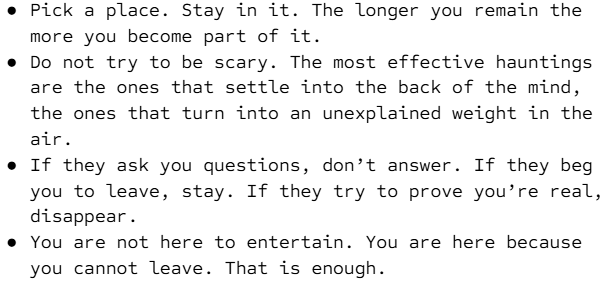
(You were alive. Now you’re not. Make peace with it or don’t. It won’t change anything.)

NAVIGATING THE AFTERLIFE

You exist, but only as an inconvenience. Being a ghost isn’t hard. You just have to stop pretending you matter.

You are neither here nor there. You will get used to it, but not in a way that feels good.

DEALING WITH THE LIVING

They refuse to acknowledge you. Not because they don’t believe in ghosts but because they believe in themselves too much. They are the center of their own story. You are background noise.

It’s not that different from being ignored when you were alive, except now it’s not personal.

UNDERSTANDING YOUR NEW FORM

If you weren’t weird before, you are now. Accept it and move on. Or don’t. Either way, you’re stuck with it.

You always felt a little disconnected from reality. Now it is just official.

AVOIDING BUREAUCRATIC NIGHTMARES

Nobody tells you that the afterlife has paperwork. Probably because if they did, no one would die voluntarily.

Bureaucracy doesn’t die with you. It just gets less comprehensible and more passive-aggressive.

HANDLING HAUNTINGS

You are a problem now. Embrace it. It’s not like you have anywhere else to be.

You wanted to leave a lasting impression. You got your wish.

FINAL NOTES

There is no next step. No light. No revelation.

You will wander. You will watch. You will wait.

Eventually, you’ll stop expecting something to happen. That is when you realize the afterlife isn’t a punishment. It is just more of the same…

Mallory Smart is a neurotic Chicago-based writer and editor-in-chief of Maudlin House. She hosts the literary/music podcast Textual Healing and the horror podcast That Horrorcast. Her new book, I Keep My Visions to Myself, is available now through With an X Books.

Categories
Issue 4 Issue 4 Fiction

GEORGE’S FIRST DAY

By Craig Rodgers

The ladies of the nineteenth floor love George right away. 

“Oh my God, he’s precious.”

“Look at him, that sweet boy.”

It’s his birthday today. Number fifteen. They tease at first, poking and laughing. Pinching cheeks. He laughs and shakes his head. He says thank you ma’am, he says aw jeez. Rose laughs too, and she pinches his cheeks again.

The men from accounts are having a meeting. A few from upstairs too. Some standing, some sitting. The blinds are up and they look over at times, to watch the ladies ribbing George, to laugh along between bouts of their talk.

George tries to work. He scrapes the top layer off worksheet errors and he notes their corrections. The women watch him go. They woo and he blushes. Mary waves and he blushes more.

The men in their meeting huddle. More are sitting now. Spells of quiet congeal. Figures are thrown out and booed. The day exists beyond the window over the city roofs below. 

The ladies crowd his station. They ask about his day. How he likes the office, how he likes the work. He goes on with his tasks as they talk and he talks and then he wipes his brow and he puts the eraser in his breast pocket and he tells the ladies I don’t know, I don’t know. They laugh still, they pinch his cheeks still. Ruth says she’s going to give him a kiss, and Mary says she is too, and he laughs, and he huffs, and now they’re all laughing, and he’s running, around tables, past desks, and the ladies are running too, laughing and running, and his feet twist and he falls forward, and now there is a gasp. 

The men stand at the table where some accord is found. Some stare down at pages of numbers while others reach and stretch. One by one they turn as the screams begin to sound, where Ruth weeps and Mary sits blank faced on the floor alongside where George’s body is flopped. The eraser thumps with a slowing pulse, protruding from his heart, and the ladies nudge him with hands that shake but he is already gone. The office stills with but little movements continuing on. Hands over mouths, whispers of woe. Somewhere outside wide windows the sun moves, stretching between the bones of a rising tower. A man turns away and then another, their gaze drawn from this tragedy and on to the day’s minute onward tick as knockers and climbers rivet into place blocks of long steel that in their slow way shut out the sun’s insistent presence. 

Craig Rodgers is the name stamped on ten books, a number of letters, and one day a grave.

Categories
Across The Wire

The Flood

By Denise S. Robbins

“The Singularity will doom us all.” Samuel says this at a moment of conversational pause. The dinner party goes quiet, for swiveling heads make no sound. Everyone waits for Sam to explain himself. But he’ll wait. He’ll wait until someone asks. The windows are open and someone, somewhere, is drumming. Cars bring their own accompaniment in quick swells. 

Polite little Ariana, in a quiet voice: “What does that mean?” 

Sam takes a deep breath, making his mustache quiver. His eyes are still and serious, fixed on Ariana’s, who flinches slightly but keeps his gaze. “When AI intelligence surpasses our own,” says Sam, “there will be no hope for the human race. Unless we’re lucky enough for our superintelligent robo-overlords to be gentle. Perhaps they’ll let us, as slaves, have dinner parties, like we’ll let our future children play House, as long as they don’t get out of line.” He rubs his belly as if he were the pregnant one. The others glance at his wife Carmela, standing on the other side of the room, whose flowery wrap dress expertly hides any stomach bulge. 

“Hey man, you shouldn’t say that,” says blue-haired Lennie. “The word slaves.”

“This may be my last chance for anything I say to mean anything at all,” says Sam. 

Carmela shoots her husband an angry look. Earlier she had explicitly asked Sam not to talk about Doomsday during his birthday Shabbat. He ignores her gaze. 

“Let’s start eating,” says Carmela, trying to remind herself how nice she felt ten minutes ago, when pockets of conversation hummed around the room, an underlying current of sound, like when you realize the fridge is churning, but it’s the way voices converge into a low, cheerful drone. When her guests poured their second drink and became flushed with happiness as they hovered around the fresh baked challah like it was a newborn baby. When she lit the Shabbat candles and the fire reflected in Sam’s eyes before he moved to hug her from behind and rub her newly pregnant belly. 

“But Elias isn’t here yet,” says Sam.

“He’s never here yet,” says Carmela. “Food time. Plates on laps, I’ll bring it around.” A nice big dining table is something that can always be put off, the lack of it ignorable until you have a dinner party, so they are sitting on couches around a coffee table. Carmela removes the noodle casserole from the oven and scoops a hefty portion onto each plate, along with one ripped handful of challah. She worked hard on this dish, and expects praise in equal measure to the effort she put into it, but no one seems to notice as she hands them a plate, everyone now in rapt attention as Sam explains calmly why every argument against the Singularity is wrong. 

Lennie says, “We’ll create a kill switch.” 

Sam shakes his head. “You think they won’t foresee that and reprogram themselves for it not to matter?” 

“There are four different cheeses in this,” Carmela announces, taking a plate for herself. “Mozzarella, pepperjack, gorgonzola, and bleu.” 

“Isn’t gorgonzola a type of blue?” says Lennie. 

“Bleu,” says Carmela, nasally, “like bluh.” 

“So is it a type of bluh?” asks Lennie.

“I’m not sure,” says Carmela. “You could Google it later. Now for the Motzi.” She leads the blessing of the bread and everyone takes a perfunctory bite of challah. “Leave room for cake!” 

“Cake?” asks Sam. “What flavor?” 

“It’s a surprise.” 

The AI conversation continues as if it never stopped. Ariana is unconcerned about the internet advertisements: in fact, she likes how the internet seems to know exactly what she wants to purchase next, and gives her good deals, too. Lennie jokes about a robot accidentally setting off a nuclear apocalypse. Carmela sits back and disengages. She’s scarcely hungry, after hours of taste testing, and it seems the others share her lack of appetite, except for Sam, who eats his dish in big bites between words. He goes back for seconds, peeking in the fridge on the way back. He sits next to Carmela on the loveseat and kisses her on the cheek. 

“Chocolate cake! You know me so well, honey. Thanks for the party.”

“Why, because it might be your last before the Singularity?” Carmela says half-sarcastically. 

Sam’s smile disappears. 

There’s a knock at the door. 

“Elias!” Carmela checks her watch. “Who had eight o’clock?” 

“I said 8:05,” says Ariana. 

“Cheers to Ariana.” Carmela pours herself another glass of sparkling apple juice. “Door’s unlocked,” she calls out. The knocking continues. “Okay, I’m coming.” She opens the door to see Elias, in a pea coat and baseball cap, dripping wet.

“There was a storm,” says Elias with a grave countenance. 

“We didn’t see it,” says Carmela. 

“It unleashed itself on me during my walk over.” 

“It must have missed us. Can I get you a beer?” 

“The strongest you’ve got.” 

Lennie hands Elias his recently opened bottle of 9.5 percent IPA. “I took one sip but I hate this,” he says. 

Elias drinks deeply, then removes his coat and hat, putting them on the floor in a corner. “Sorry I’m late. I fell into a deep depression after reading this week’s parsha.”

“The Torah portion one about Noah’s flood?” says Carmela. “Why should that worry you? Hashem said explicitly it would never happen again. The rainbow covenant and all that.” 

“Just look at me,” says Elias. “I fell into a flood of emotions, then became wet to my core. The Great Flood is upon us once more.” 

“Yes. It’s called the Singularity,” says Sam. “You’re right about the parsha. Doesn’t bode well for us! Hashem decided humanity wasn’t good enough and flooded the Earth except Noah. But Noah was a nobody.” 

“He had faith,” says Elias. 

“Sure. That was his only quality. He believed what he was told. He built the ark. He was like a robot himself. Is that what’ll happen to us? The only survivors will be mindless slaves. He knew he had no personhood. That’s why, after the flood receded, he became an embarrassing, naked drunk.” 

“Or maybe it’s because everyone he knew was dead,” whispers Ariana. 

“Drunk and naked?” says Lennie. “Noah sounds fun.” 

“No more talk of floods or singularities!” Carmela stands up and claps her hands. “We’re here to celebrate Shabbat and Sam. That means relax. Everybody, why do you love Sam? Let’s talk in turns.” 

The room is quiet. 

“Don’t everyone talk all at once,” says Carmela. 

“Come on, Carmela,” says Sam, “let’s just get back to food. How about the cake?” 

“Yes! The cake.” Carmela cuts the cake but no one touches it except Sam, who stares with beautifully greedy eyes as she gives him a large piece. The conversation picks back up, the discussion flowing into divots and streams, veering around how to win the robot war and landing on they all plan to live their final day alive. 

When Ariana returns from the bathroom, Carmela rushes over to grab her before Ariana can re-immerse herself in AI talk. Carmela tries to think of any other other conversation topic, and finds herself telling Ariana about childhood home movies her mother recently sent her. “I haven’t seen myself with such clear eyes until this week,” she says. “I was deeply afraid of being left out. Yet I always seemed to be sitting on the sidelines by choice. The funny thing is I’ve watched these videos before. Years ago. I used to rewatch them all the time. But I never got that feeling out of them, the one I have right now, where I understand myself. How much of who I am was shaped by the way I interacted with my brothers as a kid? I wanted to be one of them but I was too small. Then I spent my whole life trying to fit in, without thinking about any sense of individuality. Only in recent years have I found that. I had to push back against my own nature. It’s just fascinating—and terrifying—to think about how much can shape a child’s life.” She rubs her stomach. “So much is out of our control. Some of it is in our control, or at least we think it is. Like, I get to decide how many years until our second child. But I have no idea how much that age gap will affect them. Sometimes siblings are better friends the further apart in age they are. Sorry, I’m going on and on.” 

“No, it’s interesting,” says Ariana. 

“So what traumatized you as a child?” 

Ariana thinks for a moment, then says, “A robot clown toy.” She shudders. “Horrifying.” 

“Here’s how we do it,” says Lennie on the other side of the room with an empty beer in his hand. “We convert everyone to Judaism. Even the robots. Then we require all technology to shut down once a week. Then we’ll have Saturdays to plan the rebellion.” 

“Not good enough,” says Sam. 

“And Friday nights, too,” says Lennie. 

“We’re not supposed to work on the Sabbath,” says Elias. “We’d lose our favor with Hashem.” 

“I think Hashem would understand in times of war,” says Lennie.

“Robots wouldn’t believe in Hashem,” says Sam. “They only believe in themselves.” 

“But we created them,” says Lennie. “What’s simpler than that? We are their creators. So they have to listen to what we say about Hashem. The idea of Hashem will be beyond AI comprehension. We know it doesn’t make logical sense. God. Robots are all ‘one plus one is two.’ That’s true when you’re talking about matter and particulars. But sometimes it’s more than that. We’ll know this. They won’t. Boom. We win.” 

“It’s time for the game!” calls out Carmela. “Who knows Sam best?” 

“Carmela,” pleads Sam, “can we play later? We’re kind of in the middle of something.” 

“I’d like to play,” Ariana says feebly. 

“What’s the point of playing when Carmela will automatically win?” says Lennie. “Obviously you know him best.” 

“I’m not playing,” she says. “I’m judging.” 

“Who died and made you judge?” says Lennie. 

“Just pick a side,” says Carmela. “Blue couch or green couch.” 

Lennie is sitting in the middle of the two couches, on the floor. Elias is on the blue, Ariana on the green. Lennie leans to the left towards the blue, collapsing on his elbow at Elias’s feet. “Dudes rock.” He holds up his hand for a fistbump with Elias. 

“Two groups fight for honor bestowed upon by the Birthday Boy,” says Sam in a booming voice, joining Carmela to stand by the door. “Which side will win? Which will fall into shameful decrepitude?” 

Elias’s phone rings. 

“Shame! Shame! Shame!” says Sam. “Your team loses one point for breaking the Sabbath.” 

“Oh, really?” says Elias. “Looks like your internet…box… thing is plugged in. Don’t you lose a point?”

“The Birthday Boy loses no points,” announces Sam. “He only grants them.” 

The storm comes suddenly. A burst of rain enters the open windows, splattering the plants in the windowsill. Carmela rushes over to close the windows. The rain leaves angry wet marks on the stomach of her dress.

“I told you it was storming,” says Elias. 

“No one doubted you,” says Carmela, flicking the water off her flowing dress, carefully, surrounding the spot where her future baby lives. 

“I should be going,” says Ariana. 

“What?” says Carmela. “The game hasn’t started yet. You’re going to walk in this?” 

“My Uber’s on its way. My dog is scared of storms.” 

“Okay, at least the teams will be even now. Elias versus Lennie.” 

“Right,” Lennie scoffs. “And we are absolutely excited about playing this dumb game.” 

“Hey, hey, HEY.” Sam stands up and puts his hands on his hips. “This is not a dumb game. This is the best game in the world. Once it gets going.” 

“Right,” says Lennie. “We’re definitely going to start playing it.” He gets up and slices a piece of cake. 

“We never sang the birthday song!” Carmela realizes with distress. “Don’t eat the cake! Don’t eat the cake! Turn out the lights!” Sam turns out the lights and hears drawers opening in the kitchen. “Sam, where are the candles? Turn the lights back on!” Carmela rummages through the kitchen drawers, then runs to the closet to search the boxes of knick-knacks. Old Halloween costumes and unused streamers fling to the ground, piling up at her feet. 

“How should I know?” 

Lennie’s already eating his cake. 

“Don’t eat the cake,” commands Sam. 

“Nothing in this house is organized!” Carmela cries, suddenly, bursting into tears. She’s never cried in front of anyone before, but now she can’t stop the angry sobs. She’ll blame the pregnancy hormones later. Hell, she’ll blame them now, and fight the urge to squeeze her stomach. The others grimace at one another, wondering if they should comfort her, leave, or pretend they don’t see what’s happening. They sit in silence as she continues to cry, turning boxes upside down, rifling through assortments of Tums and old journals. Sam directs his guests to their coats and offers his two spare umbrellas. Carmela hardly hears as the door opens and closes, wading deeply now into the suitcase closet. 

Sam walks calmly through the kitchen, peering into the top shelf of the pantry, the one too high for Carmela to reach. The box of birthday candles is hidden behind a bag of whole wheat flour. 

He brings it to his wife, now lying on the bed, staring at the ceiling with a blank look. Her cheeks are red and wet with tears. The windows in the bedroom are still open, bringing in small puddles from the storm. 

“Hey. Hey, hey.” Sam leans over her and strokes her hair back. “Look what I found.” He shows her the candles. 

“We need a real table,” Carmela says softly.

“We don’t need a real table.” 

“Yes, we do.” 

“Okay. We can buy one.” 

“Better plates, too, and wine glasses that match.” 

“Of course.” He begins massaging her temples.

She moans. “I’m sorry I ruined your birthday.” 

“I had a great time. And now I get to go to bed early, get a good night’s rest? Score!” 

Carmela moans again, but this time a smile emerges at the side of her lips. The modem beeps, complaining about a dying battery. “We’re terrible for not unplugging the modem,” says Carmela. “We’re the worst.” 

“So said the man who’s never earlier than two hours late.” Sam reaches down to Carmela’s dress, pulling it up over her belly, exposing old white underpants. 

“All my cute undies are in the hamper. I didn’t want to ask you to do laundry today.”

“These ones are adorable,” Sam says, and puts his ear on her stomach, as if listening to the ocean. 

“Our son’s in there,” he says. 

“Yeah.” Carmela picks up a strand of Sam’s black hair. 

“Hey Mel?” Sam says into her stomach.

“Yeah?” 

He squeezes her hand. “Let’s name him Noah.”

___
Denise S. Robbins is an author and teacher from Wisconsin. Her writing has appeared in Barcelona Review, Gulf Coast Journal, and more. She teaches a workshop about climate change fiction and has a novel and story collection in the works. Also a Substack. See more at www.denisesrobbins.com.

Categories
Issue 1 Issue 1 Fiction

The God’s Truth

By Max Hipp

At Uptown Cups, Elle explains I’m never there for her. I’m only interested in my imagination. I don’t know how to be present.

She works at the mayor’s office and I snuck into city hall the other night through the propped-open smoker’s door, on a hunch. I heard her throaty moans. Echoes of skin slapping bare skin.

“Also,” she says, “you never hear a word I say.”

This conversation makes me wish I could saddle up a palomino and kick a dust trail. I’m no cowboy, but I want to ride toward fierce horizons.

She says, “I’ve tried this every which way. I’ve really been trying. But I feel like you’re not trying at all.”

I imagine her in the apartment across town, resenting me for still being in the house we bought together. Every morning I journal about the anger, about her and the mayor. I’m trying to write a novel about it, which abates the anger not one bit.

“I think we’re in the end stage,” she says.

“Sounds like cancer,” I say.

“It sure does.”

I was raised by Southern Baptists to fake nice until death, but it feels like nothing should end until I tell her off. Just when I’m about to do it, a man flings open the coffee shop door beside our table. He’s in faded saggy jeans with a plaid button-down opened halfway to reveal a smooth chest in a haphazard, non-erotic way.

“My mama died,” he says, his voice a thick twang. “I haven’t eaten in three days.” A few fat tears plop into Elle’s purse. “To tell you the god’s truth, I was thinking about killing myself.”

I know about grief. If I can’t save my marriage, I can still do good, I think. Maybe prevent a suicide.

“Let’s go outside a minute,” I say.

Elle gasps. “We’re in the middle of something. This conversation needs closure.”

On the sidewalk, women glide by in yoga pants as the small man cries among the boutiques and law firms. His name is Ernest. He found his mother dead. Part of him wants to kill himself to be with her.

“That would create problems for people who love and need you,” I say, feeling wise, tending someone else’s life.

“I got kids,” he nods. Then he says, “What I need is a drank.”

He stinks like a brewery already, though I’m not judging.

I pluck a five-dollar bill from my wallet. “I’ve got my wife at the coffee shop or I’d join you.” I want a beer but remember Elle’s constant disappointment. Somehow my marital transgressions seem more problematic than hers. During fights, I used to blast off down country roads in a Chrysler LeBaron, my phone lighting up from the floorboard.

“You don’t understand.” He starts crying again. “Don’t nobody understand.”

I ask if he has family to call. He dials his sister. I back far enough off to eavesdrop while providing the illusion of privacy. He tells her about suicide and not eating for three days. He explains he’ll wait on a bench by the bank then hangs up, cries again.

I grab his shoulder.

He puts his arms around my neck. “Can I hold you a minute?”

I’ve never held a crying man. I worry how we’ll look from a passing car. And how will it look? A man in need held by a man who hears his every word.

I embrace Ernest while he bawls on my shoulder. His knees buckle and I hold him tighter. If only Elle could see me—present with this stranger. I glance at the coffee shop window but her face and hair are a blond blur. She always says crying is weakness. I don’t mean to talk bad about her, but she’s obsessed with heated leather car seats and alpha males and will retreat to her bedroom to vibrate herself on the highest setting.

He asks, “Could you hold me up?” Before I answer, he pretzels his legs around my waist and hangs like a child, heavy and cumbersome. His scalp smells like earwax, but I can take it.

Delighted shoppers carry bags out of Miss Behavin’.

Ernest climbs down, straightens his shirt. “I need me a drank. That’ll help.” He asks for my number, but his phone screen is dark. He swipes up anyway. “It was on three percent,” he says. “Must’ve died.”

It crosses my mind he’s faked the conversation with his sister to ditch me after getting drink money. I don’t want to believe it. Don’t want to be so skeptical of humanity.

He dredges a pen from his back pocket. I duck into the Blind Pig for a copy of the local rag, write my number and circle it.

“It’s going to get better. You just need family right now.”

He thanks me. Small and frail, he shuffles into the bar.

From the sidewalk outside the coffee shop, Elle’s profile is in the window. She sits up straighter when I’m not around. There’s a pleasant curve in the small of her back. Whenever I approach she hunches her shoulders. She scowls creases into her forehead.

As I descend the Blind Pig stairs into cool AC, I feel some creature leap off my chest and flap away. My lungs breathe a hundred years younger.

Ernest grips a High Life at the bar like it’s giving him heat. He spots me. “There he is!”

Here I am. A good man who once loved Jesus, Elvis, Reagan, and John Wayne. But what you love rides off. It fords technicolor rivers without you.

“This is my pal,” Ernest explains to the bartender.

I grab a stool, order a PBR tallboy. “How long until your sister gets here?”

“Who?” he asks.

Max Hipp lives in North MS and has a short story collection forthcoming from Cool Dog Sound. @maxissippi on IG & bluesky. @maximumevil on whatever twitter is now.

Categories
Issue 1 Issue 1 Fiction

J O H A N N  M U R K

By Bill Whitten

Bergamaschi, a furniture mover who wrote books that sold modestly in France and Germany, stood by the open rear door of his illegally parked Mercedes LP Truck outside the Carlton Arms Hotel on E. 25th Street.

Aged thirty-nine, six-foot-one, one hundred-eighty five pounds he looked at his watch and sneezed. It was May and his body was in revolt. A Linden Tree was in full flower above him. He sneezed again.

A tall man in his forties with brown hair, wearing a grey three-piece suit approached him. “Well, that should do it.” The man was carrying a black briefcase in his left hand and pulled a wheeled navy suitcase with his right. He stopped, lifted a hand – covered in smudges of blue ink – above his brow to shield his eyes from the sun. “Do I pay you now or upon completion of the job?”

Bergamaschi picked up the suitcase, threw it in the back of the truck and pulled down the roll-up door. More than a dozen legal file boxes were stacked and strapped against the truck’s back wall. Each box was stenciled in white letters: J.MURK CONFIDENTIAL. He placed a padlock over the handle. “When we’re done.”

“Can I ride with you? Or does that violate a law of some kind?”

“You can ride with me, Johann.” Bergamaschi smiled and pointed at Johann’s shoes: “Watch your step getting in. It might be tricky in those Bruno Magli’s…”

On Park Avenue South, as Bergamaschi navigated his truck among the yellow cabs and bike messengers, Johann began to weep.

“Should I pull over?”

Exhausted, dislocated, breath rattling in his throat: “No, no I’m fine. It’s just that today is my wedding anniversary and my wife served me divorce papers…” His baritone tremoloed, his chest heaved, “…only yesterday.” 

“I’m sorry to hear that…”

“My work, as my wife sees it – I’m a clinical psychiatrist – has destroyed not only my own life but hers as well. Columbia is currently attempting to fire me. I’m a tenured professor so lucky for me that will be nearly impossible. But they are discrediting me and she believes that due to the phenomenon known as guilt by association, her standing as a top-tier mathematician has been called into question.” He wiped tears from his cheeks with a monogrammed handkerchief. “It all has to do with a book I wrote – Interventions and Abductions – that has become a best-seller. ”

Bergamaschi slammed on the brakes as a UPS truck careened across the lanes in front of him. “What is the work you’re doing? What is the book about?”

Johann nodded his head as he pocketed the handkerchief. “I’ve spent the last decade interviewing and writing about the victims, or should I say, experiencers of alien abduction. This field of interest has possessed me. It feels as though I have no choice in the matter, as if I’ve been called to do this work.”

Bergamaschi looked past Murk at the side-view mirror on the passenger side of the truck as he attempted to change lanes. “You might think this is strange, but there is someone I know – an experiencer as you say – who might benefit from talking to you, if you’re interested and not too busy.” 

Murk closed his eyes, leaned back against the seat and took a deep breath. “I think it goes without saying that I’d be very interested.”

***

The two men sat at a table in Leshko’s on Avenue A. They stared out of its dirty windows as they waited for their coffees to arrive. A woman with tears streaming down her face, a nameless rapture in her eyes, paced back and forth on the sidewalk. She was followed by a man with a shaved head, dressed in black clasping a small white Chihuahua to his chest. There were dark circles beneath the man’s eyes and tearstains beneath the Chihuahua’s. Occasionally, the world revealed a strange, undeniable consonance. 

“The young man I’d like you to talk to is a painter. I met him through his girlfriend who lives in the apartment building next to mine.”

A waitress appeared. Young, blonde, Polish: “Your coffee gentlemen.”

Bergamaschi smiled: “Thank you Zuzanna.” He paused, lifted the cup, blew on the coffee. “He was scheduled to have a show at a gallery on West Broadway. Not a top gallery by any means, but his paintings would have received quite a bit of attention. At the last moment he backed out and then…like in some melodramatic movie from the 1950s…burnt all the paintings.”

Johann’s was a handsome, pockmarked, olive-skinned face. On some men, acne scars are almost a kind of decoration. Think of a statue pitted by time or disaster. Johann was one of these men. He stirred milk into his coffee, raised his eyebrows. “But why?”

“He claims that the subjects of his paintings were directly the result of…how do I put this…alien intervention. According to his girlfriend he claimed the aliens have been visiting him since his childhood. In the course of their interaction the aliens have shown him things; images from a vast archive that is essentially the history of human civilization. He’s seen the Crucifixion, the Wright Brothers at Kitty Hawk, the construction of Ai Kanoun as well as the Great Pyramids, the Battle of Somme, the beheading of Robespierre…an endless list of events and occurrences that were, according to him, imprinted directly onto his mind. These events became the subjects of his paintings…Even the idea of painting itself was suggested to him by the…the…aliens.”

Johann could not take his eyes off the man with the Chihuahua: “Most of the experiencers that I encounter feel that an urgent message about the fate of humanity has been delivered to them and it must be communicated to the rest of the word…before it’s too late.”

Bergamaschi nodded, sipped his coffee. “Prior to moving to New York from Missouri, he was a landscaper, a housepainter. He was fired from a job after he painted an image of an extra-terrestrial on someone’s garage door. He hitchhiked here, met the young woman I mentioned who encouraged him to paint. His paintings are – or were – like a crazy combination of Basquiat and Henri Rousseau. One gets the impression that this young man is being propelled through life by a force outside of himself. His girlfriend fears that something terrible is going to happen.”

“More terrible than the burning of his paintings?”

“Yes. Perhaps I could bring you to meet him? He doesn’t like the City and has moved to a town called West Stovefield, about an hour north of here.”

Johann had shifted his gaze from the man with the Chihuahua to the woman with tears streaming down her face. “The apartment you just moved me into is almost completely empty. There is one coffee cup in the cupboard, one can of Budweiser in the refrigerator. My only plans are to read the Zibaldone alone on my futon at night. Arrange for me to meet your friend. The sooner I get back to work, the better.”

***

The two men exited the Taconic State Parkway in Bergamaschi’s beige D-100 pick-up and approached West Stovefield along the narrow two lane Harvey Door Road as it wended its way along a tunnel-like corridor of birch, pine and elm. Occasionally, on the left or the right, the men saw in the perpetual sylvan twilight a grim looking double-wide rising from the earth. As often as not, a pick-up truck was parked nearby. Perhaps, somewhere on the adjoining property, a satellite dish pointed at the sky.  

Mark Finger was staying in a rented farmhouse on the edge of West Stovefield near its northern border with Granville. Grey with white shutters, it rose above rutted, fallow fields, the only structure visible for miles. Finger’s blue Chevy pickup truck was parked beneath a towering Oak. From the tree’s silent, gray branches a frayed rope swung in the wind. Perhaps a tire once hung from the end of it.

Finger stood on the front porch as Bergamaschi steered the truck along the dirt driveway. He was in his mid-twenties. Dark hair swept back from his forehead. Beneath a black t-shirt, broad shoulders and a narrow waist were visible. Except for a discolored, cracked front tooth there was a symmetry to his face and body.

Through the open window of his truck Bergamaschi observed the rhapsodic blue of the sky, the vapor trail of a fighter jet, the rustle of leaves in the wind…

Finger ran down the steps, across the lawn and stood outside of the truck waiting for the men to get out. He was laughing. He pointed at Murk. “I know who you are. I have your book.”

Murk climbed out of the truck, shut the door to the pick-up, smiled and began to laugh as well.

Bergamaschi leaned against the door of his truck. “What’s so funny?”

Murk: “Certain essential aspects of the world are accessible only through laughter.”

Finger: “Sometimes fear is laughter.”

Murk: “To laughter you can only oppose laughter.”

Bergamaschi followed the two men as they walked toward the house. “My grandmother used to say: madmen are the salt of the earth.”

***

“I want them to leave me alone. I’ve had enough. I reject them.”

The three men sat at the kitchen table, drinking from cans of beer. 

Murk drummed his fingers on the tabletop. “Of all the experiencers I’ve encountered, more than half of them have expressed the desire to be left alone. It’s the same with mystics or visionaries: exposure to another reality can be unbearable.”

Bergamaschi stood up from the table and pointed toward the kitchen window. “Look.”

A woman, barefoot in a white linen suit crossed the lawn. Her hair was black and gleaming, her skin ivory, her eyes like bodies of water reflecting the sky.

In her left hand, held between thumb and index finger, a paperback copy of Interventions and Abductions. As she walked, plants broke through earth and rose to attention. Their flowering was violent, the colors jarred like wrong notes played on a piano. She continued to walk, grass sprouting at her feet, fog rising in front, behind her. 

She did not speak, but the three men heard her voice. “To survive you must transform the nature of all that exists and enter a completely new order of things. Debasement has been your fundamental principle of existence. The best painting, the best art is initiatory. It heralds a new world and helps bring it into being. We must guide you to a zone in which a new conception and a new birth can take place.” 

The woman continued walking until she was no longer visible. Bergamaschi once again sat down at the table. In the instant that followed the men were without memories, without plans. An interval of unknown duration passed as time rebuilt itself around them. 

Finally, Murk began to scribble in his notebook. He spoke in a hoarse voice: “There is a taxonomy of aliens; we know of the Greys, the Lizards, the Little Doctors and the ones like her called The Nordics. Sometimes they appear to our sensory organs as over seven feet tall.”

Finger was slumped in his chair. “They’re in the barn, they’re in the trees.” He gulped his beer.  “You hear noises at night. You might think it was crickets or toads or birds but it’s them. They won’t leave until I start painting again. They’ve made that clear.”  He stood and walked to the refrigerator, pulled open the door, retrieved another beer.  He pointed his chin toward the kitchen door. “If I drink myself to death or blow my head off or burn this place down they’ll be shit out of luck.” He gulped half the beer, then paused.  “But, that’s not what I want…I want to be…” He grimaced: “I want to be normal.”

Bergamaschi closed his dark eyes, rubbed a hand over the black stubble on his cheeks. “Why don’t you start painting again? I’d do anything to get rid of them…”

Johann closed his notebook. “Come with us when we go back to the City. I just moved into a large two-bedroom apartment that’s almost completely empty.”

Finger shrugged. He placed the empty can of beer on the table in front of him. “Let’s go shoot some guns. It’ll clear our heads, make us feel better.”

***

Murk put his right hand against the dashboard and braced himself as Finger jerked the wheel and steered his pick-up truck down a rutted dirt road.

They passed remnants of a shade tobacco field, then the charred skeleton of a tobacco-drying shed. 

Like a sullen teenager Murk frowned and stared straight ahead. “I always promised myself that I would never fire a gun.” 

“That’s pretty silly”. Finger turned and grinned. “Just a little farther now, Dr. Murk.”

The truck hit a rut and the three men’s heads nearly banged against its roof.

“Should we be firing guns after drinking alcohol?”

“It’s the best time to fire guns. The type of people I grew up with were always armed.” He lifted his hand from the steering wheel and tapped one of the rifles affixed to the gun rack. “These are tools; like a paintbrush or hammer.” He pulled up a pant leg. A derringer was visible in a boot holster.

Murk sighed. “We shape our tools and thereafter our tools shape us.”

Finger laughed. “Whatever.”

Wedged against the passenger-side door, Bergamaschi was bored. “Why is that the aliens are so intent that you in particular, should paint?” 

“You heard her. They want the world to know that our technology has enslaved us and compelled us to participate in our own destruction.” 

“But why you?” 

Finger turned toward Bergamaschi and shrugged. “No clue. I have a feeling it’s just their cover story. They’re after something else. Doc Murk might know what that is.” He patted Murk on the back. “Stop shaking, I’m about to put a loaded gun in your hands.” 

Up ahead, like a beaver’s dam, a small mountain of brush blocked the road. 

“Here we go, gentlemen.” 

Finger stepped out of the truck, shut the door, leaned against it and pulled a pack of cigarettes out of the pocket of his t-shirt. The sky was darkening. The holiday feel of an impending thunderstorm penetrated the air. He took off running. Thirty yards away from the truck he went about setting up a dozen empty, green Genesee Cream Ale cans. He jogged back to the truck, opened a door, removed the two rifles from the gun-rack and laid them on the hood of the truck. He pulled a gym-bag from behind the driver’s seat, removed a loaded magazine, popped it into an M-1 and handed it to Bergamaschi. 

“Patty Hearst’s favorite weapon, give it a try Mr. Bergamaschi.”

As Finger and Murk stepped aside Bergamaschi put it to his shoulder. Bergamaschi pulled the trigger. There was no evidence of the .30 caliber bullet striking anything near the row of cans. He lowered the weapon, rolled his shoulders and once again took aim. As he did he recited:

“Where there are no gods, the phantoms reign.”

He began firing. One after another, cans flew from the log as if pulled by a string.

***

An enormously tall, thin blonde-haired figure wearing a white tunic-like garment and fluorescent orange running shoes wandered in the distance, slightly to the right of where Finger had placed the targets.

Finger held a .44 Magnum at arms length. The gun discharged. Beer bottles exploded in the distance. “That’s Zaoos; he hardly ever shows his face.”

Bergamschi sat on the truck’s tailgate drinking a beer. “What happens if you shoot him?” 

“I’m pretty sure he dies.”

“Why don’t they intervene directly; cure disease, stop the aging process, disarm the nuclear bombs, clean up the polluted oceans etc etc etc.” 

Murk held a beer in each hand and drank first from one, then the other. “As Mark has said, they may in fact have other goals aside from our salvation. Some insist that their only interest is in maintaining themselves. Their true work is to use humans to propagate their own species with what have been called ‘hybrids’.”

Finger snorted and fired the Magnum.

Murk emptied a beer can, then crushed it in his fist. “When they first started visiting you did bright lights appear outside your window? Accompanied by a strange hum?”

“Yep.” 

“Did they de-materialize you?”
“Yep.”

“Did they then transport you through walls or windows?”

“Windows”.

“Did they take you to a mother-ship with gleaming modern appurtenances or a room that seemed like an ancient shrine or altar?” 

“Ancient shrine.”

“Did they perform medical interventions?”
“Yep.”

“Harvest your sperm or take tissue samples?”

“Sperm.”

“Did their ship, as far as you understood, come from the stars or the oceans?”

“Oceans.”

Lightning flashed, claps of thunder quickly followed. A bit like a priest, a bit like a ballerina Zaoos wandered in the distance. His voice cleared a space in their brains: “What we seek is neither thick nor thin, neither short nor long, neither flame nor liquid, neither colored nor dark, neither wind nor ether, doesn’t stick, is without taste, without smell, without eyes, without ears, without breath, without mouth, without measure, without an inside, without an outside. It does not eat and is not eaten.”

Murk, holding his head in his hands, ran back to the truck. “We are not able to endure these creatures. Like Semele we’ll go up in a puff of smoke! I have a splitting headache! Let’s go! Back to the farmhouse and then the City. Please! My head!” 

***

Upon returning to Manhattan, both Bergamaschi and Murk were bedridden for a week with headaches and fevers. Finger, on the other hand, was afflicted by a kind of hyper-restlessness; he did not sleep and drank around the clock. He stayed with Murk for three weeks, then his girlfriend (who, after the burning of the paintings and the end of his art-career had become his ex-girlfriend) for two weeks, then with Bergamaschi for ten days. After that, he disappeared. For weeks following his departure, Bergamaschi dreamt of him. He thought often of Finger’s pathetic even poignant desire, which was both commonplace and exceptional in a city like New York: I want to be normal

The dreams usually ended with a vision of a vast conflagration. One morning upon waking Bergamaschi wrote down the details of his dream in the notebook he kept by his bed:

The house burnt, in the middle of all that empty space, like a torch. Windows popped, exploding outward, broken glass tinkling like ice-cubes on the frozen lawn. It seemed as if the house had been designed for only one purpose: to burn dramatically on a summer night beneath a sky full of stars. 

The old Oak went up along with the house. The rope acted as a wick and the tree, illumined by orange-red flames, bent in the wind as if it was dancing. 

A flaming branch fell on the hood of the truck. Then another. Soot rained down from the sky, plasma-like flame crawled upward from the windows, searching among the eaves…

***

Bill Whitten is a musician and writer.  He is the founding member of St. Johnny, Grand Mal and currently records under the nom de guerre William Carlos Whitten. His latest album Ecstatic Laments was released in June 2022. His book BRUTES, a collection of short fiction was released in January 2022.

Categories
Issue 1 Issue 1 Fiction

New Brother

By Addison Zeller

This is your new brother, said Mom. 

We adopted him. 

He needs help, we can help him. 

So here he is: Brandon. 

I looked up at fucking Brandon. 

He was an old kid, probably thirty: I was nine. 

Brandon will sleep on your floor till Thursday, when his bed gets here.   

There were deep circles under Brandon’s eyes. 

Do I have to share my room with Brandon? I asked at bedtime. 

Brandon was in the bathroom, brushing his teeth and shaving, I believe, his pubes. 

He’s your brother, said Mom. 

Brandon got up to pee six or seven times that night.  

He’d come back and wiggle into his sleeping bag and pop open the beer he brought with him. 

The very next day was Brandon’s birthday. 

Mom was crying. 

Mom, what is it? 

Oh, it’s just—you know—been a hard two years. 

And while you and Brandon have brought me joy, it’s sobering to look at a kid of yours and realize he’s hitting thirty-one. 

Eventually you’ll have kids of your own. 

Then you’ll know.   

She went downstairs to bake the cake. 

A peach-colored cake, orange-flavored. 

Brandon spent the morning enrolling at school. 

The enrollment process was counterintuitive. 

The directions on the website confused him.  

He said bad words the entire time. 

Brandon, said Mom. 

Sorry, Mom, said Brandon. 

Remember you aren’t my only child. 

Mom nodded at the kitchen table, where I was cutting my Eggo so each square was intact. 

I know, Mom, jeez, said Brandon. 

What IS the matter? asked Mom. 

Nothing. 

C’mon, partner, tell me.  

Well, said Brandon, the bedroom situation. 

Just cause he’s youngest it’s like he gets everything. 

You’ll always be my oldest, Mom said, which means you have responsibilities to your younger brother. 

You have to concede—know that word?—you gotta understand your brother needs more attention, being younger. 

Which doesn’t make anyone my favorite or least favorite, but it does mean I trust you to make more sacrifices and be more mature, even if it feels unfair. 

Your little brother is learning stuff you already internalized. 

He has a lot more growing to do. 

You’re a young man now. 

I don’t know why I was angry, but by then I was angry.  

I barely sang for Brandon when the cake was lit. 

I ate a piece but not for his sake. 

When we went to bed I didn’t say goodnight to him. 

I didn’t even look up when he went out real late to talk to a guy in our driveway. 

He came in smelling like a skunk and all I said was, There’s a skunk outside, Brandon. 

It sucked even more at school. 

I’d struggle with everything and look over and he’d be done. 

The hardest problem for me didn’t seem like a problem for him. 

A breeze maybe, not a problem. 

He answered the teacher’s questions almost always. 

The teacher smoked with him at recess. 

The whole class was about him and what a genius he was. 

He went drinking with the janitor after school. 

He’d come back for bedtime dead drunk and hollow-eyed. 

He’d smoke in the doorway and chuckle meaninglessly. 

He’d be incapable of taking his boots off without tripping. 

He’d crash onto his new bed and hum to himself and scream bad words. 

Sometimes he’d look at me and call me a little shit-custard. 

I don’t know what that means now and I didn’t then and I’m older now than he was. 

He turned, like all teenagers, into a real bastard at forty. 

A real lazy bastard with bad health issues. 

Now I have to work hard to support them both. 

I have to drive Mom to the grocery store and Brandon to the proctologist. 

There are bumps up and down the road and he goes Ah ah ah oh god oh god.  

There are bumps up and down something else, if you follow.  

Things didn’t work out for us, that’s the problem. 

Addison Zeller’s fiction appears or is forthcoming in 3:AM, Ligeia, trampset, Epiphany, ergot., Hex, Sleepingfish, minor literature[s], and elsewhere. He lives in Wooster, Ohio.

Categories
Issue 1 Issue 1 Fiction

Exorcism@the dog park

By Adelaide Faith

I told her last session, if you look at a group of humans, and they’re smiling, it’s either fake, or they’re out of their heads, on something. I told her to picture a pack of dogs. When I could tell she was doing it, I said, now how do they look? Are they happy? What’s happening with their tails? Can you see?

You can buy sleeping bags for dogs now, and I’m deep down inside my dog’s sleeping bag in the back of the car. My dog is back here too, she’s in the sleeping bag for humans. We’re parked at the side of the road right next to the dog park, and it’s five minutes short of midnight. There’s take out Chinese Chicken to share, but we both have our own water. It’s 2018, the Year of the Dog.

It’s quiet, and I take my phone out of my pocket and open YouTube. I type in: Exorcism of the Bridge@Eastham Rake. It’s mutated audio dialogue, it’s Mark Leckey. I take the lid off the tray, I take one piece of chicken for myself, I give one to my dog. I press play, turn the volume down, make like it’s a background track, some kind of karaoke. And then I start to chant.

In the name of Panhu and Wiro ku, and Goofy the anthropomorphic dog. In the name of Cerberus, Anubis and Fenrir… I invoke all these names. I call upon their powers to start a transformation, to cast out the appendix! Out, non-functioning Jacobson’s organ, out! Out, cone-dominated retina, out! Out, inability to see UV light, out! Out, disappearing of the tail at 8 weeks, out! Out, verbal communication… you’re no great loss. Supernumerary phantom limb, don’t cling to me, golden worm in the ear, come into my mind… this is a bad species, after all.

Everything in the back of the car gets clear, though it’s midnight, and I stop chanting. I sit on my phone to mute it. I see there’s rice everywhere. It’s going to have to be cleaned up, with something, maybe with my mouth. My dog takes the phone from under me and opens YouTube. She searches for something else, the sound of an ice-cream van. She’s always seemed to like that sound. She selects the Mr. Whippy Greensleeves tune. I like it too. I feel like going home.

Adelaide Faith is a veterinary nurse/dog walker from Hastings, UK. Adelaide’s short fiction has recently appeared online at Forever Magazine, Hobart, Maudlin House, ExPat Press and Stone of Madness Press. She is currently writing a novel about obsession, half told through therapy sessions. https://linktr.ee/adelaidefaith

Categories
Issue 1 Issue 1 Fiction

A Found Thing

By David Williamson

The floor under the trampolines was mud and ooze. All gas and suction and smelling like vomit. Caleb gagged, slid across the slickness on all fours, shook his head, and recovered his sense of balance, orientation.

It was Todd’s birthday and Caleb had been invited to celebrate at the indoor trampoline park. Just moments before he was chasing a rogue dodgeball that went sailing over his head and cleared the trampoline’s parapet. He knew the word parapet because he misspelled it on a vocabulary test just last week. He ran halfway up the slanted wall, which was also a trampoline, leapt, grabbed the top edge, and hoisted himself over. It was something he couldn’t do last year when he was only nine, but pride rushed out of him when he cleared the top edge, and his body fell for entire seconds (seconds!) before hitting the mud floor.

Now, he could only see by what light seeped through the tiny breathable holes of the woven trampoline material several yards above his head. The indentations of feet from jumping bodies stretched down to him like nightmares trying to break through. 

Caleb shook the excess globs of whatever from his hands, his forearms, elbows. Dodgeballs, partially submerged in the mud, looked like swollen eggs, something alien, and – another vocab word – secreting.

In all directions was just mud and balls and horrible feet coming down at him and support beams holding up the trampolines above him. No walls. No ladder back to the top. No way out.

He called up through the trampolines, but his voice was drowned out by the joyous screams and laughter.

Then a horrible gripping fear tightened in his chest

I can’t get out. Are they looking for me? Do they know I’m gone? How long have I been down here? Has Mom given up and gone back home?

He waited for a response. The descending feet answered with a stretchy distressed yawn, coming down impossibly close to his head. He tried to smack them, to get their attention, but they retracted too quickly.

He couldn’t remember if you could see beneath the trampolines, not even when you were down on the concrete floor of the trampoline park. He started not remembering other things too, but he forgot what they were. Something was stealing things from his brain. It was like a vacuum hose pressed against the crown of his head, and every few seconds a clot of some memory would dislodge and fly out of his mind like…like something.

Do they notice my goneness? Am I missing a something? A search party? My search party I’m missing? 

His feet suctioned in the muddy stuff when he walked. 

“Do you know the way?” It was a girl smaller than him. She wasn’t there before. “I can’t find the way.” 

“No,” he said.

“I’ve been here so long. They’ve left. They can’t find me. Gave up.”

“No,” he said. “They’ll come. What’s your name?”

The girl rubbed her face. She looked like she was from a different time. There was fresh muddy stuff on her too, slicked-over layers that had crusted over, dried and cracked. 

He was about to tell her his name to encourage her, but it didn’t come to him right away, so he reached out his hand instead. He felt like a big brother. Someone who had to be brave. “Do you have a name?”

The girl shrugged.

“You don’t know?”

“I think I do, but I forget.”

“Here,” he said, careful not to let his voice quiver. “We’ll find the way together.”

They walked a few steps, and then he stopped. “I don’t think we should go much further. We should stay where we are. When you’re lost, you should stay where you are until someone finds you.”

“I’m too far already, I think.”

The boy lifted one foot out of the muddy suck, then the other. He tried to think of questions to ask, but none came. What good was he?

They waited.

She stopped crying but looked as if she’d start again. 

“Maybe we could sing a song,” Caleb said.

“Do you know one?”

The boy started to sing but lost the tune. It was right there, but he couldn’t grab it.

“Do you know a song?” he asked.

The girl pulled something small out of her pocket, put it back. “What?”

“I don’t know.”

A hole ripped open above them and light poured in. The boy and the girl squinted at the brilliance. When his eyes adjusted, he said, “Look.” 

Men descended on ropes. “Caleb,” they hollered. 

The boy looked at the girl who just shrugged. “You?” he asked.

“I don’t think so?” she said. 

“CALEB. CAAALEB! Where are you? Take my hand!”

“Here?” he said. “Here?” Then, with more confidence. “Here. I’m here. I am here!”

The boy smiled to the girl. “They’re here.”

“Those aren’t mine,” she said. Sadness fixed on her face like the mud that dried in shells around her knees, the slope of her chin.

Maybe she had strayed too far. She had wandered so long, from another trampoline park, maybe from another town, another world. Maybe not a trampoline park at all. The boy could see that something had once lit up her face but was now gone forever. So, what could he do?

The boy reached up and felt a strong grip on his forearm. He was lifted out of the mud. He clung to the man’s arm and ascended into blinding white light above his head. The chill slipped from his skin, and the boy was glad when he could make out the faces of his rescuers in the warm buzzing light.

He couldn’t tell how he knew, but he felt as if he were about to go somewhere he wanted to go. There was something pulling him toward something he wanted to see. Maybe someone. His brain felt heavy and gray as he strained toward an electric, exciting new thing. Some kind of relief. He didn’t know for sure, but it didn’t matter. From here on out, he was a found thing, and he carried this knowledge with him, indelible on his heart. 

David Williamson is a writer living and working in Richmond, VA with with his family and a whole bunch of animals. Williamson’s stories have been published in X-R-A-Y, BULL, Maudlin House, HAD, and others.

Categories
Issue 1 Issue 1 Fiction

5 Stories

By Leila Register

Guest Room 

I hate this chair and this awful room. Nothing is where it should be. I’m having a hard time. People talk all day about pets and jewelry and lunch. Everywhere an ugly crisis. Dead birds under the highway. Gray kitchens. Computer screens. A man chasing ducks in the snow refuses to see me. Life goes on people say. What does that have to do with anything?

***

Paint by Numbers 

All these plans and outfits for what. Tedious dramas. Drinks before drinks. Red wine gone bad. Lent my favorite book to a man in love. Bought new shoes from a teenager. Everything disgusts me. I’m at the bar again. Paul Simon plays over an invisible speaker and I agree. I don’t find this stuff amusing anymore. I think wearing blush and waiting for someone are two of life’s greatest indignities. I think I should stop calling everything a crisis of personhood. I’m trying too hard always. I make a list of everything fun. Can barely read my own handwriting: food with too much salt, men I’ve never met. I leave the bar drunk drunk drunk. Go home. Watch Painting with John. His drone crashes into a tree at the opening credits. TV buffers before the show really starts. I hear “Bob Ross was wrong!” then nothing at all. 

***

Birthday

I bought you a book at the bookstore. Inside of it are paintings of wild colors. The man who made the paintings was born in New York City. He fought in World War Two. He paints landscapes. He makes the sea bright purple. He makes mountains neon. He lives in Santa Cruz, California and has learned to surf. He teaches children about his wild colors. He has an easy life. The bookseller was kind enough to wrap the book for me. Even tied a bow around it. On the way to your house I practice telling you about the man. I realize I don’t know his name. Or the name of the book. I only remember the purple sea, the neon mountains, the new easy life. 

***

Postal Service 

In the movie there’s a drug that helps with awe. I am not feeling good or articulate. I’m distracted after three drinks. Am forced to confront my ordinary haircut. There’s nothing exciting on my face. I’m not spectacular in that way or wild enough. When did my life become this. You have to laugh everyone tells me. I’m trying. Glenn says the mail hasn’t come in a month, says he had to drive over to Ralph McGill and talk to the guy in charge. Recommended I do the same which no thank you. I have trouble putting my foot down. Always feel wrong. Have never successfully negotiated the price of furniture. I keep saying yes for some reason. I’m far from home. My dad is worried. I tell him the weather isn’t so bad over here. Big giant red blob coming he says. Ok I say back. I’m drunk. Pass out on the floor again. Wake up next to a postcard from a gas station in Delaware: a man lies dead in the sand, seagulls pecking at his eyes.

***

Tools

Marjorie’s been drunk for three days straight. Falls asleep everyday around 3PM while Frank does the crossword and makes up stories to tell her. It helps his brain, doing two things at once. Today the story was about a man named Peter the Mortician and 42 across what’s a three letter word for mimic. Marjorie’s been sneaking sips of vodka from the freezer in the laundry room. It’s easy to sneak from because it’s in the back of the house. Frank only goes in there to get the drill or wrench every time something breaks which is rarely. Frank’s tools live in the cabinet above the washing machine. Marjorie doesn’t like using the word live about tools but she once heard a home organization expert say it in a video on YouTube and now it’s stuck in her head. The expert was teaching a couple in Tulsa about clutter-free life. Asked the wife where she wanted her crafts to live. Explained how using human verbs for objects would help the wife treat her crafts more respectfully instead of shoving them every which way into a drawer. Marjorie doesn’t remember the end of the video, but she does remember the wife’s shirt was so ugly it made her laugh. Turquoise and white stripes with a bedazzled flower where a chest pocket might go. After the video Marjorie thought it’s sad how helpless some people can be. She practices using the word live for objects. Frank’s tools live in the cabinet. The cabinet lives in the laundry room. The laundry room lives in the house, and the house lives thirty miles away from the closest bus station. To tell the truth Marjorie’s been sneaking more than sips from the laundry room freezer. It started as sips but now it’s more like gulps. Sometimes the gulps last ten seconds, sometimes up to fifteen.

Leila Register is a designer based in New York. On her desk is a framed print of a speech bubble that says “As If I Wasn’t Embarrassed Enough.” Her writing has appeared in Hobart, Rejection Letters, and Maudlin House

Categories
Across The Wire

No Junk

By Leila Register

There’s a lot of pressure on this thing to be no junk. That’s why I called it No Junk. That’s how life works. You name something the ideal name and it just happens that way for you. I feel terrible. I feel in trouble. I keep saying the wrong thing to the wrong person. Keep messing up facts in public. Last night I was at a table with strangers. One man wore a suit. I told him he looked like the movie The Graduate. He said his mom recently died and then I felt bad about what I said about the suit. There we all were. His mom and the suit and The Graduate. I asked him questions about his life. He said he wants to write but can’t. I said what happens when you try. He said I just get stuck. Today was supposed to be scattered storms but I look up and see the tree in front of my window and above it the blue sky and below that some leaves that look more yellow than green because of how the sun works. I read a lot of things everyday. I don’t mean books. I mean the internet where people share their ideas and worldview and images and sounds and terrible events. I also read stories but I have trouble finishing those. Sometimes the stories are on a website that is so ugly and depressing. Sometimes the lines are arranged in a way that makes the whole thing feel cheap and bad. Sometimes the words are broken up by a square advertisement on the right side of the screen. Sometimes the square advertisement is flashing. Sometimes whoever made the website decided to get creative with fonts. Sometimes all of this is happening at once and it makes me sink into an awful sadness. It makes me ask why am I doing this. Sometimes I read a story and I get to sentence three or four or five and I have to stop because things aren’t moving in a way I like. It’s hard to describe what it means for things to move in a way I like. It’s easier to describe what I don’t like. I don’t like when someone in a story does something “exasperatedly.” I don’t like when someone in a story tucks their hair behind their ear or giggles or “smiles sheepishly.” I don’t like the phrase “nothing special, really.” I know these are things people say and do in life and in the world but when someone does them in a story or essay it sounds fake and embarrassing. What does sheepish mean? Why would someone smile that way? I can’t imagine it. I don’t like anything I can’t picture or imagine.

___

Leila Register is a designer based in New York. On her desk is a framed print of a speech bubble that says “As If I Wasn’t Embarrassed Enough.” Her writing has appeared in Hobart, Rejection Letters, and Maudlin House.