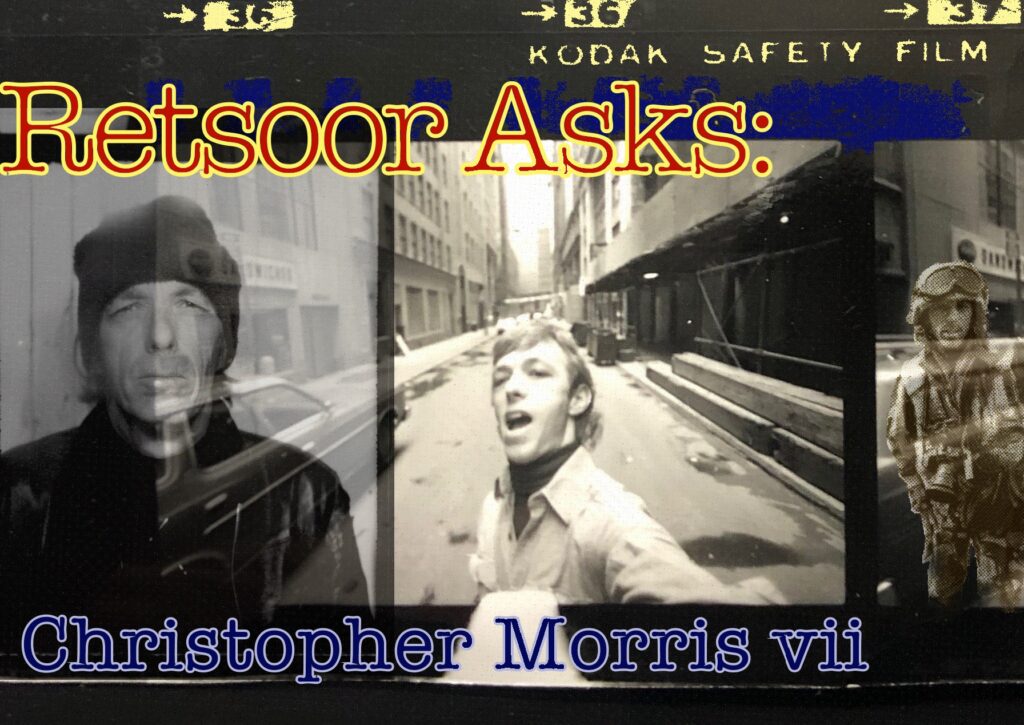
images courtesy of Christopher Morris vii
foreword by Rob Kaniuk
I called Christopher after I got the answers via text. We had to clear a few edits, a couple emojis. I’d just come back from mom’s birthday dinner. My nephew was the main catalyst behind me contacting Mr Morris, and he had asked, at the dinner party, when the call was happening.
“In about an hour.”
He said he was hype to hear how it went. I told Chris all of this, and it seemed to make the call feel like talking to a friend of the family. Mom was born in ‘52, and he was born in ‘58, so we talked about the nineteen-hundreds for most of the call. I was acutely aware it was the legend conflict photographer himself on the line––best of my generation. We talked about allegorical editing and Jungian symbolism in his work. About documenting men who do not want to be documented, about remaining invisible in hostile territories, and how genocide is a disease that never stops.
His work during the fall of Yugoslavia earned him the Robert Capa Gold Medal in ‘91. He told me it was that night, looking at the snow white linen, black ties, and what would now be considered the Epstein Class, he decided he’d never accept another award or attend an opening night for his work in conflicts.
“I stood there, looking at all of that, getting an award for taking pictures of dead children––and you have to understand, I left Somalia a week before (Apr., ‘92). They fit me in a suit and got me on stage in a hurry. I was wearing the same shoes that I’d had in Vukovar (Nov., ‘91)–– all I could think about was the absolute horror that was caked on my shoes. I felt disdain, I felt physically ill, like there was a real chance I’d make a mess of the stage. I had a hard time looking at society in the same way I always had, so I left as soon as I could and caught a flight to cover the siege of Sarajevo. That’s the last time I accepted an award in person.”
He went on to tell me he had to stop working with AI because it started asking creepy questions. Captions have always been a problem for Mr Morris, so he asked an AI assistant to help. It wasn’t long before the assistant had questions. Who gave you permission to take pictures of dead children in morgues? What right did I have, he asks himself over the phone. I want to tell him thank you, but that’s not right. What I mean is, we need people like Christopher, who, for whatever their reason(s), go to the world’s darkest places and risk their lives to show us what we do not want to see from places that don’t want to be seen. It’s imperative we pause from our manicured lawns and Sunday roasts to be gut-shot by images that tell the stories we refuse to hear.
We ended the call the way it started: talking about family and what it means to be human.
Retsoor asks: can people change?
CMvii: Absolutely that’s what life is all about. Every day is about change and the knowledge you allowed yourself to absorb, leading to change, specifically mistakes throughout what you believed before, every day should be about growth and change
—
RS: Is the belief in God a choice?
CMvii: Yes, understanding that you have control over where you want to let your mind travel
—
RS: Is everything singular or plural?
CMvii: Plural… how could it be singular, this makes no logical sense, just hold your hand out in front of you and look at the infinite world around us, and this is only what you can see in the now, with the factual understanding that there is only the present now, every living thing is in in this “now” 🧚🏻♀️ the past is gone and the future has no existence yet. Very plural world 🌎 we are in.
—
RS: What percentage of the world is evil?
CMvii: If you’re asking about us. 100 percent have evil tucked away inside, built in as part of some animal survival instincts, that all of humankind understands. This may be kept locked away in the societal box of evil, only to be deployed for some faux moral righteousness and/or belief that your god condones the slaughter of others. Not to mention the destruction of life on our planet. That we smother and destroy for profit. So the percentage of evil in this world is all of humankind.
—
RS: What % of your personality can you choose?
CMvii: Another trick question? Also infinite choices in the direction of your mind and where you allow it take you, even the belief that Santa Claus is real. Our beliefs form our personalities. Our kind is constantly trying to trick us with fantasies. Playing off emotions, fear, hate, jealousy, lust, greed. Where we have the absolute choice in what to absorb and believe is real. If you’ve ever had to sit and stare at someone diagnosed as clinically insane, they can look into you and start to smile, for they see something in you that not even you can see.
—
RS: How has mental health affected your creative life?
CMvii: Dealing for over three decades of covering man at his most evil and the true horror that they bring onto mothers and their children, standing over the dead like some kind of “Weggee” police photographer, focusing the camera on the destruction of innocence, with all the smell and sounds. This gets tucked away not only as film, but as traumatized neurons in my brain. With this constant discomfort, it allows me to see in an allegorical way of storytelling with symbolism and metaphors throughout all my work which is directly related to man.
—
RS: Which parent do you sound like when you’re angry?
CMvii: My mother and her Italian heritage
—
RS: What % of utility have we lost or gained from the internet?
CMvii: I don’t know if I can answer that clearly or properly, but I know that if all our devices stopped working today, society would have a difficult time functioning just trying to find their way from point A to point B on the planet. So yes, we have lost a lot but we’ve also gained an extreme amount of knowledge that is at everybody’s fingertips if they have access to a device that can connect them.
—
RS: Do you do what you do so you don’t get sad or because you are?
CMvii: since my childhood I fell in love with the craft of photography, it was never even a choice as a way to make an income to survive, it’s always been a pure love of mine, even to this day as I typed this, I live for creativity, even when I’m in my most depressed state, and my true depression comes from not being able to share all my creative ideas and thoughts, but this just inspires me to create when I enter depression and if I’m in extreme happiness, I also just want to create.
—
RS: Does answering questions in a public forum worry you or inspire you?
CMvii: No I have no worries. Anybody that knows me knows that I speak my mind freely even when it causes me extreme problems. I have nothing to prove to anybody. I have many haters out there and I have many people that have some kind of respect for me. Nothing I say really matters.
—
RS: Which list is longer: a list of everything wrong or a list of everything that isn’t?
CMvii: For me, it would be the list of everything that’s wrong if you’re talking about myself personally. In my life, by identifying all the things that are wrong, I can rectify that and change to turn them into something positive. If I look at a success, or list of everything that is right, it’s not very motivating.
—
RS: If you had the choice, would you choose to live again without knowing you were given a choice?
CMvii: I’m having a hard time comprehending the question. My answer would have to be definitely not., I had the most unbelievable life anybody could ask for, invigorating, but also quite frightening.
—
RS: Bonus question: Drugs?
CMvii: Yes, for everything is a drug, waking up in the morning and opening your eyes is a drug. Everything you do about your day is drug induced. From the coffee you might drink, to washing your face, hugging your dog, life is the drug 🧚🏻♀️
—
RS: Bonus Jeopardy: one small regret (big ones also welcome) I have is:
CMvii: Not understanding the now, always chasing, no time to breath and just absorb the beauty of life all around me, to lay on the ground on the ground for hours and stare at the grass and little insects that are alive and grunge to survive in the same now, no future no past, we share everything with all life forms. I’ve encountered this lying in fields pinned down by men trying to kill me. Lying there with ants and living grass looking up at the be the beautiful, beautiful clouds ⛅️ slowly drifting bye…
Thank you! J
Christopher Morris is one of the most celebrated photojournalists of the last four decades. A founding member of VII Photo Agency, he was on contract with TIME Magazine from 1990 to 2020, documenting close to 30 foreign conflicts and covering the presidencies of George W. Bush and Barack Obama as a member of the White House press pool. His work spans conflict, politics, power, and culture — from the fall of the Berlin Wall and the wars in Yugoslavia, Colombia, Afghanistan, Chechnya, Somalia, Yemen and Panama, the first Gulf War, to the US invasion of Iraq, and the Arab Spring in Libya.
Morris is the recipient of numerous major awards including the Robert Capa Gold Medal, the Olivier Rebbot Award, the Infinity Award for Photojournalism from the International Center of Photography, and a multitude of World Press Photo awards. He has published two books with Steidl “My America” was published in 2006, and “Americans” in 2011. Outside of Time magazine, he has worked for an extremely long list of global publications worldwide.
In 2009 with Time Magazine leaving the White House coverage. Morris was approached by the Italian fashion magazine AMICA, for an assignment in New York, after the Editor in Chief was shown a copy of his “My America” monograph, which led to a four year collaboration, bringing his unique journalistic craft to Milano and Paris, where he was based until 2017, documenting fashion, government leaders and celebrities.
In 2022 he started long term grant on the environmental changes in his home state of Florida.
Currently he has been working for the past years organizing his 40 year archives into what he likes to call a “Living Archive.”