Categories
Across the Wire Vol. 4

The Dunes

By Jon Doughboy

The Oregon Coast in the year 2000. The dunes of a new millennium. In the backseat a younger he, high-school dropout, hitchhiking in search of adventure, seeking a sense of purpose, a coherent self, a fine young woman to write poems to and ogle with soulful, sensitive anguish. To worship. The northwest coast of conifer-studded sand, an alien land to the eyes of an east coast teen, child of highways and denuded hills, medians hosting deciduous trees in their death throes, blighted chestnuts and scraggly sumacs adorned with assorted trash. Sprawling condo developments sliding into polluted rivers. George Washington crossed here, no, there, well, also, probably here and don’t forget there. 

NIN is playing. NIN was playing, then. Is playing, now, again, a twenty-three-year-old memory. The girl behind the wheel is singing along and staring in the rearview mirror, locking eyes with him, with the he of then, and singing “I want to fuck you like an animal.” It’s intoxicating, was intoxicating. He was scared. Horny. Aglow in the eyes of someone’s desire. Here is the hangover, still, residual radiation at age forty. But he didn’t like NIN because his friend’s older brother and schizoid drug dealer used to blast them out of waist-high speakers and they had to creep past his room as kids, tiptoeing cartoon spies hung on tenterhooks by his random acts of terror, until they were old enough to creep into the brother’s room to buy an overpriced eighth or take a hit from the gravity bong in a gray mop bucket in the corner, the plastic jug bobbing in it like a maimed apple. 

“I wanna feel you from the inside,” she’s singing, his ride, the owner of the Astrovan, vehicle of choice for rubber tramps and kidnappers alike, trailing rust and coolant and cigarette butts along the Oregon Coast. How did he end up here? Bus from Connecticut to Chicago. Rideshare from Chicago to Billings. Hitching onward from there to Idaho. Three more rides, more drugs, more propositions, to Seattle, then south, some college kids, an old trucker who was obsessed with the lizardmen lying in conspiratorial caves across the southwest on the brink of a mass invasion. Where are these dunes, he’s wondering, was wondering, and the dunes were more than dunes, they were freedom, proof, despite his doubtful parents and even more doubtful teachers, that he could manage himself, handle the world, grab it by the balls and not get shaken loose like stray and feeble lint clinging to its sex-slicked pubic hairs. 

“I want to fuck you like an animal” and he wondered and wonders what it would have felt like, fucking her, being fucked by her. She was thick and young but older than him, nearing twenty so to a sixteen-year-old, mature, experienced. Worldwise, sexwise. Where are these dunes? But her friend in the passenger seat is the one he was attracted to, desirous of. Eighteen, maybe. A fellow dropout, beautiful brown filthy hair, that hippie bounce, crown of leaves and grit and glitter. 

Beyond the dunes, the sea. The Pacific Ocean. He’s never seen it before. Where do the currents lead? How far Hawaii, Japan? What’s beyond beyond? Is Bobby Darin alive and kicking, crooning there?

He’s looking—was looking, the younger him—out the windows, searching for the dunes, avoiding the confident and penetrating glare of the driver. Too much energy, too many hormones, the rush of uncertainty, youth, hope, angsty wonder. He wants to fuck! He wants to feel! Inside, outside. Like a man, an animal, like the ocean eroding the shore. He’s floating above the van—him, the one he’s become, middle-aged, sluggishly juggling debts and regrets—breathing in its fumes, white coolant and burned oil smog billowing out of a pitted muffler, the smoke of a thousand spit-soaked roaches, patchouli, peanut butter, Old English-soaked upholstery. The other, younger him, is restless in the backseat, nervous, looking for the dunes he cannot see, though from these heights, from the bird’s eye of time, they’re clear as day to the older one, undulating beige waves breaking on pine and spruce reefs. His younger self can’t hear the elder version’s urgent croaking. It’s muffled by the passing years. No matter how loud his older self yells. No matter how important or timely his advice. Time is a vacuum. Time is a room, a cell silent save for the click of the door as it locks behind you. Time is and was and will be. 

NIN is blasting. The dunes are coming up. The dunes are here and gone. The lizardmen — who knows? — are thriving in their caves. The sixteen-year-old he is driven on, fueled by lust and pride and fear. The forty-year-old version drifts after him, an irrelevant flutter, weightless as a dream, howling mute warnings from a possible future. Somewhere, somewhen, beyond.

Jon Doughboy is a janitor at the Hrabal School of Embodied Poetics in Prague. Watch him pull some palavers out of the trash @doughboywrites

Categories
Across the Wire Vol. 4

FUTURES IN WHICH YOU’RE NOT WELCOME

By Sam Pink

A huge dog charged me in the street snapping

and I just yelled Hey and

it stopped, growled a little then retreated.

My battles settle themselves anymore.

At least, that’s what I want.

Burning in reverse. Problem solved.

We should all be kind to each other.

Isn’t that cool of me to think. I’m so great

and I know you can see it.

Which is what’s important anymore.

The universe meets you right

at the point of existence. Unfolding through you.

Machined finely against your every move.

It takes no pleasure or pain

in your defeat or victories.

Teaching lessons through jokes

you couldn’t dream of, not caring

to be heard. With a morality way beyond

any idea you could ever have.

The universe puts you through cycles

you have to see to defeat, or ignore

and continue to be defeated by.

But the cycle will be presented

as many times as necessary.

And that’s that. I won a long time ago

when I decided to just keep going.

The difference now is, I love it.

I see behind the curtain on mental processes

I’ve developed (and clung to)

and entire architectures disappear

like completed lines in Tetris.

And some will ask, what happens

when they’re all gone, when you’ve cleared them all.

To which I say, Who gives a shit.

I’ve relied on a future version of myself I know is real

but isn’t yet and has shown no signs of coming

and it pulls me up every time.

By muscles earned. Frontiering forward.

I forget myself. All my best decisions

happen without me. Being authentic

is a stupid goal. It’s a pretense

that immediately reverses itself.

A dog doesn’t say

I’m gonna be extra like a dog today.

You should be living it.

It should be obvious. I keep reminding myself

this. It’s at the point now where

everything is absurd

but it’s not depressing, it’s funny and awesome.

It’s like how people morph into chickens

in the eyes of a hungry person in a cartoon

except to me everything morphs into

a golden retriever wearing glasses in front of a computer.

And the difference now is, I love it.

Dropped out of the pageant, king of my own sideshow.

So get with it, stupid.

American Reloading is selling

500 (blemished) 124gr hst’s for like 60 dollars, shipped.

Which is pretty dang neat.

When people say they want to see you change

they mean die.

I freeze stars with how much I hate.

And begin Spring with my warmth.

It’s called being a human.

And the difference now is, I love it.

This is not an audition.

It’s the universe unfolding,

a small part of the big idea.

Everything that happens is my fault

for listening or not.

It’s all my fault and that’s fine.

It only gets bad when I try and

blame anything else.

Because the future is ruthless and right.

I salute you on your path, from mine

where you’re not allowed.

Roses are red

violets are blue.

God loves me more

Than He loves you

Sam Pink – twitter: sampinkisalive
Instagram: sam_piink_art

Categories
Crayon Barn Chris

More June

By Dylan Smith

June 21

Catalpa flowers fell like thwack outside the lumberyard. Burnt to brown mush on the pavement. Mountain laurels blooming too, starlike pink flowers streaming all along the road into town. While Art paid for the wood I played fetch with the lumberyard dog. A giant black shepherd named Blue. I threw catalpa sticks for her at first, then rocks. Blue loved rocks. I had the birthday card from Chris in my pocket and decided to sit against the catalpa tree to open it. Low dark rolling sky. Blue there beside me panting happy in the grass. We both needed water. All the trees in town did too. On the card was that painting Chris mentioned from his museum, the portrait of Saint Francis by Bellini. We’d talked about going there together to see it. In the painting a barefoot Saint Francis has just stepped out of his cave and into a holy light. It’s a divine light, a metaphysical light, and Saint Francis is in ecstasy because of it. Eyes rolled back into his dirty balding head. Saint Francis has accepted the light, become the light, he is spreading the light around—and now the landscape is illuminated too. There’s a walled off city up above him on a hill and in the valley between this city and Saint Francis there’s a heron, a donkey, some barren trees and a spring. Thwack. A tiny amphora to gather the water. I strained my swollen eye to see it. Behind Saint Francis there’s a poetry desk with a red holy book on it and a skull—and reproduced so small you can barely see it thunk thwack, there were dashes of red paint on his palms. I looked up. Leaves as big as bibles dangled in the heavy air. Thwack. Man, I love that little donkey. Heat lightning in the distance. The mountains looked like paintings of lakes.

I turned the card over. Chris had written this: 

Bill— There’s this sticky note I found the night you helped me move out of Alma’s. It reads: FROM DANGER GROWS WHAT SAVES. I can’t remember where that quote came from. Do you? I don’t even know which one of us wrote it. I’ve been thinking about that night a lot. You talked about getting older. How the edges of things have gotten rigid. Crystallized, you said. Static. I remember the days when your birthday meant it might as well have been mine too, when the borders between us were blurry and weird. I’ve been grieving those days lately. It feels like one of us is dead. I think this sticky note has something to do with it. I wonder which one of us wrote it. —Chris 

Blue pawed at a waterless rock. Looked blissfully out at the mountains. Wisps of smoke rose up from the fallen flowers, dispersed like spirits above the pavement. Hair of the dog would’ve been good about then. Good dog, Blue. Flowers like heaps of dog shit steaming. A shiny new red truck pulled into the lumberyard lot. Parked beside Art’s van. A man jumped down, went into the store. Red neck left his red truck running. I walked over. Looked inside. Another dog sat there, smiling, the AC blasting through his wavy grizzled coat. I opened the truck door just to feel the cool air. Stench of stale beer, carnivorous farts, cigarettes. The seat covers said God Bless America right where you would sit and the radio was on. I turned the voices up. Cattle dropping dead across America for the heat. The dog looked at me kindly, knowingly, trusting, a sage. I hoisted myself up into the driver’s seat. God Bless America. I just wanted to pet the guy’s dog. 

Cell phone in one cup holder. Bottle of water in the other. A firefighter radio had been mounted to the dashboard, and the guy’s cell phone background was of him knelt down beside a giant dead antlered deer. 

First water I’d had all day. I unscrewed the plastic bottle. Took a long drink. 

That’s when Art appeared in the truck windshield, grinning. Sheets of yellow inventory paper in his hand. He pointed at the van. I said goodbye to the dog and jumped down. 

“I know Blue, I know, you’re a horse, I know, go find yourself a rock,” Art said. 

Art’s van is like a mobile barn. Piles of spare plumbing parts, chords and rope and saws, screws everywhere, random scraps of dry wall and wood. The white paint is all tagged up from when Chris and I took it into the city for a job. Now Art rarely drives it to town anymore, only when we need to load it with lumber. The van must be a little longer than the truck. I climbed in. We’d already gone to the hardware store and Alma’s new well pump sat in a box at my feet. A marked light fell in through the spraypainted porthole window. I started to turn through the radio stations. 

“That took forever,” I said. 

“Kid working the register wouldn’t know a hawk from a handsaw.” 

Art dug around behind himself and pulled up a box of Beck’s. 

“I think you just quoted Shakespeare,” I said. 

“No shit? My old foreman used to say that all the time. You sure that’s Shakespeare?”

The red neck came out of the store with a drooping plastic bag. Nodding and waving at Art. 

“Pretty sure it’s from Hamlet,” I said. 

“Wow—I guess that’s what happens when your apprentice is a poet. Quoting Shakespeare is so boojswhaaa, Sunshine. I feel like a weekender.”

“These beers are going to be hot as shit.”

“Hot beer is better than no beer.”

Art sawed the air with his hand to let the red truck back out first. The guy waved again. Gave us a thumb’s up. I thought he looked like a cop. But Art was holding his beer out above the dashboard now, cradling the bottle before him like a skull. 

To Beck’s, or not to Beck’s,” Art yelled, laughing. “That, Sunshine, has always been the question.”

Art drove us up the dirt path toward the lumber. 

“Goddamn,” I said. 

“Yes. ’Tis the Devil’s Temperature.”

Blue was up there howling at us. I poured the rest of the red neck’s water into a bowl for her as Art backed the van into one of the outbuildings. Loading the lumber took a long time. Art talked about wood grain being growth rings. The lighter wood grows in spring, Art said. The darker part through the fall. Tighter rings mean drought years.  Metaphase. Anaphase. Telophase. Less water means less growth. When we finished loading the lumber Art threw a couple rocks up the hill for Blue. Lightning, nearer, split the sky apart—then thunder. Blue galloped back down toward the store. Goodbye, Blue. It was getting pretty late in the day. Nearly night. The lumber was longer than the van by a foot, so Art strapped the back doors to the boards with some rope. 

“What’s this wood even for?” I asked. 

“I’ll buy thee a pitcher of beer if you help me unload it tonight.” 

“Unload it where?”

“Property back up toward the farm. You’ll know it. We’d be going in for pizza and beer at the Country Inn first.”

“Yes, Art,” I said. “God, please, yes.”

Art stomped the fallen flowers off his boots as we entered the Country Inn. Chainsawed black bear sculptures by the staircase. Peonies in glass jars opening softly wild in the lamplight. In the mirror above the mantel Art removed his dirty hat and waved it at the two locals drinking wine by the dining room window. Lily pads on the dark pond water. Purple yellow mountain flowers muted in the murky light. Beyond the pond I could see Diane’s house tucked up into the darkness between some trees, the faintest red fluorescent smear of her electric car, and the local women waved back warmly as Art and I maneuvered our way around empty tables toward the heavenly lavender light of the bar. My comfort forever in that lavender light, the red and blue neon entwining. Even if it was Chris’s drug dealing theater friend Lumbersweeney behind the wooden doors, a book between his knees, highlighting something in the high and silent holy. I put my sunglasses on. Conrad was hunched in his usual corner spot against the wall, staring another knot into the bartop. Behind him a beer sign burned with wild horses and there was an empty stage framed by red curtains beyond the red booths—and now kicking through the kitchen doors to our left entered Donna with a tray of pasta and salad and fish. 

“Eyes up, Sweeney,” Donna hollered down the bar. “Anywhere you want, fellas.”

Lumbersweeney dropped the highlighter into his book and stood, smiling. 

“It smells like a chainsaw in here,” Art said. 

“My Hippy’s trying to fix a broken toilet,” said Donna, smiling too, and then she disappeared back behind us with the food.

Lumbersweeney placed a cold Beck’s on a coaster for Art as he put back on his hat. 

“A Sloop for you Sweet William, our poet, my long lost friend?”

“Thanks Sweeney,” I said. 

Lumbersweeney brought down a pint glass from above and poured me the needed golden nectar. Lean arms smeared dark with old sailor tattoos, his mustache black as two raven feathers. Poor old Conrad had just noticed we were there and, frowning, he was struggling to get a surgical mask onto his face. The sounds coming from his mouth made me think of a reptile’s eyes wetly blinking. 

“What book you got there, Sweeney?” Art said. 

With one hand Lumbersweeney set down my pint and with the other he lifted up from below a brand-new-looking copy of Capital Volume 1 by Karl Marx. 

“Jesus Christ,” Art said. 

“Either of you ever read it?”

“I tried to once in college,” I said. 

“Well let me tell you, Bill—the dude’s critique is clicking for me on every level. I know our Anarchy Book Club went to hell as soon as Chris left but I’ve stuck it out through the first three chapters and now I’m finally seeing the shape of it. Funny you two should walk in on such a night—I literally just got off the phone about it with Chris.”

“You talked to Chris?”

“Not an hour ago, Bill—you should know he’s been trying to get ahold of you. Sounds like you two had a hell of a night in the city. I’m sorry I missed it. Chris seemed awfully concerned about where things stand with you considering what with all the drinking and drugging and the sneaking away with all of Chris’s stuff and such. Classic fucking Bill, I said. But you should call him up, settle the score—you can use my phone if you need it. Anyway, I convinced him to come back up here for the party we’re throwing on the Fourth.”

“Wait, Sweeney, what? Come back up where?”

Art chuckled. 

“Up here, Ol’ Bill. To the upstate country. Of course taking into consideration the unfortunate location of your shack, I mean seeing as it’s on your almost-sister’s land and all well I offered Chris my futon down the road—and then of course Hippy being Hippy, he offered Chris a room upstairs for the night, and that was that. 

My eye throbbed badly with all the blood that had rushed to my head. I looked down at my hands. They were vibrating like the prongs of a tuning fork. 

“I’d like a shot of something,” I said. 

Lumbersweeney poured out three shots of whiskey and we took them. Conrad didn’t get one. He made more noises with his mouth. 

Lumbersweeney went on:

“Art—I’ve actually been looking to run into you. Day after the party here I’m hoping to throw another Hangover Wake for myself—Hippy agreed to help refurbish the old Coffin, but I’ll be in need of your and Bill’s tractorial assistance beforehand what with all the digging and lifting and of course with the ceremonious lowering day of and such. Have you time for that?”

“You got it, Sweeney,” Art said. 

I chased the shot by drinking slowly and intently my entire pint of Sloop. Then I lifted my sunglasses up into my hair. 

“Christ, Bill—what the hell happened to that eye?”

But barreling out from behind Conrad’s back came Hippy Quick careening out of the bathrooms with his bare summer arms outstretched and that tremendous dirty wizard’s beard yelling, “Saint Art! Speak of the Devil himself! The very man! Hallelujah!”

“Heya Hip,” Art said. 

Hippy rounded the bar like a bear and swung an arm around Art’s neck in a kind of giant violent loving hug. Sawdust and pitch in his beard, the sleeves ripped off his ruined flannel shirt. That’s when I noticed the pipe wrench in his hand. In the mirror behind the bar Hippy set down the pipe wrench and reaching over Art’s beer he took the bones of my hands so tiny into his, and he shook them. “Does me damn good to see you two drinking beer in here tonight,” Hippy said. Glasses goggled the sea glass green of his eyes. I looked away. Saw myself. My nose had turned bright red from the whiskey. If all of Art is supposed to be a mirror held up to Nature, and Nature a mirror to the Divine, then why do I always look so fucked up and broken?

Blood, I thought. Bloody blood blood, blood. 

I lifted up my empty glass. Hippy really did smell like a chainsaw. 

“Get these men more drinks, Sweeney, and some pizzas—you fellas want some pizza?”

“Have a whiskey with us Hip,” Art said. 

“No, no.”

Lumbersweeney poured a few out. 

“Come on Hip,” Art said. 

“Unfortunately it’s been deemed Dry Weekdays around here, Art. Donna’s orders, unfortunately.”

“Trouble again?”

“Trouble? Me? No, look—I’m a grown man. A grown man must consent to being in trouble, Art. I’ve consented to no such thing. Trouble, no—nothing like that. It’s more like. Well. Yes. Yes, I suppose you could say I’m in some kind of trouble—but anyway, look—it’s no matter fellas. You came in on a perfect night. Sweeney here was just giving Ol’ Conrad and myself a lecture on what was it again, Sweeney? Hegel’s goddamn what?”

“Dialectic,” Sweeney said. 

“Jesus Christ,” I said. 

“Just give them the quick of it, Sweeney—get a load of this, Art, it’s fascinating stuff—Sweeney, start with what you were saying about The Absolute.”

“I need another goddamn drink,” Conrad said. 

I took my shot. Sweeney took his too. 

“I’m trying to remember when the last funeral for you was, Sweeney,” Art said. 

“Going on three years now, Art. That was the Halloween Wake. A lifetime ago, it seems to me.”

And all at once I remembered Chris at the bottom of Alma’s stairs smiling up at me in the morning three years ago hungover. Our first time visiting Alma’s farm upstate from the city—The Inn’s infamous Happy Birthday Art But It’s Also Halloween Party. All I remember from that night was Alma dressed up like the Holy Ghost, her two eye holes cut from a clean white sheet and on her head a nearly invisible wire crown holding aloft a golden glow stick halo, the way she lifted the sheet up to scream I’M THE HOLY GHOST at the locals with her perfect black eye paint streaming in the hot packed bar, and then it was the next morning waking up hungover and alone in Alma’s attic and the film guy who she’d eventually leave for Chris was there, I think his name was Sebastian or something, he was down there making breakfast for Alma and failing to build a fire and Chris was at the bottom of the stairs smiling up at me in his Evel Knievel cape saying Bill—we’re late for Lumbersweeney’s Burial—should we go?—and then it was the fresh wet mountain smell through the window of Alma’s car and a blur of dark blue fog through the gentle drift of morning—and I remembered the way Lumbersweeney had prepared people ad naseum the night before handing out pamphlets and explaining in all seriousness that his Coffin had been built to Divinely Inspired Dimensions, taking into consideration of course Celestial Mechanics through which the Coffin would by way of its decomposition Transfigure, transcending of course the limits of linear time and undergoing as it were a kind of Interstellar Odyssey through which it would gather its collection of Galactic Artifacts and bring back up from Below new forms of Interdimensional Residue, Lumbersweeney said—and it was explained at length how Lumbersweeney could not himself be in the Coffin per se but would as it were remain Above in order to attend the Wake and eulogize himself and in this way it would be Art—it was supposed to be some kind of Art—and I remembered the way Art himself was already working the tractor when Chris and I arrived, dumping cascades of beautiful black dirt into Lumbersweeney’s grave in that field above the pond with a small crowd of hungover mourners huddled over the hole in dark clothes and Hippy Quick was there in bright robes holding out a lantern which hung from his walking stick and Lumbersweeney with his hands raised on high in the not quite rain quoting Quod set supers set sick quod infers and looking wild, totally wild. 

“I already made my plans for the Fourth,” I said. 

Art laughed. Took his shot. Wiped his mouth.

“Plans, Sunshine? What plans.”

“You suppose there’ll be a fire ban by then?” Hippy said. 

Lumbersweeney opened another Beck’s for Art.

“Absolutely. At this rate? I’m surprised there’s not one in place already, Hip.”

Conrad mumbled something jumbled to himself in the corner. Blue mask down around his chin. Legend has it that Conrad’s son died leaving The Country in a decade ago drunk. Last seen leaving with no headlights on. A deer. A tree. Dead son dead and gone. 

Lumbersweeney poured me another Sloop.

“Conrad needs another too,” I said. 

“I heard him, Bill. Will you free up by morning for my Burial at least?”

“Sorry, Sweeney, but these plans of mine extend out into the unforeseeable morning. You can send Chris my best though. I’m sure he’ll enjoy your grave little play.”

Sweeney slammed my beer onto the bar. 

“Is there a problem between me and you, Bill?”

“Thesis. Antithesis. Synthesis,” Hippy said. 

The pipe wrench was there on the bar beside his hand. 

“Easy does it, Sunshine,” Art said. 

I was staring at myself in the mirror. 

“Won’t somebody please just get me a goddamn drink,” Conrad said. 

But like an angel on my shoulder in the mirror behind the bar Donna entered again with an empty tray.  

“Hippy, darling—run up and get that smart thermostat from off my desk.” 

“Gentlemen,” Hippy said—the saloon doors singing shut behind him. 

“Beers are on me if you can fix whatever’s wrong with our toilet, Art. The beautiful bastard’s been in there all afternoon. What might take him another day could probably be done in an Artful moment from you.”

“You got it, Donna,” Art said. 

Lumbersweeney had subtly sidestepped to the other side of the taps and was lighting a tray of tea candles. I put my sunglasses on. Art entered the bathroom with Hippy’s pipe wrench and the beer. 

“Alma called today, Bill. She wants to buy my kiln.”

I was unable to process that information. Donna came around the bar to wipe some glasses dry, but then she was there before me with her hands on her waist. Looking at me. She picked a piece of hay off my shirt. 

“Take those goddamn sunglasses off and let me see,” Donna said. 

“Oh come on, Donna,” I said. 

“Let me see.”

She leaned in close to look. 

“Have you had it looked at yet?”

“Just by you and the person who glued it.”

“Can you see out of it fine?”

“Of course I can, Donna. It just itches is all. And throbs a little. Like there’s dust in it.”

“Looks more to me like a plank,” Sweeney said. 

My stool fell loudly behind me as I stood. 

“Oh fuck you Lumbersweeney,” I said. “You’re nothing but a sidekick, man—a fucking clown. I’ve seen Chris leave behind a hundred of you. You’re an unpainted fucking clown.”

“Outside,” Donna said. 

“What, Donna—you’re kicking me out?”

Donna had taken a few steps back against the mirror. She was pointing at the door. 

“Yes,” Donna said. “Out. Go. Now.”

A half hour later Art came out with Hippy’s walking stick and some pizza. I’d made a big fire in the pit by the pond and was drinking a Beck’s from Art’s van. He set the pizza box on a rock by the fire. Handed me the stick. “Hippy wants you to have it for your limp.” Art sat beside me on the log. I handed him a beer. We looked into the fire for a long time together. Lights came on at Diane’s. Somewhere nearby Hippy’s dog had been buried. A starless night. The fire kept changing.

“Where are we unloading that lumber, Art?”

“Your therapist’s house.” 

“I knew it,” I said. 

“Is that going to be a problem?”

“No. It’s alright. Maybe I’ll make an appointment.”

“That’s probably a good idea.” Art opened the beer with his knife. “She wants a new deck.”

“That’s good,” I said. 

“Lumbersweeney thinks you’ve cracked up.”

“Who cares,” I said. “Everything I said I could have said about myself. I wasn’t even really talking to him.” 

Art laughed. Shook his head. 

“I think I’m in love with Alma, man,” I said. 

Art looked out into the night. I could hear Diane’s son screaming, playing, laughing. 

“I don’t get what you’re so hung up about,” Art said. “That’s supposed to be a good thing, love.”

“I’m afraid Chris will never talk to me again. That’s best case scenario. Worst case scenario is—”

“They say when you bury a feeling you bury it alive, Sunshine. The same is true for love. You can’t decide who you love.”

“Sure you can,” I said. 

“Well then do it already. Make your decision. Fear is stupid. You need to live your life.”

Art led us back up the hill through the dark. I liked the feel of Hippy’s walking stick in my hand. At Diane’s we unloaded the lumber loudly, board after board, thunk thunk thunk. Lights were strung from tree to tree and every window in the house was lit. But nobody came out. I tried to eat a slice of pizza but got the red sauce everywhere. 

Art drove us back to the barn. 

There were lights on in the farmhouse too. 

“Wow,” I said. “Alma’s back.”

The van engine clicked as it cooled. 

My Volvo looked like a coffin of itself in the dark.

“What’s this,” Art said. 

I had tossed the birthday card onto Art’s yellow lumberyard papers. 

“From Chris. It’s Saint Francis receiving the stigmata.” 

Art leaned in closer to look, frowning, then he sank back into the driver’s seat. 

“A stigmata is when—”

“No, no—I know about that,” Art said. “I thought you said stomata.”

Art got out of the van. I did too. The sky had cleared. The stars were out. It never did rain. 

Alma’s body brightened the frame as she moved to and fro through her kitchen. 

“You going over there tonight?” Art asked. “She still doesn’t have any water.”

“I’m too drunk,” I said. 

Something hit hard against the hood of Art’s van with a thwack. We both jumped in the dark. 

“It’s flowers,” I said. “Alma’s catalpa must be blooming too.” 

“I know. I keep thinking I stepped in dog shit whenever I cross the road.” 

I started for the hill with the help of Hippy’s walking stick. 

“One thing before you hike up,” Art said. “My brother’s kid. Down in Arizona. Got into a little trouble.”

I had stopped in the middle of the street. 

“I didn’t know you had a brother,” I said. 

“I’m taking the kid in for the summer. Teaching ‘em how to work.”

“When?”

“Probably be here for the Fourth.”

“Jesus Christ. Okay. What’s his name?”

“Pretty strange kid,” Art said. “Name changes a lot. Right now they go by Spitgum.”

“Spitgum.”

“That’s right.”

“Alright, Art.”

“Nighty night, Sunshine.”

“Alright, Art. Goodnight.”

Dylan Smith is looking for a job if anyone knows of any jobs in Brooklyn.

Categories
Across the Wire Vol. 4

SNIP

By Anthony Neil Smith

The doc called Logan and me back to the ER after midnight on a middle-aged husband shouting about his wife having a heart attack and no one helping her. 

We’d already dealt with a drunk who’d taken a swing at a nurse a couple of hours before. Logan had enjoyed cuffing the guy and manhandling him out to the curb to wait for the cops. Logan was the type who dreamed of being a cop but couldn’t pass the physical. The man had a gut and I’d never seen a vegetable anywhere near his mouth. But when the cops showed, he was all, “Got your perp here, attempted assault on an employee. Intoxicated.” Like it was an audition. “Keep up the good work,” they said. “We need guys like you fighting crime.” He couldn’t tell these dicks were fucking with him.

I’d known them both, worked with them on the force. I hung behind. I didn’t want to hear Horace’s ribbing. He knew it, and didn’t care. “You stay safe, Beau. Don’t let anyone cough on you.”

“Yeah, yeah.”

The other, Jimbo, asked, “You ever get your license again?”

He knew I hadn’t. My bike was chained up outside in plain sight. Assholes.

Anyway, this husband trying to help his wife. I got it. This hospital is in a small Minnesota town, a make-do sort of hospital. Always short-handed, they hired the best of the rest. 

Like me. A half-assed security guard.

I scoped the scene at the patient’s room. Mid-forties hockey mom, D-cups, gripping both rails and panting. “It doesn’t feel right. Something’s wrong.” The husband stood at her side, leaning over, brushing hair from her face, while one of the younger nurses held an oxygen mask in one hand. “You’re okay. I promise, you’re okay. I’m telling you, you’re not having a heart attack. I swear.”

Another woman, thin, flat-chested, white streak running through straight dark hair parted in the middle, saw us first. “Seriously? Are you fucking serious?”

The husband looked up. Thick professor glasses topped by thick eyebrows. A little fat, double-chinned, in sweatpants and a t-shirt that swamped him. A souvenir from Ireland, green with their flag on it.  

I waved him towards the door. “Sir, can we talk –”

“Are you insane?” The hippie woman came for us. 

Last thing we needed.

Logan puffed up. “Ma’am, calm down.”

“All he did was get her some help! They called security on a man trying to get help for his wife?”

Logan reached for his Taser but I grabbed his wrist. “Dude, please.”

Oblivious. He kept at this granola-looking woman. “You need to stand down.”

“You want to tase me? You want to tase my brother-in-law?” The sister stepped into the hall and swung the door closed behind her. Or tried to. 

Logan reached over her shoulder and slammed his palm flat against it. “That’s not how it’s going down.”

“I can’t believe this!”

Logan wouldn’t be happy until he had a chance to tase the fuck out of somebody while I only wanted to get through each shift invisible. An afterthought. 

I talked the sister down. Took all the shit she flung at us in stride. You had to let people vent. They weren’t all threats. Logan was still posing, though. “We can’t have that type of behavior. Your brother-in-law is disturbing the peace.”

I interrupted them both and said, “Please. All I’m going to tell him is play nice from now on. Can you ask him to speak with us?”

Which seemed to do the trick.

Maybe on the surface I was a placid security guard, trying to deescalate the situation. 

Scratch me though, and right under the skin I’m boiling. Wishing I’d never rolled my squad car drunk and gotten fired from the only job I’d ever wanted. 

Two years ago? It’s always yesterday to me. On a good day it feels like last week, never far from my mind. 

Out at three in the morning after a fight with Vicki, who’d finally found out I’d got a vasectomy because I didn’t want another kid. I mean, we already had four, all two years apart, bottomless pits for food and attention and toys. Of course I’d wanted kids. Of course when I, a lapsed Lutheran, sort of, and only child, met Vicki, from a Mormon family of nine, I’d known the deal. She wanted to be a Pioneer Woman mom. Trad mom. Hand-me-downs, bulk shopping, family game nights instead of TV. I went for it anyway. I’d always thought Vicki had my heart in her hand. Now I think she’d memorized a how-to book. How to Mold the Man of Your Dreams, or some such like A Godly Man Needs a Godlier Wife

Then we had the kids. After my second daughter – two boys, two girls – I was done. Scared to touch Vicki, more fertile than MiracleGro. Like her eggs were out on patrol, searching for sperm, one measly sperm that might’ve dribbled in when I pulled out and let go on her stomach. Every other woman, better odds you can shoot a million up in there and they all miss, but not Vicki. Something about the women in her family. I’ve got five sisters-in-law and twelve nieces and nephews whose names I can’t remember, even sitting in a pew behind them week after week.

I’d come home aching, only to be leapt on by toddlers. Shin splints, nut punches, sprained muscles. I’d say “Not now,” but Vicki would say, “I’ve had them all day, so it’s your turn.” And I’d say, “You don’t get it. I chased some guys. I tackled one. We had some domestics resist. Please, honey. Can’t they watch cartoons?” But she’d give me a look, the one reminding me I’d told her a long time ago I was on board. Sickness, health, wealth, debt, an arkload of children, I was on board. 

So I got snipped. Never told her. 

Thing was, our little Minnesota town, they’re all in each other’s business, so if a fellow Saint worked at the clinic, and found out from another Saint that Vicki’s husband Beau had been to Dr. You Know Who in order to you know what, well…you know. 

To be honest, I’m surprised I got away with it for as long as I did. Six months of some great God-inspired fake procreational lovemaking. No more pull outs, no more cold shoulders, no more looks. Wham-bam-I-love-you-ma’am! 

My wife’s not stupid. She had an inkling. I think it was more she threw out some bait before reeling in the tea, or whatever they call it, the gossip, the down-low. Our Sainted friends at the clinic almost burst their lungs holding onto those delicious tidbits as long as they did. 

Getting back to the squad car, though. 

I had come home from work. Funny looks from the kids among their hundreds of thousands of Lego pieces. No noise from the kitchen, Vicki not cooking that night for our battalion. 

“We ate pizza,” my oldest son said. “Mom’s upstairs.”

I knew I was in for it. 

She’d planned to turn it into pure drama. Waiting for me in the bedroom, skimpy panties and thick lipstick – on a school night? Posing like a centerfold. Laying a trap.

“I know you know.” I sat at the foot of the bed. “I get it.”

By the time we were done – I never even had time to change out of my uniform – I stormed downstairs to the basement and turned the hockey game up loud while she put the kids to bed, something we usually partnered on. 

Once I knew everyone was down for the night, and Vicki retreated to our room to pray for my lyin’ ass soul, I headed to a fellow cop’s house. Horace. We played Call of Duty and NCAA Basketball and drank a kiddie pool’s worth of Golden Light before he brought out the Evan Williams, as if we weren’t already dizzy enough, while he virtually dunked on me as I spilled the story. 

“Fucking Mormons,” he’d said. “No offense.”

We laughed and made fun of a Mormon wife’s cavernous vagina after popping out eight or nine or eleven soccer-ball-headed kids. I didn’t tell him it was a myth and Vicki could still squeeze my Mister Mister tightly after four, because I was drunk and thought he was funny. “Hot dog down a hallway!” What a joker. 

As I left, he clapped me on the shoulder and slurred, “You…right…thing.” You did the right thing. Guessing he meant the snip. At no point did he say “Stay here, you can’t drive” or “Let me call you an Uber.” Just waved me on my way.

The first few well-lit blocks were fine. I had a curb to follow. But I took a right and there were three roads where there had been only one, overlapping, so I tried to punch through the foggy ones and race right down the middle. A cul-de-sac. I kept on bowling down the center. Dreaming I was an F-1 driver. Blink Blink. 

A yard! A house!

Yanked my wheel to the right, going faster than I realized, and went zero-g before doing an impression of a brick in a clothes dryer. 

I avoided the house, thankfully, and any people due to the late hour, but ripped up this poor guy’s yard. Took the bumper off his GMC pick-up. Felt like I took it off with my teeth. And still – and still – I walked away with only bruises and one broken finger. 

My true blue bros covered for me, of course. If I’d killed someone, it might have been a different story. The higher-ups hid the part about me being drunk – no one tested me, field, breath, or blood. I lost control because I was sleepy. An unfortunate accident was all it was.

Behind the scenes, though, boy howdy. 

I was screamed at. Throttled. Humiliated. Stripped of my badge. 

Then there was Vicki. 

As mad as she was at me getting snipped, it wasn’t like we were done. For a good Mormon woman, “divorce” was a word for soap operas. No, no. Only whispered, never a serious consideration. Around others, she was thankful and blessed I survived intact. Alone, she told me I would have to complete a very long list of making-up over a very long time in order for us to be okay again. 

As in okay okay. As in “letting you anywhere near our bed, let alone my vagina.”

First on the list: church counseling. 

Even in a severely traditional, male-powered system like the LDS, fuck’s sake, the counselor raked me over the coals and then some.

Thankfully, friends of friends of friends helped put me back on my feet with this security gig, even though Vicki had to take a part-time gig at the craft and hobby shop to help with the bills. All in all, we were doing okay, considering. 

Considering losing one’s badge and gun feels a lot like losing one’s dick and balls, even if it only shot blanks. 

So that’s where we were. A perfectly acceptable stalemate. 

When the husband came out of the room, easing the door closed behind him, I knew he was angry. The heat sloughed off in waves. But this was a professor, not a bar brawler. He was angry, embarrassed, and afraid of us all at once. But not afraid enough, not now. Not anymore.

“You understand why we’re here,” I started. Might as well try to get this back on track. I held out my hand. “I’m Beau. This is Logan.”

“Terry,” he said. “My wife is having a heart attack.”

Logan, Mr. Congeniality, said, “I don’t care about the why, okay?” 

I wanted to slap him upside his head. 

“You weren’t here. My wife was telling us good-bye. She thought she was going to die right then. And no one could be bothered?” 

“You have to treat the staff cordially.”

“That’s on them. I don’t think it’s cordial to let my wife suffer.”

I nodded. “Absolutely. You’re right. I understand.”

I did, I really did. I can’t imagine what I’d have wanted to do to these assholes if they’d pulled some of this shit on Vicki, or one of my kids.

But Logan? He couldn’t help himself. “You will follow the rules, or you will not like what’s next. You know what’s next?”

A sneer. He held his wrists together and out. “You want to cuff me now? Solve all your problems.”

I saw Logan, like a gunfighter at high noon, his fingers flicking, wanting to go for those cuffs.

“We don’t have to at all, sir.” 

“Good to know. Can I go in with my wife now?”

If Logan wanted to force the guy to comply, I couldn’t stop him. But I hoped not. I said, “Yessir. Have a good night, sir.”

“My wife’s having a heart attack, you tell me to have a good night.” He shook his head and stepped into the room. Closed the door without another look at us guards. 

Logan let out a breath. “Dude. He is pissed.”

Idiot. 

“I’m going on break. Please, don’t pepper spray anyone until I’m back.”

I found some coffee. I went outside. 

On the curb was the woman’s sister, the granola with the long straight hair and Birks. Sitting, smoking, staring. Getting close to two in the morning. Since I didn’t want to spook her, I made some noises, jiggled the arsenal on my utility belt, and took a wide berth coming around so she’d see me. 

I waved. Like a child. I waved at her. “Hey, remember me? In there? You alright?”

She glared at me, her head nodding in a sort of I can’t even believe you’re talking to me right now. Held the cigarette in an elegant manner, like a book jacket photo. No make-up, not much affect. I don’t know, something about me was drawn to her. But I waited as she sharpened her tongue.

Once she had, “My younger sister is having a heart attack. The doctors and nurses are ignoring her. And they send the goon squad when Terry tries to get her help. I’m not alright, you asshole. Not at all.”

“Can’t say I disagree.”

“Only doing your job?”

Shrug. “That’s why I get the big bucks. Nothing was going to happen. I told him to be a little more careful.”

She took a long drag, then tilted her chin up and blew a stream into the cool air. Even though she was a bit older than me and what I’d call a hard-scrabble Midwestern woman, no great beauty, something about the way she blew smoke and looked me in the eye got blood running to places it shouldn’t have. Or was it that my wife had frozen me out for far too long now and any sort of vibe got my juices going?

“Mind if I sit?” I pointed to the curb beside her. Feeling silly.

“Don’t you have sick people to arrest?”

“Come on.”

She wrapped her arms around her knees and squeezed. “Free country.”

I took off my belt, took a seat, grunting halfway down. I might’ve thought Logan was too much of a balloon to be a cop but I’d gained a beer belly myself. Since I’ve been off beer this past year – not my choice – I guess it was now a custard-filled Bismarck belly. “Name’s Beau, by the way.”

She held out her free hand. “Godiva.”

“Seriously?”

“Well, I wouldn’t want you to run my real name and check me out.”

“Fair.”

“Married, I see?”

I looked at my wedding ring, had forgotten about it to tell you true. “Mm. Four kids.”

“Happily?”

“When I’m not fucking up I’m pretty happy.”

She raised her eyebrows. “Hey, you just got interesting. Give me an example of how you fucked up.”

Sure. Why not? “I got a vasectomy without telling her because she wanted more kids, and I did not.”

Godiva laughed. A hearty, roiling laugh. A little phlegmy. “I’m guessing she caught you?”

“Too small a town to keep a secret. I should’ve known.”

She rocked into me. “My, my. Still together?”

“Oh, she won’t leave me. I won’t leave her, either. We’re both stubborn enough. Oh, and she’s – we’re – Mormon.”

Another laugh, softer. Another pull from the cigarette. “Too bad.”

I thought about asking her if she’d take me to whichever vehicle they’d arrived in and let me slip it to her. Just sex. A physical relief. Not love. Not at all. Bend her over the seat and go, man, go. I imagined a woman like her had secrets. Secrets only revealed when she was naked. How I’d like to know, yeah, how I’d really like to know.

But I was a coward and wouldn’t dare. Instead, I’d head inside to the men’s room and rub one out thinking about how raw and slippery and filthy it could be. Imagine myself as a stronger man than I am, someone who can make a woman like Godiva beg for it, instead of having to beg my wife to even let me hold her hand in church, sleep in my own bed, kiss her on the lips anymore. But that’s who I was. If my wife had ended up in the ER like this, she would’ve ordered me to hunt down these bastard doctors and give them a piece or our…her…mind. Never on my own. Not sure I could work myself up to it.

The brother-in-law, Terry, stumbled out of the sliding doors. Startled us. He saw us sitting together but nothing registered on his face. He wilted to the concrete beside Godiva. Face flushed purple, eyes red and wet. “She’s…um…they took her to surgery.”

“What?”

“The surgeon told me. He told me.”

“Told you? Told you she’s in surgery?”

“Told me…Jesus. She died, Gin. She died. She’s gone. She’s really gone.”

They broke down together, ugly, insistent, painful. And me. A third wheel. Sitting there beside them, wondering how much I’d miss Vicki if she were to suddenly not be there anymore. And…I don’t know, not half as much as Terry would miss…never got her name. 

They embraced and wept and said things neither could understand.

I stood, grabbed my belt, and slipped inside the sliding doors. Carried the belt to the bathroom with me. They weren’t the first people I’d seen lose loved ones on this job. It got easier, though. I locked myself in a stall and dropped my pants. Tried to remember all of the details of Godiva’s grin before Terry cockblocked, at least in my version, what I needed to feel better right then.

Is that cruel? Someone’s wife and sister dead, and me wanting to get off? I mean, people die every other week at this hospital. They just do. We all do. I formed a callous over my heart months ago. What about me? What about my life being worth dying over?

I worked my hand down there. Thought of Godiva’s feet, her hair, her scent. 

Nothing. Whatever I felt outside had faded. 

That was okay.

It would all be okay. 

I sat on the toilet and wondered how Vicki would humiliate me tomorrow.  

Anthony Neil Smith is a novelist (Slow Bear, The Drummer, Yellow Medicine, many more), short story writer (HAD, Bull, Cowboy Jamboree, Maudlin House, Reckon Review, A Thin Slice of Anxiety, BRUISER, many more), and professor (Southwest Minnesota State University). One of his pieces was chosen for Best American Mystery and Suspense 2023. He was previously an associate editor with Mississippi Review Web, and is now editor of Revolution John. His short story collection The Ticks Will Eat You Whole is forthcoming in 2025 from Cowboy Jamboree Press

Categories
Across the Wire Vol. 4

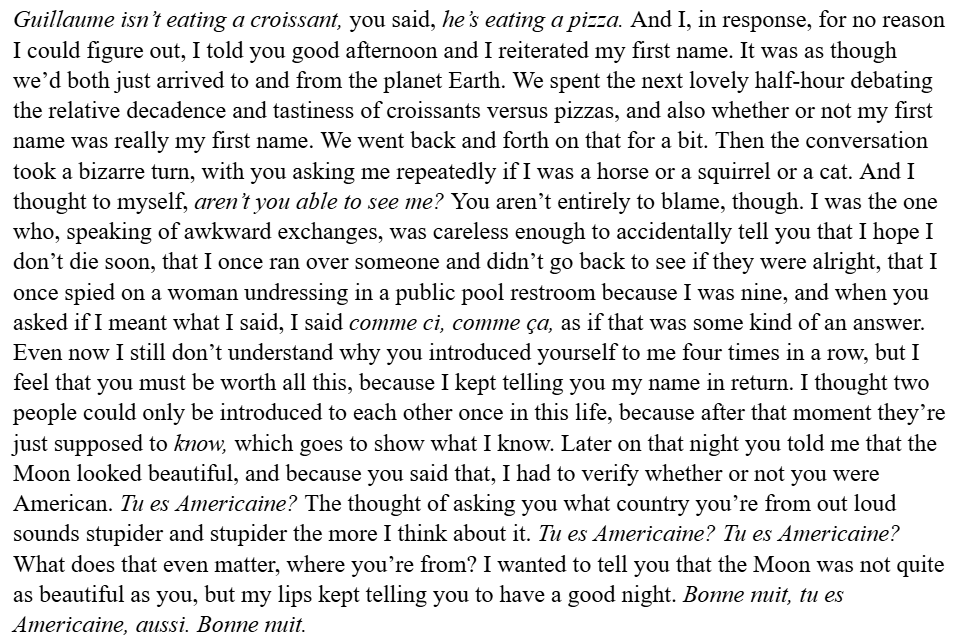
Grief Therapy

By Carla Sarett

Carla Sarett writes poetry, fiction and, occasionally, essays; and has been nominated for the Pushcart, Best Microfictions, Best American Essays, and Best of Net.  She has published one full-length collection,She Has Visions (Main Street Rag) and two chapbooks, including My Family Was Like a Russian Novel (Plan B) Carla has a PhD from University of Pennsylvania and is based in San Francisco. x/twitter: @cjsarett

Categories
Across the Wire Vol. 4

Two Poems

By Jeffrey Hermann

You Couldn’t Pay Me

They say to be good at one thing but I can’t decide. I make some phone calls and I send some texts but it’s Friday. People are heading out to Long Island. “Don’t fuck it up” is the best job advice I ever got. The world only needs so many healers. Someone has to drive the truck. Someone has to think about scrap metal. I’m thinking about scrap metal when I discover a thirteenth month. It’s sunny but breezy and it loves people, unlike the others. Offers worth millions come pouring in. Instead I name it after my dog and give it away, no charge. According to the calendar it’s still July. In the Atlantic, sharks are doing what they do. Only the beach people are worried. If there’s blood in the water, they can’t smell a thing. Seen from below, their legs look like flippers. 

Hold On, Is this Thing in Reverse? 

We saw a shadow on an x-ray in the shape of New Jersey. It was nothing, some normal muck inside the body. The doctor rubbed his eyes and left the room. When he got home to his place in Secaucus his kids were watching pilot episodes of shows that never made it. The nurse stayed with us and spoke with her hands; two birds finishing each other’s sentences. I saw them later in the next room delivering difficult news, then they went home to the Palisades. Sometimes I look at the sky and forget which season comes next. Will tomorrow be a little colder or a little warmer? Sometimes I don’t fully trust my car’s instrument panel. People who aren’t afraid of being alone probably get too many phone calls. I silence mine and sometimes miss my wife asking for help. My two greatest fears are letting go of her hand in the hospital hallway and rolling backward over an embankment.

Jeffrey Hermann‘s work has appeared in Okay Donkey, Electric Lit, Heavy Feather, Trampset, and other publications. His first full-length collection of prose poetry and flash fiction will be published by ELJ Editions in 2026. Though less publicized, he finds his work as a father and husband to be rewarding beyond measure.

Categories
Across the Wire Vol. 4

How to Forget

By MD Wheatley

“Hullo, good afternoon potential future friends, you can call me MD, as in medical doctor, or Mountain Dew. Funny, heh? I think so too. I grew up on Mountain Dew. Anywhoozle, thanks for joining me here today in Conference Room B. You could have easily gone to A but instead you chose B and I love that because I would’ve done the same. I’ll BE your friend. OK, I’ll chill. As I’m sure most of you can tell, this is my first time here and I’m happy to be here. The pamphlets instructed us to do all sorts of things, like share interests, personal qualities (good and bad), show-and-tell-type objects, to which I defer all. Truth is, my interests are likely going to bore most of you, and tomorrow I may wake up interested in the synchronicity of fishing and Battle Royales, if I even wake up tomorrow. Nice, OK, some of you are walking out. Just so you know, the dude in Conference Room A eats raw eggs and doesn’t believe in sunscreen. Have fun losing your new friend to skin cancer at 35! Shit, where was I? Sorry, I chew my nails when I lose my train of thought. Choo choo! Uh, I like Morrissey. I like cassette tapes. I like live music. Have you ever surrendered your body to live music? No? Me neither!!! I like skating. I like reading. I like reading books. Short books. Sorry, talking to myself out loud here. Um, I like esoteric shit. I learned that word like a year ago. Pretty dope word. If you know, you know. I like to think of myself as Dave Masters from the beginning of Stoner by John Williams. You know, before he died in the war. Or the protagonist in Good Old Neon. Neal’s ghost. Good old Neal. And whether you know either of those references or not is besides the point. The point is, I said it. I confessed it. I confessed to a self-diagnosis. And given the time and space, I could diagnose you. Hell, I could diagnose all of us, but what do I know? What do you know? You don’t know me, and I don’t know you. We think we know each other, but who are we fooling? No one. We are the fools. I planned to stick to the script but my note cards got all jumbled in my pocket. Out of order. So, instead, I’ll share with you a poem I wrote because that’s all I know to do. To share a feeling in hopes someone will nod their head in agreement. Sometimes the moon looks like a fingernail. Nice, I see you nodding over there. This one’s for you, buddy. It’s called I Need More Friends To Love Unconditionally, I’m a Really Good Friend, I Promise, Will You Be My Friend? You’re not as tough as you think you are … a blender can still nub all 4 of your fingers quicker than you can say W-T-F … what’d you think was gonna happen? … that your skin was too thick? … your bones made of steel? … it is true though … I kept one of your fingers as a souvenir … right after I asked you to save all of em … which was right after I asked, why’d you do that? … this isn’t high school anymore … you can’t just run away … or not show up … everyone that knows you now … is always gonna know you. Ah frick, sorry. I cry easily. Give me a second. I’m not smelling my armpit, promise. Where was I? Oh yeah, the poem. Everyone that knows you now … is always gonna know you … is always gonna remember that you stuck your hand in a fucking blender … a goddamn blender, Jesus … the sad thing … or funny … or maybe it’s a good thing … is that I’ll always love you … and you know that … I think that’s why you do such stupid shit … because you know I’ll always love you no matter what … and the sad reality is … if you live a life of self-destruction that ends with an entire hand of nubs … I’ll never question you or wonder why you did that to yourself … instead I’ll ask myself … how could I have loved you better? … how could I have saved you? … because here’s the hard truth, OK? … sometimes you wake up before dreams get to the good part … and sometimes you fall asleep before life gets to the good part … Wow, thank you, thank you. I’ll wait a second. Thanks for the love. This is the part where I wrap things up. So, if you’re interested in getting to know me better, I’ll have a newsletter sign up sheet at my booth. It’s back and to the left. I know it’s rude to point, but which way to the little poet’s room? I really, really have to pee. Before I began I thought it was just nervousness but I legit have to piss like a racehorse. Please excuse me. Thanks for your time. OK sweet, bye. Or see you—ooh here comes the pee. Imagine saying bye for eternity..”


MD Wheatley’s a husband, father, and writer living in Charleston, SC. Read more here—mdwheatley.us

Categories
Across the Wire Vol. 4

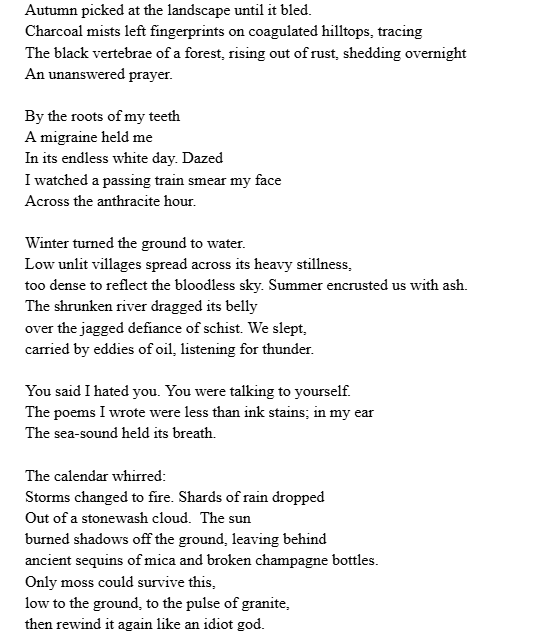
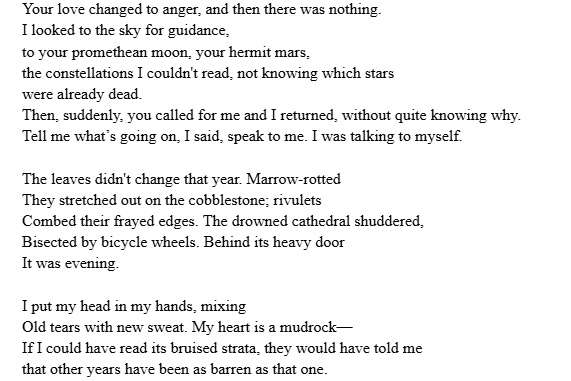
Three Poems

by Graeme Bezanson


Graeme Bezanson is a writer living in southwestern France. His work has appeared in or is forthcoming from BOMB, X-R-A-Y, GlitterMOB, Sixth Finch, HAD, and elsewhere. You can find him online at graemebezanson.com.

Categories
Across the Wire Vol. 4

My Heart Belongs in an Empty Big Mac Container Buried Beneath the Ocean Floor

By Homeless

After Laura, the days were long and filled with even more sad-looking blue whales than usual. The rooms of Daniel’s house became packed like subway cars during rush hour, often leaving him warm, uncomfortable and unable to move, not to mention so crowded with sadness he could barely even lift his hand up high enough to scratch his nose. And every time Daniel looked out a window, regardless of the time of day, the sky was always wet-looking and gray and, or so Daniel thought at least, seemed gradually approaching, like it was calculatedly moving in on him—an insanely focused assassin coming to smother him with its grayness until he suffocated. And rather than do anything about all this (What is there to do? was the question Daniel’s brain kept rhetorically asking), Daniel just accepted his current situation. He knew he could only wait it out and hope for the assassin-sky to either change its mind or grow lazy and apathetic over killing him because, seeing him helplessly pinned down by sad-looking blue whales, there would be no sport or challenge in removing the speck that was Daniel from this world, and so, instead, it would just leave him be. Then Daniel, with nothing else to do, would do all he could do—wait for some of the sad-looking blue whales to eventually wander out of his house on their own, as if bored or suddenly remembering they wanted to watch Titanic again.


And so the days passed like gravestones made of mud slowly toppling into each other, forcing Daniel to eventually call out of work one morning about three and a half months after he and Laura had broken up. Even though they were no longer together, Daniel could still hear Laura getting mad at him. “You really think you can afford to call out of work? What? You want to be homeless someday?” Which always left Daniel feeling guilty (although over what exactly he didn’t know), as well as incapable of taking care of himself, of being an adult and forcing himself to do things he didn’t want to do.


Daniel did what he always did whenever he had a day off—he drove to his Graceland, his fast-food office, his Golden Arched home away from home.


Daniel drove to McDonald’s.


Or his McDonald’s, as he often referred to it.


Christian rock was playing from the speakers hidden in the ceiling when Daniel walked inside (for whatever reason this was the radio station management had decided to tune into for the past month). The nice Spanish lady working the register who knew Daniel by name already had his order punched in before he reached the counter. Daniel smiled, said thank you, paid for his iced coffee with exact change, feeling embarrassed as he did so, feeling poor as he did so—even though Daniel was poor, more so just feeling ashamed of it, really—and then grabbed his usual seat in the far back corner of the restaurant as far away from the gossipy elder patrons who frequented the restaurant as well.


Daniel took his notebook out of his messenger bag and opened to a blank page. Daniel was a writer who did the vast majority of his writing in McDonald’s because McDonald’s was the one place in the entire world where sad-looking blue whales didn’t stalk him. Any McDonald’s. The location never mattered. For whatever reason, the sad-looking blue whales refused to follow him inside. Instead, they’d stand by the front door and patiently wait for Daniel to return. And when it was time for Daniel to leave, the sad-looking blue whales picked up where they left off. They’d trail Daniel back to his car, ride shotgun, or sometimes, and which Daniel found even more humiliating and degrading, the sad-looking blue whales would sit in the back and Daniel would chauffeur them around. They controlled Daniel, the sad-looking blue whales, and as much as it killed him to admit it, although over the years he had gotten used to doing so (not that that made it sting any less), the sad-looking blue whales dictated almost everything he did.


Sometimes it was simply their laid back yet imposing presence that made Daniel do certain things, or feel certain things, or think certain things. Other times just a meager look from their lifeless black eyes, eyes like pieces of coal dropped in a murky street puddle. But most of the time, and which Daniel found to be the absolute worst, the sad-looking blue whales controlled him by crying.


“Oooooh, oooh, ooh!”


Although Daniel had heard hundreds of thousands of sad-looking blue whale cries throughout his life, it was something he’d never gotten used to, and now, at this point—thirty-one-years-old and not getting any younger—he knew he never would. Daniel didn’t understand their crying, especially considering there never seemed to be any rhyme or reason to it. At least not that Daniel was ever able to figure out.


A lot of the time the crying felt random, but also directed at other sad-looking blue whales even if there weren’t any present. And during these frequent impromptu studio sessions of their own sad, sappy music, mainly consisting of just one sad-looking blue whale but it also not being impossible during the really bad days for there to be almost an entire choir of them, it became impossible for Daniel to feel content in his own skin. Something about their cries brought to the surface the quiet, subterranean knowledge of how innately alone Daniel was, of how alone all humans were, of the underlying facts that most people who weren’t stalked by sad-looking blue whales were usually able to forget about or just completely ignore—that each of us comes into this world alone and that each of us leaves it alone, that each of us is trapped inside one human body with one conscious mind that no other person will ever be able to physically step inside of and, therefore, fully understand. And that, Daniel understood, was true loneliness—your weak and lame human brain being unable to perfectly articulate what it thinks, your mind being unable to form something vague and sharp inside of you into words for the world to comprehend. But the sad-looking blue whales had found words for it. Or maybe not words, but sounds. Sounds that said more about sadness and loneliness than any human language ever would.


“Oooooh, ooooh, ooh!”


Daniel had no idea what the sad-looking blue whales were saying exactly when they cried to each other, but his mind always translated it into “I’m alone! I’m alone! I’m alone!” And when it was late at night and Daniel was lying in bed with his cats and listening to the sad-looking blue whales cry outside his window like lonely wolves howling at a moon that had forgotten all about them, Daniel would always call back to them in his head, softly, mournfully, Me too Me too Me too


Daniel took his pen out of his pocket, his favorite pen—a Simpsons pen Laura had bought him, momentarily making him ache for her like his heart had blue balls. He stared down at the blank pages of his notebook, at the cruel, goring whiteness of them, but nothing remotely creative came to mind. Ever since Laura left, Daniel’s brain had become immobile, like a dead car with its license plates ripped off, left on the street for the city to tow. He couldn’t write, he couldn’t draw, and these two things he once looked forward to doing now just seemed to scare and intimidate him because, being unable to do both, these activities only made him feel worse about himself, which, therefore, only summoned even more sad-looking blue whales.
Daniel gave up on the idea of writing for the moment, took his headphones out of his messenger bag and plugged them into his iPhone. Daniel played the song “Careless Soul” by Daniel Johnston and put it on repeat. It was a live track and sounded like it was recorded in a coffee shop or bookstore. A girl could be heard coughing at one point and Daniel Johnston broke into tears twice during the track. There were no instruments. Just Daniel Johnston singing about being called to meet your God.


Daniel Johnston is Christian rock Daniel’s brain said.


Daniel non-Johnson laughed at himself. He felt sick and hated himself. He still loved Daniel Johnston, though. Daniel Johnston was certifiable but brilliant. Daniel Johnston loved Mountain Dew and McDonald’s. Daniel Johnston even worked in a McDonald’s. Daniel non-Johnston never worked in a McDonald’s. He’d worked at a golf course, the video department of his college, a Michael’s Arts & Crafts, a Home Depot, two doggie daycares and three animal hospitals. Now, Daniel non-Johnston worked in the stock room of a PR agency that represented beauty products. The stock room was warm, cramped, had no windows and was filled with sad-looking blue whales that were extra sad-looking and invasive. But since only Daniel could see the sad-looking blue whales, it was as if they didn’t exist to the rest of the world. So, bitterly, as well as half-heartedly, Daniel was forced to go through day after day as if nothing were wrong, as if he were completely and totally healthy, all the while still being foolishly expected to travel the same speed as everyone else in the normal world even though he was carrying an extra couple hundred tons of sad-looking blue whale dead weight.


This is bullshit… Daniel’s mind would often complain to itself throughout the course of his day at his dead end job, and then allow itself to feel momentarily good, justified in its own righteousness, knowing that, yes, this indeed was bullshit, a mass amount of it, ripe, stinking and unfair, but then the same recollection would always inevitably creep back in shortly thereafter. That life wasn’t supposed to be fair, that everyone had their own metaphorical crosses to bear, and that this one, enormous and heavier than most with a sad-looking blue whale nailed to it who cried “Oooh, ooh, oooh!” was unwaveringly his. And there was no trading it for another. There was no putting this cross down and resting, and Daniel’s mind, happy just seconds ago in the brief victory of knowing that it was right, that this curse of his was, again, in fact, bullshit, Daniel’s mind would then return to its usual damp and sullen state. He would drag himself through the day as best he could, often too frustrated and tired to care how well he was doing, just wanting nothing more than to make it to the finish line where, at the very end of the day, a box of wine was chilling in the fridge at home, waiting for him. 


Knock, knock, knock…


Daniel took his headphones off and looked behind him. Uncharacteristically, a sad-looking blue whale was at the back door of McDonald’s, pointing down at the handle as if asking Daniel to open it even though the door wasn’t locked.


Daniel hesitated. Not because he was actually contemplating letting the sad-looking blue whale inside, but rather because he had never seen their kind exhibit this unusually nosy behavior outside of a McDonald’s before.

Daniel turned away. He picked up his Simpsons pen and stared down at his notebook, ready to work.


The sad-looking blue whale could go fuck itself.

Homeless often wonders whatever happened to predictability? The milkman, the paperboy, evening tv? He’s the author of four books, and his second novel, “My Heart Belongs in an Empty Big Mac Container Buried Beneath the Ocean Floor,” comes out November 19th, 2024, from Clash Books.

Categories
Across the Wire Vol. 4

Swiss Pass

By Wallace Barker

I. Day Before Independence Day

Shuddered on the train from
Luzern to Brig sending
raw emails and biting
at the turgid air

green valleys and farm houses to
crooked mountains humped over
gray melt streams swelling
their banks thru Zermatt.

Cattle cars finally open
blinking in the cool air
my mind steaming my brow
the Matterhorn like a spike driven

into the neck of the sky.
We ate beef and pork at Walliserstube
then watched “Talented Mr. Ripley”
in our apartment.

II. Extraordinary Complication

A train station in Visp awaiting
the R90 to Genéve.

Green alps enclose the scene
assorted Swiss chocolates are dispersed.

I wore my blue socks today
touch of idiot whimsy.

We are here for such a short time!
Enraged then sad then sober then happy.

I spin the wheel.
I turn like a gear.

III. Wasserfall

At the waterfall within the cliff face
tourists in bright technical jackets 
slip the crevice like little sailboats
dropping over the horizon.

Power of the crashing churn seemed
so wasteful nature is so profligate
felt scared I might jump into it.
We took the 141 tram to the

Coop Grocery I bought two
different kinds of Swiss cookies
felt guilty about happiness.
Brown slugs along the trail

back to our farmhouse
we were careful not to step on them.
We talked about visiting Gimmelwald
tomorrow if the weather cleared.

The views are supposed to be amazing.
I sat on the couch in our wooden
farmhouse and smelled dinner cooking.
I drank an alkoholfreier beer.

IV. Bildungsroman

Crowded train through countryside
luggage in my lap and pressed tight
against foreign strangers
pebble shore to ice blue lake

flashing past the windows
difference between romance and
realism is that romantics
never mention the bugs.

Stultifying crush of mass transit
much of travel consists of these
trains and transfers and luggage.
My son plays videogames on his phone.

He wears headphones and listens
to “rage rap” when I speak
to him he cannot hear and when
I touch his shoulder he shrugs me away.

V. Falling Faintly Through the Universe

Standing in the rain at Montreux
we paid CHF 80 to upgrade
our seats on the GoldenPass Express.

We saw a fox dart in the rain
birds nesting in the train car ventilation
I drank a Rugenbräu beer (alcohol free).

Only a few hours to Interlaken
Miles and Esmé on their phones
Alicia with her embroidery.

No one looks up
next stop, Schönried
then on to Zweisimmen.

Wallace Barker lives in Austin, Texas. His most recent book “Collected Poems 2009-2022” is available from Maximus Books. His debut poetry collection “La Serenissima” is available from Gob Pile Press. More of his work can be found at wallacebarker.com

Categories
Across the Wire Vol. 4

Back in High School 

By Wilson Koewing

Back in high school it was me and Lonnie ran together. We worked at the movie theater up in Charlotte. If we weren’t working, we were at a house party somewhere. I remember one Friday, Lonnie said a girl he met in study hall wanted to join us. Lonnie wasn’t much of a lady’s man so that was unusual. 

When we picked her up it made sense. Her name was Wren. She dressed old fashioned. Like going to church. I wasn’t sure if Wren was new to town or if we’d just never noticed her. She was a grade behind. She might have dressed funny and been a year younger, but she had something about her sure made it seem like she was a lot older than she was younger. We passed a bottle of vodka around the car. She took two swigs and started screaming out the sunroof.
We lost her as soon as we got to the party. She was full out. By the time she resurfaced whispers were she’d gone behind closed doors with four different guys. It hardly mattered to me, though Lonnie looked deflated. 

We dropped her off at home around sunrise. Entire ride I was worried her dad would be outside with a shotgun. She played possum in the backseat, but once the car stopped, she sprang to life.

“I’m so sorry, daddy,” she said. “Don’t be mad. I fell asleep at Susie’s house. No, I wasn’t drinking. I hate drinking.” 

She winked and skipped away as we tore out of there. 

Wren never returned to our high school. Word was her parents put her in a Catholic school up in Belmont. Rumors circulated about the goings on at the party. For about a week it was all anybody talked about. I guess there’s no denying how it looked. No denying how easy it was for us to act none the wiser. 

I graduated that same year and we all lost touch, me and Lonnie and all the people at all the parties around where we grew up. A whole town of folks. Just seeped away. 

A decade went by then one day I got a Facebook request from Wren. It was Christmas, and I was headed home. It had been years since I set foot in the Carolinas. After high school I visited New Orleans and liked it so much I moved. Got work as a doorman on Bourbon and been there ever since. Rent a little studio a block over on Dauphine. Kind of an insular life, but there’s a never-ending magic to the Quarter. Lonely sometimes, though, even surrounded by so many people. 

After I accepted the Facebook request, Wren invited me to a Christmas party at her house. Turns out she didn’t live far from my parents. 

I arrived at a nice house in a cookie cutter neighborhood. Minivans outside. Inside it was parents and kids. I spotted Wren. She motioned me over and introduced me to her husband. He was a radiant guy, strong, healthy and utterly happy. They pointed at their three kids. Wren showed early glow of a fourth. 

Her husband went off to play host and Wren made us cocktails. I considered asking what happened back in high school, but she only seemed interested in talking about me. She seemed impressed by my living in New Orleans. Curious about how different our lives were. It occurred to me it was the longest I’d talked about myself in years. 

After that, I hung around awhile, skirting the edges and drinking. The sun set and they lit a firepit and before long there was a sway about everything. And there was good music. Then at some point, I was falling over, almost into the firepit, and the children’s horrified faces in the glow from the flames. 

I came to in the car with Wren’s husband. He was pulling into my parent’s driveway.

I took a day to recover sitting on the screen porch with my dad. In his retirement he drank and smoked and watched YouTube on a tablet out there. How-to videos. It dawned on me why he liked them. When I was a kid, he did all the handiwork around the house to save a buck. I’ll forever remember him in the garage cursing while changing the oil in our cars. Crazy that now all he’d have to do is search a YouTube video. The time he would have saved. 

I left him to go inside for a beer then wandered through the house. Not much had changed. It was like a museum. Only thing that had changed was the technology. There was a table with family photos. I stared at a picture from my high school graduation. I could hardly recognize myself. 

The next day I got a message from Lonnie. Hadn’t heard from him in almost as long as Wren. It was like the internet was telling people I was in town. 

I drove over to Lonnie’s. He lived in a trailer out in the country. He was sitting under an oak tree. We shook hands. He was drinking cheap beer and reached in a cooler and offered me one. I cracked it open. Lonnie’d been working at Freightliner for a decade. Same repetitive job every day. But he was a decade closer to retirement. He said he lived in the trailer because it was cheap and what did he care anyway. He didn’t have no wife. 

I stayed awhile drinking and catching up. Long enough for it to get dark and cold out. It was strange seeing him. I could see the Lonnie I knew when we were younger in his face, but there didn’t seem to be any youth left in him. Eventually I sort of stopped paying attention to what he was saying. Every other sentence started with, remember back in high school. 

Wilson Koewing is a writer from South Carolina. His books JADED and QUASI are available from Main Street Rag/Mint Hill Books and Anxiety Press, respectively. His debut poetry collection DETRITUS HOMME is forthcoming from Nut Hole Publishing. His latest short story collection ROLLING ON THE BOTTOM is forthcoming from Cowboy Jamboree Press.

Categories
Issue 3 Issue 3 Poetry

DISNEY’S IMAGINATION AI HAS INVENTED A GRANDFATHER WHO WILL NEVER DIE BY JULIÁN MARTINEZ

By Julián Martinez

Julián Martinez (he/him) is the son of Mexican and Cuban immigrants and is from Waukegan, IL. His work has appeared or is forthcoming in HAD, Hooligan Mag, Little Engines, The Sonora Review and elsewhere. His debut chapbook, This Place Is Covered Head to Toe in Shit (Ghost City Press, 2024) is available now. Find him online @martinezfjulian or martinezfjulian.com, or IRL in Chicago.

Categories
Issue 3 Issue 3 Poetry

SOPHISTICATED BOOM BOOM BY ADRIAN SOBOL

By Adrian Sobol

Adrian Sobol is a Polish immigrant / musician / poet. He is the author of the poetry collections The Life of the Party is Harder to Find Until You’re the Last One Around and HAIR SHIRT (forthcoming April 2025 from Malarkey Books). He lives in Chicago and is the editor-in-chief of KICKING YOUR ASS.

Categories
Issue 3 Issue 3 Poetry

UNTITLED POEM ABOUT LIGHT BY WREN DONOVAN

By Wren Donovan

Wren Donovan (she/her) lives in Tennessee. She studied at Millsaps College, UNC-Chapel Hill, and University of Southern Mississippi. When not writing, Wren reads history books and Tarot cards and lurks on twitter @WrenDonovan. Her poetry can be found in Orca, Poetry South, Cumberland River Review, Yellow Arrow, Harpy Hybrid Review, and elsewhere including WrenDonovan.com.

Categories
Issue 3 Issue 3 Poetry

THE BIRD LADY, ACCORDING TO THE PLAYGROUND BY THEODORE HEIL

By Theodore Heil

Theodore Heil is a writer based in New York. He is interested in dreams, ephemera, and other spaces of transience. His work can be found or is forthcoming in Book of Matches Literary Journal, the Bitter Melon Review, and Love & Squalor Magazine. You can find him on Twitter @theodoreheil.

Categories
Issue 3 Issue 3 Fiction

THE WHOLE PLACE WAS DARK BY DONALD RYAN

By Donald Ryan

Pop had already turned to drink long before that one mayor bought the place from the bank. Momma didn’t like it, though she never outright said anything; she also didn’t blame him. The spirits kept his spirit. But that didn’t mean we sons would spend all night at the bar with him. I tried a time or two, each time clear that needed to be Pop’s time. The box store where he managed to scrape up thirty hours a week or so both drained him and gave him no outlet for his wealth of how-to know-how. Pop knew before the second paycheck which aisle every screw, pipe, bit, and hinge was on. Aisles were all anyone ever asked about.

But it was never like Pop lived at the bar. When there was a full bottle and sitting weather, he’d make a night of sitting in the white, plastic porch chair, out there no different than the lightning bugs and cicadas. And once his belly got as warm as the night, he’d start talking about Momma’s inklings, then drift into things my older brothers probably already knew and some things I’m sure they never would. One thing, though, Pop never talked of getting out. So much of what was built up crumbled on his watch, albeit no fault of his own. Like most folk around town, he could blame Uncle Sam, could blame the economy. Still, Pop could only blame himself.

You see, when you and your brothers were just kids, he’d say, I knew nothing more than wanting to build a path of better things than the one I ended up on. And now, here we are in yet another cycle of June bugs, anything with potential worth showing already buried within no sight at all.

He’d catch the nip’s dribble on the back of his hand.

Then he’d say to it, I got to be at work early.

This had less to do with the shift starting around a late-for-him 10 or 11 and more to mean he was done with the subject, that or any. He wouldn’t let the bottle take advantage of him opening up. He was the store, and the store was closed. There was nothing that could come about to change the done that was done.

One night, out alone on the porch, my attention was split between watching heat lightning coil around bruised clouds and a paperback novel mostly spent bookmarked around my finger when headlights cut up the drive belonging to a gray truck that wasn’t Pop’s. The passenger door opened and after a brief pause for concern, knew from the backlit silhouette it was Pop’s graceful stagger traipsing up the beams.

I stood with the intention to help him up the stairs but did not move. Did not want to overstep the pride of the old man. The truck didn’t back out the drive until Pop was up and on the porch. 

That was Elliot, Pop offered, looking towards the front door. Don’t know his last name. Mc-something or O-something. Don’t matter. Nice enough fellow. Pop waited a beat, allowing the unnecessary justification to settle into the point. My truck’s still up at Tally’s, he said. You mind in the morning?   

Shouldn’t be a problem, I said as if there was a schedule to clear.

That’d be appreciated. Gives me a spell to rest my aches.   

Pop chose to rest them out on the porch when what his aches most needed was bed. If he woke Momma she’d make it the night’s mission to plan a hell of a worse morning. Tufts of laughter came from something only Pop knew to find funny. Made the drunk, old man seem buoyant, almost innocent. Sure enough, he’d feel the load come morning. So right then, we didn’t need Momma spoiling his fun.

I snuck in to get Pop a glass of water. Wasn’t sneaking really, just felt like it. If I’d gone in before Pop’s return I would’ve walked on in with no thought other than guiding the screen door to the frame. But although stone-cold sober, the intoxication of the moment dropped me off to late nights with a curfew. Of myself being carried home too late. Of the nights met with Pop and Momma waiting up in the living room, frustration in one chair, disappointment in the other. Of nights thinking I was scot-free only to get a scolding before a breakfast I couldn’t stomach. Then came these last few years. Since graduating there hadn’t been nearly such strict impositions. I was left to set my own limits which, admittedly, were still sometimes met with tacit frustrations and disappointments. Now slinking sober in the shadows, my heart raced in silent excitement louder than the precision tap of closing the cabinet door.

The screen, however, nothing could stop that late-night squeal no matter how softly guided. It’d always been loudest at this hour. 

I set a glass of water on the table next to Pop.

What am I supposed to do with this fish piss? he said. Go get the getting. 

The screen door was sure to wake Momma. 

When I came back out, I’d gotten the wrong get. Pop proceeded to half-describe a location hidden in plain sight I’d never seen. A secret now I was privy to, although I can only assume one of my brothers had surely stumbled upon this cubby in the roll-down desk where Pop used to balance the store’s books. The flask, right where half-described, hidden by a small door. But then again, one never knew with Pop. Might be the only one privy. Our folks were tolerant of a lot of mischief, had to be with three boys as we always heard, but the roll-down desk was an absolute. Even with expressed permission, it still felt unforgivable. As I reached, the old mischief swelled again, a rush far exceeding merely getting a glass of water. If Momma had heard any of this back and forth, she never showed from her bedroom. 

The flask I handed to Pop had a tree chiseled into it, guessing an oak, crude and beautiful, dead center, umbrellaing towards the edge of a circle. Fine find, said Pop. He unscrewed and flicked the lid on its hinge. He sniffed the loot inside. This was your Pap’s flask, said Pop, and before Pap, I don’t know; probably used to pay off some man’s debt. And next, it’s probably only right it gets handed down to Ricky, him being the oldest and in line to inherit shit but this old man’s debts. But this, he tapped his finger on the branches, ain’t nothing but a pretty, worn-out piece of tin. In its time, held mostly swill. But what’s in here now, it for sure ain’t swill. 

Pop swigged then clicked his teeth. He stared down at his thumb’s graze across the engraving. Yup, he said. Then he put his attention into the darkness just off the porch and slumped the flask towards me. This is the last batch of Will Hopkins, he said. You know who I mean?

I said, Maybe if I saw him. 

Pop let out a har, single and hearty, from the gut. Ain’t no seeing of ol’ Hops nowadays if he stays where he should in the dirt they put him in. He used to come in town to the store. Probably saw him back when, just never knew it. He’d loiter around like the rest of them, the difference being he’d make a few regular purchases. For his ‘renovations.’ The boys would fire back, ‘What you renovating, Hops?’ and he’d smooth as butter on the wet days and fluster over on the dry say his kitchen or his bathroom, anything with pipes, either way not a dollop of sarcasm as if everyone in town ain’t already know about his ‘renovations.’ Although, he was real particular with who he showed. I’d seen it a time or two. So it was never no bother when he didn’t pay cash-in-hand upfront. I’d full well turn around and return a bit of that cash back to his hand, no how. All was well. All was just as well. 

I put my nose to the lip and breathed in like a sommelier. Out of curiosity, not knowing what I was doing. Or maybe to catch a glimpse of what I had myself in for. There was something sweet in the kerosene. A rush to the forefront. Sasha. And damn it all, when I’d not thought that name in months. The spice, not hot like pepper but sweet like ginger. Sweet like vanilla. The only girl I could say with any confidence I ever loved. The way she broke my heart, probably the last. To think I’d finally got away. Then there it was, memory’s inescapable grand return. There was that hand lotion she’d lather on after she was done washing the brushes in the garage full of paintings I wasn’t allowed to see until she told me they were done, which wasn’t very often. Saw maybe two paintings over that last summer. Saw that one with the owl. It’ll always be my favorite painting, even if I’m the only person ever to see it. 

Don’t be shy, now. It’ll bite, sure, Pop said, but it’ll bite sweet. 

I took one to the head. 

And it did kick. 

And sure enough, a sweetness did sneak in. 

Ol’ Hops boasted running it through magnolias. The flowers? Wood? Never knew. He took that one with him, God help him. All I know is that’s what he called this batch. Magnolia. ‘Holds on for no one,’ he’d say. Pop laughed at this. 

I smiled, not yet grasping what was funny. Truly smiled at the sound of Pop’s laughter. 

I shot back another, a bit more, a bit braver. Let the bite take hold. And Pop laughed again, letting the sweetness mingle without another word into the warm night-song of cicadas and lightning.

Donald Ryan is the author of Don Bronco’s (Working Title) Shell from Malarkey Books. Other works have appeared in Bullshit Lit, Reckon Review, The Daily Drunk, The Lumiere Review, Autofocus’s How to Write a Novel anthology, and elsewhere. Donald Ryan solely exists online dot com and at dryanswords.

Categories
Issue 3 Issue 3 Non-Fiction

EXTINGUISHED BY M.M. KAUFMAN

By M.M. Kaufman

It was my last year of college and there was not one person on that campus that was not in love with Georgia at first sight.

I could tell you about her never-been-dyed blonde hair, thick and straight like dried hay that catches the sun. Do you want to hear about her button nose or her slow, loping gait, or maybe her thin, flat frame that made me think of a sexy paper doll come to life? Would you like to hear about her freckles? Because more than a decade later, I still love thinking about them.

  I could tell you more about her. What she studied. Her life goals. Her background. Her hobbies. But do I need to? All you need to know is that I was crushed in her presence like you are at eight or fourteen or twenty-two or forty-five. I hope we never lose the ability to be halted and held by beauty.

But let’s go to that drunken night in 2011. American Apparel had college-age women’s fashion in a goddamn chokehold. For the party that night on our small but magical women’s college campus, I wore a matching navy set of American Apparel lingerie and nothing else. I layered the lacy high-waisted panties over the thong because I was going for a slutty Zooey Deschanel meets Mad Men meets some sad, flat female character in a Tao Lin novel. We were all in costumes that night rather than traditional party outfits. Maybe it was some kind of spirit week? Georgia wore tight black jeans, a black v-neck tee, and a black eye-mask and big brimmed hat à la Zorro. The all-black set off her Midwest tan and blonde hair and the effect was nothing short of bewitching. She was sweet and approachable, but her beauty and the all-black was intimidating. Looking at her that night, I felt like I’d been lit on fire.

Youth was a part of it. Cusp of graduation and adulthood was a part of it. But I think the hopeful anything-can-happen-tonight buzz I felt as I chased her around the campus-wide party can be felt at any age. The rest of the parts were alcohol. 

We’d all made it to the campus hub—an overly bright building with open staircases and tall windows. My drunk ass was fumbling around on heeled booties as I drooled after Georgia. Hindsight cannot tell me if Georgia ever knew about my feelings for her. She was so even- keeled, so go-with-the-flow, I had never seen any emotion affect her. I’ll never know if she had any idea that we were all in love with her. I wouldn’t have put it past her to have known and not said anything to save us the embarrassment. She was kind down to her thin, sexy little bones and completely without airs. I need you to know this about her because of what happens next. 

Georgia, maybe riding that same hopeful high of anything-could-happen-tonight, plucked a fire extinguisher from the wall and—overcome with giggles—mumbled something like, “I wonder how this works.”

I was drenched in a foamy white spray, from my big Zooey Deschanel bangs down to my sexy librarian booties.

I laughed it off. We carried on. The night continued in common college party fashion. Our lives continued in common well-adjusted women fashion. 

But we’re not ending the story here. Because the story actually ends here, more than ten years later, when I realize that a crush is not just a figurative term for how pining after someone makes you feel. It also means the object of desire in question, my Georgia, was crushed too. She was crushed into something flat and one-dimensional, like a sexy paper doll. I had a feeling that simile was going to bite me in the ass. 

By crushing, yearning, pining, fantasizing about fucking freckles, I didn’t know one real thing about her. I got what I deserved—a face full of dousing chemical spray—not for liking a girl, not for being too cowardly to voice my feelings, but for seeing her as nothing more than something I wanted. So really, who extinguished who?

M.M. Kaufman is a writer based in Georgia. She is a Fulbright Scholar and earned an MFA in the University of New Orleans’ Creative Writing Workshop. She is currently the Managing Editor at Rejection Letters and team member for Micro Podcast. Her fiction is published with The Normal School, Hobart, Metonym Journal, Sundog Lit, Daily Drunk Mag, (mac)ro(mic), HAD, Olney Magazine, Pine Hills Review, Maudlin House, jmww, Major 7th Magazine, Rejection Letters, JAKE, and elsewhere. Find her on Twitter @mm_kaufman and on her website mmkaufman.com.

Categories
Issue 3 Issue 3 Non-Fiction

FOOL’S GOLD BY BRITTANY ACKERMAN

By Brittany Ackerman

It was the summer I was obsessed with the gas station stickers, the ones where you put in fifty cents and got a whole sleeve. I never even peeled them off their transfer paper. I collected them and kept them intact as if saving them for another time when I was ready. Ready for what? I have no idea. I was always saving things for later. I liked the Lisa Frank stickers best. Bears and tigers and dolphins, seals and pandas and even aliens. They were so unlike real animals in the real world. They were unbridled in their intense saturation of color.

I had an affinity for the unicorn family. They lived in a neon world where all day they could be found hurdling over rainbows or galloping through fields of hearts. I pretended it was my mom and me, the two of them frolicking, so happy.

We were driving back to Sedona from North Scottsdale. We’d spent the evening in Rawhide, an old Western town that promised gunfights, panning for gold, a saloon-esque steakhouse, and plenty of western themed gift shops. A cowboy hat with a pink star sat on the floor of the car below me. I’d have this hat until college. I’d wear it many-a-Halloween when I’d dress up as a cowgirl in a denim skirt and a button-down shirt tied up to reveal my midriff. The hat would follow me from New York to Florida and I’d only get rid of it when it started to seem childish as I prepared to leave for college. But at Rawhide, I absolutely had to have that hat.

We’d had the steak dinner with loaded mashed potatoes and unlimited fountain Pepsi. We’d seen the gunfight in all of its dramatics. We’d perused the gift shop, hence the cowboy hat, and we’d even gone on a horse-drawn wagon ride.

It was the summer my dad was still leaving us all the time to smoke cigarettes. It seemed like every outing was punctuated with his sudden leaving to smoke. The smoke permeated everything: the car, our clothes, the immediate air around us. My mom hated it. So my dad skipped out on the horse ride while my mom, brother, and me sat in the wagon and got pulled around the dusty grounds. Halfway through the ride, my mom started cackling, “Our horse won’t stop pissing!” The stream was unending and hit the ground hard with a splash, sending up steam. My brother and I started laughing too. Although I remember being sort of mad. I’d wanted to enjoy the ride, to pretend I was a cowgirl and that this was, in fact, my horse and he was taking me to the saloon to meet my cowboy, my love.  

I wanted to be in my imagination where anything was possible. That summer, I was rarely in reality. I was in my head and in other places and in other times. We took so many family trips and did so many extravagant things, but I painted a life for myself that was even more vivid and exciting. It wasn’t a phase. It was who I was becoming.

My mom and brother wouldn’t shut up about the horse and the pissing. I looked for my dad, scanned the crowd for his black Ralph Lauren Polo shirt and jeans, his Sperry Topsiders. But as the day turned to night, I couldn’t find him. He was out there, somewhere, also separate, but in a way of his choosing.  

My mom took my brother and me over to pan for gold where a man in a flannel button-down and a wide brim cowboy hat showed us what to do. There was a waist-high station filled with sand and covered with water. The cowboy demonstrated how to tilt the pan into the water and then swirl it around leaving only rocks in its place. If we found gold, we were supposed to call out, “Gold Rush!”

We started panning and found that there were all sorts of special stones in the sand. Tiger’s Eye, Quartz, Turquoise, Aquamarine, Citrine, Obsidian. My mom held out a small velvet bag where we put the stones we wanted to keep. I imagined making a necklace with one of the precious gems and wearing it to school to make all the other girls jealous.  

And then a kid a few feet away from us yelled “Gold Rush!” and one of the cowboys came running. It was a whole ordeal with a magnifying glass and examining the rocks closely until the miner proclaimed the kid had in fact struck gold. My brother threw down his pan into the dirt and stormed off. My mom followed after him. I kept panning, wanting to find gold of my own. The stones were pretty, but gold was the goal. Gold was what we were all there for.  

I kept shuffling down the station and tilting the pan into the water and sand and swirling it around as I brought it to the surface. It was all gravel, useless, worthless gravel, as if everyone had already panned the place clean. And then, a gilded fleck caught my eye and I brought a small piece of gold to the surface, emerging like an answered prayer.

“Gold Rush!” I yelled and the cowboy came to my side. He did the same theatrical inspection and then declared I’d struck gold, too. I held the gold in my hands as if it might have come to life at any moment. My mom and brother returned. My brother had a look on his face like he knew something about the world that I didn’t. He plucked the gold from my hand and squinted at it, rubbed it between his pointer finger and thumb. “Fool’s gold,” he laughed. I grabbed it back from him. I put it into the velvet bag with the rest of my stones. The thing is, I don’t remember if I cried when he said it, or after when he walked away back toward the car. I don’t know if my mom tried to convince me the gold was real, if anyone cared whether or not I believed.

I don’t remember leaving Rawhide, but I know that we all got in the car and headed back to Sedona for the rest of our trip out West. We’d stay a few more days and then fly back to New York. I’d keep the stones for a long time until they didn’t mean anything to me anymore, like the cowboy hat, like so many other objects of youth that are everything until they are junk.

I was asleep when my dad stopped at the gas station for cigarettes and my brother paid fifty cents to get me stickers. Two aliens drive a psychedelic Volkswagen Beetle and give the peace sign. A panda dressed in overalls carries a bucket of rainbow paint. A unicorn shakes her mane at the moon whose mouth is open in shock, in awe.  

And then they made one more stop on the side of the road. I imagine my mom must have slid her knees out from under my head. I imagine her fishing through her purse, feeling the velvet bag of stones and then finding the camera to hand over to my dad. I imagine him lining up the shot of my brother against the backdrop of the Grand Canyon, the picture that someday I will find in a family album and keep for myself.

I didn’t have to ask why my brother got me the stickers.  

Rawhide closed down in 2005 and was bulldozed, turned into condos, the same year my brother started doing opiates. The new location opened in 2006 in Chandler, Arizona, where it hosts concerts and weddings. I know that my dad no longer smokes cigarettes after he had two heart attacks in 2010. I know my mom loves her job teaching middle school because maybe it’s another chance to make kids happy. I know I went away for college and then stayed away. I know I have my own family now.  

Sometimes when my daughter is playing by herself, I wonder what’s going on in her mind. Is she telling herself a story? Is she destined to make believe? 

When she picks up a yellow block, does it remind her of the sun?

Brittany Ackerman is a writer from Riverdale, New York. She earned her BA in English from Indiana University and an MFA in Creative Writing from Florida Atlantic University.  She has led workshops for UCLA’s Extension, The Porch, HerStry, Write or Die, and Lighthouse Writers.  She is a 3x Pushcart Prize Nominee and her work has been featured in The Sun, MUTHA, Jewish Book Council, Lit Hub, The Los Angeles Review, No Tokens, Joyland, and more. Her first collection of essays, The Perpetual Motion Machine, was published with Red Hen Press in 2018, and her debut novel, The Brittanys, is out now with Vintage.  Her Substack is called taking the stairs.

Categories
Issue 3 Issue 3 Non-Fiction

ORLANDO, 1974 BY JOSH OLSEN

By Josh Olsen

I’ve been obsessed with this photograph for months. It’s a photograph of a copy of a photograph taken with my mom’s prepaid cell phone. I’d never seen it until my mom sent it to me buried in a text, and I’ve been obsessed with it for months.

The photograph is of my mom and my grandma, posed together on the grass. They’re in Orlando, Florida, in 1974, where my mom, my grandparents, and my uncle, my mom’s younger brother, were briefly transplanted from Wisconsin while my grandpa worked as a chiropractor. My mom says the photograph was taken at a company picnic for my grandma’s job at Robinson’s Department Store, in the Orlando Fashion Square mall, and I wonder who the photographer was, and why he was even there. Was he hired by Robinson’s for the company picnic or was he just a freelance photographer taking pictures in the park? 

In the photograph, my grandma is sitting on her side, propped up on her right arm, with her wild black hair blowing away from her face. My mom is posed on her hands and knees, prowling behind my grandma, staring straight into the camera. She looks 21 but my mom is only 14 years old, and my grandma is 34. They look more like sisters. 

In less than a few years, my mom’s family will be back in Wisconsin, my grandpa will no longer be a chiropractor, and shortly thereafter, I will be born. My mom will be a mother at 18 years old and my grandma will be a grandmother at 38. I made my mom a grandmother at 37, and my grandmother a great grandmother at 57 – it’s a rare achievement in my family to make it past 20 years old without becoming a parent – but that’s beside the point.

Something happened in Orlando that would forever alter my mom’s relationship with her mother. They both knew it. My mom’s whole family knew it. Her grades plummeted, her attitude changed, she even ran away from home a couple times, and one of the times my mom ran away, something happened to her. Something happened to my mom in Orlando. 

My mom won’t tell me what happened, but I think I already know. I remember her once alluding to what happened, back when I was too young to hear such things about my mom, after I heard her screaming about it one of the many nights she fought with my stepdad. Something he did to her had triggered her, decades before I was even aware of that term, decades before it was used as a term of derision lobbed at people who were mocked for being overly sensitive or weak minded. Something my stepdad had done to my mom in their bedroom had triggered her, and she began to scream and cry for help, she began to fight back, while my baby brother and I listened and cried in our bedroom, and the following morning, she told me that she had experienced flashbacks of what happened to her in Orlando. 

It wasn’t unlike my mom to share the most intimate details of her life with me, even when I was a child. I distinctly remember her picking me up one time after an otherwise typically pleasant weekend spent with my grandparents, around the same time as that screaming fight with my stepdad. Throughout the first half of my life, I spent a lot of extended weekends with my grandparents, and even occasionally lived with them, until I permanently moved in when I was 16 years old, after my mom divorced my stepdad. I can’t remember if this one particular weekend was before or after her most recent fight with my stepdad, but either would make sense. 

I threw my duffel bag into the backseat of our powder blue Ford and turned the radio to the local Top 40 station – Z93. My mom seemed uncharacteristically solemn, so I anticipated that something was out of the ordinary, yet she waited until we were a few miles down the road before revealing her big news. 

“I’m pregnant,” she said, and I instantly began to weep. I cried for many selfish reasons, but the only one that really mattered was that I knew that the father of her new baby, my first sister-to-be, was not her husband – my stepdad – and I knew this because it had been less than a couple months since she introduced me to the man she had been sleeping with on the side. 

“Why are you telling me?” I said through tears. She confessed that she had no intention to reveal to her husband, or anyone else, the identity of her unborn child’s father, and she expected me to keep it a secret, which I did, until she was ready to tell the truth, four years later, when she became pregnant again by another man who was not her husband. 

She could always count on me to keep a secret. 

It’s been well over 40 years now, and she won’t talk about what happened in Orlando, but I remember what she had screamed about during that fight with my stepdad, and what she confessed the following morning. 

There’s a sense of intimacy and comfort in this photograph from 1974 that I’ve never seen expressed between my mom and grandma, even in their most tender moments, even while they mourned my grandpa’s death, and so I assume that whatever it was that happened to my mom in Orlando, this photograph must’ve been taken before it happened. 

“Do you have the original?” I ask my mom, and she says yes. “If you’re willing to send it to me, Katie can try to clean it up,” I offer, but what comes in the mail isn’t the original, it’s a printed copy of the image she sent in a text. I thank her when I receive it, but I ask again about the original copy of the photograph. 

The next time I talk to my grandma during our weekly phone call, I mention the photograph from Orlando, and she immediately accuses my mom of stealing it from her. I try to distract her and ask about the company picnic, her job at Robinson’s, my grandpa’s abbreviated career as a chiropractor, and other details about their brief life in Orlando, but now all she wants to talk about is my mom stealing photographs from her photo albums. 

“She thinks they’re all just hers for the taking,” my grandma says. “She thinks she’s going to get them all after I die, so she just helps herself.” My grandma doesn’t like to talk about Orlando, and she admits that her and my grandpa’s decision to move there was one of the biggest mistakes of their lives. The only memory she willingly shares is the time a repairman came to her door, and he was a dead ringer for Richard Speck, the man who murdered eight women – all student nurses – in one night in Chicago, my grandma’s hometown, where she met and fell in love with my grandpa while he was a student at The National College of Chiropractic. When she saw the Richard Speck doppelgänger at her door in Orlando, she briefly feared for her life, even though she knew Speck was serving eight consecutive life sentences in prison. 

I ask my mom if she took the photograph from my grandma’s photo album, and while she is angry at me, at first, for bringing it up to my grandma, for asking her about the photograph, she eventually admits that’s what she’s done. 

“But why didn’t you just ask her first before you took it?” I say, and she excuses her actions by saying that if she did, my grandma would just say no, no questions asked, and this is how she justifies taking it from her. If my mom and grandma are incapable of communicating about something as innocuous as sharing family photographs, I imagine they’re beyond the point of talking about what happened to my mom in Orlando. 

“I’d love to see the original photograph, if you can find it,” I say to my mom. 

“What’s your obsession with this photograph?” she says in a rapid stream of near illegible voice-to-text messages and claims that neither she nor my grandma have the original. “The photographer had the original,” she says, “and he gave us a copy of that, so why do you care if the one I sent is a copy?” I felt like the conversation was getting lost in semantics but couldn’t think to say anything other than, “because those things matter to me.” 

If you have a T206 Honus Wagner baseball card, it matters if you have the original or a reprint, I was thinking to myself, but then I was also thinking to myself, am I really comparing a photograph of my mom and grandma to the T206 Honus Wagner, a baseball card that once sold for over three million dollars? 

“If you ever find the original, I would like to see it in person,” I said. 

“But you never care about the photos I do send you,” she said. 

My mom often mails me stacks of unsolicited copies of family photographs, copies of family photographs I already have copies of, copies of family photographs I gave to her, copies of family photographs I took with my own camera. They arrive in thick envelopes plastered in stamps, so many superfluous stamps, and with my name, and variations on my nickname, and mailing address written all over the envelope. Envelopes decorated with stickers and doodles and hand-drawn hearts and Xs and Os. Envelopes that smelled like patchouli. I imagine the post office must hate my mom’s envelopes. 

The photographs inside the envelopes also come adorned with stickers and doodles and notes on the back and often have the corners of the photographs rounded off with scissors, evidence that they were removed from a frame once too small for the photograph. And always, the photographs come with a letter, handwritten in cursive on a sheet of yellow legal pad paper. 

My grandparents grew to dread my mom’s yellow legal pad letters, the letters my mom would send when she needed help. My mom was a writer. She only had an audience of two, her mom and dad, but she was a fucking writer. She wrote when the phone bill was overdue. She wrote when her car wouldn’t start. She wrote when she didn’t have money for groceries or school clothes. She wrote when there was another baby on the way. She couldn’t stand to ask for help in person, or over the phone, where she would have to engage in a two-way conversation, and so she would write a letter, where she could soliloquize uninterrupted. And after my grandparents bailed her out, again and again, she wrote a letter to thank them and promise it would never happen again, things would get better soon. But she never wrote to them about what happened to her in Orlando. She never asked for their help with that. 

Still, my mom compulsively purchases notebooks, and before she has the chance to fill one, she misplaces it and buys another, and another, and another. The last time my mom needed to move back into my grandparent’s house, she filled their garage with her stuff. My grandma said my mom had boxes full of notebooks, most of them barely used. My grandma told me she was going to rent a dumpster and get my uncle and his sons to help throw all of her “garbage” away, but my mom slowly moved it all out, and into a storage unit, box by box, carload by carload, before she had her way. 

“I have so much stuff saved for you,” my mom wrote in her most recent letter to me. My mom’s single bedroom, public housing apartment, and probably at least one storage unit, overflows with every photograph, scrap, and artifact that reminds her of her four children – me, my brother, and my two sisters. This is our inheritance. 

Every time my mom sends me something, she wants me to promise I won’t throw it away. She’s saved it all for all of these years, and she wants to ensure it doesn’t end up in the trash, but I’ll admit that a lot of it does. I try to keep as much as possible, but when you indiscriminately save everything, does anything have any value? 

My certificate of baptism, inscribed by the priest who was murdered in his own church, arrives in a crumpled plastic grocery bag with baby teeth and clippings from my first haircut and pages torn out of coloring books and a concert ticket stub from the Muppet Babies Live and years of less than stellar report cards and birthday cards and Valentine’s Day cards and Halloween cards and Easter cards. 

My mom recently told me she has nearly 40 photo albums to give me, 40 full albums of photographs and miscellaneous ephemera, nearly one photo album for every year of my life, but the one photograph I really want is the photograph of my mom and grandma in Orlando, Florida in 1974, but now she tells me she can’t find it, and my grandma can’t find hers, because my mom took it, and the copy of a copy my mom mailed me is the only copy we have.

Josh Olsen is a librarian, a columnist for SlamWrestling,net, and the co-creator of Gimmick Press, an independent micro publisher of pop culture inspired literature and art. His latest book of micro essays, Things You Never Knew Existed, was published by Roadside Press.

Categories
Issue 3 Issue 3 Non-Fiction

BUGS, BAGS, BIBLES, AND SUCH BY DAISY CASHIN

By Daisy Cashin

My partner Arty and I received an email last week from our rental company. It was the third in as many months. The first was to inform us that our rent would be raised by three hundred dollars. The second was to make sure nobody let any more strangers into the building. Our neighbors let in some bible salesmen a few weeks prior, and they stole some packages on the way out. 

The lady who handles the correspondence is named Diana. I hate Diana. I have never met Diana, but I imagine she dresses her rescued pit bull in little pink doggy shoes and Carhartt vests and sends her children to yoga camp in the summer. She’s violently cheerful and only ever has bad news. If someone were to be axe murdered in our building, her subsequent email would read: 

Good morning, friends! Just reaching out to let you know that there is an axe murderer in the building. Your next-door neighbors were brutally murdered on Tuesday, but rest assured, the super will be there around 3:00 to clean the guts off the floor. 

Have a wonderful day!

Diana

In the third, most recent email, Diana told us that our next-door neighbors found bed bugs and that we might have bed bugs. She said an exterminator would be by in a few days to spray. In the meantime, we were told to wash our clothes and put them in bags. I wished the neighbors had been murdered instead. I wished the exterminator was coming for me.

When our clothes and sheets were clean, we put them into big black trash bags. Then Arty put her body in a trash bag, and we counted how many body parts we could fit in a trash bag—quite a few, especially if dismembered.

The bags quickly consumed me. The day before the exterminators came, I woke up like a pissy teenager, walked into the living room, and looked at the big pile of trash bags. Arty was tying up another bag for the pile. I huffed and asked, “Why do we have so much stuff?” Arty pulled the blue strings on the black bag real tight like she was trying to strangle a spy, then shot a look at me like, if you don’t get your unhelpful ass from ’round me, I’m going to chop you up into little pieces and STUFF you into one of these bags. She wasn’t playing, and I would have deserved it. So, I fled to Manhattan in a lazy fit of cowardice. 

On the J train, I sat next to a shirtless man. He held a water bottle full of gin in one hand and a beaten-up Bible in the other. After a big swig of gin, he read a verse out loud. Then he looked up from the Bible, stared at the people across from him, and hollered, “Look! It says right here. The plague is coming! Can’t you see, you idiots!” Everyone looked at the ground and clutched their bags. Then he continued, “See! We are all witnesses. Genesis only repeats itself! Over and over! Look, here, you idiots, it’s just Genesis over and over again.” 

“Mmhm,” I hummed, not out of biblical enthusiasm, but because I fully understood that there’s nothing quite like a water bottle full of gin to make one think they know something about God. 

But then the angry monk turned his head and gave me a pat of acknowledgment on my bicep. “See, you get it,” he said, “It’s all right here,” and pointed to his Bible. Then he stood as the train stopped at Marcy Avenue, opened his arms, and hollered, “BABYLON!” When the doors opened, he disappeared.

One stop later, I got off the train at Delancey and Essex and walked to Tompkins Square Park. I found a bench in the sun and smoked a cigarette and stared at all the wonderful weirdos boozing and grooving and the intolerable phone-holding fuckwits talking about real estate and mindful dog rearing. The sun fell through the trees, and there was less stuff.

Halfway through my cigarette, I heard the unmistakable “Excuse me, sir,” of someone who wanted something from me. I waited until the noise became unavoidable then looked down the line of benches. Seven benches down, a person in a pink dress wiggled their bare feet over their socks drying in the sun and waved. “Excuse me, sir, what’s a girl got to do to get a cigarette around here?”

I’d already survived the bible-thumping, so I figured, what the hell? And held out a cigarette. With a smile, the bench person tiptoed towards me, and her pink floral dress floated behind her like she was flying. Her smile was wide, and her skin was loose and leathery like she’d been lost at sea for some time. “Oh, goody! Thank you so much. I’m Steve,” she said sincerely. 

“Hi, Steve,” I said.

“Have you ever had a shit ton of bad luck?” Steve asked. I looked at Steve, unsure what this had to do with the cigarette. She grinned and continued, “You know, like everything for four or five years goes to absolute shit, then, all of a sudden, after all that shit, you get some amazing news, and that pile of shit that once seemed so massive now seems so small. Have you ever experienced that?” 

I thought too deeply for a moment and came to no real conclusion. “I’m not entirely sure. I’ve got bed bugs,” I said.

“Oh, honey, then you know what the hell I’m talking about.” Steve laughed and looked at the end of her still unlit cigarette. “Do you have a light? I’m sorry. I’m not always so needy.”

I held out my lighter. Steve lit the cigarette and took a deep drag. On her first exhale, she smiled and said, “Damn, American Spirits sure are the best. It’s fewer chemicals, and they burn slow.”

“That’s right,” I said, trying to kill the conversation.

“Do you think they’re telling the truth when they say there are no extra chemicals in these things?” Steve asked.

“No chance,” I responded.

“You’re probably right, damn tricksters. That’s all it is, you know, this life thing. It’s just one big trick. I would know. If there’s one thing I know, it’s tricks. I’ve been turning tricks since the eighties,” Steve giggled, tilting her head back and watching the smoke in the sun. Again, on an exhale, she said, “So, how long do you think we have left?”

“How do you mean?” I asked.

“Like on earth. Us humans. How long do you think we have left? Four years, five years?”

“Give or take,” I responded, “Ten years if we’re lucky. Ten minutes if that horny Russian lobs a couple of nukes into Europe.”

“Hey, don’t forget the aliens! It could be that the world ended years ago, and we don’t even know it’s over yet. Anyways, good luck with the bed bugs. I’ll leave you to it. I’ve just had some terrific news!” Steve said and bounced expectantly into the park. 

I sat for a minute and wondered what news Steve had just received. What sort of news would nullify five years of shit news? A new job. A bag of heroin. A new apartment. A first date. Cured of cancer. Met an alien. Realized it was all over or just beginning. 

Then I wondered how I got to be such a baby. I wondered why it was that a couple of damn bugs could make me want to give up on it all, make me move back to that comfortable bottom right corner of America and die slow like I had done all my life. I wondered why I wasn’t more like Steve. I wondered why I hadn’t found God in a water bottle full of gin in so long. I closed my eyes and went boo hoo, boo hoo inside my skull. 

Since I was sad for no reason, I figured I’d give myself a reason, so I called my Nana with dementia down there at Brown Hearth Retirement Community in Christiansburg, Virginia. After the second unanswered ring, I hoped more and more she wouldn’t pick up. By the third ring, I thought, phew, she must be playing bingo. But on the fourth ring, someone answered, and I thought, wow, Nana sounds great. Then I realized it was her caretaker. 

When my Nana finally came to the phone, she said, “Mmm, hello?” and I introduced myself over and over. Eventually, she asked, “So what’s going on? Where are you living these days? Catch me up on everything.”

“I’m in New York,” I responded, scratching a red bump on my arm.

“New York? Now, remind me, is that far away from here? Are you far away from home?”

“Pretty far,” I said.

Then Nana went silent, and I could hear the wheels turning in her mind, but the wheels weren’t connected to anything. They were just tires rolling down a dark forever hill past infinite beat-up Buicks sitting on cinderblocks. Eventually, she said, “So what are you doing there? Why are you so far from home?”

“I’m trying to be a writer,” I said.

“Well, how’s it going?” 

“I’ve got bed bugs.”

Without pause, Nana gasped and said, “Oh, sweety, how exciting. That is just wonderful. I am so happy for you.” 

My boohoo turned into a haha, and I said, “Pretty cool, right?” 

“Cool indeed,” she replied, “It is just so great to hear your voice.”

“It’s nice to hear your voice, too,” I said. 

There was another heavy pause, and I heard the wheels rolling down that damn hill again. My eyes started leaking like an old garden hose, and I clenched my teeth. Then, Nana cleared her throat and said, “So, where are you living these days? What’s new? Catch me up on everything.” 

I scratched hard at the red bumps on my arms and caught her up again and again. And it was all itchy love and lovely pain, and it ended and began and lived and died and forgot and remembered because that’s all it ever is. It’s just one big trick—genesis over and over again.

Daisy Cashin is a writer surviving in New York City via Southwest Virginia and Charleston, South Carolina. His work has appeared in Pere Ube, Esoterica Magazine, and HAD. He is currently at work on his novel Dirt Pusher, a cheery tale about a grave digger named Joe. Fans of love and loathing can find his chaos missives at ihatethesepeople.substack.com.